When Mint shut down in January 2024, millions of users were forced to find a new budgeting app — and the field has quickly consolidated around two leaders: Rocket Money and Monarch Money. Both promise to replace Mint. Neither is exactly Mint. And depending on whether you care more about cutting subscription waste or detailed long-term planning, the right answer for you will be very different.
In this guide, we compare Rocket Money and Monarch Money head-to-head across pricing, budgeting style, investment tracking, subscription management, bill negotiation, security, and user experience. We’ll also briefly cover three close alternatives — YNAB, Simplifi, and Copilot — so you can pick the right tool for your situation, not just the most popular one.
RATING: ★ ★ ★ ★ ★
Best Feature / Promotion:
Average user saves over $700+ by cancelling unused subscriptions with ease; 7 day free trial to Premium.
Get the app and start saving $$$
Security:
236-bit encryption; MFA
Number of Users:
10+ Million
Benefits:
✅ View all your finances in one places
✅ Save money on bills & unused subscriptions
✅ Create budgets, build savings
✅ Track your net worth, credit score and savings goals
The short version: Rocket Money is the best choice for people who want hands-off help canceling unwanted subscriptions and lowering bills. Monarch Money is the best choice for households serious about long-term financial planning, especially couples managing money together. Both companies confirm the core feature differences on their own comparison pages — see Rocket Money’s comparison page for their take.
🚀 Rocket Money
👑 Monarch Money
Best ForSubscription cancellation & bill negotiationCouples, detail-heavy planners, investment tracking
Free Plan✅ Yes❌ No (7-day trial)
Paid Pricing$7–$14/month (pay-what-you-want)$14.99/mo or $99.99/year
Subscription Cancellation✅ One-tap cancellation❌ Tracking only
Bill Negotiation✅ 35–60% of first-year savings❌ Not offered
Investment TrackingBasicDetailed (top of category)
Joint HouseholdLimited✅ Designed for couples
Budgeting Style“Safe to spend” + categoriesFlex Budgeting (fixed/flex/non-monthly)
Rocket Money vs Monarch Money: The Quick Verdict
Skip the rest of the article if you just want the answer:
Pick Rocket Money if you want a free app that automatically finds your forgotten subscriptions, cancels them with one tap, and offers to negotiate down your phone, internet, and insurance bills.
Pick Monarch Money if you want a comprehensive financial planning tool that handles complex households (joint accounts, multiple investment accounts, long-term goals) and you’re OK paying $99/year for it.
Now let’s go deeper.
Pricing: Rocket Money vs Monarch Money
Rocket Money Pricing
Rocket Money has a free plan that gives you account aggregation, basic budgeting, net worth tracking, and subscription identification. Most of the killer features (one-tap cancellation, bill negotiation, premium chat support, advanced credit monitoring, and the smart savings auto-saving feature) are gated behind Rocket Money Premium.
Premium uses a “pay what you want” model from $7 to $14 per month when paid annually. Behaviorally this nudges most users to the middle of the range (~$10/mo).
Monarch Money Pricing
Monarch is subscription-only — no free tier. Pricing is flat:
$14.99/month billed monthly
$99.99/year ($8.33/month equivalent)
7-day free trial with no charge if you cancel during the trial
The annual plan is the obvious choice and includes unlimited household members at no extra cost — a meaningful differentiator for couples.
Benefits
Connect 11,000+ banks, credit cards & investment accounts in one place
Net worth dashboard tracking all assets and liabilities in real time
Investment performance tracking alongside your everyday budget
Built for couples — joint account support with shared & private views
Cash flow forecasting, goal tracking & custom spending categories
Budgeting Style: How Each App Thinks About Money
Rocket Money: “Safe to Spend”
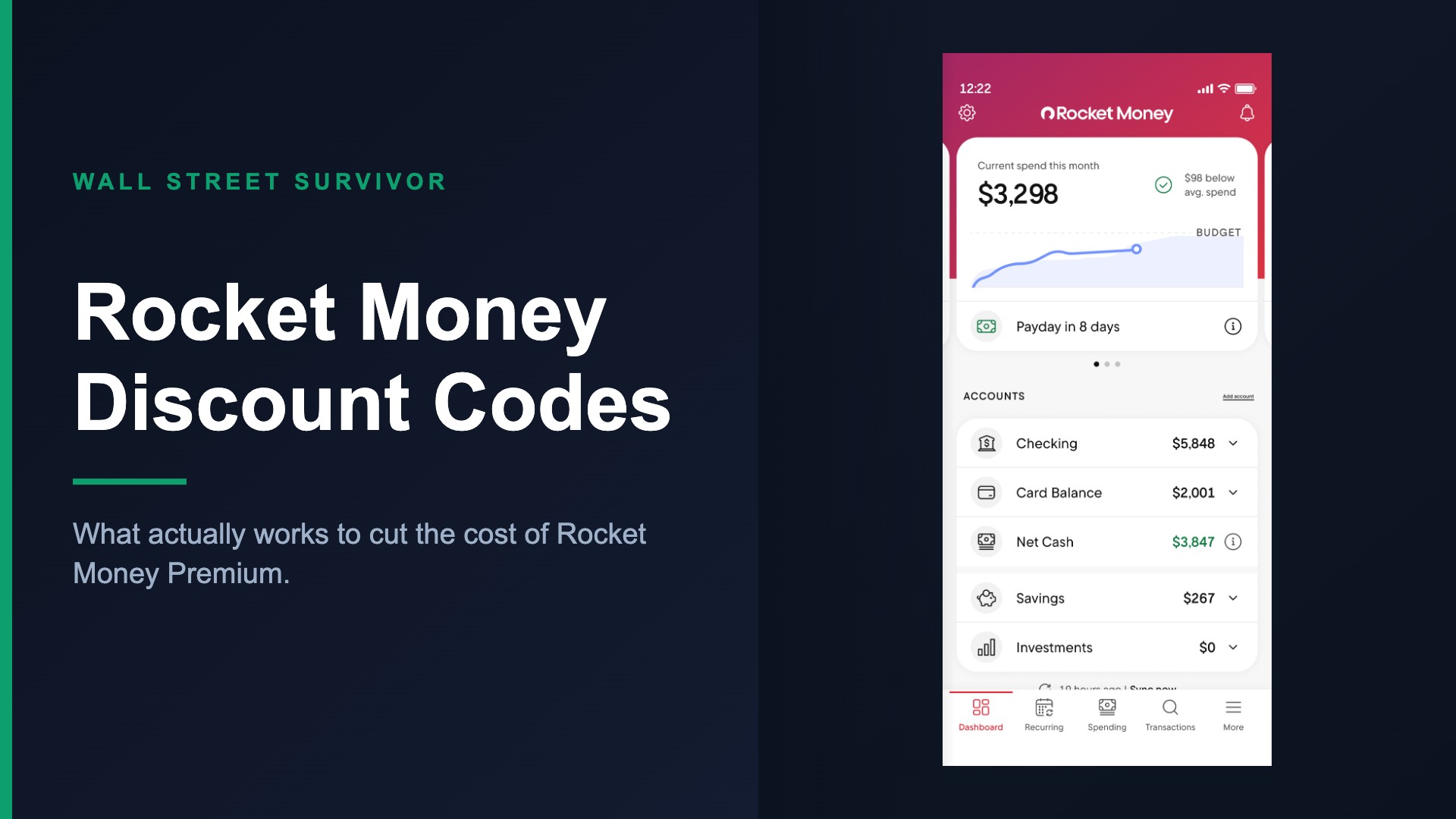
Rocket Money’s signature budgeting concept is “Safe to Spend” — a number that tells you, based on your scheduled bills and income, how much you can spend right now without missing a payment. It’s a great mental model for paycheck-to-paycheck spending and a relief if traditional category budgets stress you out.
You can also set category-level budgets, but the experience is built around the Safe to Spend number rather than around zero-based allocation.
Monarch: Flex Budgeting
Monarch popularized Flex Budgeting, which groups spending into three buckets:
Fixed expenses — rent, insurance, predictable monthly bills
Flexible spending — groceries, dining, entertainment, the stuff you control daily
Non-monthly expenses — annual insurance, holidays, car maintenance, etc.
It’s less granular than YNAB’s envelope system and less restrictive than traditional category budgeting — and for many people, it’s the missing model that finally makes a budget stick.
Subscription Cancellation & Bill Negotiation: Rocket Money’s Killer Feature
This is the clearest difference between the two apps. Rocket Money doesn’t just track subscriptions — it cancels them for you with one tap. You see a subscription you forgot about, you tap “Cancel,” and Rocket Money handles the call/chat/cancellation process on your behalf.
Rocket Money also offers bill negotiation on phone, internet, cable, and insurance bills. The service charges 35–60% of your first-year savings as a success fee — so it costs nothing unless they actually lower your bill.
Monarch tracks recurring charges so you can see them in one place, but you have to cancel them yourself, and there’s no bill negotiation service.
If subscription bloat is the problem you’re trying to solve — and it’s a real problem for most households — Rocket Money is genuinely worth the premium subscription just for this feature.
Investment Tracking
Both apps connect to your brokerage and retirement accounts and show your total net worth. The depth is different:
Monarch shows individual holdings, performance over time, asset allocation, and contribution tracking. It’s the strongest budgeting-app investment tracker on the market and is the closest replacement for Personal Capital (now Empower) on the budgeting-first side.
Rocket Money shows account balances and net worth changes over time, but doesn’t drill into individual holdings or performance.
If you have a meaningful investment portfolio and want one app for both budgeting and net worth tracking, Monarch wins this category convincingly.
Couples & Joint Households
Monarch was designed from day one for households. Couples can:
Use the same account at no extra cost
See joint and individual accounts side by side
Set shared goals (down payment, vacation, debt payoff)
Add a fee-only financial advisor as a third user (a separate paid feature)
Rocket Money technically supports shared access through credential sharing, but the product is built around an individual user.
Alternatives: YNAB, Simplifi & Copilot
YNAB (You Need a Budget)
YNAB uses a zero-based envelope budgeting method — every dollar you have gets a job before it can be spent. It’s the most rigorous of the apps reviewed here, has a passionate user base, and demonstrably changes spending behavior for people who stick with it.
YNAB costs $14.99/month or $109/year. There’s no free tier and the learning curve is real — but if you’ve tried other budget apps and they didn’t change your habits, YNAB might.
Simplifi by Quicken
Simplifi is the budgeting app from Quicken, the long-running personal finance software brand. It’s cleaner than the rest, focuses on spending plans and projected cash flow, and runs around $3.99/month on the annual plan. Worth a look if you want a fast, clean app and have no need for subscription cancellation or detailed planning features.
Copilot Money
Copilot is the design-forward, iOS-first option. The interface is beautiful, the categorization AI is the best in the category, and the app integrates investment tracking and net worth with no clutter. It’s $13/month or $95/year and is iOS/macOS only (no Android, no web app).
Side-by-Side Pricing Comparison
App
Free Tier
Annual Price
Best Use Case
Rocket Money✅ Yes$84–$168 (Premium)Killing subscription waste
Monarch Money❌ 7-day trial$99.99Couples & detailed planning
YNAB❌ 34-day trial$109Zero-based budgeting
Simplifi❌~$48Clean, simple budgeting
Copilot❌ Trial via App Store$95iOS-only, design-first users
YNAB vs Rocket Money: Which One If You’re Choosing Between Them?
These two apps live at opposite ends of the budgeting philosophy spectrum:
YNAB asks you to plan every dollar in advance. It’s prescriptive, has a learning curve, and changes behavior. Better if you’ve struggled with overspending.
Rocket Money doesn’t ask you to do much. It monitors your accounts, surfaces wasted subscriptions, and gives you a “Safe to Spend” number. Better if your spending is already mostly under control and the leak is subscriptions and bills you’ve forgotten about.
Rocket Money vs Mint: What Mint Refugees Should Know
If you’re coming from Mint, here’s the honest update:
Most Mint users land on Rocket Money because the free tier is the closest to Mint’s free model.
Power users land on Monarch because Monarch is the most feature-complete replacement, especially for investment tracking.
You can also import your Mint historical data into Monarch — a one-time migration path Monarch built specifically for the Mint shutdown.
Frequently Asked Questions
Rocket Money is cheaper if you stick with the free plan. If you compare paid plans, Monarch’s annual plan ($99.99/year) is in the same range as Rocket Money Premium’s middle tier (~$120/year). Monarch is the better deal at the high end of Rocket Money’s pricing.
No. Monarch Money is subscription-only and offers a 7-day free trial. If you cancel during the trial, you’re not charged.
Yes. The Rocket Money Premium plan includes one-tap subscription cancellation — Rocket Money handles the cancellation process with the merchant on your behalf, and you receive confirmation when it’s complete.
Monarch Money is better for couples. It’s designed for joint households with unlimited household members at no extra cost, shared goals, and side-by-side joint/individual account views.
Monarch has substantially better investment tracking — it shows individual holdings, performance over time, asset allocation, and contribution tracking. Rocket Money shows balances and net worth but doesn’t drill into individual investments.
YNAB is better if your goal is to fundamentally change spending behavior through zero-based budgeting. It has a steeper learning curve but a stronger track record of helping users break overspending patterns. Rocket Money and Monarch are better if you want passive tracking with smart suggestions rather than active planning.
Mint shut down in January 2024 and Intuit pushed users toward Credit Karma. The most popular independent replacements are Rocket Money (for free subscription tracking) and Monarch Money (for paid, full-featured personal finance management).
Final Recommendation
The honest, no-spin recommendation:
Start with Rocket Money’s free plan if you’ve never used a budgeting app before. It costs nothing, it’ll identify subscriptions you forgot about within 24 hours of linking your accounts, and you can decide later if Premium is worth it.
Try Monarch’s 7-day free trial if you’re a couple, you have meaningful investments, or you tried Mint’s full feature set and want a serious replacement.
Use both if you want to. Many users keep Rocket Money for subscription cancellation and Monarch for everything else — the apps are complementary, not mutually exclusive.