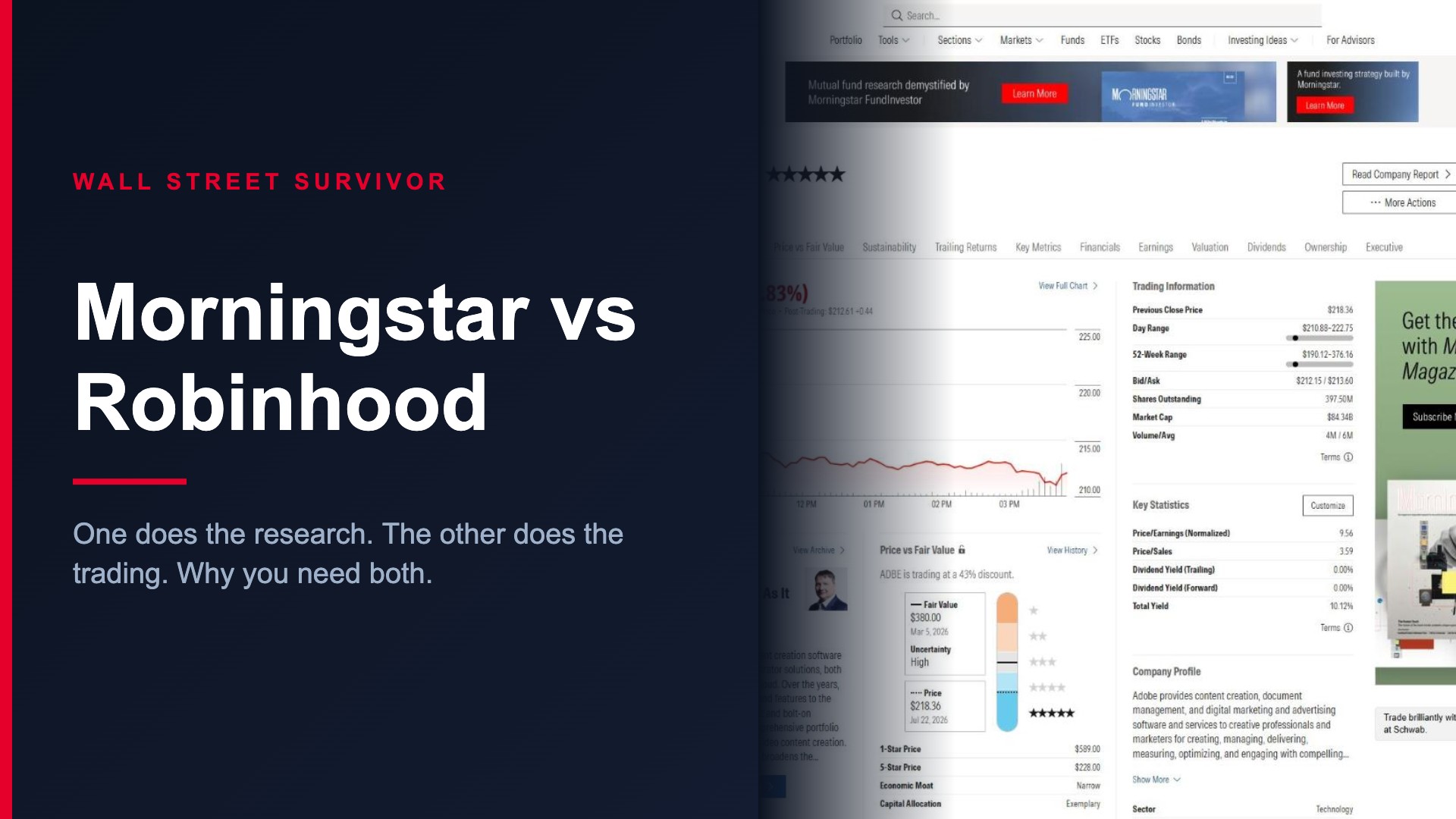
If you’ve ever looked at a mutual fund’s marketing one-pager and seen ★★★★★ next to the name, you’ve encountered Morningstar’s most famous product — the Morningstar Star Rating. The 1-to-5-star system is more than 30 years old, has shaped how trillions of dollars get invested, and is one of the few investment frameworks that retail investors and institutional advisors actually share.
But here’s what most investors miss: Morningstar publishes two completely different star rating systems. The fund star rating is backward-looking (it measures past performance). The stock star rating is forward-looking (it measures whether a stock is undervalued today). Treating them the same way leads to bad decisions.
This guide explains both systems, how the math works, what each star count actually means, and the right way to use them when you’re picking investments. All methodology comes from Morningstar’s official ratings documentation.
Fund star ratings = backward-looking, peer-relative, based on risk-adjusted past performanceStock star ratings = forward-looking, analyst-driven, based on price vs. estimated fair value
Use fund stars to screen, not to decide. Use stock stars as a valuation signal, not a buy-or-sell instruction.
What You Get
Independent research on 1,600+ mutual funds & ETFs — no conflicts of interest
Portfolio X-Ray reveals hidden overlaps, sector concentration & fee drag
120+ global analysts covering ~1,000 stocks with fair value estimates
Advanced stock, fund & ESG screeners with 40+ filter criteria
Access via web, iOS & Android — watchlists and portfolios sync across devices
The Two Different Morningstar Star Ratings
1. Fund Star Rating (Backward-Looking)
The fund star rating ranks each mutual fund and ETF against its peers based on risk-adjusted past performance, net of fees and loads. The rating is updated monthly and requires a minimum of 36 months of performance history before it’s assigned.
The math is straightforward percentile ranking within the fund’s category:
Stars
Top % of Category
What It Means
★★★★★Top 10%Best risk-adjusted past performance
★★★★Next 22.5%Above average
★★★Middle 35%Average
★★Next 22.5%Below average
★Bottom 10%Worst risk-adjusted past performance
Crucially, the rating compares funds only within the same category (e.g., Large-Cap Value, Mid-Cap Growth, Short-Term Bond). A 5-star bond fund is not necessarily a better investment than a 3-star stock fund — they’re rated against different peer groups.
2. Stock Star Rating (Forward-Looking)
The stock star rating is a different animal entirely. It’s set by a Morningstar equity analyst who first estimates the stock’s fair value (using a long-term discounted cash flow model) and then compares that fair value to the current market price.
Stars
What It Means
★★★★★Stock trades at a significant discount to fair value; appreciation beyond a fair risk-adjusted return is highly likely
★★★★Trades below fair value; outperformance likely
★★★Trades near fair value; fair risk-adjusted return expected
★★Trades above fair value; below-average return likely
★Trades at significant premium; downside risk is high
A 5-star stock doesn’t mean it’s a great company. It means the analyst thinks the market is mispricing it to the downside — there’s an opportunity to buy something for less than its estimated worth. By contrast, a 1-star stock might be an excellent company that’s just trading at a high valuation.
The Uncertainty Rating: The Most Important Number Nobody Looks At
Every stock rating is paired with an Uncertainty Rating — Low, Medium, High, Very High, or Extreme. The uncertainty rating determines how big a margin of safety Morningstar requires before rating a stock 5 stars.
Think of it this way: a stable utility company with predictable cash flows has Low uncertainty — Morningstar will rate it 5 stars when it’s trading 20% below fair value. A volatile biotech with binary outcomes has Extreme uncertainty — it might need to trade 60% below fair value before earning 5 stars.
When you see a 5-star Extreme-uncertainty stock, recognize that even Morningstar’s analyst is acknowledging a wide range of possible outcomes. That’s a different kind of bet than a 5-star Low-uncertainty stock.
The Other Morningstar Ratings You Should Know
Medalist Ratings (Gold/Silver/Bronze/Neutral/Negative)
For funds, the Medalist Rating is more important than the star rating. While stars look backward, Medalist Ratings are forward-looking — Morningstar’s view on a fund’s likelihood of outperforming its benchmark over a full market cycle, after fees.
Gold: Highest conviction — expected to outperform
Silver: Above-average conviction
Bronze: Modest conviction; expected to keep pace
Neutral: No strong view either way
Negative: Likely to underperform
Economic Moat Rating (Wide/Narrow/None)
For stocks, the Economic Moat rating measures the durability of a company’s competitive advantages:
Wide moat: Competitive advantage expected to last 20+ years
Narrow moat: Competitive advantage expected to last 10+ years
No moat: No durable competitive advantage identified
Warren Buffett popularized “moats” as a concept; Morningstar formalized it into a ratings framework. For long-term investors, a Wide Moat at 5 stars (cheap and durable) is the ideal combination.
How to Actually Use the Star Ratings
For Funds: Use Stars as a Screen, Not a Decision
Morningstar itself is consistently clear about this: fund stars are backward-looking and shouldn’t be treated as a buy signal. The right approach:
Use the star rating to narrow a category — limit your search to 4- and 5-star funds within your target category.
Then check the Medalist Rating — that’s the forward-looking view.
Then read the analyst report — manager tenure, fees, process consistency, ownership structure.
Past performance is real information, but it’s not the same as future performance — especially when fund managers change or strategies drift.
For Stocks: Use Stars as a Valuation Signal
A 5-star stock is Morningstar’s analyst saying: “the market is pricing this below what we think it’s worth.” That’s a valuation opinion, not a guarantee. Use it as one input:
Check the Uncertainty Rating — high uncertainty means wider possible outcomes.
Check the Moat Rating — Wide Moat + 5 stars = the highest-conviction combination.
Read the analyst’s bull and bear case so you understand the actual thesis.
Make sure the stock fits your overall portfolio (Morningstar can’t see your holdings — Portfolio X-Ray can).
Common Mistakes to Avoid
Comparing star ratings across categories. A 5-star small-cap value fund and a 5-star international bond fund are rated against different peer groups.
Chasing 5-star fund performance. Funds that recently earned 5 stars often mean-revert — yesterday’s outperformance often becomes tomorrow’s underperformance.
Using stock stars without checking uncertainty. A 5-star Extreme-uncertainty stock is a very different bet than a 5-star Low-uncertainty stock.
Treating 1-star stocks as “sells.” A 1-star stock is overvalued in Morningstar’s view, not necessarily a bad business. If you own a great company that’s gotten expensive, the right action might be trim rather than sell.
Where to Find Morningstar Ratings
Star ratings are free to view on Morningstar.com. To access the full analyst reports, Medalist Ratings, fair value estimates, moat ratings, and Portfolio X-Ray, you need Morningstar Investor ($249/year, frequently discounted).
Before paying full price, check our regularly updated Morningstar discount codes page — $50-off offers are usually available.
Frequently Asked Questions
For funds, 5 stars means the fund’s risk-adjusted past performance is in the top 10% of its category over the rating period. For stocks, 5 stars means Morningstar’s analyst believes the stock is trading at a significant discount to its fair value estimate.
Reliable as descriptions, less reliable as predictors. Fund star ratings accurately reflect past performance but have limited predictive power for future performance — the Medalist Rating is more useful for forward-looking decisions. Stock star ratings reflect a specific analyst’s valuation opinion at a point in time, which is useful but not infallible.
Fund stars are backward-looking and based on risk-adjusted past performance vs. peers. Stock stars are forward-looking and based on the current price vs. an analyst’s fair value estimate. The two systems are not directly comparable.
Fund star ratings are recalculated monthly based on a rolling 3-, 5-, and 10-year performance window. Stock star ratings update whenever the stock price moves materially relative to the analyst’s fair value estimate, or when the analyst revises the fair value (typically quarterly or on news).
No. The star rating is one input — use it to narrow your search, then check the Medalist Rating, fees, manager tenure, and how the fund fits your overall portfolio. Some 4-star funds with strong forward-looking ratings outperform 5-star funds whose past performance is unlikely to repeat.
The basic star rating is free on Morningstar.com. The Medalist Rating, full analyst reports, fair value estimates, and Portfolio X-Ray require a Morningstar Investor subscription ($249/year, frequently available at a discount).
A fund needs at least 36 calendar months of performance history before Morningstar assigns a star rating. Newer funds will show no rating until they hit that threshold.
The Bottom Line
Morningstar’s star ratings are some of the most influential — and most misunderstood — labels in investing. Used correctly, they’re a powerful filter; used as a buy/sell signal, they’ll lead you astray.
The shortcut for serious investors: use star ratings to narrow your field, then look at the forward-looking Medalist Rating (for funds) or fair value estimate plus uncertainty rating (for stocks). That combination is what makes Morningstar genuinely useful — and it’s what’s gated behind the Morningstar Investor subscription.