As financial services firms move AI systems from pilot projects into live investment workflows, the quality of the data underneath those systems has become the defining variable, a hallmark hallucinated output in a valuation model or earnings analysis can have immediate, costly downstream consequences. The challenge is structural: most financial data available to AI tools is web-sourced, inconsistently formatted, and not traceable to original filings, which means AI-generated outputs inherit those errors at scale and become difficult to audit or act on. Meanwhile, even at the most sophisticated investment firms, analysts still spend enormous portions of their time pulling figures from SEC filings, investor presentations, and earnings releases by hand before they can begin any actual analysis. Daloopa addresses this at the infrastructure level, providing a structured, source-linked financial dataset covering more than 5,900 public companies globally, with each data point hyperlinked to its original filing, and delivering it through multiple formats including Excel, API, cloud integrations, and MCP connectors that plug directly into AI platforms analysts already use. The company’s platform delivers up to 10 times more data points per company than competing providers, cuts model-building ramp time by up to 70%, and has demonstrated that grounding AI agents in its auditable dataset improves retrieval accuracy by as much as 71 percentage points compared to web-based retrieval. Trusted by more than 160 of the world’s leading hedge funds, mutual funds, and bulge-bracket banks as well as Anthropic, OpenAI, and Perplexity, Daloopa has more than doubled revenue over the past year as firms accelerate their push toward automated investment research.
AlleyWatch sat down with Daloopa CEO and Co-founder Thomas Li to learn more about the business, its future plans, recent funding round that brings the company’s total funding raised to $101.4M, and much, much more…
Who were your investors and how much did you raise?
We raised a $47M Series C led by Brighton Park Capital, with participation from Squarepoint Capital, Touring Capital, and Nexus Venture Partners.The financing comes at a point where investment firms are starting to move AI into real production workflows across research, valuation, and analysis, which is increasing the importance of having reliable, auditable financial data infrastructure underneath those systems.
Tell us about the product or service that Daloopa offers.
Daloopa provides structured, source-linked financial data infrastructure that powers financial institutions’ research workflows.Historically, a lot of financial analysis has depended on analysts manually pulling and entering data from sources including company filings, investor presentations, and press releases, then validating the accuracy of each datapoint. That process is time-consuming and becomes even more challenging once AI systems start relying on that data – or web-scraped inputs – at scale.Daloopa’s platform covers more than 5,500 public companies globally, with each datapoint linked back to its original source for auditability. Investment firms use the platform across workflows like valuation, modeling, research, and reporting, and increasingly as part of AI and agentic workflows as well.
What inspired the start of Daloopa?
The original inspiration for Daloopa really came from seeing how much of financial analysis still depended on highly manual work. Even at some of the most sophisticated investment firms in the world, analysts were spending huge amounts of time pulling numbers from filings, cleaning data, checking sources, and rebuilding the same workflows over and over again in Excel.At the time, that was already inefficient for humans, but we also realized it was going to become a much bigger problem once AI systems started getting applied to financial workflows. If the underlying data is inconsistent or not traceable back to original source documents, the outputs become unreliable very quickly.So the idea behind Daloopa was to build a structured, source-linked financial data layer that investment firms could actually trust and use in production workflows.
How is Daloopa different?
I think one of the biggest differences is that we built Daloopa around where financial workflows are going, especially as AI becomes part of how investment research and analysis get done.Historically, the process was highly manual, with analysts spending a huge amount of time collecting, entering, and validating financial data before they could even begin the actual analysis work. What’s changing now is that AI can automate a lot of that work, but only if the underlying data is reliable and structured correctly.The other major difference is the depth of the dataset itself. We go very deep at the company level, and customers are increasingly using Daloopa not just inside traditional models and research workflows, but directly inside platforms like ChatGPT, Claude, Perplexity, and Rogo.
What market does Daloopa target and how big is it?
We primarily serve financial institutions, including hedge funds, mutual funds, bulge-bracket banks, and increasingly AI-native financial platforms.The broader market is financial data and financial infrastructure, given the introduction of AI and agentic workflows at financial institutions. As firms start operationalizing AI across research, modeling, valuation, and reporting, the demand for reliable underlying financial data increases significantly.
What’s your business model?
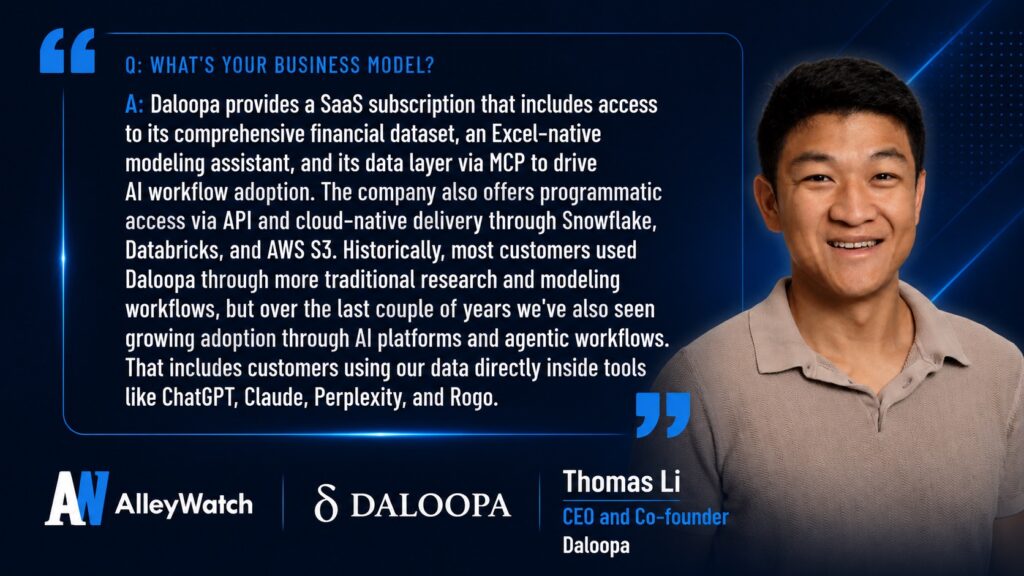
Daloopa provides a SaaS subscription that includes access to its comprehensive financial dataset, an Excel-native modeling assistant, and its data layer via MCP to drive AI workflow adoption. The company also offers programmatic access via API and cloud-native delivery through Snowflake, Databricks, and AWS S3.Historically, most customers used Daloopa through more traditional research and modeling workflows, but over the last couple of years we’ve also seen growing adoption through AI platforms and agentic workflows. That includes customers using our data directly inside tools like ChatGPT, Claude, Perplexity, and Rogo.
How are you preparing for a potential economic slowdown?
Our focus is on solving a real problem that’s becoming even more critical as AI adoption in financial services increases.If anything, firms are under more pressure to improve efficiency and productivity, and that tends to accelerate interest in automation and AI-driven workflows rather than slow it down.
What was the funding process like?
It was a very thoughtful process. We spent a lot of time talking with investors who really understood the nuances of data businesses and financial infrastructure specifically, because this is a very different type of company than a typical application software business.What ultimately stood out with Brighton Park was their depth of understanding around the importance of data quality, accuracy, and long-term infrastructure value in financial services.
What are the biggest challenges that you faced while raising capital?
I think one of the biggest challenges is that data businesses are very nuanced businesses. In our world, small differences in data quality and accuracy matter a lot to customers, especially once AI is used inside real investment workflows.So a big part of the process was finding investors who really understood the importance of the underlying data layer and appreciated the complexity behind building it well.
What are the milestones you plan to achieve in the next six months?
A big focus for us over the next several months is continuing to expand the depth and coverage of the dataset itself. We already cover more than 5,500 public companies globally, but we want to go deeper across the companies.We’re also investing heavily in AI and agent workflows on top of the data layer, particularly around products like Scout and other tools that help customers automate parts of research, modeling, and analysis workflows.And then more broadly, we’re continuing to expand integrations and partnerships across the AI ecosystem as adoption accelerates across financial services.
What advice can you offer companies in New York that do not have a fresh injection of capital in the bank?
I think the biggest thing is staying very focused on the customer and solving their biggest challenges. The best way to find product-market fit is to solve a real problem your customers care deeply about.
What’s your favorite spring destination in and around the city?
Going for a run in Central Park.

You are seconds away from signing up for the hottest list in NYC Tech!
Sign up today