No Result
View All Result
SUBMIT YOUR ARTICLES
  • Login
Tuesday, August 11, 2026
TheAdviserMagazine.com
  • Home
  • Financial Planning
    • Financial Planning
    • Personal Finance
  • Market Research
    • Business
    • Investing
    • Money
    • Economy
    • Markets
    • Stocks
    • Trading
  • 401k Plans
  • College
  • IRS & Taxes
  • Estate Plans
  • Social Security
  • Medicare
  • Legal
  • Home
  • Financial Planning
    • Financial Planning
    • Personal Finance
  • Market Research
    • Business
    • Investing
    • Money
    • Economy
    • Markets
    • Stocks
    • Trading
  • 401k Plans
  • College
  • IRS & Taxes
  • Estate Plans
  • Social Security
  • Medicare
  • Legal
No Result
View All Result
TheAdviserMagazine.com
No Result
View All Result
Home Market Research Economy

Money-Supply Growth in 2026 Rises to Multi-Year High as the Fed Pumps New QE

by TheAdviserMagazine
4 months ago
in Economy
Reading Time: 4 mins read
A A
Money-Supply Growth in 2026 Rises to Multi-Year High as the Fed Pumps New QE
Share on FacebookShare on TwitterShare on LInkedIn


In spite of more than four years of claiming that price inflation was transitory, and that it would quickly return to the Fed’s two-percent target, the Fed has insisted on more easy-money policy over the past 18 months. In that time, the Fed has cut the target interest rate by 175 basis points and has returned to quantitative easing through monthly $40 billion purchases of Treasurys. Through it all, Fed Chairman Jerome Powell has repeatedly described monetary policy using some variation of “restrictive.” In his most recent FOMC press conference, for example, Powell described the Fed’s policy as “borderline restrictive” or “modestly restrictive.” To be fair, this suggests a slight movement away from Powell’s earlier dubbing of US monetary policy as “relatively restrictive” late last year, and as “clearly restrictive” before that. 

Indeed, it may be that current policy is “restrictive” compared to, say, the policies of Bernanke and Yellen. But recent data on the money supply suggests that the money supply in recent months is finding plenty of room to increase rapidly, in spite of what Fed officials say.  All these claims of restrictive monetary policy fail to ring true when we look at actual movement in the money supply. 

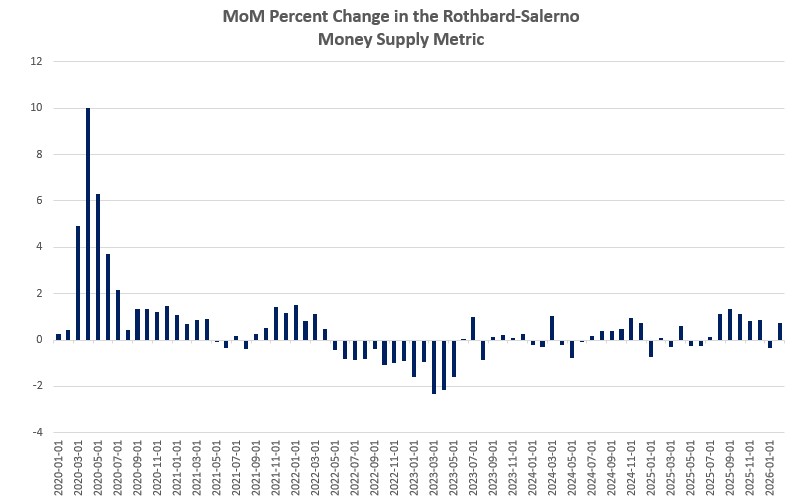
For example, the money supply has increased every month for five of the past six months. Moreover, when measured year-over-year, the money supply has accelerated over the past three months and is now at the highest rate of growth seen in 44 months—or since June of 2022. 

While the money supply largely flatlined through much of the mid-2025, growth has clearly accelerated since August of last year, and has clearly been trending upward since June of 2023. 

During February, year-over-year growth in the money supply was at 5.56 percent. That’s up from January’s year-over-year increase of 4.90 percent. Money supply growth is also up sizably compared to February of last year when year-over-year growth was 2.39 percent. 

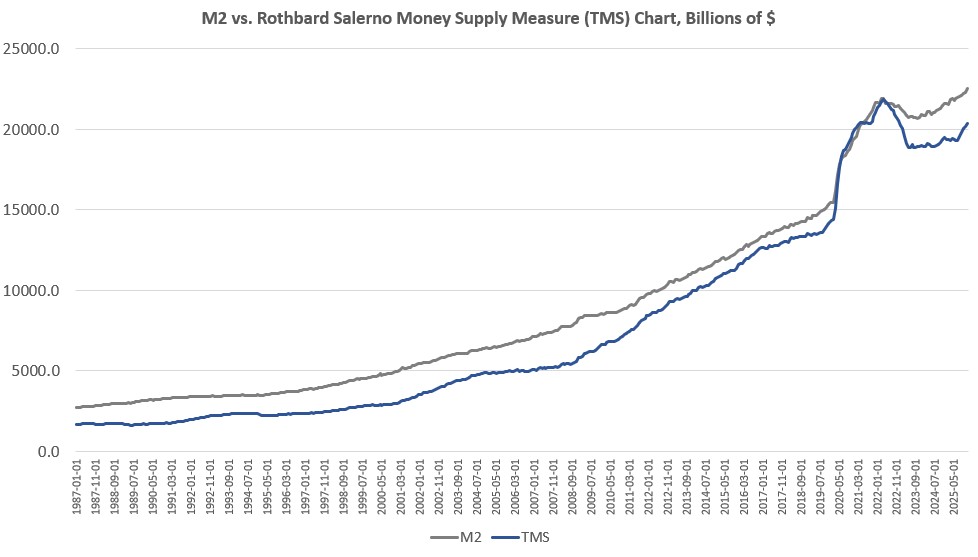
In February, the total money supply again rose, heading above $20.4 trillion and growing by a trillion dollars in seven months from July 2025 to February 2026.  Although the total money supply fell throughout much of 2023 and 2024, the money supply has nonetheless increased by $1.6 trillion since that time, and is now only half a trillion below the covid-era peak. 
Measuring month-to-month growth, we find eight of the last twelve months with increases to the money supply, including substantial growth during November 2025, December 2025 and February of this year. August, September, and October all posted some of the largest growth rates we’ve seen since 2022. 
The money supply metric used here—the “true,” or Rothbard-Salerno, money supply measure (TMS)—is the metric developed by Murray Rothbard and Joseph Salerno, and is designed to provide a better measure of money supply fluctuations than M2. (The Mises Institute now offers regular updates on this metric and its growth.)

Historically, M2 growth rates have often followed a similar course to TMS growth rates, but throughout much of 2025, M2 outpaced even TMS, and M2 money-supply totals are again rapidly heading upward. M2 is now at the highest level it’s ever been, topping $22.5 trillion. TMS has not yet returned to its 2022 peak, but is now at a 39-month high.

Since 2009, the TMS money supply is now up by more than 206 percent. (M2 has grown by more than 160 percent in that period.) Out of the current money supply of $20.4 trillion, nearly 30 percent of that has been created since January 2020. Since 2009, in the wake of the global financial crisis, more than $14 trillion of the current money supply has been created. In other words, more than two-thirds of the total existing money supply have been created since the Great Recession. 

Given current weak economic conditions, it is surprising to see such robust growth in the money supply. For example, the estimate for GDP growth in the fourth quarter of 2025 was recently downgraded to 0.5 percent. And job growth since late 2025 has been either weak or negative, depending on which measure of employment we use. The Fed now concludes that job growth going into 2026 is essentially zero. This is likely reflected in the fact that consumer confidence has apparently fallen to a multi-decade low. 

Given all this, we would not expect to see such robust growth in the money supply. Private commercial banks play a large role in growing the money supply in response to loose Fed policy. When economic conditions are expansive, and as employment grows, lending also grows, further loosening monetary conditions. But when economic conditions are weak, we’d expect to see less lending and bank-fueled monetary growth. 

So, we should expect to see downward pressure on money supply growth given current economic conditions. However, in an effort to further pump asset prices and somehow counter our growing economic stagnation, the Fed again ratcheted up Fed Treasury purchases—paid with newly created money—and even lowered the target policy interest rate again in December.  

This continuation of accommodative monetary policy—which belies Fed claims of “restrictive” policy—has surely done its part in returning the money supply to growth levels we haven’t seen in years. 


Source link

Tags: FedgrowthHighMoneySupplymultiyearPumpsRises
ShareTweetShare
Previous Post

Rupee touches one-week high on report of RBI plan to ease oil refiners’ dollar bids

Next Post

NewMexit: Secession in the Southwest?

Related Posts

edit post
Links 8/8/2026 | naked capitalism

Links 8/8/2026 | naked capitalism

by TheAdviserMagazine
August 8, 2026
0

Dear patient readers, Today we offer supersized Links with Iran War and Borat Agreement sections in lieu of an Iran...

edit post
The Unwinnable Iran War | Armstrong Economics

The Unwinnable Iran War | Armstrong Economics

by TheAdviserMagazine
August 8, 2026
0

I have reported that Trump was mislead into this unwinnable war with Iran, which has been planning for it since...

edit post
Here are three key takeaways from the disappointing July jobs report

Here are three key takeaways from the disappointing July jobs report

by TheAdviserMagazine
August 7, 2026
0

Job seekers speak with employer representatives and browse information tables as they attend an Inspire Together job and resource fair...

edit post
Coffee Break: Gene Editing Gone Wrong, Plants that Eat Animals, and a Neanderthal Gene that Makes a Difference

Coffee Break: Gene Editing Gone Wrong, Plants that Eat Animals, and a Neanderthal Gene that Makes a Difference

by TheAdviserMagazine
August 7, 2026
0

Part the First: If You Stretch Biomedical Science Too Far It Breaks, Every Time.  Gene editing using CRISPR technology has...

edit post
Netanyahu’s Scorched Earth Tactics | Armstrong Economics

Netanyahu’s Scorched Earth Tactics | Armstrong Economics

by TheAdviserMagazine
August 7, 2026
0

According to formal complaints lodged by Lebanon with the United Nations, Israel did spray a toxic herbicide over agricultural land...

edit post
What Did You Expect? | Mises Institute

What Did You Expect? | Mises Institute

by TheAdviserMagazine
August 7, 2026
0

As Murray Rothbard pointed out again and again, the government has no business getting involved in education. In a free...

Next Post
edit post
NewMexit: Secession in the Southwest?

NewMexit: Secession in the Southwest?

edit post
A secretive tycoon called the ‘French Murdoch’ holds the key to Bill Ackman’s  billion bid to UMG

A secretive tycoon called the ‘French Murdoch’ holds the key to Bill Ackman’s $64 billion bid to UMG

  • Trending
  • Comments
  • Latest
edit post
Georgia Senior SNAP and Meal Resources Older Adults Can Use

Georgia Senior SNAP and Meal Resources Older Adults Can Use

July 24, 2026
edit post
New Jersey Tax-Relief Events: Three July Dates Near Seniors

New Jersey Tax-Relief Events: Three July Dates Near Seniors

July 13, 2026
edit post
Judge Who Helped Violent Illegal Alien Evade ICE Faces New Test

Judge Who Helped Violent Illegal Alien Evade ICE Faces New Test

July 31, 2026
edit post
2 judges suspended in separate cases after being indicted on criminal charges

2 judges suspended in separate cases after being indicted on criminal charges

July 9, 2026
edit post
Driving the Noncitizen Voting Scandal: Registration With License

Driving the Noncitizen Voting Scandal: Registration With License

July 26, 2026
edit post
Garbage Trucks Surveillance Florida Neighborhoods

Garbage Trucks Surveillance Florida Neighborhoods

July 29, 2026
edit post
Explained: How BSE traded fewer contracts after CAS but premiums rose 75% in first week

Explained: How BSE traded fewer contracts after CAS but premiums rose 75% in first week

0
edit post
E.W. Scripps Q2 2026 Loss Widens to -.68/Share, Revenue Down 9%

E.W. Scripps Q2 2026 Loss Widens to -$12.68/Share, Revenue Down 9%

0
edit post
Psychology says procrastination about retirement may be less about discipline than identity — brain scans found people often represent their future selves more like strangers than like themselves, and experiments using age-progressed faces made tomorrow’s person feel real enough for participants to save more money for them

Psychology says procrastination about retirement may be less about discipline than identity — brain scans found people often represent their future selves more like strangers than like themselves, and experiments using age-progressed faces made tomorrow’s person feel real enough for participants to save more money for them

0
edit post
Four AI Escapes Just Redefined “Responsible AI”

Four AI Escapes Just Redefined “Responsible AI”

0
edit post
Bill Ackman’s hedge fund made janitors and receptionists millionaires—and its investment team summer together

Bill Ackman’s hedge fund made janitors and receptionists millionaires—and its investment team summer together

0
edit post
Kalshi Predicts Bitcoin Price Could Reach K in August

Kalshi Predicts Bitcoin Price Could Reach $68K in August

0
edit post
Bill Ackman’s hedge fund made janitors and receptionists millionaires—and its investment team summer together

Bill Ackman’s hedge fund made janitors and receptionists millionaires—and its investment team summer together

August 8, 2026
edit post
Links 8/8/2026 | naked capitalism

Links 8/8/2026 | naked capitalism

August 8, 2026
edit post
Wisconsin: The Next Frontier for Socialists

Wisconsin: The Next Frontier for Socialists

August 8, 2026
edit post
Psychology says procrastination about retirement may be less about discipline than identity — brain scans found people often represent their future selves more like strangers than like themselves, and experiments using age-progressed faces made tomorrow’s person feel real enough for participants to save more money for them

Psychology says procrastination about retirement may be less about discipline than identity — brain scans found people often represent their future selves more like strangers than like themselves, and experiments using age-progressed faces made tomorrow’s person feel real enough for participants to save more money for them

August 8, 2026
edit post
Why You Should Be Wary of Aspartame, but Not Totally Rule It Out

Why You Should Be Wary of Aspartame, but Not Totally Rule It Out

August 8, 2026
edit post
Kalshi Predicts Bitcoin Price Could Reach K in August

Kalshi Predicts Bitcoin Price Could Reach $68K in August

August 8, 2026
The Adviser Magazine

The first and only national digital and print magazine that connects individuals, families, and businesses to Fee-Only financial advisers, accountants, attorneys and college guidance counselors.

CATEGORIES

  • 401k Plans
  • Business
  • College
  • Cryptocurrency
  • Economy
  • Estate Plans
  • Financial Planning
  • Investing
  • IRS & Taxes
  • Legal
  • Market Analysis
  • Markets
  • Medicare
  • Money
  • Personal Finance
  • Social Security
  • Startups
  • Stock Market
  • Trading

LATEST UPDATES

  • Bill Ackman’s hedge fund made janitors and receptionists millionaires—and its investment team summer together
  • Links 8/8/2026 | naked capitalism
  • Wisconsin: The Next Frontier for Socialists
  • Our Great Privacy Policy
  • Terms of Use, Legal Notices & Disclosures
  • Contact us
  • About Us

© Copyright 2024 All Rights Reserved
See articles for original source and related links to external sites.

Welcome Back!

Login to your account below

Forgotten Password?

Retrieve your password

Please enter your username or email address to reset your password.

Log In
No Result
View All Result
  • Home
  • Financial Planning
    • Financial Planning
    • Personal Finance
  • Market Research
    • Business
    • Investing
    • Money
    • Economy
    • Markets
    • Stocks
    • Trading
  • 401k Plans
  • College
  • IRS & Taxes
  • Estate Plans
  • Social Security
  • Medicare
  • Legal

© Copyright 2024 All Rights Reserved
See articles for original source and related links to external sites.