No Result
View All Result
SUBMIT YOUR ARTICLES
  • Login
Saturday, June 13, 2026
TheAdviserMagazine.com
  • Home
  • Financial Planning
    • Financial Planning
    • Personal Finance
  • Market Research
    • Business
    • Investing
    • Money
    • Economy
    • Markets
    • Stocks
    • Trading
  • 401k Plans
  • College
  • IRS & Taxes
  • Estate Plans
  • Social Security
  • Medicare
  • Legal
  • Home
  • Financial Planning
    • Financial Planning
    • Personal Finance
  • Market Research
    • Business
    • Investing
    • Money
    • Economy
    • Markets
    • Stocks
    • Trading
  • 401k Plans
  • College
  • IRS & Taxes
  • Estate Plans
  • Social Security
  • Medicare
  • Legal
No Result
View All Result
TheAdviserMagazine.com
No Result
View All Result
Home Market Research Startups

When Apollo 11 splashed down in the Pacific in 1969, the recovered astronauts were sealed in a quarantine trailer for weeks because nobody could rule out lunar microbes, while around their capsule the ocean teemed with creatures far stranger than anything feared from the Moon

by TheAdviserMagazine
3 days ago
in Startups
Reading Time: 6 mins read
A A
When Apollo 11 splashed down in the Pacific in 1969, the recovered astronauts were sealed in a quarantine trailer for weeks because nobody could rule out lunar microbes, while around their capsule the ocean teemed with creatures far stranger than anything feared from the Moon
Share on FacebookShare on TwitterShare on LInkedIn


On July 24, 1969, three days after leaving lunar orbit, Neil Armstrong, Buzz Aldrin and Michael Collins splashed down in the Pacific Ocean about 900 miles southwest of Hawaii, and within minutes a Navy frogman from the USS Hornet was tossing biological isolation garments into the bobbing Columbia capsule. The astronauts pulled the suits on inside the spacecraft, climbed out into a life raft, and were scrubbed down with sodium hypochlorite while the recovery swimmers wiped the hatch with iodine. Nobody on the ship was allowed to breathe the same air as them. Somewhere beneath the raft, in water more than 15,000 feet deep, swam animals that NASA’s planetary protection officers had never thought to worry about — and that were, by almost any measure, far weirder than the lunar bugs they feared.

The quarantine lasted 21 days from the moment the lunar module lifted off the Moon. Most of that time was spent inside a converted Airstream trailer called the Mobile Quarantine Facility, bolted to the deck of the Hornet and then flown, with the astronauts still inside, to the Lunar Receiving Laboratory in Houston.

The bug nobody could rule out

The fear had a name in the planning documents: back-contamination. The Interagency Committee on Back Contamination, set up in 1966, had spent three years arguing about what to do if Armstrong tracked something alive into the command module. No one believed it was likely. No one was willing to say it was impossible.

The Outer Space Treaty of 1967 obliged signatories to avoid “harmful contamination” of Earth by extraterrestrial material. So the protocol was built around the worst plausible case: a lunar microorganism that could replicate in terrestrial soil, water, or lungs. The astronauts, their suits, the rock boxes, and 22 kilograms of lunar samples were all treated as a potential biohazard until proven otherwise.

That is why the frogman, Lieutenant Clancy Hatleberg, wore his own isolation suit. Why the life raft was sunk after use. Why the helicopter that carried the crew to the Hornet was decontaminated. Why President Nixon, greeting them on the carrier deck, spoke to the astronauts through a glass window in the side of the trailer.

Three weeks in an Airstream

The Mobile Quarantine Facility was about 35 feet long and slept six. Armstrong, Aldrin and Collins shared it with a NASA flight surgeon, a recovery engineer, and, for parts of the journey, a cook. The interior had filtered negative-pressure ventilation so that any air leak would flow inward, not outward. Food trays were passed through a sealed lock. Waste was chemically treated before disposal.

The trailer was lifted off the Hornet in Pearl Harbor, flown by C-141 to Ellington Air Force Base in Texas, then trucked to the Lunar Receiving Laboratory at the Manned Spacecraft Center. There the crew transferred into a larger sealed complex with laboratories, living quarters, and a debriefing room with a glass wall. They stayed until August 10, 1969.

Enforced isolation typically brings predictable psychological effects: irritability, sleep disruption, a flattening of mood, then a strange reluctance to leave when the door finally opens. Quarantined populations consistently show elevated rates of anxiety and low mood during and after confinement. The Apollo 11 crew, by their own accounts, mostly played gin rummy and read mail.

Mice that lived, microbes that didn’t

While the astronauts waited, the lunar samples were doing the real work. Inside the Lunar Receiving Laboratory, technicians ground small portions of moon rock into slurries and injected them into germ-free mice, Japanese quail, and oysters. They exposed cockroaches, houseflies, brown shrimp and a small zoo of plant species to lunar dust. They cultured the samples on dozens of growth media at temperatures ranging from near freezing to body heat.

Nothing grew. Nothing died. The mice, by the end of the observation period, were healthier than some of the control animals. On August 10, 1969, the Interagency Committee on Back Contamination declared the crew releasable. The hatch opened. Armstrong went home to his family in El Lago, Texas.

The same protocol was repeated for Apollo 12 and Apollo 14. By Apollo 15, NASA had seen enough negative results to drop the crew quarantine entirely. The Lunar Receiving Laboratory kept handling samples under containment, but the astronauts walked off the recovery ship and went to the press conference.

What was actually under the raft

The splashdown coordinates put Columbia roughly above the Central Pacific abyssal plain, in a column of water about 4,900 meters deep. The surface layer where the raft floated was warm, blue, and almost empty. A few meters down, the water filled with siphonophores — colonial animals related to jellyfish, some species of which grow into ribbons more than 40 meters long, longer than a blue whale, drifting in coordinated pulses through the dark.

Below them, in the mesopelagic zone the astronauts were floating above, lived hatchetfish with upward-pointing tubular eyes, anglerfish with luminous lures, and the vampire squid, an animal with the oldest lineage of any living cephalopod, which turns itself inside out when threatened and lives in water with so little oxygen that almost nothing else can metabolize there.

Deeper still, on the seafloor, were xenophyophores — single-celled organisms the size of dinner plates that build their own shells out of sediment grains. They are among the largest single cells on Earth, and in 1969 science barely knew they existed; the first detailed deep-sea photographs of them were still years away.
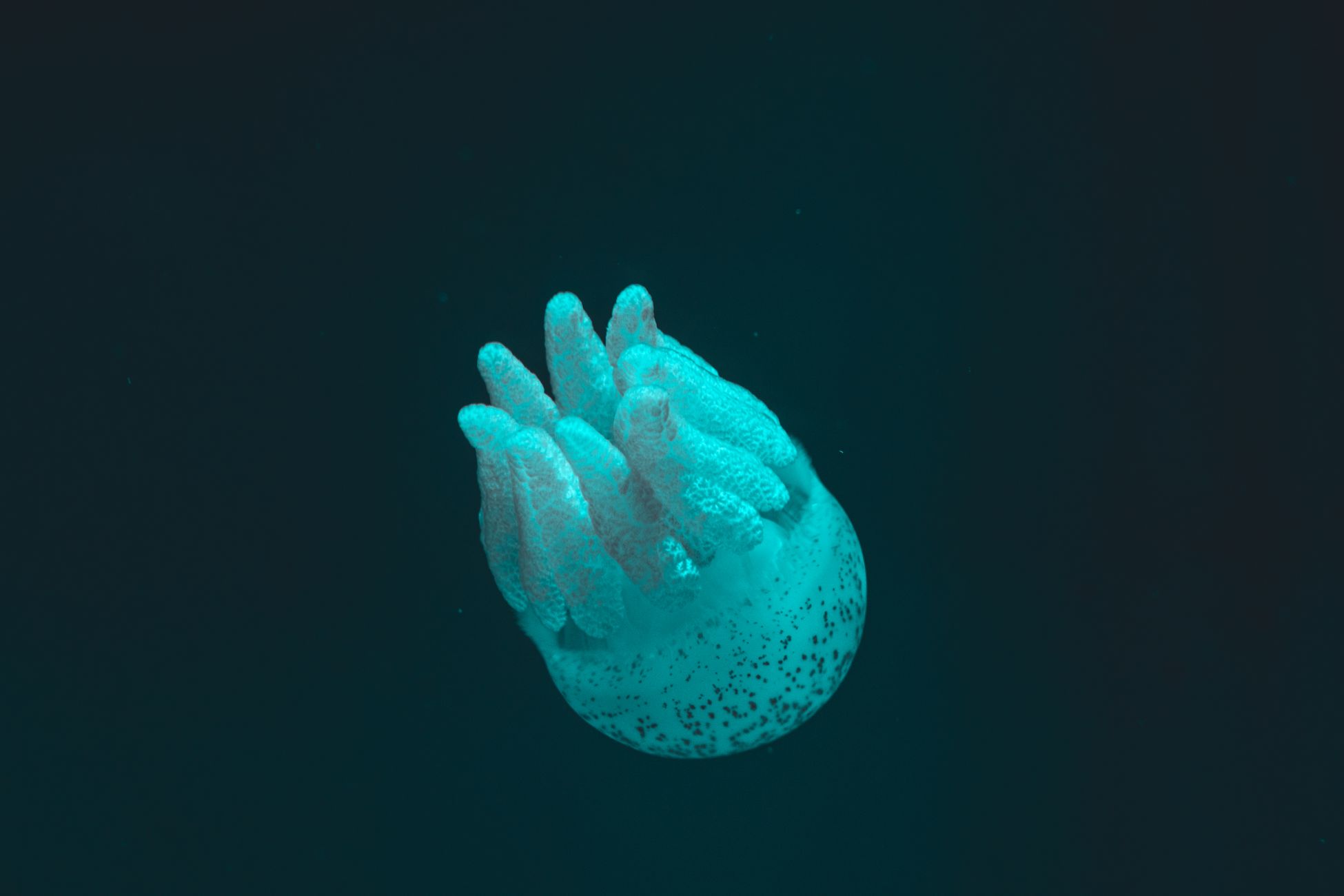
Mesmerizing close-up of a Rhopilema jellyfish floating gracefully underwater.

The frogman and the siphonophore

Lieutenant Hatleberg, swimming around the capsule in his isolation suit, was within meters of a biosphere that contained tube worms living on chemosynthesis, copepods that perform the largest daily migration of any animal on the planet, and bioluminescent dinoflagellates that, if disturbed at night, would have lit up his fin-strokes in pale blue. The protocol he was executing assumed the threat lay inside the spacecraft.

The chemistry of the threat assessment was almost poetic. Hatleberg scrubbed the hatch with iodine — element 53, atomic weight 127 — to kill whatever might have hitched a ride from a body that had, in fact, been sterile for four billion years. The Apollo 11 samples, analyzed for decades afterward at Houston and a handful of partner labs, contained no organic carbon of biological origin, no cells, no nucleic acids. The Moon was, and is, dead.

Why the worry was rational anyway

The decision to quarantine was not paranoia. It was the logic of asymmetric risk. The probability of lunar life was extremely low. The cost of being wrong — releasing a replicating organism into a planet with no evolutionary defenses against it — was civilizational.

That same logic now governs Mars sample return planning. The European Space Agency and NASA have spent more than a decade designing a Mars Sample Receiving Facility to biosafety level 4 standards, the same containment used for Ebola. Mars, unlike the Moon, has a plausible biological history. The Apollo 11 quarantine was the dress rehearsal.

The crews who came after

By Artemis II, the protocol had inverted. The four-person crew — Reid Wiseman, Victor Glover, Christina Koch and Jeremy Hansen — flew around the Moon without landing, returned to Earth, and walked off the recovery ship under their own power, with no isolation trailer waiting. The Orion capsule re-entered at high speed, slower than Apollo’s lunar-surface return because Artemis II did not land, and splashed down in the Pacific. There was no back-contamination committee meeting them, because no one had touched lunar soil.

When astronauts do return from the lunar surface on Artemis III, NASA will reinstate a sample containment protocol — but probably not a crew quarantine. The Apollo data settled that question. The Artemis II recovery was broadcast live, and the crew walked into a NASA press event within hours.

The picture nobody framed

The most famous Apollo 11 recovery photograph shows Nixon leaning toward the trailer window, grinning, while Armstrong, Aldrin and Collins press their faces to the glass from inside. Behind the Hornet, out of frame, the Pacific extended down nearly five kilometers to a seafloor sparsely lit by the slow flicker of bioluminescent bacteria and dotted with manganese nodules that grow at a rate of about one millimeter per million years.

The men in the trailer had walked on another world. The world they had just splashed into was, in places they would never see, stranger than the one they had left. NASA’s procedures, decades of cell culture work, and the institutional memory of those early splashdowns were aimed outward, at a possibility that turned out not to exist, while the planet’s actual biological frontier sat quietly under the keel of the recovery ship.

By the time the trailer was unsealed in Houston, the Columbia capsule had been wiped down a final time. The lunar samples were locked in nitrogen-filled cabinets where most of them still sit, untouched, in case future instruments can read something current ones cannot. The Pacific closed over the splashdown site. The siphonophores kept pulsing in the dark.




Source link

Tags: ApolloastronautscapsulecreaturesfearedLunarmicrobesmoonoceanPacificquarantinerecoveredRulesealedsplashedStrangerteemedTrailerweeks
ShareTweetShare
Previous Post

South Korea fines Coupang record $409 million for data breach

Next Post

The immortal jellyfish, Turritopsis dohrnii, can reverse its own life cycle when injured or starving, melting its adult body back into an immature polyp and starting over, a biological rewind that in theory lets a single individual escape death indefinitely

Related Posts

edit post
Most people don’t realise the loneliest stretch of adulthood often arrives in the early 50s, when the children have left, the parents are still here but smaller, and nobody in the house is being raised anymore

Most people don’t realise the loneliest stretch of adulthood often arrives in the early 50s, when the children have left, the parents are still here but smaller, and nobody in the house is being raised anymore

by TheAdviserMagazine
June 12, 2026
0

For decades, the dominant warning about midlife went something like this: the empty nest will hit when the last child...

edit post
On October 29, 1969, a UCLA student named Charley Kline tried to send the word ‘LOGIN’ over ARPANET to Stanford, and the system crashed after the letter O — making the first message ever transmitted across the internet the accidental, almost biblical ‘LO’

On October 29, 1969, a UCLA student named Charley Kline tried to send the word ‘LOGIN’ over ARPANET to Stanford, and the system crashed after the letter O — making the first message ever transmitted across the internet the accidental, almost biblical ‘LO’

by TheAdviserMagazine
June 12, 2026
0

At roughly 10:30 p.m. on October 29, 1969, a UCLA graduate student named Charley Kline put on a telephone headset,...

edit post
The Wollemi pine was known only from ancient fossils until a park ranger rappelled into a canyon outside Sydney in 1994 and found a grove still alive, and the exact location is now a state secret guarded by Australian rangers

The Wollemi pine was known only from ancient fossils until a park ranger rappelled into a canyon outside Sydney in 1994 and found a grove still alive, and the exact location is now a state secret guarded by Australian rangers

by TheAdviserMagazine
June 12, 2026
0

Fewer than 100 mature Wollemi pines grow in the wild. Their exact location is a state secret, withheld from maps...

edit post
ShinyHunters breached more than 100 organisations through a PeopleSoft flaw before Oracle issued an advisory, and the reason two-thirds were universities says everything about how enterprise software actually fails

ShinyHunters breached more than 100 organisations through a PeopleSoft flaw before Oracle issued an advisory, and the reason two-thirds were universities says everything about how enterprise software actually fails

by TheAdviserMagazine
June 12, 2026
0

The story of the latest ShinyHunters campaign is not really about a bug in Oracle PeopleSoft. It is about what...

edit post
Inside the Financial Times investigation that took five years and nearly destroyed the reporter who exposed Wirecard

Inside the Financial Times investigation that took five years and nearly destroyed the reporter who exposed Wirecard

by TheAdviserMagazine
June 12, 2026
0

Inside the Financial Times investigation that took five years and nearly destroyed the reporter who exposed Wirecard Five years. €1.9bn...

edit post
Claude Fable 5 is Anthropic’s most capable public AI model, and will hand your conversation to a weaker model the moment it detects a biology or chemistry question — Anthropic admits the net is overly broad and plans to narrow it

Claude Fable 5 is Anthropic’s most capable public AI model, and will hand your conversation to a weaker model the moment it detects a biology or chemistry question — Anthropic admits the net is overly broad and plans to narrow it

by TheAdviserMagazine
June 11, 2026
0

On Tuesday, Anthropic released Claude Fable 5, the first publicly available model in its Mythos class — a family the...

Next Post
edit post
The immortal jellyfish, Turritopsis dohrnii, can reverse its own life cycle when injured or starving, melting its adult body back into an immature polyp and starting over, a biological rewind that in theory lets a single individual escape death indefinitely

The immortal jellyfish, Turritopsis dohrnii, can reverse its own life cycle when injured or starving, melting its adult body back into an immature polyp and starting over, a biological rewind that in theory lets a single individual escape death indefinitely

edit post
World Cup Fever Not Expected to Be Growth Driver

World Cup Fever Not Expected to Be Growth Driver

  • Trending
  • Comments
  • Latest
edit post
Supreme Court Delivers More Bad Redistricting News for Democrats

Supreme Court Delivers More Bad Redistricting News for Democrats

May 19, 2026
edit post
From Maine to Michigan, Democrats Are Making Communism Great Again

From Maine to Michigan, Democrats Are Making Communism Great Again

May 16, 2026
edit post
Florida Roads Become a Battleground for Illegal Immigration

Florida Roads Become a Battleground for Illegal Immigration

June 9, 2026
edit post
The 8 States That Still Tax Social Security in 2026

The 8 States That Still Tax Social Security in 2026

June 6, 2026
edit post
It’s Time To Talk About Massie

It’s Time To Talk About Massie

May 23, 2026
edit post
A Tax on Social Media – Blue-State Governments’ Newest Ploy

A Tax on Social Media – Blue-State Governments’ Newest Ploy

June 5, 2026
edit post
Gold slumps to 6-month low even as inflation fears rise. Here’s why bullion is out of favor

Gold slumps to 6-month low even as inflation fears rise. Here’s why bullion is out of favor

0
edit post
Why Politicians Lie—and How Easy Money Keeps the Boom Alive

Why Politicians Lie—and How Easy Money Keeps the Boom Alive

0
edit post
Binance CZ Says Crypto Is Not Dead, Predicts “Super Cycle”

Binance CZ Says Crypto Is Not Dead, Predicts “Super Cycle”

0
edit post
Mortgage Rates Today, Friday, June 12: A Little Lower

Mortgage Rates Today, Friday, June 12: A Little Lower

0
edit post
When Apollo 11 splashed down in the Pacific in 1969, the recovered astronauts were sealed in a quarantine trailer for weeks because nobody could rule out lunar microbes, while around their capsule the ocean teemed with creatures far stranger than anything feared from the Moon

When Apollo 11 splashed down in the Pacific in 1969, the recovered astronauts were sealed in a quarantine trailer for weeks because nobody could rule out lunar microbes, while around their capsule the ocean teemed with creatures far stranger than anything feared from the Moon

0
edit post
California Seniors 62+ Can Defer Property Taxes at 7% — Why the Postponement Program Is Getting a Second Look This Summer

California Seniors 62+ Can Defer Property Taxes at 7% — Why the Postponement Program Is Getting a Second Look This Summer

0
edit post
Binance CZ Says Crypto Is Not Dead, Predicts “Super Cycle”

Binance CZ Says Crypto Is Not Dead, Predicts “Super Cycle”

June 13, 2026
edit post
Trump to name one of his personal lawyers for powerful Southern District of New York

Trump to name one of his personal lawyers for powerful Southern District of New York

June 13, 2026
edit post
SpaceX’s IPO exposes the first crack in tokenized stocks

SpaceX’s IPO exposes the first crack in tokenized stocks

June 13, 2026
edit post
64-Year-Old Tech Exec Holds .6 Million in One Stock. The Wrong Move Could Cost 0,000.

64-Year-Old Tech Exec Holds $1.6 Million in One Stock. The Wrong Move Could Cost $400,000.

June 13, 2026
edit post
California’s Property Tax Postponement Program and Its February Deadline

California’s Property Tax Postponement Program and Its February Deadline

June 13, 2026
edit post
Trump says he’ll sign deal with Iran to reopen Hormuz Sunday

Trump says he’ll sign deal with Iran to reopen Hormuz Sunday

June 13, 2026
The Adviser Magazine

The first and only national digital and print magazine that connects individuals, families, and businesses to Fee-Only financial advisers, accountants, attorneys and college guidance counselors.

CATEGORIES

  • 401k Plans
  • Business
  • College
  • Cryptocurrency
  • Economy
  • Estate Plans
  • Financial Planning
  • Investing
  • IRS & Taxes
  • Legal
  • Market Analysis
  • Markets
  • Medicare
  • Money
  • Personal Finance
  • Social Security
  • Startups
  • Stock Market
  • Trading

LATEST UPDATES

  • Binance CZ Says Crypto Is Not Dead, Predicts “Super Cycle”
  • Trump to name one of his personal lawyers for powerful Southern District of New York
  • SpaceX’s IPO exposes the first crack in tokenized stocks
  • Our Great Privacy Policy
  • Terms of Use, Legal Notices & Disclosures
  • Contact us
  • About Us

© Copyright 2024 All Rights Reserved
See articles for original source and related links to external sites.

Welcome Back!

Login to your account below

Forgotten Password?

Retrieve your password

Please enter your username or email address to reset your password.

Log In
No Result
View All Result
  • Home
  • Financial Planning
    • Financial Planning
    • Personal Finance
  • Market Research
    • Business
    • Investing
    • Money
    • Economy
    • Markets
    • Stocks
    • Trading
  • 401k Plans
  • College
  • IRS & Taxes
  • Estate Plans
  • Social Security
  • Medicare
  • Legal

© Copyright 2024 All Rights Reserved
See articles for original source and related links to external sites.