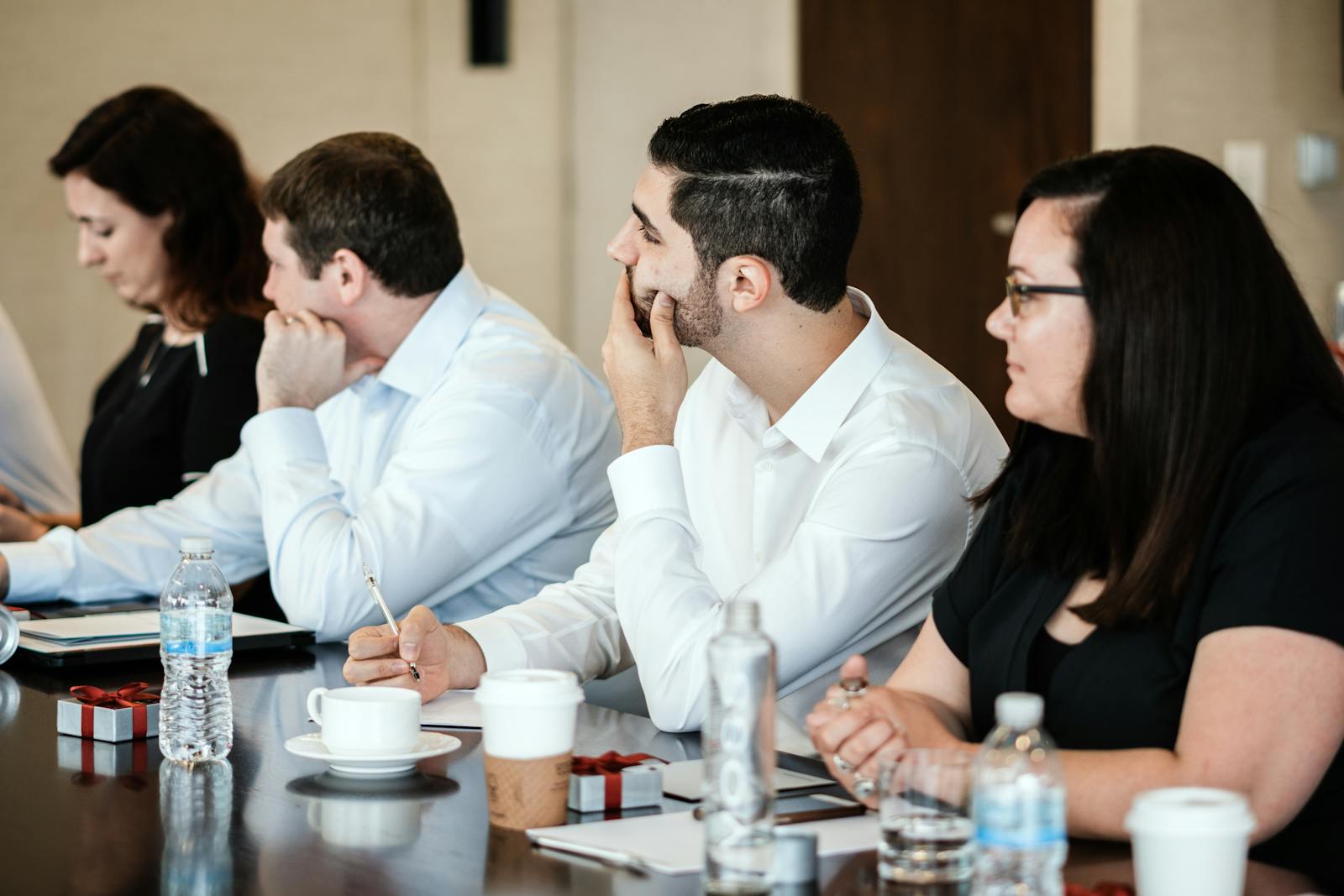
Stanford research on group dynamics found that in the average six-person meeting, three people do 70% of the talking. The other three are not disengaged. Brain imaging on similar setups shows the quiet ones often have higher cognitive load than the talkers.
They’re not absent. They’re calculating.
This gets misread as shyness. As disengagement. As someone who needs to work on executive presence. It’s almost never any of those things.
The internal accountant nobody sees
The conventional wisdom about quiet people in meetings is that they lack confidence, lack ideas, or need coaching to speak up more. Most leadership development is built on that assumption. It’s wrong.
What’s actually happening is a high-speed cost-benefit analysis. The quiet person isn’t absent. They’re running numbers. Will this contribution be remembered as the moment I added something useful, or as the moment I became the person who talks for the sake of talking? Is the room warm enough right now to receive a slight disagreement, or will it cost me social capital I’ll need next quarter? Is the VP going to interpret this as initiative or as me overstepping someone more senior?
This isn’t paranoia. It’s pattern recognition built from years of watching how rooms actually work.
Where the calculation comes from
People don’t develop this habit randomly. They develop it because, at some point, speaking carried a cost they’re still paying off.
Maybe it was a manager whose tone suggested the opposite of interest. Maybe it was a family where being clever was tolerated only up to a point, and past that point you were getting above yourself. Maybe it was a school where the kids who answered too often got a particular kind of social punishment that the teachers never noticed.
The psychologist Gurpreet Kaur, writing in Psychology Today, describes overthinking as two habits looping on repeat: replaying the past and rehearsing the future, both stemming from a nervous system that won’t relax until it has certainty. People who grow up in environments where mistakes come at a heavy cost, she notes, learn to mentally brace for every possible outcome. The strategy that kept them safe as children turns into rumination in adulthood.
By the time these people are in conference rooms, the bracing is automatic. They don’t decide to do it. They just do it.
The cost analysis isn’t irrational. It’s just expensive
What makes the meeting-quiet person interesting is that their analysis is correct. They have read the room accurately. The VP does get prickly when junior people contradict her favourites. The product lead does remember who pushed back on his roadmap last month. The cost they’re calculating is real.
The problem isn’t that the analysis is wrong. The problem is that running it in real time, every time, eats almost all the working memory you have left over for actually contributing.
Research into stress and memory bias suggests something useful here. A 2025 study from the University of Toyama, led by Professor Yuko Hakamata, found that people with elevated anxious traits show a specific tendency to encode and retrieve emotionally negative information more strongly than positive information. That bias correlates with elevated cortisol and stress vulnerability. In a meeting context, the brain is running a negativity-weighted simulation. Every potential contribution gets stress-tested against the worst version of how it might land.
That’s not a small cognitive tax. It’s most of the budget.
What looks like silence is often the cleanest thinking in the room
The pattern is easy to miss. Feedback rolls in saying a manager doesn’t listen, when what’s really happening is that meetings have become competitions to win rather than rooms to think in. The people who say the least often turn out to be the ones who have understood the problem most completely. They just don’t see any upside in saying so until they’re sure their version will be received as insight rather than as showing off.
This pattern shows up everywhere once you start looking. The colleague who emails a beautifully reasoned three-paragraph analysis ten minutes after the meeting ends. The team member who, in a one-on-one, casually mentions the strategic flaw nobody addressed in the group setting. The person who waits for the third or fourth speaker before contributing, because by then the contribution is positioned as a synthesis rather than an opinion.
None of these people are confidence-deficient. They’re managing a different problem.
The performance trap and the replay loop
Parin Somani, writing in Forbes, makes a point that lands harder than it sounds: many leaders find meetings difficult because they’ve started treating each interaction as a performance. Once the mind locks onto how we’re being perceived rather than what we’re trying to contribute, anxiety spikes and quality drops.
The cost-analysis people are trapped in performance mode. They’re not asking what’s the right answer. They’re asking what answer won’t carry social cost. Those are different questions, and the second one is much harder to solve in the eight seconds before the conversation moves on.
Somani’s suggested fix is worth taking seriously: enter each interaction with a defined contribution in mind. Not a script. A goal. The value you’re trying to add. This shifts attention away from self-monitoring and toward outcome, which is roughly the opposite of what the cost-analyst is doing.
And when the meeting ends, the self-monitoring doesn’t stop. It just changes shape. The meeting-quiet person replays the room, repeatedly, reconstructing the moment they didn’t speak and running alternative versions of it on a loop until evening. Building on work examining post-conversation rumination, the brain’s impulse is to extract certainty from an event that didn’t deliver any. The meeting was ambiguous. The cost analysis was inconclusive. So the mind keeps re-running the simulation, hoping that this time it’ll resolve.
It rarely does. What it produces instead is exhaustion, a vague sense of having underperformed, and the resolution to speak up more next time. That gets immediately overruled by the next round of cost analysis in the next meeting. Same machinery that makes people leave a draft message open for hours before sending it. The fear isn’t of being wrong. It’s of being misread.
Why the analysis runs faster in some rooms than others
The cost calculation isn’t constant. It varies by room.
In rooms where speaking has previously been punished, even subtly, even once, the analysis runs faster and lands more conservatively. In rooms where contributions are met with curiosity rather than evaluation, it runs slower and the threshold drops. People who seem quiet in one meeting and animated in another aren’t being inconsistent. They’re responding accurately to two different incentive structures.
This is why advice to speak up more is useless. The quiet person already knows they’re being quiet. What they’re tracking is whether this specific room rewards or punishes the kind of contribution they’re considering.
If you want them to speak, change the room. Don’t coach the person.
Class, gender, and who pays the highest tax
The cost of speaking isn’t distributed evenly. People who arrived in a given professional environment from outside its dominant culture pay a higher cost per contribution. The first in their family to do this kind of work. Women in heavily male rooms. Anyone whose accent or vocabulary marks them as not-quite-from-here.
Working-class kids who end up in rooms where everyone seems to have absorbed the rules of professional communication through their pores often assume those people are just better at it. They aren’t. They’re paying a much smaller surcharge on every sentence. Their cost analysis returns a green light by default. The outsider’s takes longer because the calculation includes variables theirs doesn’t.
This is one of the unwritten rules of how some rooms work. The people who feel they belong don’t have to run the analysis. The people who don’t, do. The cognitive load difference is enormous.
The hidden upside
Here’s what gets missed in most discussions of meeting-quiet people: the calculation, although expensive, produces sharper output.
A 2026 Forbes piece on “bad” habits that actually signal emotional intelligence pointed out that what looks like habitual overthinking often reflects a deeper psychological skill: the capacity to hold multiple perspectives simultaneously and weigh second-order consequences. People who run cost analyses on their contributions are, by definition, modelling the room. They know who will hear what, and how. That’s not a flaw. It’s a sophisticated social capability that’s been pointed in a defensive direction instead of an offensive one. The leaders who learn to redirect this capability, using it to read the room rather than to censor themselves, become unusually effective. They see things others miss. They time interventions. They know when to push and when to wait. The same machinery that had been quietening them is, once redirected, a kind of strategic instinct most people don’t develop at all.
What changes when the calculation eases
The shift, when it happens, is rarely dramatic. It’s not that the cost-analyst suddenly becomes the loudest voice. They just stop running the full analysis on every sentence.
One marker is that they stop rehearsing ordinary sentences before saying them. The small contributions, the questions, the asks for clarification, the noting of confusion, start coming out without pre-processing. The analysis still runs on the bigger interventions. But the baseline traffic flows.
The other marker is the reduction in post-meeting replay. Social anxiety, in its everyday rather than clinical form, is partly a problem of evidence-gathering. The brain keeps reviewing the meeting because it never felt resolved. As the room starts to feel less expensive, the replay quiets.
What to do if you recognise yourself
If this is you, the first move isn’t to force yourself to speak more. It’s to notice when the analysis is running, and to ask whether the room actually warrants it.
Some rooms do. Some rooms genuinely punish speaking, and the calculation is correctly returning red. In those rooms, the answer isn’t to override the analysis. It’s to spend less time in the room, or to choose a different forum where the cost is lower. A one-on-one. A written follow-up.
But many rooms don’t warrant it. Many rooms have shifted, the threat has receded, and the analysis is still running on outdated data. The original cost was real, but it was paid years ago, in a different environment, with different people. The current room would absorb the contribution fine. The brain just hasn’t updated the model.
The repair isn’t confidence-building. It’s evidence-gathering. Speak once in a low-stakes moment. Notice that nothing bad happened. Speak again. Notice again. Over time, the cost analysis recalibrates because the data changes.
What to do if you manage someone like this
Stop telling them to speak up more. They know.
Change the conditions instead. Ask for their view directly, by name, on something you know they’ve thought about. Do it in a way that gives them room to decline rather than performing on demand. Follow up after the meeting. Read what they send you. Notice that the three-paragraph email at 5pm is often the actual analysis the meeting needed and didn’t get, and treat it as such.
If you want their thinking to surface in real time, the lever isn’t the person. It’s the room.
Make it cheaper to speak. Stop interrupting. Stop punishing half-formed contributions. Stop letting the loudest voice define what counts as a good idea. The cost-analysts in your team are already doing the work. They’re doing it silently because the room has taught them that’s the safer place to do it.
The quiet person in the meeting isn’t the problem. The room is. The loud voices that have colonised every meeting, the interrupters, the people who mistake volume for value, the cultures that reward performance over thought. That’s what’s broken. Fix that, and the rest sorts itself out.
If you run meetings and the same three people do 70% of the talking, you are not running a meeting. You are running a stage. The thinking is happening in the silent half of the room, and you’re not getting access to it.
Build a different room. The contributions you’ve been missing will arrive on their own.
Feature image by Karl Solano on Pexels