
No Result
View All Result
SUBMIT YOUR ARTICLES
  • Login
Saturday, May 9, 2026
TheAdviserMagazine.com
  • Home
  • Financial Planning
    • Financial Planning
    • Personal Finance
  • Market Research
    • Business
    • Investing
    • Money
    • Economy
    • Markets
    • Stocks
    • Trading
  • 401k Plans
  • College
  • IRS & Taxes
  • Estate Plans
  • Social Security
  • Medicare
  • Legal
  • Home
  • Financial Planning
    • Financial Planning
    • Personal Finance
  • Market Research
    • Business
    • Investing
    • Money
    • Economy
    • Markets
    • Stocks
    • Trading
  • 401k Plans
  • College
  • IRS & Taxes
  • Estate Plans
  • Social Security
  • Medicare
  • Legal
No Result
View All Result
TheAdviserMagazine.com
No Result
View All Result
Home Market Research Startups

People who keep their phone face-down on every table aren’t always being secretive, they may have spent years learning that every unexpected notification meant someone needed something from them

by TheAdviserMagazine
2 hours ago
in Startups
Reading Time: 7 mins read
A A
People who keep their phone face-down on every table aren’t always being secretive, they may have spent years learning that every unexpected notification meant someone needed something from them
Share on FacebookShare on TwitterShare on LInkedIn


A table for four. Drinks ordered. The person across from you slides their phone out of their pocket, glances at it briefly, and places it screen-down next to their water glass. They have not said anything about it. They probably will not. The gesture happens so quickly it barely registers as a gesture at all.

The easy reading is suspicion. Something to hide. A name, a message, a life that does not quite fit the one being shown at dinner. And yes, sometimes that is exactly what is happening.

But for a lot of people, the motion has nothing to do with secrecy. It is about stopping the body from reacting to a screen before the mind has decided whether to let it. The buzz still happens. The notification still arrives. The screen, however, no longer flashes a name, a demand, or a problem into the middle of dinner.

That difference can matter more than it looks like it should.

What the gesture is actually doing

Placing a phone face-down accomplishes one very small thing: it removes the visual cue of an incoming request.

The person is not necessarily trying to disappear. They are buying a pause. Two seconds. Three. Long enough to finish a sentence, take a breath, or stay present with the person across from them before deciding whether the outside world gets to enter the room.

For people who grew up or worked in environments where contact often meant obligation, that tiny pause can feel surprisingly important. A phone lighting up is not just information. It can feel like the beginning of a task.

That is why the behaviour can look dramatic from the outside while feeling completely practical from the inside.

Why some people learned to brace before answering

The original CDC-Kaiser Adverse Childhood Experiences study, conducted from 1995 to 1997, found that nearly two-thirds of participants reported at least one adverse childhood experience. The National Conference of State Legislatures summary of ACEs describes those experiences as including abuse, neglect, and household challenges such as separation, substance abuse, incarceration, violence, and mental illness.

That research does not prove that a face-down phone means someone had a difficult childhood. It does, however, offer a useful wider context: a large number of adults learned early that home was not always predictable, and that incoming contact did not always bring something pleasant.

For a child in that kind of household, a ringing phone could mean a parent was upset. A relative needed help. A bill had gone unpaid. A sibling was in trouble. A school was calling. The sound itself became attached to the feeling that something was about to be asked of them.

Years later, the device has changed. The old expectation can remain.

The notification as a request you can’t refuse

There is a particular kind of person who becomes known as reliable before they ever get the chance to decide whether they want that role.

They answered the phone when a parent could not cope. They answered when a friend was spiralling late at night. They answered work messages on weekends because nobody else seemed willing to. They answered family calls because not answering created more trouble than picking up.

Over time, the sound of a notification stops feeling neutral. It starts to feel like a small bill arriving.

Someone, somewhere, needs something. And historically, the person hearing the buzz has been the one expected to provide it.

Turning the phone face-down is a quiet way of saying that, just for the duration of this dinner, this conversation, this walk, the bill can wait.

The small act of not being available to everything

Psychologists have long studied psychological reactance, the pushback people can feel when their freedom or control seems threatened. An open-access review in Zeitschrift für Psychologie describes reactance as a response that can arise when people feel their freedom has been limited or taken away.

Most examples sound bigger than a phone on a table: a teenager resisting a strict rule, an employee pushing back against a mandate, a customer rejecting pressure from a salesperson.

But the same basic feeling can show up in smaller forms. A person may not be rebelling against the person texting them. They may simply be resisting the assumption that because they can be reached, they must be available.

The face-down phone is one of those small refusals. It does not say, “I do not care.” It says, “I need a little space between being contacted and being claimed.”

The cost of always being reachable

Modern work has made this harder. The boundary between work and the rest of life has become thin for many people, especially anyone whose job lives inside email, Slack, WhatsApp, Teams, or text messages.

For someone with a neutral history around contact, a notification may simply be annoying. For someone who has spent years being the person everyone turns to, the same notification can feel heavier.

It is not only the message. It is the meaning carried by the message: respond, solve, reassure, fix, absorb, decide, rescue.

This is why the phone itself can become the place where a person’s boundaries either hold or collapse. The object is small. The role attached to it is not.

What it looks like in practice

Watch a group of friends sit down for dinner. The face-down phones often belong to specific people.

The one who manages an ageing parent’s medical appointments. The one whose younger sibling still calls in crisis. The one whose boss treats weekend availability as proof of commitment. The one whose ex only texts when something has gone wrong. The one who has spent years being praised for being “so dependable” when what they really became was permanently reachable.

None of these people are necessarily being secretive. Some are simply trying to eat a meal without being pulled into another person’s emergency before the first course arrives.

The same habit can show up in caretaking professions too. Nurses. Social workers. Support staff. Managers. People whose working lives have taught them that an unexpected message is rarely just an update.

The difference between hiding and shielding

It matters how the gesture is read, because the response to suspected secrecy and the response to self-protection are completely different.

If a partner assumes secrecy, the next move is usually suspicion. Questions. Jokes that are not really jokes. A glance at the screen. A request to explain why the phone is always turned over. That kind of reaction can make the person doing it feel even more watched. It confirms the very thing the habit was trying to soften: that contact, attention, and visibility all come with pressure.

If the gesture is read as shielding, the response is much calmer. Nothing has to be made into a scene. The phone stays face-down. The conversation continues. The person across the table understands that the gesture may not be about them at all.

What changes when the pattern becomes conscious

Recognising the habit can be useful, not because it needs to be judged, but because it can reveal patterns.

Some people notice they only flip the phone over around certain names. Others do it at certain hours, such as Sunday evenings or late at night. Some notice the habit appears when they are tired, overstretched, or already feeling responsible for too many people.

Once the pattern is visible, the protection can become more deliberate. Notification settings. Do-not-disturb windows. Separate tones for urgent contacts. Work apps silenced outside certain hours. A phone left in another room during meals instead of lying face-down like a threat that has been politely muted.

For some people, that is enough. They do not need to psychoanalyse the gesture. They only need to admit that being reachable all the time has not been good for them.

Photo by mahdi chaghari on Pexels

The wider context

The face-down phone belongs to a larger family of small adult habits that look strange in isolation and make more sense with context. Not picking up unknown numbers. Preferring text to voice calls. Feeling uneasy when the doorbell rings. Keeping the phone volume low. Refusing to keep the phone beside the bed. Reading a message preview but waiting before opening the full conversation. These habits are sometimes dismissed as rude, avoidant, or suspicious. Sometimes they are. But sometimes they are ordinary attempts to create a little distance from a world that has trained people to respond before they have ever had a chance to ask whether they want to. The face-down phone is not always a secret. Sometimes it is a boundary that has not yet found words. And sometimes that boundary is the only one a person has been able to build without having to defend it out loud.

A small kindness toward the people who do this

If someone keeps their phone face-down on every table, the most useful response may not be interrogation.

They may not have a neat explanation. They may not even have noticed how often they do it. The gesture may have started so long ago, and become so automatic, that it now feels less like a choice than a setting.

What helps is the absence of pressure. No teasing. No suspicion dressed up as curiosity. No demand to prove there is nothing to hide.
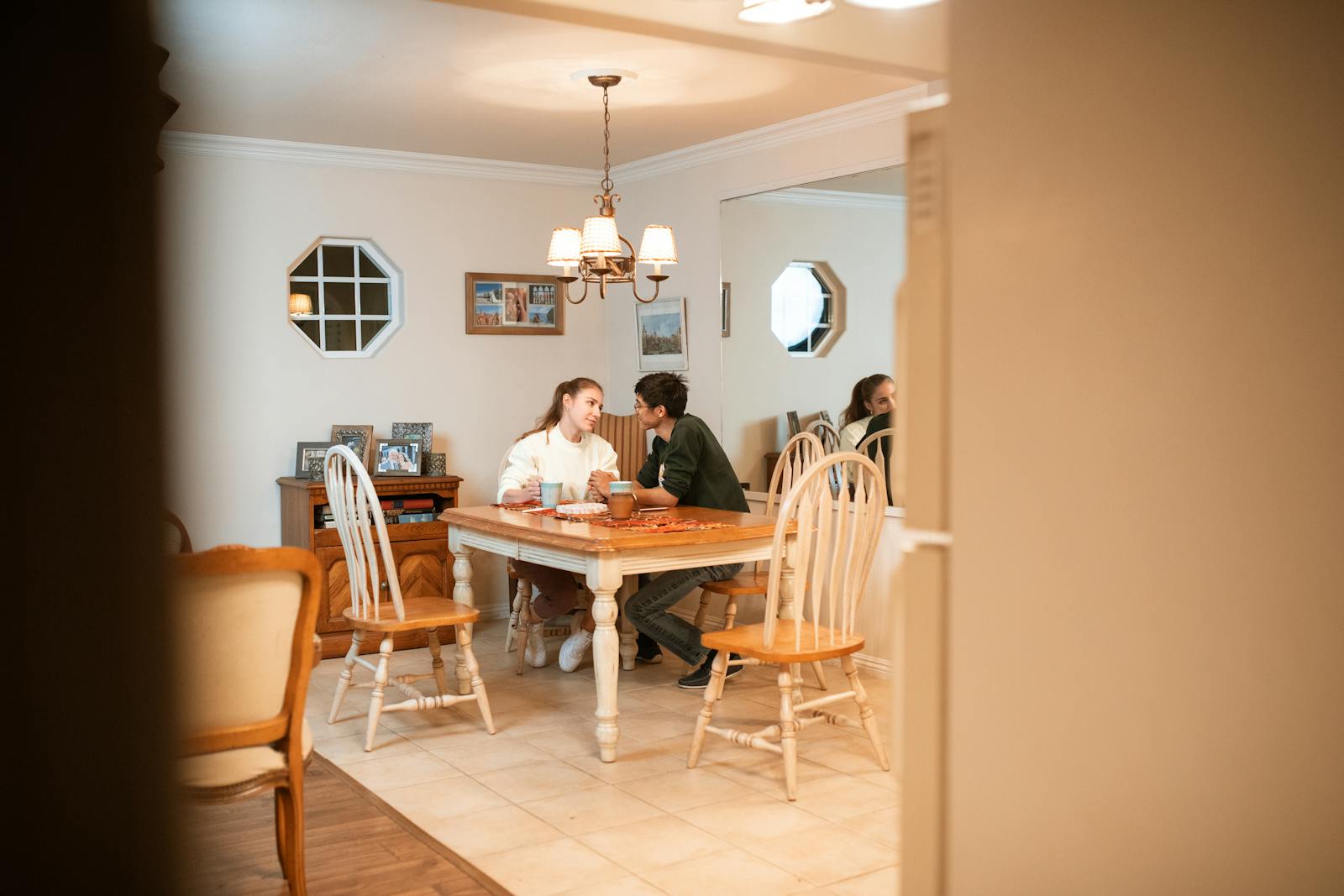
quiet dinner conversation
Photo by RDNE Stock project on Pexels

So here is the question worth sitting with: what does it say about modern life that an entire category of adults has had to invent a tiny, wordless ritual just to claim a few uninterrupted minutes of their own evening?

A face-down phone is not a dramatic act of rebellion. It is barely an act at all. And yet it is doing the work that, for previous generations, simply leaving the house used to do. If something that small has become necessary, the problem is probably not the people performing the gesture.

Maybe the better question is not why they keep flipping their phones over. Maybe it is why the rest of us still expect them not to.

Feature image by RDNE Stock project on Pexels

About this article

This article is for general information and reflection. It is not medical, mental-health, or professional advice. The patterns described draw on published research and editorial observation, not clinical assessment. If you’re dealing with a serious situation, speak with a qualified professional or local support service. Editorial policy →




Source link

Tags: arentfacedownlearningmeantneededNotificationpeoplePhonesecretivespentTableUnexpectedYears
ShareTweetShare
Previous Post

Trump Media posts $405 million loss driven by crypto holdings

Related Posts

edit post
People who say nothing in arguments and process everything later aren’t conflict-avoidant, they figured out that anything said in real time gets weaponized and anything said later gets the courtesy of having been considered

People who say nothing in arguments and process everything later aren’t conflict-avoidant, they figured out that anything said in real time gets weaponized and anything said later gets the courtesy of having been considered

by TheAdviserMagazine
May 9, 2026
0

Maya sat across from her partner during a Sunday afternoon argument about something neither of them would remember by Wednesday,...

edit post
The AlleyWatch April 2026 New York Venture Capital Funding Report – AlleyWatch

The AlleyWatch April 2026 New York Venture Capital Funding Report – AlleyWatch

by TheAdviserMagazine
May 8, 2026
0

New York City’s venture capital market posted a strong April 2026, with startups raising $1.79 billion across 65 deals —...

edit post
People who reread their own messages after sending them aren’t always insecure — they may be running a final check on whether the version of themselves they sent matches the version they meant to send

People who reread their own messages after sending them aren’t always insecure — they may be running a final check on whether the version of themselves they sent matches the version they meant to send

by TheAdviserMagazine
May 8, 2026
0

Rereading your own messages after sending them is not automatically a sign of insecurity. Sometimes it is simply a quality...

edit post
The 9 Largest NYC Tech Startup Funding Rounds of April 2026 – AlleyWatch

The 9 Largest NYC Tech Startup Funding Rounds of April 2026 – AlleyWatch

by TheAdviserMagazine
May 7, 2026
0

Armed with some data from our friends at CrunchBase, I broke down the largest NYC Startup funding rounds in New...

edit post
Many adults who grew up watching their parents struggle with money carry a low background fear of running out for decades past the point where the math makes sense, finally realizing they aren’t budgeting for their future, but soothing the child who watched scarcity play out at the kitchen table

Many adults who grew up watching their parents struggle with money carry a low background fear of running out for decades past the point where the math makes sense, finally realizing they aren’t budgeting for their future, but soothing the child who watched scarcity play out at the kitchen table

by TheAdviserMagazine
May 7, 2026
0

For many adults, the assumption is that financial anxiety is purely rational. They believe checking a bank balance three times...

edit post
Why Your AI Works One Day and Fails the Next

Why Your AI Works One Day and Fails the Next

by TheAdviserMagazine
May 6, 2026
0

If you’ve spent any time building with AI, you’ve likely experienced this. One day, the system feels incredible. It answers...

  • Trending
  • Comments
  • Latest
edit post
Gavin Newsom issues ‘final warning’ amid California’s dire housing crisis — what’s at stake for millions of residents

Gavin Newsom issues ‘final warning’ amid California’s dire housing crisis — what’s at stake for millions of residents

May 3, 2026
edit post
Florida Warning: With Senior SNAP Benefits Averaging 8/Month, Thousands Risk Losing Assistance in 2026

Florida Warning: With Senior SNAP Benefits Averaging $188/Month, Thousands Risk Losing Assistance in 2026

April 27, 2026
edit post
Minnesota Wealth Tax | Intangible Personal Property Tax

Minnesota Wealth Tax | Intangible Personal Property Tax

May 6, 2026
edit post
10 Cheapest High Dividend Stocks With P/E Ratios Under 10

10 Cheapest High Dividend Stocks With P/E Ratios Under 10

April 13, 2026
edit post
Exclusive: America’s largest Black-owned bank launches podcast with mission to unlock hidden shame holding back generational wealth

Exclusive: America’s largest Black-owned bank launches podcast with mission to unlock hidden shame holding back generational wealth

April 29, 2026
edit post
NYC Mayor Mamdani knocked Ken Griffin in pied-a-terre tax promo. His firm calls the move ‘shameful’

NYC Mayor Mamdani knocked Ken Griffin in pied-a-terre tax promo. His firm calls the move ‘shameful’

April 23, 2026
edit post
‘K-Shaped’ Economy Is Giving Way to an ‘E-Shaped’ Divide

‘K-Shaped’ Economy Is Giving Way to an ‘E-Shaped’ Divide

0
edit post
People who keep their phone face-down on every table aren’t always being secretive, they may have spent years learning that every unexpected notification meant someone needed something from them

People who keep their phone face-down on every table aren’t always being secretive, they may have spent years learning that every unexpected notification meant someone needed something from them

0
edit post
AMA recap: Questions on AI liability for tax professionals

AMA recap: Questions on AI liability for tax professionals

0
edit post
Concurrent Gainers: 14 stocks gain for 5 straight sessions, rally up to 25% – Consistent performers

Concurrent Gainers: 14 stocks gain for 5 straight sessions, rally up to 25% – Consistent performers

0
edit post
Fake QR Codes Are Fueling a New Wave of Senior Scams

Fake QR Codes Are Fueling a New Wave of Senior Scams

0
edit post
Iran War: Iran Yet to Answer US Proposal as Recent Exchange of Fire in Gulf Exposes US Weapons Shortages; More on Poor Prospects for Global Economy, Resumption of Old Normal Gulf Traffic Levels

Iran War: Iran Yet to Answer US Proposal as Recent Exchange of Fire in Gulf Exposes US Weapons Shortages; More on Poor Prospects for Global Economy, Resumption of Old Normal Gulf Traffic Levels

0
edit post
People who keep their phone face-down on every table aren’t always being secretive, they may have spent years learning that every unexpected notification meant someone needed something from them

People who keep their phone face-down on every table aren’t always being secretive, they may have spent years learning that every unexpected notification meant someone needed something from them

May 9, 2026
edit post
Trump Media posts 5 million loss driven by crypto holdings

Trump Media posts $405 million loss driven by crypto holdings

May 9, 2026
edit post
Warren Buffett’s Successor Greg Abel Just Broke This 13-Quarter Streak at Berkshire Hathaway. Could This Be a Turning Point for the Stock Market?

Warren Buffett’s Successor Greg Abel Just Broke This 13-Quarter Streak at Berkshire Hathaway. Could This Be a Turning Point for the Stock Market?

May 9, 2026
edit post
Fake QR Codes Are Fueling a New Wave of Senior Scams

Fake QR Codes Are Fueling a New Wave of Senior Scams

May 9, 2026
edit post
Strategy’s STRC Returns To 0 Par Value, Will Michael Saylor Resume Bitcoin Buying?

Strategy’s STRC Returns To $100 Par Value, Will Michael Saylor Resume Bitcoin Buying?

May 9, 2026
edit post
Trump sees ‘beginning of the end’ in Russia’s war on Ukraine as both sides agrees to 3-day ceasefire

Trump sees ‘beginning of the end’ in Russia’s war on Ukraine as both sides agrees to 3-day ceasefire

May 9, 2026
The Adviser Magazine

The first and only national digital and print magazine that connects individuals, families, and businesses to Fee-Only financial advisers, accountants, attorneys and college guidance counselors.

CATEGORIES

  • 401k Plans
  • Business
  • College
  • Cryptocurrency
  • Economy
  • Estate Plans
  • Financial Planning
  • Investing
  • IRS & Taxes
  • Legal
  • Market Analysis
  • Markets
  • Medicare
  • Money
  • Personal Finance
  • Social Security
  • Startups
  • Stock Market
  • Trading

LATEST UPDATES

  • People who keep their phone face-down on every table aren’t always being secretive, they may have spent years learning that every unexpected notification meant someone needed something from them
  • Trump Media posts $405 million loss driven by crypto holdings
  • Warren Buffett’s Successor Greg Abel Just Broke This 13-Quarter Streak at Berkshire Hathaway. Could This Be a Turning Point for the Stock Market?
  • Our Great Privacy Policy
  • Terms of Use, Legal Notices & Disclosures
  • Contact us
  • About Us

© Copyright 2024 All Rights Reserved
See articles for original source and related links to external sites.

Welcome Back!

Login to your account below

Forgotten Password?

Retrieve your password

Please enter your username or email address to reset your password.

Log In
No Result
View All Result
  • Home
  • Financial Planning
    • Financial Planning
    • Personal Finance
  • Market Research
    • Business
    • Investing
    • Money
    • Economy
    • Markets
    • Stocks
    • Trading
  • 401k Plans
  • College
  • IRS & Taxes
  • Estate Plans
  • Social Security
  • Medicare
  • Legal

© Copyright 2024 All Rights Reserved
See articles for original source and related links to external sites.