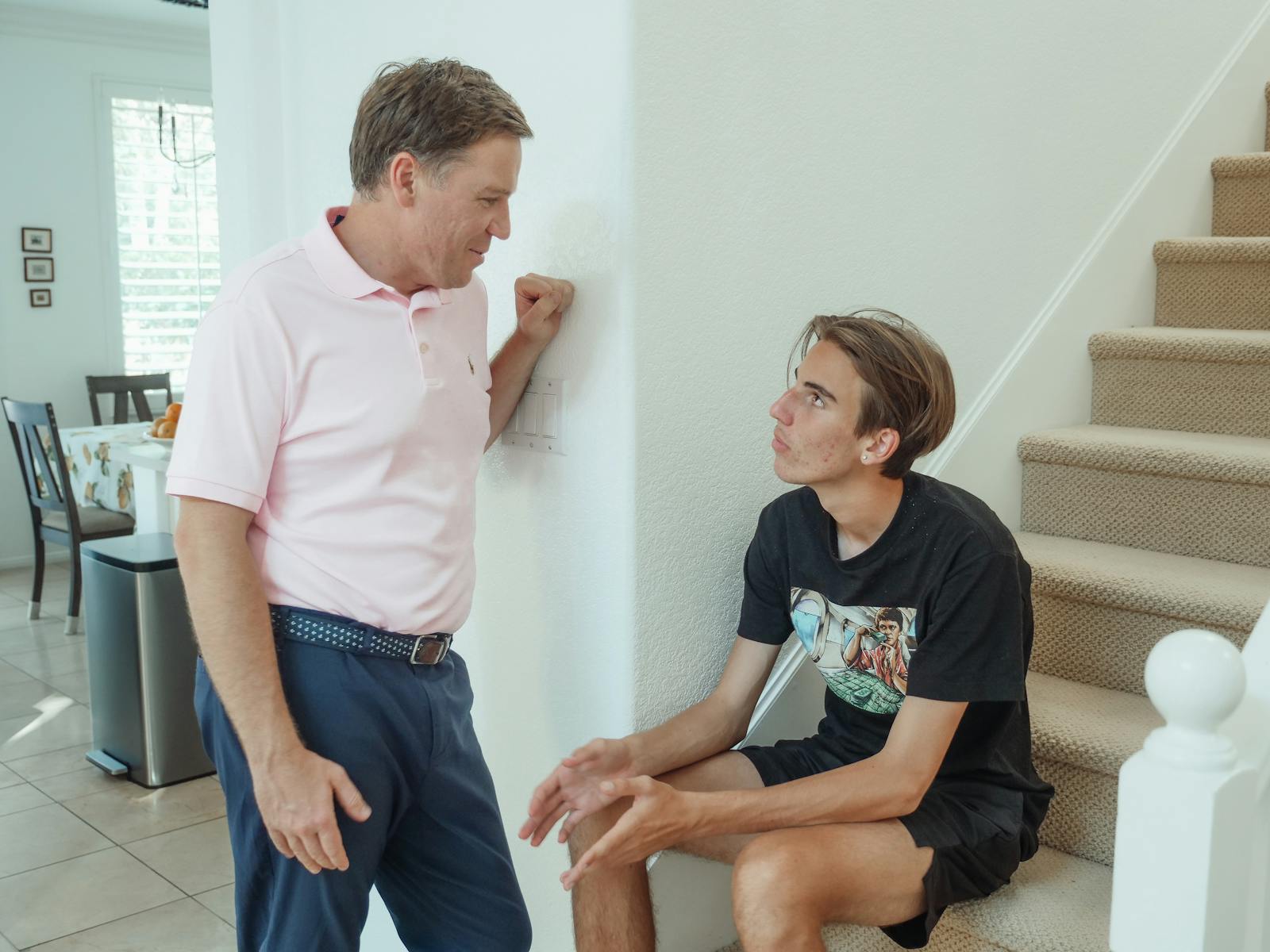
I drove to my parents’ house last summer for a long weekend, and somewhere on the second day I noticed something I’d been not-noticing for about thirty years.
It was the Saturday morning, in the kitchen. My mother had asked me how the drive had been. I told her. Then she asked about the dogs. I gave her the dog update. Then she asked about a project at work. I said it was going fine. Then she asked about the weather in Bangkok. I said it had been hot. Then my father came in and asked when I needed to leave on Monday, because he wanted to time the drive to the station.
I answered all of these questions cheerfully and accurately. I was, by any reasonable measure, having a perfectly nice morning with my parents. And somewhere around the question about the weather, a quiet voice in the back of my head said: they haven’t asked you a single question about how you actually are. Not one. Not this morning, not last night, not yesterday afternoon when you arrived. They’ve asked you about everything around you. They haven’t asked about you.
I tried to dismiss this thought. It felt ungenerous. It felt like the kind of thought you’d have if you were determined to find something wrong with a perfectly nice visit. I pushed it away and finished my coffee and went out for a walk.
On the walk, I tried, as a kind of mental experiment, to remember the last time my parents had asked me a real question about my interior life. About whether I was happy. About what I was struggling with. About what I was hoping for, or afraid of, or quietly working through. I went backward through years. I couldn’t find one.
I sat down on a bench by a pond and was, briefly, sadder than I’d expected to be on a Saturday morning in August.
The architecture of logistical love
What my parents do, and what I think a lot of parents of their generation do, is something I’ve come to think of as logistical love.
It is, I want to stress, a real form of love. They’re tracking my life. They’re paying attention. They want to know about the drive because they’re glad I made it safely. They want to know about the dogs because they’re trying to be good grandparents-by-proxy to two animals they’ve never met. They want to know about the weather and the work and the route to the station because these are the data points of a son’s life that they have been trained, by their own upbringing, to ask about.
The questions are real. The interest is real. They’re just, almost without exception, questions about the surface of my life. The shell. The container.
What’s inside the container, the actual lived experience of being me, on a Tuesday, at thirty-eight, in a foreign city, with whatever weather is happening in my head that week, doesn’t get a question. It hasn’t, as far as I can tell, gotten a question in decades.
I want to be careful here, because I don’t think this is malicious. I don’t think my parents have made a decision to avoid the inside of my life. The decision was made for them, by their own parents and their own culture, long before I was born. They were raised in a generation where you didn’t ask about the inside of someone’s life because it would have been a kind of intrusion, almost rude. The inside was private. The outside was the thing you talked about. They are, in this sense, asking the only questions they were given the equipment to ask. The architecture is logistical because logistics was the only architecture available.
What this teaches you, over time
Here’s the thing I figured out on the bench by the pond. The thing that surprised me.
If you spend three decades being asked only about the surface of your life by the people who are supposed to know you best, you eventually stop having access to the inside yourself.
That sounds dramatic. It isn’t, actually. It’s just the slow effect of repetition. You learn, very young, what’s askable and what isn’t. The askable things get rehearsed and refined. They become the part of your life you can describe at speed. The unaskable things, the fears, the regrets, the slow questions, the bits of you that don’t have neat answers, stay in a kind of cellar. Nobody’s gone down there in years. The light fixture probably doesn’t work anymore.
By the time you’re thirty-eight, you’ve spent so many phone calls, so many family lunches, so many car rides answering surface questions about your life that you’ve gotten extraordinarily good at the surface. You can produce, on demand, a fluent and accurate report on any topic that lives above the waterline. The drive. The job. The dog. The weather in Bangkok.
What you’ve lost, slowly, is the muscle for talking about anything below it. Not because you don’t have things below it. Everyone has things below it. The muscle just hasn’t been exercised. The questions that would have exercised it never came. So when you sit down with a friend or a partner or a therapist who actually asks you, in good faith, how you really are, you find that the answer takes a while to formulate. You’re rusty. The cellar door is heavy. You haven’t opened it in a while.
And here’s the part that hit me hardest on the bench. Most adult children, in this situation, don’t realize anything is missing. They think the surface conversations are the conversations. They think being asked about the drive and the dogs is what being known feels like. They’ve never had the other kind, so they don’t know what they’re not getting.
I’d lived most of my life like that.
The realization that there had been a different kind of conversation available all along, and that I’d been quietly going without it for thirty years, was a small grief that I didn’t see coming.
Why the surface questions feel like care
I want to give my parents their due here, because the surface questions are not nothing.
The surface questions are how my parents demonstrate that I’m in their thoughts. The fact that my mother remembers I’m coming home, asks about the drive, knows the dogs’ names, tracks the work project from one phone call to the next. That’s a form of attention. It takes effort. It requires her to hold the data of my life in her head between visits. There’s love in the data-holding. I don’t want to dismiss that.
And in fairness, plenty of adult children would kill to have parents who asked even this much. There are people my age whose parents don’t track the surface either. Who don’t know what city they live in. Who have to be reminded what they do for a living. Compared to that, my mother knowing the dog’s name is a gift.
So the surface questions are a real form of love. They’re just not the whole form. And the absence of the deeper form, on a long enough timeline, has a cost that I think most adult children of well-meaning parents don’t fully clock until they’re in their late thirties and start, finally, to feel the gap.
What I tried, on the second afternoon
I’ll tell you what I did, and what came of it, because the smallest experiments often produce the most useful information.
On the Saturday afternoon, after the bench, I went back to the house and sat down at the kitchen table with my mother. She was doing something with onions. I asked her, in as casual a voice as I could manage, what she’d been worried about lately.
She paused. She was clearly not expecting the question. She said, after a few seconds, “Worried about? Nothing in particular. Why, are you alright?”
I said I was fine. I said I was just curious. We talked about the onions for a bit.
That was, on the surface, a failed experiment. I’d asked an interior question, and the answer I got was a deflection plus a return-to-surface. Nothing earth-shaking happened.
But here’s what I noticed. Later that evening, after dinner, my mother brought me a cup of tea and sat down on the sofa and said, “You know, what I have been worrying about a bit, is your father’s hip.” And then she talked, for about ten minutes, in a way I’d never heard her talk, about something real. Not earth-shaking. Just real. A small interior thing she was carrying around.
The afternoon question had landed, eventually. It had taken a few hours to germinate. The deflection in the kitchen wasn’t a refusal. It was just my mother, who had also spent her life answering surface questions, needing some lead time to remember how to talk about the interior.
I have, since then, started asking my parents one interior question per visit. Not a list. One. Lightly. With no expectation of an immediate answer. I’ve found that the answers, when they come, often arrive hours or days later, in unexpected moments. The architecture is shifting, slowly. They’re getting used to a new kind of question. So am I, for that matter.
What I’d say to anyone who just noticed
If you’re reading this and thinking that your own parents only ask about logistics, and that you’ve spent your life answering, and that you’ve gone slightly numb to the gap, you’re not alone. You’re in an enormous and quiet club.
The thing I’d want you to know is that the gap doesn’t have to be a verdict on your parents. They are probably loving you the only way they were taught to love. The surface questions are the love language they were given. They’re not withholding the deeper questions on purpose. They were never handed those questions themselves.
What you can do, if you have the energy, is ask the questions you wish were being asked of you. Ask one. Lightly. Don’t make a project of it. Don’t sit your parents down for the big conversation. Just drop one interior question into the kitchen on the Saturday afternoon and see what happens.
Sometimes nothing happens. Sometimes the question lands hours later, when the onions are done and the tea is being made.
The cellar door, in my experience, opens slowly. Both of them have been locked for a long time. Both of them, mine and my parents’, need a bit of oil on the hinges.
I called my mother last Tuesday. Halfway through, after the weather and the dogs, she said, “I’ve been thinking about what you asked me in August.” And then she told me something else.
About this article
This article is for general information and reflection. It is not professional advice. For your specific situation, consult a qualified professional. Editorial policy →