by Dennis Crouch
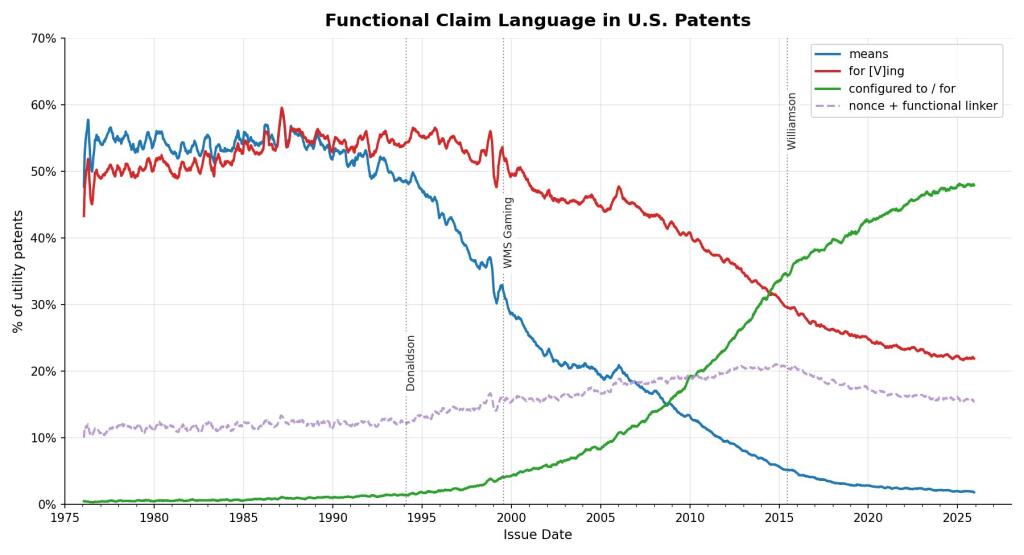
Twelve years ago I posted a chart on Patently-O tracking three patterns of functional claim language across U.S. utility patents from 1976 through 2013. The chart showed the steep post-1994 collapse of traditional means-plus-function claims and the simultaneous rise of “configured to/for” as the patent attorney functional replacement of choice. See Dennis Crouch, Functional Claim Language in Issued Patents, Patently-O (Jan. 23, 2014). [Read this post via PDF]
That data was collected and published the year before the en banc decision in Williamson v. Citrix Online, LLC, 792 F.3d 1339 (Fed. Cir. 2015). This post extends the dataset up to May 2026 and adds a fourth time series capturing the construction Williamson brought within the reach of 35 U.S.C. § 112(f): a generic “nonce” noun coupled with a functional linker phrase (e.g., “module for”). The full dataset now covers approximately 8.3 million utility patents issued from January 1976 through mid-May 2026.
The headline updates from 2014 are dramatic but unsurprising. “Configured to/for” now appears in almost 50% of utility patents issued. It overtook “means for” around 2008-2009 and surpassed the “for [Verb]ing” construction in 2014. Traditional means-plus-function language has fallen to less than 3% of utility patents, a huge decline from its 1980s modern peak.
The new finding, and the one I focus on more in this post is a new fourth line. The Williamson-targeted “nonce” words rose from roughly 11% of utility patents in 1976 to a peak of 20% in 2010-2014, then turned downward through the post-Williamson decade and now sits at about 16%. A companion per-word chart below shows the decline concentrated in exactly the nonce terms the Federal Circuit has flagged: “unit” and “module” both peak at 2014 and decline thereafter, while potentially structurally loaded terms like “device” continue rising. Williamson appears to have done meaningful work, at least to shift language.