No Result
View All Result
SUBMIT YOUR ARTICLES
  • Login
Thursday, June 18, 2026
TheAdviserMagazine.com
  • Home
  • Financial Planning
    • Financial Planning
    • Personal Finance
  • Market Research
    • Business
    • Investing
    • Money
    • Economy
    • Markets
    • Stocks
    • Trading
  • 401k Plans
  • College
  • IRS & Taxes
  • Estate Plans
  • Social Security
  • Medicare
  • Legal
  • Home
  • Financial Planning
    • Financial Planning
    • Personal Finance
  • Market Research
    • Business
    • Investing
    • Money
    • Economy
    • Markets
    • Stocks
    • Trading
  • 401k Plans
  • College
  • IRS & Taxes
  • Estate Plans
  • Social Security
  • Medicare
  • Legal
No Result
View All Result
TheAdviserMagazine.com
No Result
View All Result
Home Market Research Startups

AI Doesn’t Fail Because of Models. It Fails Because of Systems.

by TheAdviserMagazine
2 months ago
in Startups
Reading Time: 4 mins read
A A
AI Doesn’t Fail Because of Models. It Fails Because of Systems.
Share on FacebookShare on TwitterShare on LInkedIn


There is a quiet frustration building inside a lot of companies right now.

They have experimented with AI, built prototypes, and in many cases shipped something that looks impressive in a demo. And yet, when it comes time to rely on it, to put it in front of customers, or to trust it inside real workflows, things start to break.

At the inaugural York IE AIConf in Ahmedabad, Ashish Patel, Senior Principal Architect for AI, ML & Data Science at Oracle, put words to what many teams are experiencing: “Demos are easy. Reliability is hard.”

That line captures the gap between experimentation and execution, and it points to a deeper truth. AI does not fail because the models are not good enough. It fails because the systems around them are not.

The 90/10 Trap

Most teams fall into what Ashish described as the 90/10 trap. Ninety percent of the effort goes into building something that works in a controlled environment, while the final ten percent, the part that makes it reliable, scalable, and production ready, is where things begin to unravel.

The issue is not intelligence. It is structured. Static workflows break when they encounter edge cases, and systems often lack memory, error handling, and proper tool integration. What looks like a smart system in a demo quickly reveals itself to be fragile in the real world.

Even more importantly, teams tend to misdiagnose the problem. They assume the model is the bottleneck, when in reality, the bottleneck is the lack of system capabilities around it.

That insight shifts the conversation from model selection to system design. And that is where the real work begins.

Why Better Models Don’t Fix the Problem

If the model is not the bottleneck, then what is? The answer is context.

There is a common belief that better models produce better outcomes. It feels intuitive. Bigger models, more training data, and more intelligence should lead to better answers. But in practice, performance is not driven by intelligence alone. It is driven by how well the system informs that intelligence.

As Ashish explained, a model’s output is only as reliable as the specific, up to date data provided in the prompt. Without context, even the most advanced models fail in simple ways. They do not understand your business, your data, or your constraints, so they fill in the gaps. And they do it convincingly.

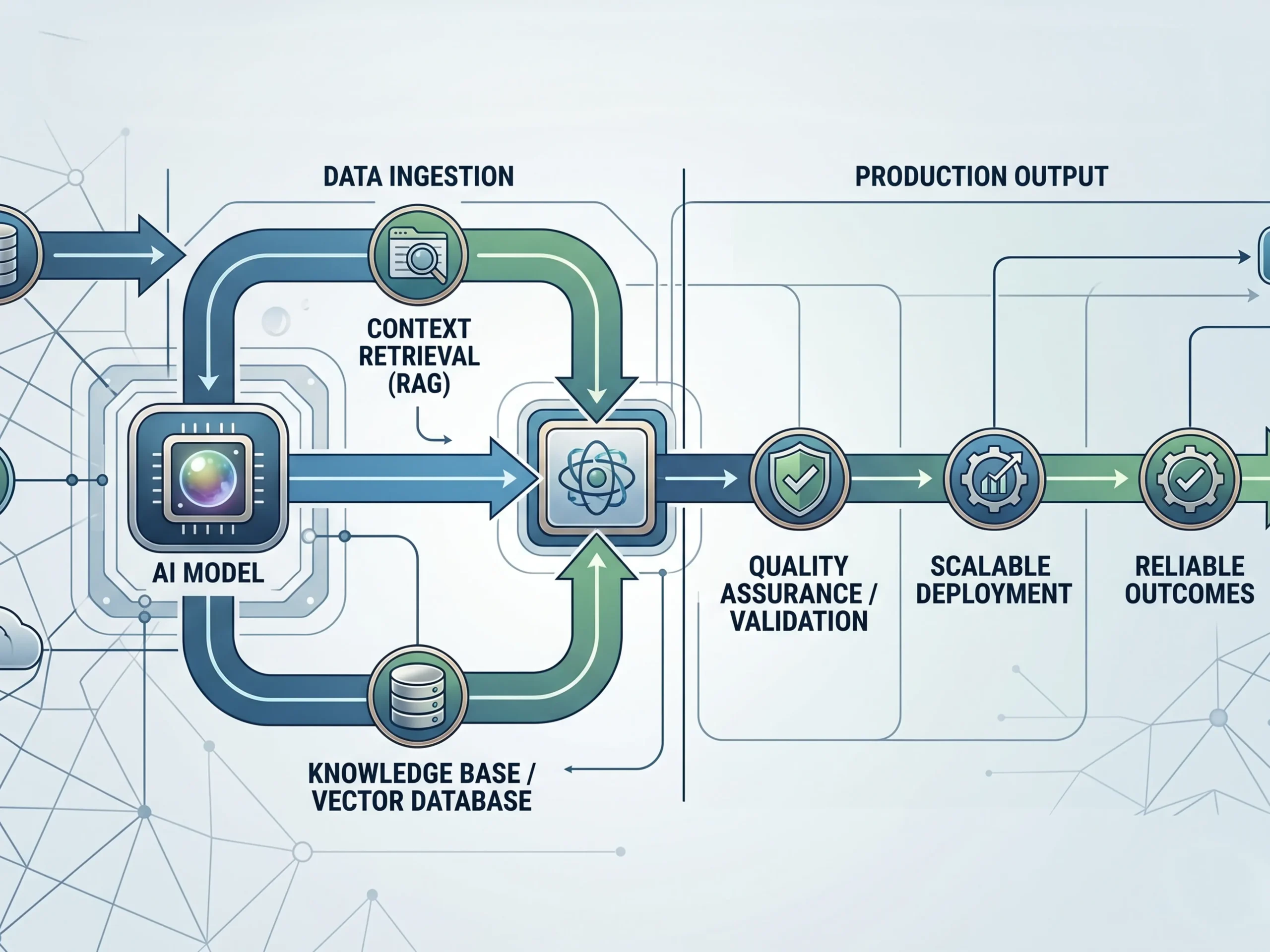
This is why so many teams struggle with accuracy. They invest in fine tuning, prompt engineering, and new tools, when the real issue is that the system is not providing grounded, relevant information. Ashish offered a practical rule that cuts through the noise: use RAG first. Ninety percent of agentic failures are context related, not behavior related.

That means your retrieval layer matters more than your model choice. Data quality and accessibility are not backend concerns. They are the foundation of performance.

Hallucination Is a Design Problem

This also reframes one of the most talked about challenges in AI: hallucination.

Most teams treat hallucination like a glitch, something that occasionally happens and needs to be caught after the fact. But that framing misses the point. Garbage in, garbage out. Wrong context leads to wrong output.

Models are designed to be helpful. When they lack information, they fill in the gaps with plausible answers. They are not malfunctioning. They are operating exactly as designed. The failure is in the system that surrounds them.

There are three patterns that show up consistently. First, poor context, where the system cannot retrieve the right information. Second, no validation layer, where outputs are never checked before being used. And third, weak architecture, where there is no redundancy or second opinion built in.

Fixing hallucination is not about writing better prompts. It is about building better systems through stronger retrieval, built in validation, and structures that allow outputs to be tested before they are trusted.

From One Agent to Many

As teams begin to address these challenges, the architecture naturally evolves. Most start with a simple idea: build one powerful AI agent that can handle everything. It is a logical starting point, but it quickly becomes limiting.

As tasks grow more complex, a single agent runs into cognitive overload. It is responsible for too much context, too many decisions, and too many responsibilities at once. As that load increases, accuracy drops and errors become more frequent.

The solution is not to build a smarter single agent. It is to build a system of agents.

In a multi agent architecture, each agent has a defined role. One researches, another analyzes, another executes, and another reviews. Instead of one generalist trying to do everything, you create a team of specialists. This structure introduces something most AI systems lack today: verification.

As Ashish noted, in a multi agent setup, one agent can double check the work of another. One agent produces an output, another critiques it, and a third synthesizes the result. The system becomes more reliable not because any single model is perfect, but because the system is designed to catch mistakes.

This is the shift from isolated intelligence to coordinated intelligence, and from outputs to outcomes.

What Actually Separates Systems That Work

By the end of the session, the distinction became clear. There are two types of AI systems being built today.

The first are experimental. They are impressive in demos but brittle in production, relying on prompts, linear workflows, and best case assumptions. The second are structured. They are designed for real world conditions, incorporating memory, retrieval, validation, orchestration, and resilience.

These systems are built to recover when something breaks, not just to work when everything goes right. That is the difference between building something that looks like AI and building something that actually works.

The Bottom Line

AI is not just a model problem. It is a systems problem.

The teams that win in this next phase will not be the ones chasing the latest model release. They will be the ones investing in architecture, context, retrieval, validation, and coordination. They will move beyond demos and build for reliability.

Because in the end, the goal is not to create something that looks intelligent. It is to create something that can be trusted. And that only happens when the system is designed to support it.

To stay up-to-date on all upcoming York IE events, follow us on LinkedIn.



Source link

Tags: DoesntFAILfailsModelssystems
ShareTweetShare
Previous Post

Bajaj Finance Q4 net rises 22%, AUM crosses Rs 5 lakh crore

Next Post

Cloud revenue is now 18% of Alphabet’s business. Is Google’s identity as a search company changing?

Related Posts

edit post
CEO Lesson From My Father: Answer the Call

CEO Lesson From My Father: Answer the Call

by TheAdviserMagazine
June 18, 2026
0

The CEO role is one of ultimate accountability.  Having come from a family business on Main Street (aka Lake Ave),...

edit post
The generation that grew up without seatbelts, without locked doors, and without parents who tracked their afternoons developed a particular relationship to risk that the current world has very little use for, and many of them are quietly mourning a kind of competence nobody asks them to demonstrate anymore

The generation that grew up without seatbelts, without locked doors, and without parents who tracked their afternoons developed a particular relationship to risk that the current world has very little use for, and many of them are quietly mourning a kind of competence nobody asks them to demonstrate anymore

by TheAdviserMagazine
June 18, 2026
0

The same generation that rode in the back of station wagons without seatbelts, drank from garden hoses, and disappeared into...

edit post
Survive Your Startup’s First Few Inspections by Sidestepping These 5 Snags

Survive Your Startup’s First Few Inspections by Sidestepping These 5 Snags

by TheAdviserMagazine
June 17, 2026
0

Inspections can create anxiety for entrepreneurs, prompting late-night searches for receipts before tax audits and rushed site assessments before regulatory...

edit post
Novellia Raises M to Fix the B Data Problem Sitting at the Heart of Drug Development – AlleyWatch

Novellia Raises $18M to Fix the $50B Data Problem Sitting at the Heart of Drug Development – AlleyWatch

by TheAdviserMagazine
June 17, 2026
0

real world, but the infrastructure built to deliver that understanding has a fundamental flaw at its center: patients have no...

edit post
Tech layoffs are running 44% ahead of last year while the same companies post record profits and mint new billionaires — and the structural setup is stranger than 2008 because there’s no crash to blame

Tech layoffs are running 44% ahead of last year while the same companies post record profits and mint new billionaires — and the structural setup is stranger than 2008 because there’s no crash to blame

by TheAdviserMagazine
June 17, 2026
0

The tech layoffs story is being told backward. The conventional reading is that something must have gone wrong — a...

edit post
The adult who apologises for crying even when alone in their own kitchen isn’t oversensitive, they grew up around someone whose mood the whole house had to navigate around tears

The adult who apologises for crying even when alone in their own kitchen isn’t oversensitive, they grew up around someone whose mood the whole house had to navigate around tears

by TheAdviserMagazine
June 17, 2026
0

Some apologies are older than the moment that produced them. When a grown adult stands at their own kitchen sink,...

Next Post
edit post
Cloud revenue is now 18% of Alphabet’s business. Is Google’s identity as a search company changing?

Cloud revenue is now 18% of Alphabet's business. Is Google's identity as a search company changing?

edit post
ETMarkets Smart Talk | “Tax, TCS & Clarity: What’s holding Indian investors back from going global”, explains Himanshu Kohli

ETMarkets Smart Talk | “Tax, TCS & Clarity: What’s holding Indian investors back from going global”, explains Himanshu Kohli

  • Trending
  • Comments
  • Latest
edit post
Florida Roads Become a Battleground for Illegal Immigration

Florida Roads Become a Battleground for Illegal Immigration

June 9, 2026
edit post
Louisiana’s Age-Tiered Homestead Exemption: 8 Details About the Proposed 2028 Amendment

Louisiana’s Age-Tiered Homestead Exemption: 8 Details About the Proposed 2028 Amendment

June 15, 2026
edit post
The 8 States That Still Tax Social Security in 2026

The 8 States That Still Tax Social Security in 2026

June 6, 2026
edit post
It’s Time To Talk About Massie

It’s Time To Talk About Massie

May 23, 2026
edit post
A Tax on Social Media – Blue-State Governments’ Newest Ploy

A Tax on Social Media – Blue-State Governments’ Newest Ploy

June 5, 2026
edit post
Red Snapper Used as Cudgel by Fed Judge

Red Snapper Used as Cudgel by Fed Judge

May 31, 2026
edit post
Bank of England holds interest rates at 3.75% amid Iran war peace prospects

Bank of England holds interest rates at 3.75% amid Iran war peace prospects

0
edit post
Crypto Today: Bitcoin Treasury Funding Vote, FTX-Linked Charges, Sports Contracts Ban Push

Crypto Today: Bitcoin Treasury Funding Vote, FTX-Linked Charges, Sports Contracts Ban Push

0
edit post
Accenture cuts revenue outlook, stock crashes 11% in pre-market trading

Accenture cuts revenue outlook, stock crashes 11% in pre-market trading

0
edit post
Is Going Back to an Old Job a Smart Move — or a Step Backward?

Is Going Back to an Old Job a Smart Move — or a Step Backward?

0
edit post
Bonus Depreciation, Explained Without the Jargon

Bonus Depreciation, Explained Without the Jargon

0
edit post
Crowdstrike – CRWD: Partnerschaft mit Amazon Web Services liefert frisches Umsatzpotenzial!

Crowdstrike – CRWD: Partnerschaft mit Amazon Web Services liefert frisches Umsatzpotenzial!

0
edit post
Crypto Today: Bitcoin Treasury Funding Vote, FTX-Linked Charges, Sports Contracts Ban Push

Crypto Today: Bitcoin Treasury Funding Vote, FTX-Linked Charges, Sports Contracts Ban Push

June 18, 2026
edit post
Walmart Plus Membership | 50% off One Year! Money Saving Mom®

Walmart Plus Membership | 50% off One Year! Money Saving Mom®

June 18, 2026
edit post
The next-generation ‘Tiger Cubs’ who see the AI bubble risk—and know exactly where the next trade is

The next-generation ‘Tiger Cubs’ who see the AI bubble risk—and know exactly where the next trade is

June 18, 2026
edit post
Bank of England holds interest rates at 3.75% amid Iran war peace prospects

Bank of England holds interest rates at 3.75% amid Iran war peace prospects

June 18, 2026
edit post
Accenture cuts revenue outlook, stock crashes 11% in pre-market trading

Accenture cuts revenue outlook, stock crashes 11% in pre-market trading

June 18, 2026
edit post
Is Going Back to an Old Job a Smart Move — or a Step Backward?

Is Going Back to an Old Job a Smart Move — or a Step Backward?

June 18, 2026
The Adviser Magazine

The first and only national digital and print magazine that connects individuals, families, and businesses to Fee-Only financial advisers, accountants, attorneys and college guidance counselors.

CATEGORIES

  • 401k Plans
  • Business
  • College
  • Cryptocurrency
  • Economy
  • Estate Plans
  • Financial Planning
  • Investing
  • IRS & Taxes
  • Legal
  • Market Analysis
  • Markets
  • Medicare
  • Money
  • Personal Finance
  • Social Security
  • Startups
  • Stock Market
  • Trading

LATEST UPDATES

  • Crypto Today: Bitcoin Treasury Funding Vote, FTX-Linked Charges, Sports Contracts Ban Push
  • Walmart Plus Membership | 50% off One Year! Money Saving Mom®
  • The next-generation ‘Tiger Cubs’ who see the AI bubble risk—and know exactly where the next trade is
  • Our Great Privacy Policy
  • Terms of Use, Legal Notices & Disclosures
  • Contact us
  • About Us

© Copyright 2024 All Rights Reserved
See articles for original source and related links to external sites.

Welcome Back!

Login to your account below

Forgotten Password?

Retrieve your password

Please enter your username or email address to reset your password.

Log In
No Result
View All Result
  • Home
  • Financial Planning
    • Financial Planning
    • Personal Finance
  • Market Research
    • Business
    • Investing
    • Money
    • Economy
    • Markets
    • Stocks
    • Trading
  • 401k Plans
  • College
  • IRS & Taxes
  • Estate Plans
  • Social Security
  • Medicare
  • Legal

© Copyright 2024 All Rights Reserved
See articles for original source and related links to external sites.