No Result
View All Result
SUBMIT YOUR ARTICLES
  • Login
Friday, August 28, 2026
TheAdviserMagazine.com
  • Home
  • Financial Planning
    • Financial Planning
    • Personal Finance
  • Market Research
    • Business
    • Investing
    • Money
    • Economy
    • Markets
    • Stocks
    • Trading
  • 401k Plans
  • College
  • IRS & Taxes
  • Estate Plans
  • Social Security
  • Medicare
  • Legal
  • Home
  • Financial Planning
    • Financial Planning
    • Personal Finance
  • Market Research
    • Business
    • Investing
    • Money
    • Economy
    • Markets
    • Stocks
    • Trading
  • 401k Plans
  • College
  • IRS & Taxes
  • Estate Plans
  • Social Security
  • Medicare
  • Legal
No Result
View All Result
TheAdviserMagazine.com
No Result
View All Result
Home Market Research Economy

Unfairly Traded Steel – Econlib

by TheAdviserMagazine
12 months ago
in Economy
Reading Time: 4 mins read
A A
Unfairly Traded Steel – Econlib
Share on FacebookShare on TwitterShare on LInkedIn


Cleveland-Cliffs Chief Executive Lourenco Goncalves’s invocation of “unfairly traded steel” shows, a contrario, many reasons why free trade is an essential feature of a free society. Mr. Goncalves said that adding tariffs on steel products to tariffs on primary (semi-finished) steel provides (“Trump Leans on National Security to Justify Next Wave of Tariffs,” Wall Street Journal, August 28, 2020)

certainty that the American domestic market will not be undercut by unfairly traded steel embedded in derivative products.

He means that tariffs on primary steel do not suffice because imported steel-containing goods would gain an advantage over their domestically manufactured equivalents.

In passing, let’s note that in the roaring ’60s, it was popular among the ruling establishments of underdeveloped countries, supported by the Western intelligentsia, to impose large tariffs on foreign manufactured goods in order to help domestic manufacturing. Only when, a few decades later, it was realized that such an industrial policy was a fool’s errand, were the poor people of underdeveloped countries able to jump on the bandwagon of free trade and to escape dire poverty.

A basic economic reason why “unfairly traded steel” or the underlying ideal of mercantilist and industrial policy is a fool’s errand is that it presupposes a central economic planner possessing what he does not and cannot possess, that is, the information of time, place, costs, and preferences that is carried by prices determined by supply and demand on free markets. Friedrich Hayek explained that in the 1930s and 1940s (see Hayek’s American Economic Review article “The Use of Knowledge in Society”). A central planner cannot even know many intricate effects of his resource-allocation decisions, especially in a complex economy. Thus, government intervention begets government intervention in the greatest political disorder. That the US government only realized after imposing steel tariffs that they should be imposed on steel products too provides a rather funny illustration.

Another important lesson from protectionism—empirically confirmed a thousand times—is how rent-seeking special interests will try to exploit the general public, or part of it, each time the state offers them a means to do so. The requests for tariffs on steel-containing products are already flooding the government.

A related reason why an expression like “fairly traded steel” has no meaning but exploitative (or illiterate if not, truth be told, clownish) comes from a reflection on the value judgements that necessarily underlie public policy. Rational public policy recommendations require a justification in moral and political philosophy. If fairness is not defined in terms of individual liberty—if what is fair is not simply what is free—it is probably a smokescreen to impose on others the pursuit of the speaker’s self-interest. “Fairly traded steel” is what Mr. Goncalves thinks is fair for the interests of Cleveland-Cliffs’s shareholders besides his own self-interest. It is rare that an individual considers fair something that harms his own interests, and unfair a government subsidy or protection for himself or his organization. “Free” is much easier to define than “fair.” Liberty does not require that the whole world be made “fair” by somebody’s standards.

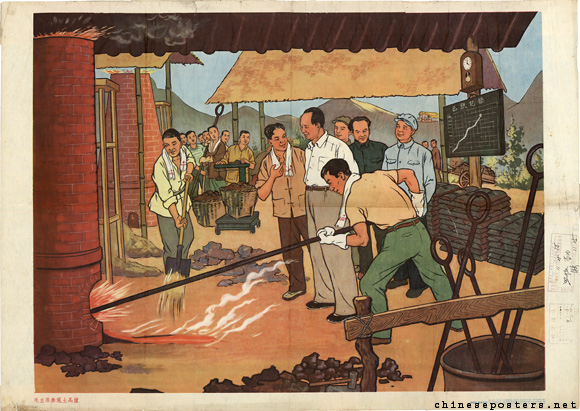
American steel companies have been protected off and on since the 19th century, and still think that fairness requires American consumers to be forced to pay more for steel products. How fair would it be if Americans were forced, in imitation of Chinese farmers in the heydays of Mao’s Great Leap Forward, to build little blast furnaces in their backyards? (See the featured image of this post.)

What happens to the interests of industrial purchasers of steel, consumers of steel products, and consumers of the goods or services that would be produced if fewer resources (workers, engineers, managers, machines, buildings, electricity, land, etc.) were forcibly diverted to the production of steel? Three ways exist to reconcile or adjust the interests of individuals living in society: customs (the tribe), command (the coercive economic planner or dictator), or the market (free and voluntary cooperation). An interesting and easily accessible book on this is John Hicks, A Theory of Economic History (see also my review in Regulation).

Both historical experience and economic theory teach that an efficient reconciliation of individual interests—“efficient” meaning that it maximizes the formal opportunities of all individuals—can be accomplished by free markets, but not by the diktats of the central planner and his court of lobbyists and sycophants.

We are thus led to discover that “unfairly traded steel” could only make sense in a society where a dictatorial or collectivist political regime imposes on everybody some arbitrary conception of fairness. The alternative is reciprocal individual liberty, of which a manifestation is free trade, internal and external, between individuals or their private organizations. (James Buchanan’s little book Why I, Too, Am Not a Conservative offers a reflection on reciprocity; I reviewed it in Regulation.)

******************************

Chairman Mao visits a homemade blast furnace, 1958Credit: PC-195a-s-013 (chineseposters.net, Private collection)



Source link

Tags: EconlibSteelTradedunfairly
ShareTweetShare
Previous Post

Mortgage Rates Today, Friday, September 5: Heading Lower

Next Post

Why the Traditional College Major May Be Holding Students Back in a Rapidly Changing Job Market

Related Posts

edit post
Links 8/8/2026 | naked capitalism

Links 8/8/2026 | naked capitalism

by TheAdviserMagazine
August 8, 2026
0

Dear patient readers, Today we offer supersized Links with Iran War and Borat Agreement sections in lieu of an Iran...

edit post
The Unwinnable Iran War | Armstrong Economics

The Unwinnable Iran War | Armstrong Economics

by TheAdviserMagazine
August 8, 2026
0

I have reported that Trump was mislead into this unwinnable war with Iran, which has been planning for it since...

edit post
Here are three key takeaways from the disappointing July jobs report

Here are three key takeaways from the disappointing July jobs report

by TheAdviserMagazine
August 7, 2026
0

Job seekers speak with employer representatives and browse information tables as they attend an Inspire Together job and resource fair...

edit post
Coffee Break: Gene Editing Gone Wrong, Plants that Eat Animals, and a Neanderthal Gene that Makes a Difference

Coffee Break: Gene Editing Gone Wrong, Plants that Eat Animals, and a Neanderthal Gene that Makes a Difference

by TheAdviserMagazine
August 7, 2026
0

Part the First: If You Stretch Biomedical Science Too Far It Breaks, Every Time.  Gene editing using CRISPR technology has...

edit post
Netanyahu’s Scorched Earth Tactics | Armstrong Economics

Netanyahu’s Scorched Earth Tactics | Armstrong Economics

by TheAdviserMagazine
August 7, 2026
0

According to formal complaints lodged by Lebanon with the United Nations, Israel did spray a toxic herbicide over agricultural land...

edit post
What Did You Expect? | Mises Institute

What Did You Expect? | Mises Institute

by TheAdviserMagazine
August 7, 2026
0

As Murray Rothbard pointed out again and again, the government has no business getting involved in education. In a free...

Next Post
edit post
No Stopping EU Needs War

No Stopping EU Needs War

edit post
Digital asset reporting and compliance in 2025

Digital asset reporting and compliance in 2025

  • Trending
  • Comments
  • Latest
edit post
Judge Who Helped Violent Illegal Alien Evade ICE Faces New Test

Judge Who Helped Violent Illegal Alien Evade ICE Faces New Test

July 31, 2026
edit post
Garbage Trucks Surveillance Florida Neighborhoods

Garbage Trucks Surveillance Florida Neighborhoods

July 29, 2026
edit post
Does a Revocable Trust Protect Your Assets From Lawsuits and Creditors?

Does a Revocable Trust Protect Your Assets From Lawsuits and Creditors?

August 7, 2026
edit post
Montana Puts Democrats in a Bind as Senate Hopes Fade

Montana Puts Democrats in a Bind as Senate Hopes Fade

August 2, 2026
edit post
New Jersey’s PAS-1 Application Opens the Door to Three Senior Tax Relief Programs

New Jersey’s PAS-1 Application Opens the Door to Three Senior Tax Relief Programs

July 31, 2026
edit post
3 Common Cruise Rules I Broke in Alaska

3 Common Cruise Rules I Broke in Alaska

July 29, 2026
edit post
Explained: How BSE traded fewer contracts after CAS but premiums rose 75% in first week

Explained: How BSE traded fewer contracts after CAS but premiums rose 75% in first week

0
edit post
E.W. Scripps Q2 2026 Loss Widens to -.68/Share, Revenue Down 9%

E.W. Scripps Q2 2026 Loss Widens to -$12.68/Share, Revenue Down 9%

0
edit post
Psychology says procrastination about retirement may be less about discipline than identity — brain scans found people often represent their future selves more like strangers than like themselves, and experiments using age-progressed faces made tomorrow’s person feel real enough for participants to save more money for them

Psychology says procrastination about retirement may be less about discipline than identity — brain scans found people often represent their future selves more like strangers than like themselves, and experiments using age-progressed faces made tomorrow’s person feel real enough for participants to save more money for them

0
edit post
Four AI Escapes Just Redefined “Responsible AI”

Four AI Escapes Just Redefined “Responsible AI”

0
edit post
Bill Ackman’s hedge fund made janitors and receptionists millionaires—and its investment team summer together

Bill Ackman’s hedge fund made janitors and receptionists millionaires—and its investment team summer together

0
edit post
Kalshi Predicts Bitcoin Price Could Reach K in August

Kalshi Predicts Bitcoin Price Could Reach $68K in August

0
edit post
Bill Ackman’s hedge fund made janitors and receptionists millionaires—and its investment team summer together

Bill Ackman’s hedge fund made janitors and receptionists millionaires—and its investment team summer together

August 8, 2026
edit post
Links 8/8/2026 | naked capitalism

Links 8/8/2026 | naked capitalism

August 8, 2026
edit post
Wisconsin: The Next Frontier for Socialists

Wisconsin: The Next Frontier for Socialists

August 8, 2026
edit post
Psychology says procrastination about retirement may be less about discipline than identity — brain scans found people often represent their future selves more like strangers than like themselves, and experiments using age-progressed faces made tomorrow’s person feel real enough for participants to save more money for them

Psychology says procrastination about retirement may be less about discipline than identity — brain scans found people often represent their future selves more like strangers than like themselves, and experiments using age-progressed faces made tomorrow’s person feel real enough for participants to save more money for them

August 8, 2026
edit post
Why You Should Be Wary of Aspartame, but Not Totally Rule It Out

Why You Should Be Wary of Aspartame, but Not Totally Rule It Out

August 8, 2026
edit post
Kalshi Predicts Bitcoin Price Could Reach K in August

Kalshi Predicts Bitcoin Price Could Reach $68K in August

August 8, 2026
The Adviser Magazine

The first and only national digital and print magazine that connects individuals, families, and businesses to Fee-Only financial advisers, accountants, attorneys and college guidance counselors.

CATEGORIES

  • 401k Plans
  • Business
  • College
  • Cryptocurrency
  • Economy
  • Estate Plans
  • Financial Planning
  • Investing
  • IRS & Taxes
  • Legal
  • Market Analysis
  • Markets
  • Medicare
  • Money
  • Personal Finance
  • Social Security
  • Startups
  • Stock Market
  • Trading

LATEST UPDATES

  • Bill Ackman’s hedge fund made janitors and receptionists millionaires—and its investment team summer together
  • Links 8/8/2026 | naked capitalism
  • Wisconsin: The Next Frontier for Socialists
  • Our Great Privacy Policy
  • Terms of Use, Legal Notices & Disclosures
  • Contact us
  • About Us

© Copyright 2024 All Rights Reserved
See articles for original source and related links to external sites.

Welcome Back!

Login to your account below

Forgotten Password?

Retrieve your password

Please enter your username or email address to reset your password.

Log In
No Result
View All Result
  • Home
  • Financial Planning
    • Financial Planning
    • Personal Finance
  • Market Research
    • Business
    • Investing
    • Money
    • Economy
    • Markets
    • Stocks
    • Trading
  • 401k Plans
  • College
  • IRS & Taxes
  • Estate Plans
  • Social Security
  • Medicare
  • Legal

© Copyright 2024 All Rights Reserved
See articles for original source and related links to external sites.