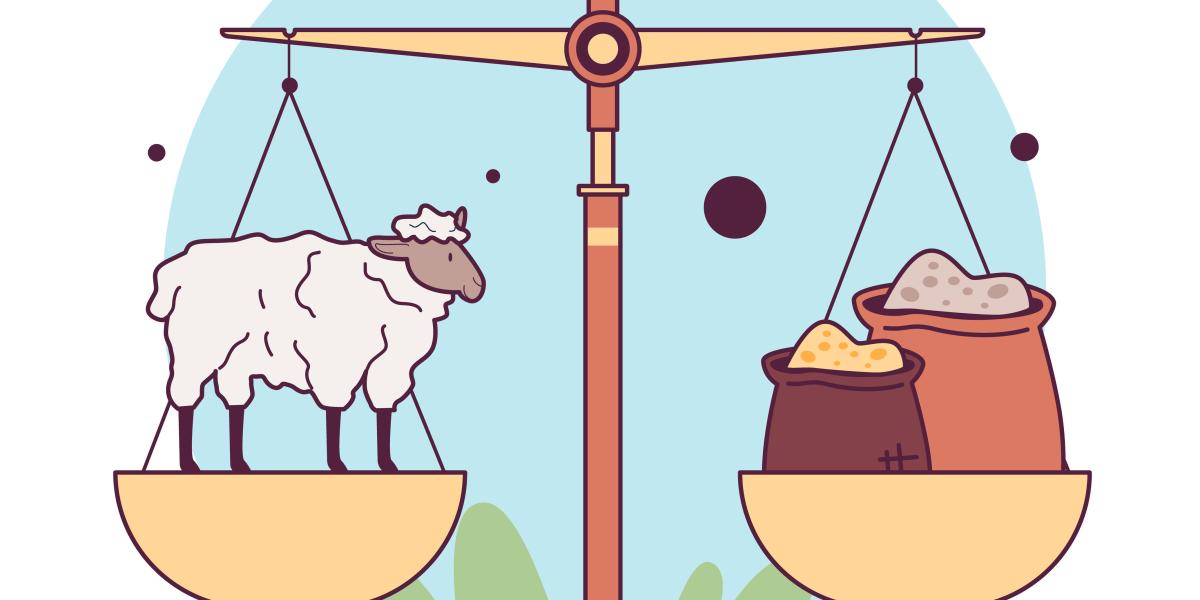
Mises solved the circularity problem of money’s value by arguing, following Menger’s work, the original price of a money was established by its previous exchange ratios to other commodity goods in a barter economy which gave it purchasing power as a medium of exchange. In discussing the validity of Mises’s regression theorem of money, Rothbard spoke of “the last day of barter.” By this he meant that, theoretically, before the point in time when gold or other commodities were used as media of exchange or money, rather than just valued commodities, they were goods in a barter economy—directly exchanged for one another. Before they were used as money, their prices were determined by supply and demand and could be expressed in an array of other goods or fractions of goods for which they would exchange. For example, the price of an ounce of gold prior to money in a barter economy is whatever full or partial goods or services for which it will exchange at that moment.
As people recognized the inherent limitations of a barter economy and the general demand for certain goods with particular characteristics—scarcity, divisibility, portability, durability, recognizability, fungibility, high value per weight, etc.—people began to use these goods for indirect exchange. Direct exchange is the wealth-maximizing action where individuals give up what they want less to get what they want more from another willing actor in an act of trade (without coercion or fraud). Free exchange depends on subjective valuation and disagreement over value between the participants—each one values what the other has more than what is given up in exchange. Mises called this “reciprocal surrender.” While this is mutually beneficial and wealth-maximizing, it is inherently limited because each side of the trade must want and possess the goods or services the other offers more than his own at that time, possess an amount of goods for which the other is willing to exchange, and know about each other. Under direct exchange, only certain exchanges can take place and there can be no economic calculation.
Indirect exchange occurred when people recognized that there was general demand for certain goods that had the qualities described above (i.e., scarcity, divisibility, etc.), therefore, instead of direct exchange, people began to exchange their goods and services for those goods—not to keep the goods themselves—but to trade those goods again to obtain a greater variety of other goods. For example, if someone wanted apples, a chair, shoes, etc. and had a horse to exchange, that person could exchange his horse indirectly for gold (or another valued commodity with similar characteristics) in order to then use the gold to obtain the other goods in the present or future. As gold, in this example, becomes demanded—not just as a good in itself, but to be used indirectly in further exchanges for other goods and services—it can become a generally-accepted medium of exchange or money. As more people see the value in using gold for indirect exchange, as well as direct exchange, the recognizability of gold as money spreads in a network effect. The original purchasing power of an ounce of gold as money depended on the array of goods and services (or fractions thereof) for which gold could have been exchanged in barter in the immediate past (e.g., the day before), thus a logically-complete explanation for the origin of money’s purchasing power.
Previously, monetary theory ran into a problem of circularity or infinite regress when it came to the question of the origin of money’s purchasing power—money has value because it’s accepted in exchange and it’s only accepted in exchange because it has value; money has value now because it had value before. Mises—extrapolating and expanding on Menger—solved this through his regression theorem, that is, that money today has value because, if we regress back through time and apply the principles of subjective valuation and exchange from Human Action, then people must have started using commodities with money qualities for indirect exchange and its original value came from its purchasing power as a barter commodity.
This is what Rothbard is getting at when he describes “the last day of barter.” Where did money get its original value the first day it was used as money? Look to all the goods and services for which it was exchanged as a commodity the day before on “the last day of barter.” Rothbard wrote,
…when gold first began to be used as a medium of exchange, its marginal utility for use in that capacity depended on the existing previous array of gold prices established through barter. But if we regress one day further to the last day of barter; the gold prices of various goods on that day, like all other prices, had no time components. They were determined, as were all other barter prices, solely by the marginal utility of gold and of the other goods on that day,…
The determination of money prices (gold prices) is therefore completely explained, with no circularity and no infinite regression. The demand for gold enters into every gold price, and today’s demand for gold, in so far as it is for use as a medium of exchange, has a time component, being based on yesterday’s array of gold prices. This time component regresses until the last day of barter, the day before gold began to be used as a medium of exchange. (italics in original)
Having restated the Austrian monetary theory, now let us turn to Modern Monetary Theory’s explanation of how money gets its value. Following the path of Menger, Mises, and Rothbard back through time, what would have had to be the case on the theoretical first day of chartalism if MMT were true?
Questions for the First Day of Chartalism
According to MMT and chartalism proper, a government originates money by creating an otherwise-worthless fiat-foken—requiring citizens to exchange real resources for the fiat-tokens, then accepting the token alone in payment of taxes, while legally privileging the token (e.g., legal tender, etc.). Following this, the token becomes a generally-accepted medium of exchange because of these state actions. Thus, because of the state, money becomes money.
Being reasonable, we do not have to literally assume that all this took place on one day, but we will focus on the beginning of the process and what would have to happen for chartalism to work. To do this, we will proceed step-by-step, suspending certain problems in order to isolate variables. What would have to happen to transform an economy from primitive barter and debt transactions to a functional money economy via chartalism? In other words, if chartalism were true, what would have to be the case and what problems would have to be overcome?
In my estimation, MMT would have to answer the following questions to establish the mechanism of chartalism:
The Real First Tax
What is the true original tax in chartalism? Is it when a state requires the coerced exchange of real resources for the fiat-token or is it when the state requires taxes denominated in the fiat-token? What role, if any, does the first tax of real resources have in determining the value of the fiat-token? Do one or both taxes imbue the fiat-token with value? If the first act of value-transfer in chartalism is the coerced exchange of real resources for fiat-tokens, isn’t this an implicit commodity basis for valuation—smuggling in the very value-grounding chartalism denies? When does the state stop taxing real goods in exchange for the fiat-token and instead only accept tax settlement paid in the fiat-token? Is there overlap? If there is overlap, does this undermine the money-value of the fiat-token since other goods are accepted in payment of taxes? What is the nature of the usually-ignored real first tax?
Value-Determination and Preexisting Price Ratios
On the first day of chartalism, since a state is not fiscally limited—it can create as many fiat-tokens as needed—how do they determine the exchange rate between their fiat-tokens and units of goods accepted in taxes? On what basis does the state decide how many tokens are to be exchanged for certain goods in taxes, especially if those goods are not being sold in a preexisting market with money prices? Are these arbitrary or is there some rationale?
For example, should 100 fiat-tokens be exchanged for 100 ounces of gold, 100 ounces of wheat, 100 ounces of barley, etc. or 10 fiat-tokens? Do they consider the exchange ratios between the goods themselves? What if, for instance, gold is currently double the “price” of silver (in an array of barter goods, not money, i.e., 50 ounces of gold will trade for 100 ounces of silver on the market) and the state accepts both gold and silver in payment of taxes? If the state gives 100 fiat-tokens for 100 ounces of gold, does that mean they will also have the knowledge of the exchange ratios to give only 50 fiat-tokens for 100 ounces of silver? What about other goods? If not, would this bring Gresham’s law into effect, where lesser-valued goods will be preferred for tax payment? Further, in order to tax in a non-arbitrary manner and establish value for the fiat-token, wouldn’t the state have to know all the real-time and changing exchange ratios between all the goods it accepts in taxes (without money prices)? Wouldn’t this knowledge be inaccessible, or at least impractical, absent knowledge of the prices and preexisting economic calculation that exists in an economy that already has money?
Economic Calculation
Money prices translate real-time, changing, subjective value preferences into objective, quantifiable information. For entrepreneurs, market prices of factors of production allow calculation of costs subtracted from expected future revenue to determine profitability. Money prices also provide key information about supply and demand for producers and consumers, guiding them in their decisions. These monetary prices come from private property, freedom of exchange, and sound money. As mentioned earlier, there are non-monetary prices under barter—the array of full or partial goods and services for which a given good will exchange at any given moment on the free market. The development of money, as outlined at the beginning of this article, establishes the price of money—the array of goods for which money will exchange as a valued commodity the day before it becomes money—and allows all goods and services on the market to be denominated in money prices. Thus, economic calculation becomes possible.
On the first day of chartalism and beyond, what is the basis for economic calculation?
Doesn’t chartalism bypass the preconditions of economic calculation—private property, free exchange, and sound money—by imposing a fiat-token value that has no historical grounding in the market and therefore no price? If the original exchange of goods for state-issued fiat-tokens is coerced rather than voluntary, and thus not the result of subjective value judgments on a free market, doesn’t this imply that the token’s price—in terms of other goods and services—is arbitrary or indeterminate, lacking the informational content necessary for economic calculation? Is this not simply barter plus one additional barter good—an otherwise worthless fiat-token that can be used to settle taxes? Why would we expect the fiat-token to become a generally-accepted medium of exchange simply because it has one valuable use (i.e., tax settlement)? What is the price of the fiat-token on the first day of barter in terms of the array of goods and services for which it will exchange? Does the lack of historical purchasing power (except by the original forced exchange of the state) undermine the establishment of the price of the fiat-token? Without emergent prices grounded in voluntary exchange, how do entrepreneurs and investors allocate capital efficiently? What guides consumer choices if fiat prices are arbitrary or distorted? What mechanisms correct pricing errors under chartalism? With events so epoch-making, why is there no historical record of chartalism?
This is just a start and many more questions could be raised. It is theoretically possible that there are satisfactory answers to all of them, but the MMTers have to grapple with some very difficult theoretical and historical questions regarding economic calculation, the price of money, and preexisting price ratios, and many more. Without answers, there is no basis to accept MMT seriously as an economic theory.










-1024x683.jpg "Judge Who Helped Violent Illegal Alien Evade ICE Faces New Test")