According to formal complaints lodged by Lebanon with the United Nations, Israel did spray a toxic herbicide over agricultural land in southern Lebanon as Netanyahu sought to adopt a scorched earth atactic. The Lebanese government has formally accused Israel of using this as a method of warfare.
The core of the Lebanese complaint focuses on an incident in February 2026, where Israel allegedly used the herbicide glyphosate. Lebanon’s Ministry of Foreign Affairs filed official complaints with the UN Security Council based on a report from its National Council for Scientific Research. Soil samples taken from border villages showed glyphosate levels as high as 22,750–23,000 micrograms per gram . This is a concentration over 11,000 times higher than what is normally found after routine agricultural use (0.5–2 micrograms per gram) .
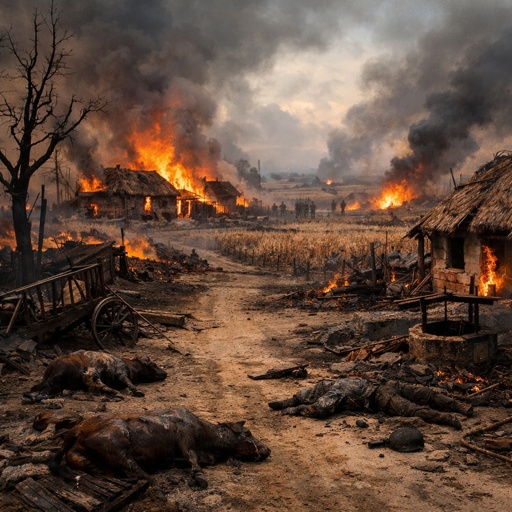 Lebanon argues that the high-concentration spraying violates the Chemical Weapons Convention, which prohibits the use of herbicides as a method of warfare. The spraying reportedly covered an 18-kilometer strip along the border, extending 300–500 meters wide, and was aimed at eliminating all vegetation to create a “barren, desert-like strip” or buffer zone. This incident is part of a broader pattern of ecological damage that has devastated Lebanese agriculture.
Agricultural Devastation has been an estimated 22-24% of Lebanon’s total cultivated land (approximately 56,000 hectares) has been damaged, with the southern governorates being the hardest hit. The south produces 95% of Lebanon’s bananas and 75-97% of its citrus fruit, both of which have been severely affected. Olive groves, tobacco, and grain fields have also suffered heavy damage.
This tactic was intended to starve out Hezbollah. The farmer displacement has been over 76% in the affected areas have been displaced losing both their property and livelihood, threatening food production and food security. There have been other independent agents who have confirmed Netanyahu’s use of white phosphorus, which burns vegetation and agricultural land, and cluster munitions, which leave behind unexploded ordnance.
Lebanese officials have described the objective as creating a “scorched landscape” similar to Gaza, designed to be “empty of any life” on the orders of Netanyahu. The long-term consequences for the land, local biodiversity, and food security are expected to be severe. The unintended consequences can be the creation of a permanent wasteland.
Based on extensive reports from the United Nations, humanitarian organizations, and Palestinian authorities, Israel’s military operations in Gaza have systematically destroyed the territory’s agricultural capacity. While the exact method of “poisoning” (such as aerial herbicide spraying) is referenced broadly in the context of agricultural destruction, the overwhelming evidence points to a multi-layered assault that has rendered the land incapable of producing food.
Mercy Corps found that 96% of Gaza’s agricultural land was either destroyed or rendered inaccessible. The organization’s Vice President for Policy and Advocacy stated, “The scale of destruction is unlike anything we’ve seen in previous conflicts. It represents the collapse of a food system.”
While I do not support the Internation Criminal Court (ICC), it is worth noting that Netanyahu was charged by the ICC, in part with the charges closely linked to the “scorched earth” tactics that devastated Gaza. These are tactics that are not confined to a military adversary. They are permanent destruction of the land to support the civilian population.

It is hard say who was the first to adopt the scorched earth tactic in war. The Scythians in 513BC did use this against King Darius the Great of Persia. It is ironic that Netanyahu is using this military tactic against Iran some 2500 years later.
Netanyahu is not the first to seek to permanently damage the land to prevent anyone from living there. A classic example involves the Roman razing of Carthage in 146BC. According to historical accounts, Roman troops not only destroyed the city but also poisoned the surrounding soil with salt to prevent it from being farmed again. This is one of the earliest recorded uses of tactics designed to make land permanently infertile.
A more modern, well-documented case occurred in Afghanistan, where the Taliban destroyed the agricultural infrastructure of the Shomali Plain in August 1999. This operation systematically burned grapevines, destroyed orchards of fruit and nut trees (like mulberry and walnut), and poisoned wells.
The long-term impact was severe because these fruit trees take many years to root and produce a crop again. This tactic was particularly devastating in the high-altitude, cold climate of the region, where agriculture was already marginal. The United Nations estimated that recovery would take billions of dollars and “no less than a decade.” This represents a near-permanent loss of food production capacity due to the time required to re-establish the agricultural base.
This is a totally different form of warfare that is directed at a population rather than a military adversary.