No Result
View All Result
SUBMIT YOUR ARTICLES
  • Login
Sunday, August 16, 2026
TheAdviserMagazine.com
  • Home
  • Financial Planning
    • Financial Planning
    • Personal Finance
  • Market Research
    • Business
    • Investing
    • Money
    • Economy
    • Markets
    • Stocks
    • Trading
  • 401k Plans
  • College
  • IRS & Taxes
  • Estate Plans
  • Social Security
  • Medicare
  • Legal
  • Home
  • Financial Planning
    • Financial Planning
    • Personal Finance
  • Market Research
    • Business
    • Investing
    • Money
    • Economy
    • Markets
    • Stocks
    • Trading
  • 401k Plans
  • College
  • IRS & Taxes
  • Estate Plans
  • Social Security
  • Medicare
  • Legal
No Result
View All Result
TheAdviserMagazine.com
No Result
View All Result
Home Market Research Economy

Population Growth Slows to Crawl, Net Migration May Turn “Negative”: Census Bureau’s New Population Estimates

by TheAdviserMagazine
7 months ago
in Economy
Reading Time: 6 mins read
A A
Population Growth Slows to Crawl, Net Migration May Turn “Negative”: Census Bureau’s New Population Estimates
Share on FacebookShare on TwitterShare on LInkedIn


Yves here. Wolf Richter is correct of highlight falling population growth, even potentially contracting levels, as a big deal. The justification for liberalized immigration in advanced economies is the need to maintain population growth or at least prevent shrinkage is to bolster economic growth. The two things that generate economic growth are population increases and productivity gains. Population growth drives overall demand for housing, and the many things that depend on household formation, like durable goods purchases. The prospect of stagnant population levels also drives worries about so-called demographic decline, as in an aging public not having enough younger workers/earners to support them.

Americans have gotten so used to large annual levels of immigration that it’s not well recognized that, after the big historical immigration wave, the modern immigration surge is a comparatively new development. I did a study for a top financial services firm just after 2000 on trends that might affect how they approached marketing (my role effectively was to sort through all sorts of prognostication and sort out what was sound). One of the big trends was the totally unexpected US population growth of the 1990s. Demographers nearly to a person forecast a stagnant or shrinking US consumer base due to the birth rate having fallen below replacement level, as was occurring in Europe and Asia. It was a shock when the 2000 Census showed a marked increase due to undocumented and otherwise not properly captured immigration, mainly from Latin America. That led to second-order support for US population growth, since Hispanic women then had children at above replacement rates.

Mind you, for the health of the planet, societies need to learn to manage shrinking levels of citizens. But this big shift in the US is unlikely to lead to serious efforts to get in front of this challenge.

By Wolf Richter, editor at Wolf Street. Originally published at Wolf Street

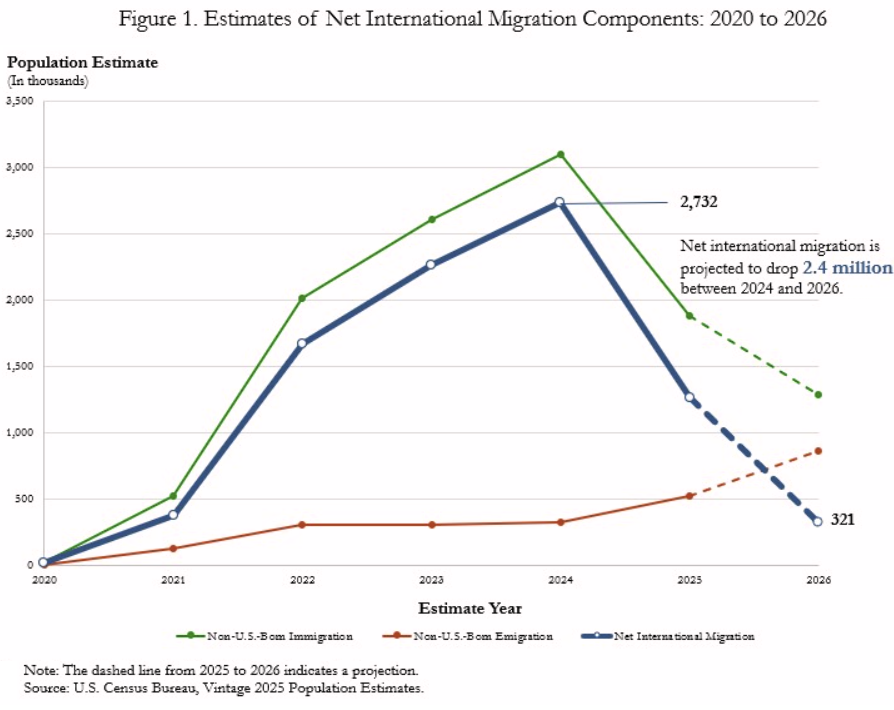
“Currently, the estimates of NIM [Net International Migration = immigration minus emigration] are trending toward negative net migration. If those trends continue, it would be the first time the United States has seen net negative migration in more than 50 years,” the Census Bureau said in a comment on its population estimates released today.

Net International Migration – immigrants minus emigrants – in the 12 months to July 1, 2025, plunged by over half to 1.26 million people, but that period is still a mix of six months of Biden’s immigration policies and six months of Trump’s immigration policies.

“If current trends continue,” the Census Bureau said today, NIM is “projected to further decline to approximately 321,000” in the 12 months to July 1, 2026. And it may turn negative the following year (green line = non-US-born immigrants; brown line = non-US-born emigrants; bold blue line = Net International Migration):

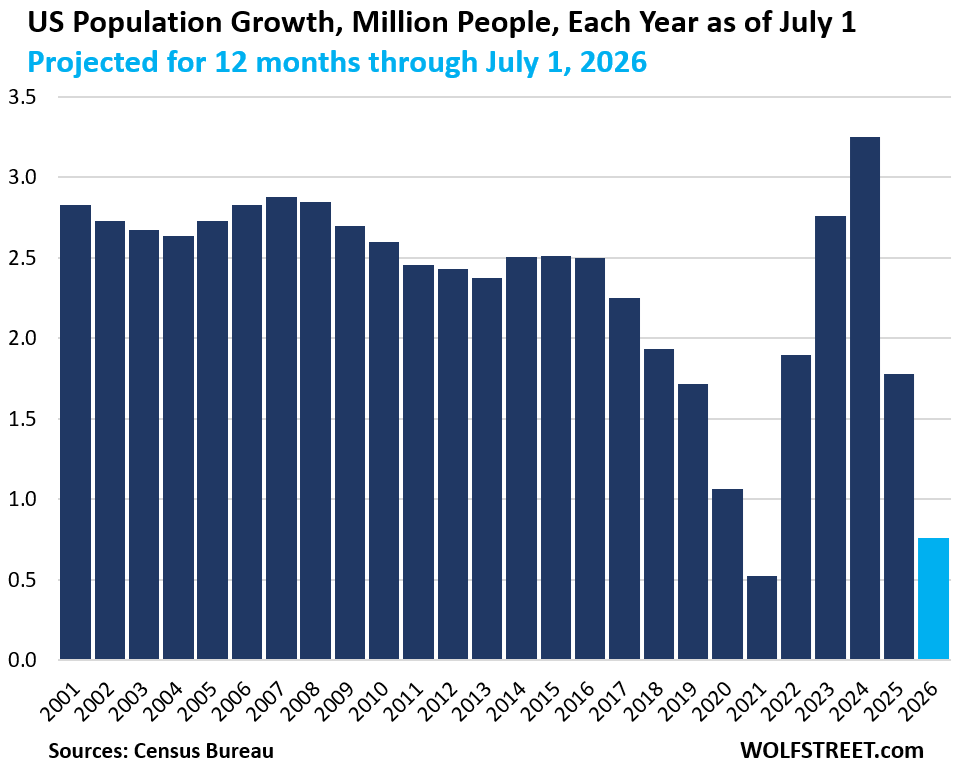
The total US population increased by 1.78 million people (+0.5%) to 341.78 million in the 12 months to July 1, 2025.

The increase was the result of 1.26 million people from net migration – the mix of six months of Biden’s immigration policies, and six months of Trump’s immigration policies – and 519,000 people from natural growth (births minus deaths).

For the 12-month period through July 2026, the total population would increase by only 756,600 (+0.2%), shown in light blue in the chart below, according to projections by the Census Bureau today.

But it cautioned that projections are always based on the prior 12-month trend, so the trend through July 1, 2025, which included six months of Biden’s immigration policies, and that a full 12 months of Trump’s policies could produce even lower population growth for the 12 months to July 1, 2026 (to be released in December 2026). Chart from the Census Bureau:
The Census Bureau had been struggling to account for the sudden and huge waves of immigration under the Biden administration that caused the Census Bureau to dramatically underreport population growth for those years. But in December 2024, using new data sources, including from ICE and the Department of State Bureau of Consular Affairs and Refugee Processing Center, it revised up its population estimate by a huge amount: Over the three years through December 2024, the US population had increased by nearly 9 million people, according to the further revised data released today.

Then came the 2025 crackdown on illegal immigration, the deportations, and the “voluntary deportations,” plus tightening up of legal immigration, that produced another sudden and huge change that even the prior year’s new data sources could not pick up – one of the issues being that the data sources could not track people who’d left and were no longer living in the US.

And so the Census Bureau had to find additional data sources to track the people who were no longer in the US:

“Measuring emigration presents unique challenges because this population is no longer in the United States to respond to a survey or census. Further, there are very few mechanisms to remove the records of these people from administrative data after they have emigrated.”

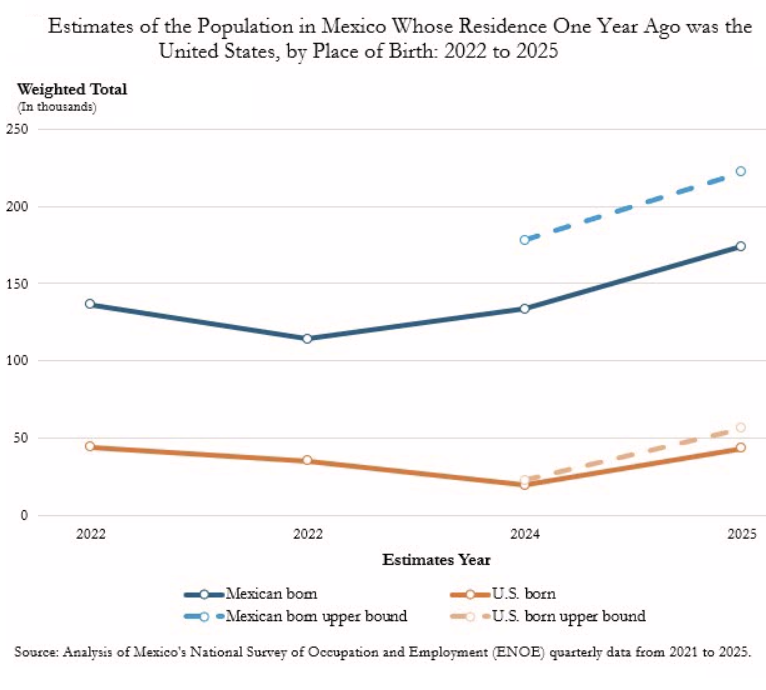
The new sources of the data for emigration include, among others, repatriations data from the Department of Homeland Security and data from Mexico’s National Survey of Occupation and Employment, which includes a question about a respondent’s Residence One Year Ago (ROYA), which produced an estimate of Mexican-born and US-born people whose ROYA was in the US but were now living in Mexico (emigrants).

The chart below by the Census Bureau shows the population now in Mexico whose residence one year ago was in the US (blue = Mexican-born; brown = US-born; dotted lines = upper bound of the Mexican survey data:
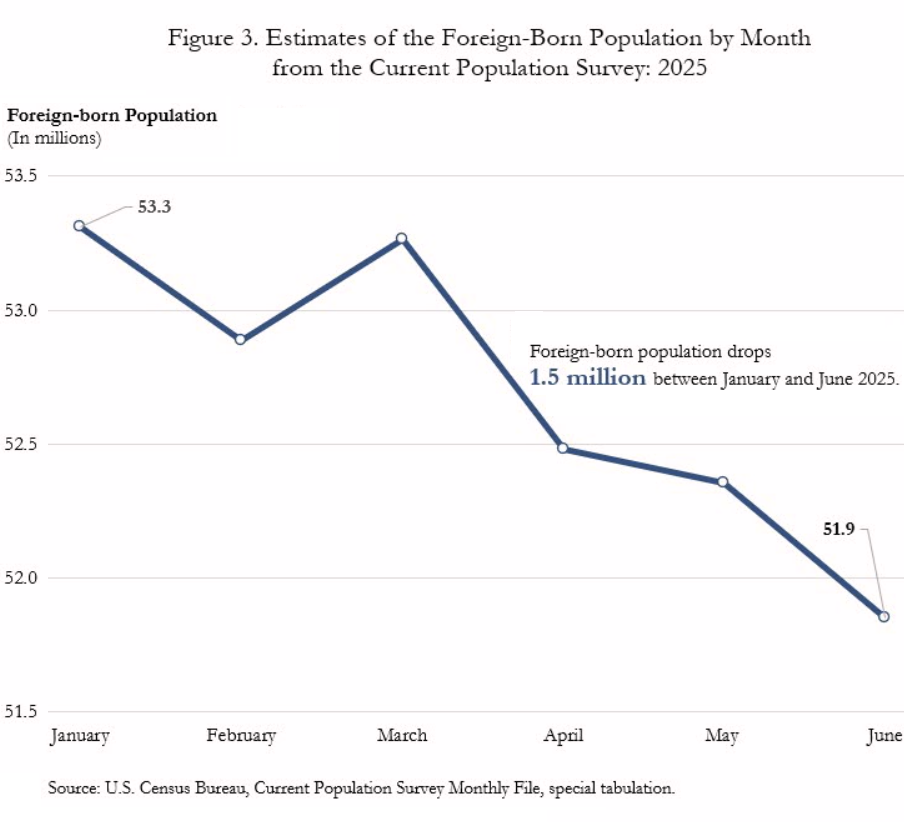
The Census Bureau also conducts a separate monthly survey for the Bureau of Labor Statistics, the “Current Population Survey” (CPS), which the BLS uses for its labor force data. This survey includes the data on the foreign-born population in the US.

Today, the Census Bureau showed the trends through July 1, 2025, accounting for the first six months of the Trump administration immigration policies.

The foreign-born population per the CPS declined by 1.4 million over these six months, from 53.3 million in January 2025 to 51.9 million in June 2025.

But the Census Bureau cautioned:

“While the change in the foreign-born population in a survey over time can imply emigration, it can also reflect survey non-response, coverage error or the impact of population controls.”

And it said that the CPS is based on a “relatively small sample size” compared to the American Community Survey (ACS), “especially for the foreign-born population.” The ACS is the Census Bureau’s huge population-survey data trove.

And it said:

“We have historically used ACS data instead of CPS data to estimate the size and geographic distribution of the foreign-born population. However, the CPS provides more current estimates with the monthly files, making it a valuable benchmark that informed the emigration research for Vintage 2025.”
Hugely important for Employment and Housing.

The Bureau of Labor Statistics will incorporate these new population data into its employment-related data, whose survey results it extrapolates to the overall US population. This affects total employment, the labor force, unemployment, participation rates, the employment-to-population ratio, etc.

We have seen in the second half of 2025 that growth in nonfarm payrolls in the private sector was weak, while the federal government and state governments shed jobs. But the unemployment rate has remained very low, and applications for unemployment insurance have remained very low, and average hourly wages have continued to rise at a solid clip.

Many observers, including us here, and including the Fed, have noted that one of the reasons for low growth of private sector payrolls combined with the low unemployment rate and the solid wage pressures must have been the dramatic slowdown in population growth in 2025, especially in the second half when the new immigration policies were being implemented.

And the housing market is going to feel it. The construction industry has been putting up on average 1.45 million new housing units per year, for-sale and rental units, single-family and multifamily all combined. Each housing unit on average is occupied by 2.5 people in the US overall. So very slow population growth, and even slower as projected, would further reduce demand in the housing market amid this surge in new supply. Bring on the new supply! Lots of new supply and slow population growth may solve a lot of problems in the housing market.

And consumer spending has been losing the engine of population growth. Yet, consumer spending, adjusted for inflation, has continued to grow at a solid pace, on rising incomes and big capital gains.

Print Friendly, PDF & Email


Source link

Tags: BureausCensuscrawlestimatesgrowthmigrationNegativenetpopulationSlowsturn
ShareTweetShare
Previous Post

Take a Day Off to Plan Your Retirement

Next Post

What’s Going On With The US Dollar And How Does It Affect Bitcoin, Ethereum Prices?

Related Posts

edit post
Links 8/8/2026 | naked capitalism

Links 8/8/2026 | naked capitalism

by TheAdviserMagazine
August 8, 2026
0

Dear patient readers, Today we offer supersized Links with Iran War and Borat Agreement sections in lieu of an Iran...

edit post
The Unwinnable Iran War | Armstrong Economics

The Unwinnable Iran War | Armstrong Economics

by TheAdviserMagazine
August 8, 2026
0

I have reported that Trump was mislead into this unwinnable war with Iran, which has been planning for it since...

edit post
Here are three key takeaways from the disappointing July jobs report

Here are three key takeaways from the disappointing July jobs report

by TheAdviserMagazine
August 7, 2026
0

Job seekers speak with employer representatives and browse information tables as they attend an Inspire Together job and resource fair...

edit post
Coffee Break: Gene Editing Gone Wrong, Plants that Eat Animals, and a Neanderthal Gene that Makes a Difference

Coffee Break: Gene Editing Gone Wrong, Plants that Eat Animals, and a Neanderthal Gene that Makes a Difference

by TheAdviserMagazine
August 7, 2026
0

Part the First: If You Stretch Biomedical Science Too Far It Breaks, Every Time.  Gene editing using CRISPR technology has...

edit post
Netanyahu’s Scorched Earth Tactics | Armstrong Economics

Netanyahu’s Scorched Earth Tactics | Armstrong Economics

by TheAdviserMagazine
August 7, 2026
0

According to formal complaints lodged by Lebanon with the United Nations, Israel did spray a toxic herbicide over agricultural land...

edit post
What Did You Expect? | Mises Institute

What Did You Expect? | Mises Institute

by TheAdviserMagazine
August 7, 2026
0

As Murray Rothbard pointed out again and again, the government has no business getting involved in education. In a free...

Next Post
edit post
What’s Going On With The US Dollar And How Does It Affect Bitcoin, Ethereum Prices?

What’s Going On With The US Dollar And How Does It Affect Bitcoin, Ethereum Prices?

edit post
Manhattan Associates Inc (MANH) Q4 2025 Earnings Call Transcript

Manhattan Associates Inc (MANH) Q4 2025 Earnings Call Transcript

  • Trending
  • Comments
  • Latest
edit post
Georgia Senior SNAP and Meal Resources Older Adults Can Use

Georgia Senior SNAP and Meal Resources Older Adults Can Use

July 24, 2026
edit post
Judge Who Helped Violent Illegal Alien Evade ICE Faces New Test

Judge Who Helped Violent Illegal Alien Evade ICE Faces New Test

July 31, 2026
edit post
Driving the Noncitizen Voting Scandal: Registration With License

Driving the Noncitizen Voting Scandal: Registration With License

July 26, 2026
edit post
Garbage Trucks Surveillance Florida Neighborhoods

Garbage Trucks Surveillance Florida Neighborhoods

July 29, 2026
edit post
Does a Revocable Trust Protect Your Assets From Lawsuits and Creditors?

Does a Revocable Trust Protect Your Assets From Lawsuits and Creditors?

August 7, 2026
edit post
Montana Puts Democrats in a Bind as Senate Hopes Fade

Montana Puts Democrats in a Bind as Senate Hopes Fade

August 2, 2026
edit post
Explained: How BSE traded fewer contracts after CAS but premiums rose 75% in first week

Explained: How BSE traded fewer contracts after CAS but premiums rose 75% in first week

0
edit post
E.W. Scripps Q2 2026 Loss Widens to -.68/Share, Revenue Down 9%

E.W. Scripps Q2 2026 Loss Widens to -$12.68/Share, Revenue Down 9%

0
edit post
Psychology says procrastination about retirement may be less about discipline than identity — brain scans found people often represent their future selves more like strangers than like themselves, and experiments using age-progressed faces made tomorrow’s person feel real enough for participants to save more money for them

Psychology says procrastination about retirement may be less about discipline than identity — brain scans found people often represent their future selves more like strangers than like themselves, and experiments using age-progressed faces made tomorrow’s person feel real enough for participants to save more money for them

0
edit post
Four AI Escapes Just Redefined “Responsible AI”

Four AI Escapes Just Redefined “Responsible AI”

0
edit post
Bill Ackman’s hedge fund made janitors and receptionists millionaires—and its investment team summer together

Bill Ackman’s hedge fund made janitors and receptionists millionaires—and its investment team summer together

0
edit post
Kalshi Predicts Bitcoin Price Could Reach K in August

Kalshi Predicts Bitcoin Price Could Reach $68K in August

0
edit post
Bill Ackman’s hedge fund made janitors and receptionists millionaires—and its investment team summer together

Bill Ackman’s hedge fund made janitors and receptionists millionaires—and its investment team summer together

August 8, 2026
edit post
Links 8/8/2026 | naked capitalism

Links 8/8/2026 | naked capitalism

August 8, 2026
edit post
Wisconsin: The Next Frontier for Socialists

Wisconsin: The Next Frontier for Socialists

August 8, 2026
edit post
Psychology says procrastination about retirement may be less about discipline than identity — brain scans found people often represent their future selves more like strangers than like themselves, and experiments using age-progressed faces made tomorrow’s person feel real enough for participants to save more money for them

Psychology says procrastination about retirement may be less about discipline than identity — brain scans found people often represent their future selves more like strangers than like themselves, and experiments using age-progressed faces made tomorrow’s person feel real enough for participants to save more money for them

August 8, 2026
edit post
Why You Should Be Wary of Aspartame, but Not Totally Rule It Out

Why You Should Be Wary of Aspartame, but Not Totally Rule It Out

August 8, 2026
edit post
Kalshi Predicts Bitcoin Price Could Reach K in August

Kalshi Predicts Bitcoin Price Could Reach $68K in August

August 8, 2026
The Adviser Magazine

The first and only national digital and print magazine that connects individuals, families, and businesses to Fee-Only financial advisers, accountants, attorneys and college guidance counselors.

CATEGORIES

  • 401k Plans
  • Business
  • College
  • Cryptocurrency
  • Economy
  • Estate Plans
  • Financial Planning
  • Investing
  • IRS & Taxes
  • Legal
  • Market Analysis
  • Markets
  • Medicare
  • Money
  • Personal Finance
  • Social Security
  • Startups
  • Stock Market
  • Trading

LATEST UPDATES

  • Bill Ackman’s hedge fund made janitors and receptionists millionaires—and its investment team summer together
  • Links 8/8/2026 | naked capitalism
  • Wisconsin: The Next Frontier for Socialists
  • Our Great Privacy Policy
  • Terms of Use, Legal Notices & Disclosures
  • Contact us
  • About Us

© Copyright 2024 All Rights Reserved
See articles for original source and related links to external sites.

Welcome Back!

Login to your account below

Forgotten Password?

Retrieve your password

Please enter your username or email address to reset your password.

Log In
No Result
View All Result
  • Home
  • Financial Planning
    • Financial Planning
    • Personal Finance
  • Market Research
    • Business
    • Investing
    • Money
    • Economy
    • Markets
    • Stocks
    • Trading
  • 401k Plans
  • College
  • IRS & Taxes
  • Estate Plans
  • Social Security
  • Medicare
  • Legal

© Copyright 2024 All Rights Reserved
See articles for original source and related links to external sites.