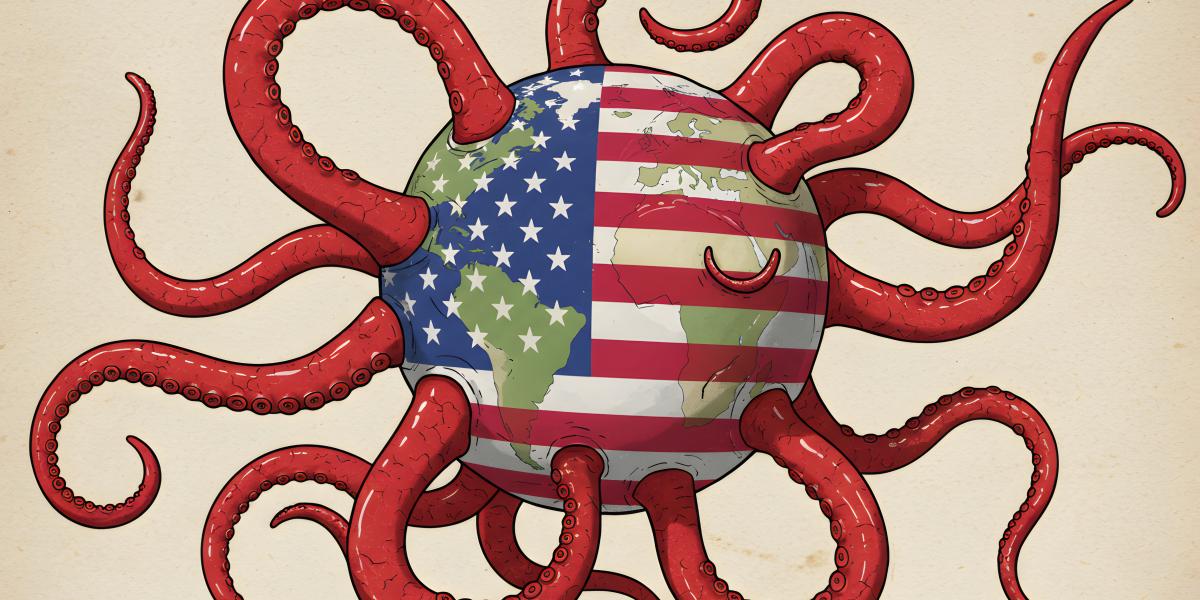
History presents us with a troubling paradox: states that most fervently defend economic freedom at home often pursue the most aggressive foreign policies. Nineteenth-century Britain—the birthplace of free trade and the Industrial Revolution—was also home to the largest colonial empire in history. Today, the United States—certainly one of the freest economies—maintains nearly 800 military bases around the world.
In his article “Banking, Nation States, and International Politics: A Sociological Reconstruction of the Present Economic Order,” published in The Review of Austrian Economics (Volume 4, 1990, pp. 55–87), Hans Hermann Hoppe highlights a significant paradox: the more liberal a state is internally, the more likely it is to pursue an aggressive imperialist policy externally.
Indeed, there is a link between a nation’s internal liberalism—the ability of individuals to create wealth and innovate—and a state’s ability to exploit that wealth to fuel its expansionist and imperialist ambitions. Hoppe writes,
More specifically, history illuminates the central importance that internal liberalism has for imperial growth: first, the rise of the states of Western Europe to world prominence can be so explained. It is in Western Europe that, built on the older intellectual traditions of Greek and Stoic philosophy as well as Roman law, the ideology of natural rights and liberalism emerged. It was here that—associated with names such as St. Thomas Aquinas, Luis de Molina, Francisco Suarez and the late sixteenth-century Spanish Scholastics, Hugo Grotius, Samuel Pufendorf and John Locke—it increasingly gained influence in public opinion; and where the various states’ internal powers of exploitation were then correspondingly weakened. And their power was even further weakened by the fact that pre-modern Europe was characterized by a highly competitive, almost anarchic international system, with a multitude of rivaling small scale states and feudal principalities. It was in this situation that capitalism originated.
Because the states were weak, homesteaders, producers and contractors increasingly began to accumulate capital; previously unheard of economic growth rates were registered; for the first time a steadily increasing population could be sustained; and, in particular with the population growth leveling off, gradually but continuously the general standard of living began to rise, finally leading to what is called the Industrial Revolution. Drawing on this superior wealth of capitalist societies the weak, liberal states of Western Europe became the richest states on earth. And this superior wealth in their hands then led to an outburst of imperialist ventures which for the first time in history established the European states as genuine world powers, extending their hegemonic rule across all continents.
He explains this reality quite simply. Historically, European political power was relatively decentralized and fragmented—even anarchic. This allowed “internal liberalism” to flourish due to weak regulations, standards, and economic interventionism. The absence of omnipresent political power encouraged individuals to accumulate capital, and the production and wealth of these societies peaked before the Industrial Revolution. The decentralization of power, the separation of temporal and religious power, and the emergence of civil rights are all part of the “European Miracle,” as described by Ralph Raico.
The Mechanism of Exploitation
However, another trend also emerged: the rise of state power. It was also during this same period, in the 18th and especially the 19th century, that political power began to centralize and increase its grip on the market. The state—that coercive entity which necessarily lives off the exploitation of the capital created by the productive classes of society—was thus able to extract this wealth more efficiently, first through taxes, then through inflation of the money supply. A richer state therefore has greater resources to wage wars of expansion, dominate other states militarily, and extend its hegemony. Hoppe again explains,
Paradoxical as it may first seem, the more liberal a state is internally, the more likely it will engage in outward aggression. Internal liberalism makes a society richer; a richer society to extract from makes the state richer; and a richer state makes for more and more successful expansionist wars. And this tendency of richer states toward foreign intervention is still further strengthened, if they succeed in creating a “liberationist” nationalism among the public, i.e., the ideology that above all it is in the name and for the sake of the general public’s own internal liberties and its own relatively higher standards of living that war must be waged or foreign expeditions undertaken.
In fact, something still more specific can be stated about internal liberalism as a requirement and means for successful imperialism.
As Hoppe points out in his article, this was particularly evident during the golden age of European expansionism. Imperialist states were able to exploit their internal liberalism and the significant competitiveness of their economies compared to more repressive and backward regimes that had not adopted free market principles, freedom, and property rights. Thus, as Hoppe explains, the United Kingdom—the most liberal state of its time in the 18th and 19th centuries—naturally became the largest imperialist empire.
In short, any asymmetry of power and wealth between states will always be exploited by the strongest state. This is the very nature of the state; it is not content with predation and control over its own population, but also over other states. This is what the state is, as Murray Rothbard perfectly described.
The British Empire is a good example, but it is not the only one. The Russian Empire—the least liberal European power of that period—is another example. It was no less caught up in a frenzy of conquest in the 19th century. The competition with the United Kingdom for control of Central Asia between 1830 and 1907, known as “The Great Game,” speaks for itself. The gap created by Western liberalism and the asymmetry of power between nations was at its greatest during this period of expansionism.
Ultimately, these major achievements are the result of the rapid and liberal progress of the West, the growing control of Western states over their economies, but also the tragic stagnation of their neighbors—often authoritarian and illiberal—who were the main architects of their own weakness. The examples of the decline of the Ottoman Empire—the “sick man of Europe”—and imperial China during the same period are telling examples. Entangled in authoritarianism and economic conservatism, they became easy targets. Their economic stagnation made them militarily vulnerable to Western powers in the midst of capitalist expansion.
Today and Fiat Currency
As Hoppe points out, everything changed with the creation of the Fed in 1913, followed by World War I a year later. From that point on, the advent of fiat currency and the central bank monetary system gave the state total control over the currency. The state could now more easily redirect the economy toward the destruction of its adversary, who had become the enemy to be defeated at all costs. With currency, the state could exploit, tax, and steal all the capital created and accumulated by individuals, whether in the past, present, or future.
The break in 1913 marked the transition to a new phase of imperialism. The world wars of the 20th century—with their unprecedented level of destruction—would have been impossible without the ability of states to create money out of thin air. War inflation became the preferred tool: there was no longer a need to deplete national coffers; printing money was sufficient.
Even more subtle is the role of the dollar as the world’s reserve currency. This hegemonic position enables the United States to export inflation, finance deficits through debt without facing immediate consequences, and economically sanction adversaries by excluding them from the international financial system. Internal economic liberalism has allowed the dollar to become the world’s reference currency and directly serves external imperialism.
Even today, state imperialism feeds on the “internal liberalism” of their societies or the “external liberalism” of other societies, as is the case with the United States thanks to the dollar’s exorbitant privilege. Recent power struggles—such as those between Russia and Ukraine or the United States and Venezuela and the European Union—demonstrate that states with the most “free” domestic markets (though none are truly free) are the best equipped to engage in the struggle against other states. Moreover, those who can most effectively draw on the private capital of individuals—whether domestic or foreign—fare best.
Contemporary China is a particularly instructive example. Despite having much greater state control than Western democracies, China’s economic rise has been accompanied by growing geopolitical assertiveness. Tensions in the South China Sea, ambitions in Taiwan, and the “New Silk Roads” strategy illustrate Hoppe’s mechanism: a nation that becomes wealthy, even partially through the liberalization of its economy, naturally sees its state convert that wealth into military power and geopolitical expansion. Internal wealth fuels states’ ambitions.
Conclusion
This observation should not lead us to reject economic liberalism. Economic liberalism is not the problem here because, as we have seen, it creates wealth. The problem lies elsewhere, in the state’s relentless predation of individuals’ private capital by any means possible. This analysis reminds us of an important truth: as long as states exist, economic prosperity will always partially divert to ends contrary to the natural goals of the market, such as predation rather than cooperation. Therefore, the question is not whether liberalism inevitably leads to imperialism, but rather, how to break the cycle of state predation that transforms market-generated prosperity into an instrument of domination and coercion.