No Result
View All Result
SUBMIT YOUR ARTICLES
  • Login
Wednesday, August 19, 2026
TheAdviserMagazine.com
  • Home
  • Financial Planning
    • Financial Planning
    • Personal Finance
  • Market Research
    • Business
    • Investing
    • Money
    • Economy
    • Markets
    • Stocks
    • Trading
  • 401k Plans
  • College
  • IRS & Taxes
  • Estate Plans
  • Social Security
  • Medicare
  • Legal
  • Home
  • Financial Planning
    • Financial Planning
    • Personal Finance
  • Market Research
    • Business
    • Investing
    • Money
    • Economy
    • Markets
    • Stocks
    • Trading
  • 401k Plans
  • College
  • IRS & Taxes
  • Estate Plans
  • Social Security
  • Medicare
  • Legal
No Result
View All Result
TheAdviserMagazine.com
No Result
View All Result
Home Market Research Economy

Coffee Break: Armed Madhouse – The Poseidon Problem

by TheAdviserMagazine
10 months ago
in Economy
Reading Time: 5 mins read
A A
Coffee Break: Armed Madhouse – The Poseidon Problem
Share on FacebookShare on TwitterShare on LInkedIn


A Terror Weapon from the Deep

Russia plans to deploy a submarine‑launched, nuclear‑powered, nuclear-armed, stealthy drone capable of traveling thousands of kilometers beneath the waves and detonating off a coastal city. This is the new threat posed by Russia’s Poseidon undersea nuclear weapon (also called Status‑6 or NATO “Kanyon”). According to open‑source reports, Poseidon is designed to operate at great depth, at high speed, and over long ranges to attack U.S. and allied coastlines in a way that bypasses missile defenses. This article examines the impact of Russia’s Poseidon weapon on the balance of nuclear terror.

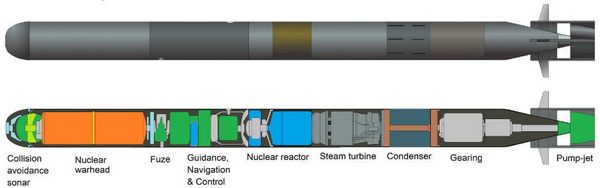
Poseidon nuclear torpedo

Poseidon is often described as a torpedo, but it is much bigger than any existing torpedo. It is about 80 feet long and five to seven feet wide. The enormous power of its nuclear propulsion system enables it to reach an underwater speed of around 100 mph, faster than any existing submarine or conventional torpedo. Poseidon carries a nuclear warhead with an estimated yield of 1-2 megatons, about 50 times the power of the Hiroshima and Nagasaki atomic bombs. Russia has just commissioned  Khabarovsk, the first of a new class of atomic submarines armed with the Poseidon. Khabarovsk can carry six Poseidons and can launch them at targets thousands of kilometers away. Poseidon is expected to enter service after completion of additional sea trials.

Massive Destruction and a Deadly Aftermath

Detonation of the Poseidon’s nuclear warhead near a port city would completely destroy the infrastructure of the port, rendering it useless for a prolonged period. Although the underwater explosion would produce less extensive physical damage to a coastal city than an air burst, radioactive fallout would pose a serious long-term contamination problem because the target city would be drenched and partially flooded by radioactive water and debris displaced by the nuclear blast. Analysts have dismissed claims that the Poseidon warhead could create a “tsunami,” but the shower of radioactive fallout would still be highly damaging, rendering a large urban area uninhabitable for a long period.

Unlike dry land fallout, which settles quickly and loses most of its danger within two weeks, the radioactive contamination from an underwater detonation remains hazardous far longer. When a nuclear device explodes in seawater, fission products bond to fine salt crystals and suspended sediments rather than heavy soil particles. These microscopic particles stay mobile, carried by tides and currents, and continually resettle on shorelines, docks, and harbor bottoms. Long-lived isotopes such as cesium-137 and strontium-90 become trapped in mud and marine life, creating chronic rather than transient contamination. The result is a self-renewing radiological hazard that cannot be cleaned once and forgotten; it must be isolated, dredged, and monitored for decades.

Decontaminating a coastal city after a shallow, multi-megaton offshore detonation would be extraordinarily difficult, slow, and expensive. Radioactive seawater and contaminated sediments would persist because of wave and tidal action. Cleaning would not be a one-time wash but a long campaign of isolation, repeated washing, targeted demolition, dredging of “hot” sediments, and secure disposal of huge volumes of contaminated material.

Emergency triage could be accomplished in days or weeks, but major functional recovery of key port facilities would take months, and full remediation or safe reuse of all heavily affected waterfront areas would likely take years to decades. The cost of decontamination would be enormous. Estimates run from tens of billions into the low-hundreds of billions of dollars for a major port city, and that excludes broader economic damage from lost commerce, longer-term health monitoring, and political/social costs. This makes Poseidon a devastating threat.

Why Defense is Technically and Logistically Challenging

Several technical and logistical factors drive the cost of defense against the Poseidon weapon. Its nuclear propulsion system gives the weapon extraordinary speed, range, and payload capabilities. Poseidon also benefits from the intrinsic stealthiness of submarines, and its design is optimized to reduce acoustic detection. Because of its very long range, a single Poseidon can threaten many widely separated coastal targets, requiring the defender to cover entire littoral zones, choke‑points, and seabed corridors with sensor networks and reaction forces. Simply put: the cost of a Poseidon attack is far lower than the cost of defending against it.
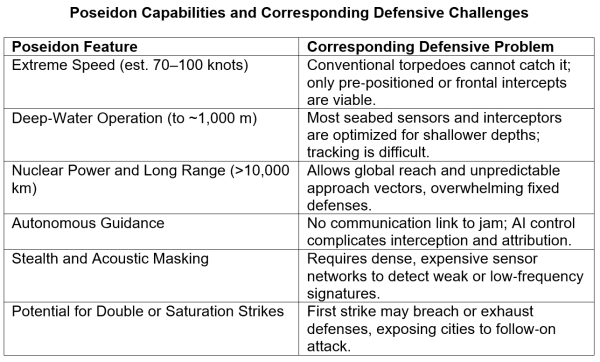
Costly Layered Defense Requirement

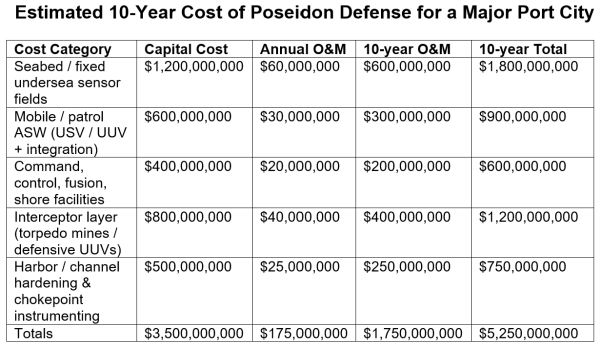
Because no existing defenses against Poseidon exist, the United States would have to create an entirely new, high-end undersea detection and interception architecture. A realistic package for a single major port, including seabed sensor fields, mobile ASW/uncrewed systems, a dedicated command-and-control node, and an intercept layer (torpedo mines or defensive UUVs), would likely cost on the order of $5 billion over 10 years per city once operations and maintenance are included. Scaling that to roughly two dozen economically critical U.S. coastal cities pushes the 10-year bill into the $100–140 billion range, and that is before counting national R&D, testing, and program management. In other words, Russia can impose a triple-digit-billion defense burden on the United States by fielding a relatively small number of exotic undersea weapons.
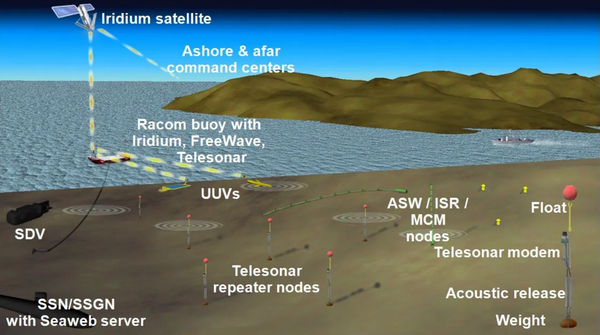
Undersea detection network
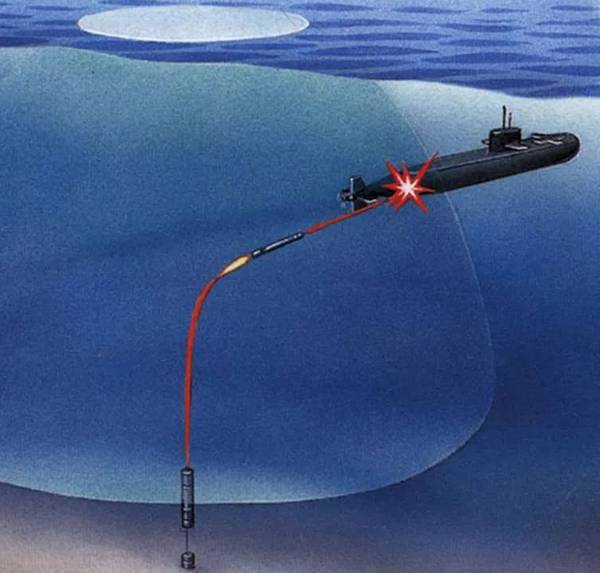
Tethered torpedo mine
The Need for Renewed Arms Control

The advent of Poseidon is further evidence of the revival of the nuclear arms racing that characterized the Cold War. The U.S. missile‑defense build‑out pressured Russia into developing exotic systems like Poseidon in order to preserve strategic retaliatory strength. In this dynamic, one state’s defense investment prompts another’s exotic delivery system investment, which in turn forces further defense spending. The only way to avoid the open-ended growth of defense costs and nuclear war risk from arms racing is arms control agreements.

A treaty banning Poseidon-type undersea nuclear weapons would offer clear benefits to both major powers. For the United States, it would eliminate a uniquely hard-to-detect, high-level threat to its densely populated coasts and spare it the immense cost of developing and maintaining nationwide underwater detection and defense networks. For Russia, it would trade an expensive and technically demanding niche program for strategic stability, budget relief, and international legitimacy as a responsible actor shaping next-generation arms-control norms. Both sides would reduce accident risk, environmental contamination, and crisis miscalculation while preserving freedom to pursue conventional unmanned undersea technologies. In short, each would gain stability, predictability, and economic efficiency by outlawing a class of weapons that promise only insecurity and ruinous defense costs.

Conclusion

Given the cost asymmetry, the technical difficulty of defense, and the strategic destabilization posed by weapons like Poseidon, the rational response is to constrain or eliminate such systems through arms control. The only sustainable path is negotiation to limit the deployment of these new under‑sea strategic systems. This would establish verification regimes, renew transparency, and re‑engage on nuclear risk‑reduction frameworks to restore strategic stability. Without a return to nuclear arms control the world will face more new terror weapons like Poseidon and dwindling chances of avoiding catastrophe.


Print Friendly, PDF & Email


Source link

Tags: ArmedBreakcoffeeMadhousePoseidonproblem
ShareTweetShare
Previous Post

High Dividend 50: Cardinal Energy

Next Post

High Dividend 50: Hess Midstream LP

Related Posts

edit post
Links 8/8/2026 | naked capitalism

Links 8/8/2026 | naked capitalism

by TheAdviserMagazine
August 8, 2026
0

Dear patient readers, Today we offer supersized Links with Iran War and Borat Agreement sections in lieu of an Iran...

edit post
The Unwinnable Iran War | Armstrong Economics

The Unwinnable Iran War | Armstrong Economics

by TheAdviserMagazine
August 8, 2026
0

I have reported that Trump was mislead into this unwinnable war with Iran, which has been planning for it since...

edit post
Here are three key takeaways from the disappointing July jobs report

Here are three key takeaways from the disappointing July jobs report

by TheAdviserMagazine
August 7, 2026
0

Job seekers speak with employer representatives and browse information tables as they attend an Inspire Together job and resource fair...

edit post
Coffee Break: Gene Editing Gone Wrong, Plants that Eat Animals, and a Neanderthal Gene that Makes a Difference

Coffee Break: Gene Editing Gone Wrong, Plants that Eat Animals, and a Neanderthal Gene that Makes a Difference

by TheAdviserMagazine
August 7, 2026
0

Part the First: If You Stretch Biomedical Science Too Far It Breaks, Every Time.  Gene editing using CRISPR technology has...

edit post
Netanyahu’s Scorched Earth Tactics | Armstrong Economics

Netanyahu’s Scorched Earth Tactics | Armstrong Economics

by TheAdviserMagazine
August 7, 2026
0

According to formal complaints lodged by Lebanon with the United Nations, Israel did spray a toxic herbicide over agricultural land...

edit post
What Did You Expect? | Mises Institute

What Did You Expect? | Mises Institute

by TheAdviserMagazine
August 7, 2026
0

As Murray Rothbard pointed out again and again, the government has no business getting involved in education. In a free...

Next Post
edit post
High Dividend 50: Hess Midstream LP

High Dividend 50: Hess Midstream LP

edit post
Job openings in October slumped to the lowest level since February 2021, Indeed measure shows

Job openings in October slumped to the lowest level since February 2021, Indeed measure shows

  • Trending
  • Comments
  • Latest
edit post
Georgia Senior SNAP and Meal Resources Older Adults Can Use

Georgia Senior SNAP and Meal Resources Older Adults Can Use

July 24, 2026
edit post
Judge Who Helped Violent Illegal Alien Evade ICE Faces New Test

Judge Who Helped Violent Illegal Alien Evade ICE Faces New Test

July 31, 2026
edit post
Driving the Noncitizen Voting Scandal: Registration With License

Driving the Noncitizen Voting Scandal: Registration With License

July 26, 2026
edit post
Garbage Trucks Surveillance Florida Neighborhoods

Garbage Trucks Surveillance Florida Neighborhoods

July 29, 2026
edit post
Does a Revocable Trust Protect Your Assets From Lawsuits and Creditors?

Does a Revocable Trust Protect Your Assets From Lawsuits and Creditors?

August 7, 2026
edit post
Montana Puts Democrats in a Bind as Senate Hopes Fade

Montana Puts Democrats in a Bind as Senate Hopes Fade

August 2, 2026
edit post
Explained: How BSE traded fewer contracts after CAS but premiums rose 75% in first week

Explained: How BSE traded fewer contracts after CAS but premiums rose 75% in first week

0
edit post
E.W. Scripps Q2 2026 Loss Widens to -.68/Share, Revenue Down 9%

E.W. Scripps Q2 2026 Loss Widens to -$12.68/Share, Revenue Down 9%

0
edit post
Psychology says procrastination about retirement may be less about discipline than identity — brain scans found people often represent their future selves more like strangers than like themselves, and experiments using age-progressed faces made tomorrow’s person feel real enough for participants to save more money for them

Psychology says procrastination about retirement may be less about discipline than identity — brain scans found people often represent their future selves more like strangers than like themselves, and experiments using age-progressed faces made tomorrow’s person feel real enough for participants to save more money for them

0
edit post
Four AI Escapes Just Redefined “Responsible AI”

Four AI Escapes Just Redefined “Responsible AI”

0
edit post
Bill Ackman’s hedge fund made janitors and receptionists millionaires—and its investment team summer together

Bill Ackman’s hedge fund made janitors and receptionists millionaires—and its investment team summer together

0
edit post
Kalshi Predicts Bitcoin Price Could Reach K in August

Kalshi Predicts Bitcoin Price Could Reach $68K in August

0
edit post
Bill Ackman’s hedge fund made janitors and receptionists millionaires—and its investment team summer together

Bill Ackman’s hedge fund made janitors and receptionists millionaires—and its investment team summer together

August 8, 2026
edit post
Links 8/8/2026 | naked capitalism

Links 8/8/2026 | naked capitalism

August 8, 2026
edit post
Wisconsin: The Next Frontier for Socialists

Wisconsin: The Next Frontier for Socialists

August 8, 2026
edit post
Psychology says procrastination about retirement may be less about discipline than identity — brain scans found people often represent their future selves more like strangers than like themselves, and experiments using age-progressed faces made tomorrow’s person feel real enough for participants to save more money for them

Psychology says procrastination about retirement may be less about discipline than identity — brain scans found people often represent their future selves more like strangers than like themselves, and experiments using age-progressed faces made tomorrow’s person feel real enough for participants to save more money for them

August 8, 2026
edit post
Why You Should Be Wary of Aspartame, but Not Totally Rule It Out

Why You Should Be Wary of Aspartame, but Not Totally Rule It Out

August 8, 2026
edit post
Kalshi Predicts Bitcoin Price Could Reach K in August

Kalshi Predicts Bitcoin Price Could Reach $68K in August

August 8, 2026
The Adviser Magazine

The first and only national digital and print magazine that connects individuals, families, and businesses to Fee-Only financial advisers, accountants, attorneys and college guidance counselors.

CATEGORIES

  • 401k Plans
  • Business
  • College
  • Cryptocurrency
  • Economy
  • Estate Plans
  • Financial Planning
  • Investing
  • IRS & Taxes
  • Legal
  • Market Analysis
  • Markets
  • Medicare
  • Money
  • Personal Finance
  • Social Security
  • Startups
  • Stock Market
  • Trading

LATEST UPDATES

  • Bill Ackman’s hedge fund made janitors and receptionists millionaires—and its investment team summer together
  • Links 8/8/2026 | naked capitalism
  • Wisconsin: The Next Frontier for Socialists
  • Our Great Privacy Policy
  • Terms of Use, Legal Notices & Disclosures
  • Contact us
  • About Us

© Copyright 2024 All Rights Reserved
See articles for original source and related links to external sites.

Welcome Back!

Login to your account below

Forgotten Password?

Retrieve your password

Please enter your username or email address to reset your password.

Log In
No Result
View All Result
  • Home
  • Financial Planning
    • Financial Planning
    • Personal Finance
  • Market Research
    • Business
    • Investing
    • Money
    • Economy
    • Markets
    • Stocks
    • Trading
  • 401k Plans
  • College
  • IRS & Taxes
  • Estate Plans
  • Social Security
  • Medicare
  • Legal

© Copyright 2024 All Rights Reserved
See articles for original source and related links to external sites.