Listen to the article
Dive Brief:
Hampshire College officials have secured a loan agreement that will give the struggling institution the financial resources it needs to hold its final fall semester as planned, Jennifer Chrisler, the college’s president, said in a Monday update to the campus community.
The Massachusetts liberal arts college has reached an “agreement in principle with a philanthropic partner” on a loan that will allow Hampshire to teach-out students through Dec. 31, 2026, Chrisler said. The college expects to finalize the agreement in July.
Aside from providing a short-term financial cushion, the loan will enable Hampshire to create future uses for its campus that align with the institution’s values, Chrisler said. Monday’s announcement came less than two weeks after Chrisler warned students that the college may have to shutter early if it did not secure additional funding.
Dive Insight:
Even with the agreement, Hampshire is not safe from “all potential challenges to teach-out operations,” Chrisler said.
College officials are working with its faculty union to determine which instructors will teach during the institution’s final days.
“We are pleased to have had constructive conversations with the faculty on a framework to ensure that we have the expertise, advising capacity, and mentorship necessary to support the students remaining at Hampshire through the teach-out,” Chrisler said.
This week, the college will finalize which staff will be needed for its wind-down, Chrisler said.
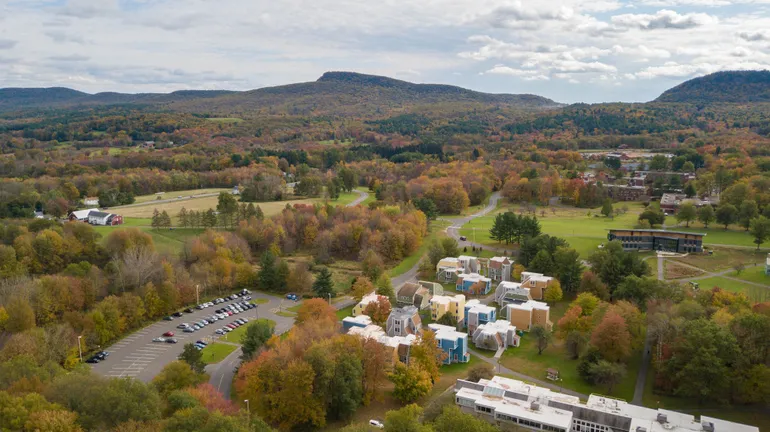
Hampshire officials are also securing insurance for the college’s remaining days and looking to sell its 800-acre campus. Questions about what will become of the land have swirled since the college announced its forthcoming closure in April.
Two land conservation groups — The Trustees of Reservations and Kestrel Land Trust — put forward a joint proposal last month to preserve Hampshire’s fields, forests and wildlife habitats. The groups would also preserve activities at the Red Barn, an event venue, and Hampshire Farm, which grows organic produce and raises livestock.
They envision development taking place within Hampshire’s core campus and would work with the town, the surrounding community and developers “to ensure that conservation and development complement each other in this still rural landscape,” they said in a news release.
Another group, Hampshire Next, is raising money to create “a community-led effort to organize and secure a future where a new expression of Hampshire’s mission can be nurtured,” according to its website. The group — a coalition of Hampshire students, employees, alumni and other stakeholders — has secured over $1.6 million in pledges from over 1,300 people as of Tuesday afternoon.
Jerome Segal, a political activist and philosopher, also put forward a proposal in late May to refinance Hampshire’s debt, slash its operating costs and merge the college with a newly incorporated institute he oversees as president.
Hampshire’s closure announcement earlier this year followed a yearslong turnaround effort that came up short. Before the announcement, Hampshire’s accreditor warned that the college could be placed on probation or lose its accreditation over concerns it was no longer meeting standards related to institutional resources.
The accreditor pointed to Hampshire’s unsuccessful efforts to refinance $21 million in bond debt and develop a parcel of land.