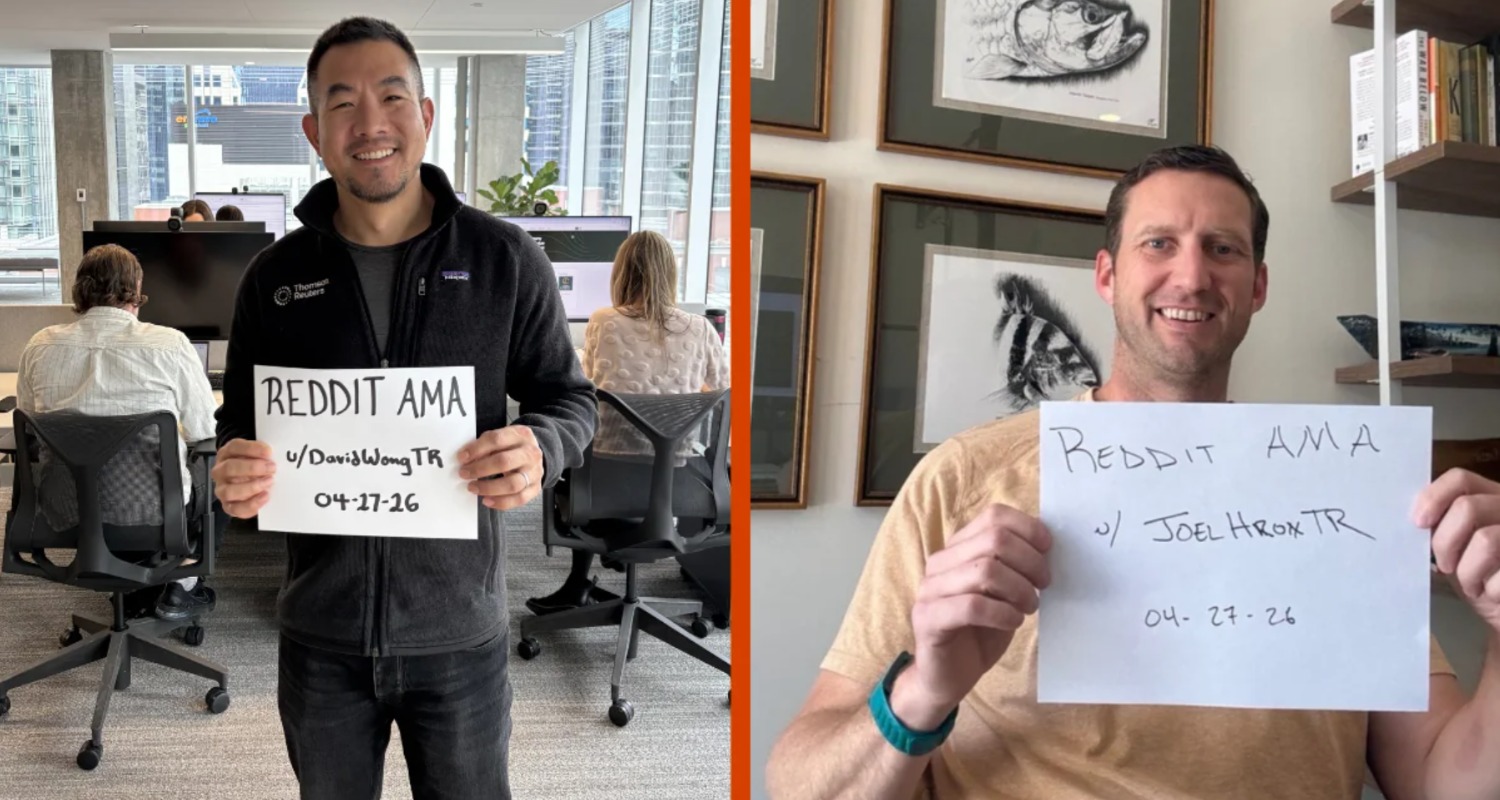
What happens when two of the most senior AI leaders at one of the world’s largest professional services companies open the floor to the internet? You get 60 minutes of sharp, unfiltered questions, and some surprisingly candid answers.
Highlights
Thomson Reuters AI leaders discuss trust, liability, and accuracy in AI for tax professionals.
The AMA reveals Thomson Reuters’ focus on fiduciary-grade AI and human accountability.
Thomson Reuters emphasizes domain depth and proprietary models for professional AI solutions.
On April 27th, Thomson Reuters Chief Product Officer David Wong and Chief Technology Officer Joel Hron hosted a live Reddit AMA under the banner: “We Build AI for Professionals Who Can’t Google Their Way to an Answer.” The 60-minute session drew substantive questions from the Reddit community, covering everything from liability concerns and data privacy to the nuts and bolts of how their AI products actually work.
For tax and accounting professionals watching the AI space closely, the exchange offered a rare window into how Thomson Reuters is thinking about the road ahead, and where the hard problems still lie.
Jump to ↓
The questions that cut to the core
Where Thomson Reuters is headed in the AI market
The questions that cut to the core
The community didn’t hold back. Here are some of the most-discussed exchanges from the session:
On AI trust and the limits of accuracy (154 upvotes)
Sassquatch3000 asked: “If, say, normal AI (LLMs) answer questions right 90% of the time, thinking models with RAG 95% of the time, and thinking LLMs + RAG agents 99% of the time… how will your AI (assuming it’s right 99.9% of the time) ultimately be trusted? Isn’t there a paradox that the more we trust the occasionally fallible thing, the more we fall into the trap of believing it when maybe we shouldn’t?”
Joel Hron responded: “Trust in professional work has never meant blind confidence, and the accountability of the human has never been more important. I think the harder question beyond the 90% -> 99% -> 99.9% accuracy is really ‘how can a human catch an issue when it exists’. This is why we’ve put so much focus on verification and transparency in our product experience. And it’s also why we just convened the Trust in AI Alliance with OpenAI, Google, Anthropic, and AWS.”
On liability when AI gets it wrong (173 upvotes)
Zhaoz asked:“Who is going to be liable when an AI system inevitably malfunctions? Seems like either a huge risk for you or the people buying AI products.”
David Wong responded: “The honest answer is that liability with professional work has always sat with the professional, and AI doesn’t change that. The professionals ultimately need to sign off on the work even if aided by AI. This is why we think it’s so crucial that professionals use products like CoCounsel because we have built them to minimize risk and errors and we have built them to encourage humans to stay in the loop. For example, we ground our answers in our research, but also point users to our research tools to validate and check the answers.”
On whether AI is even profitable (152 upvotes)
Prudent_Vanilla_9984 asked : “Are you aware that AI is very difficult, if not impossible to profit off of?”
Joel Hron responded: “For the professionals we serve, the game isn’t just about being x% more efficient. Being right is the priority. So the value prop is really about getting to better outcomes, not just faster ones. With that said, the economics of AI are certainly something the world is wrestling with. This is one of the reasons we continue to maintain optionality and fungibility in our model choices and tech stack as well as one of the reasons we continue to invest in the development of our own LLM capabilities, which we’ve announced recently as the Thomson model family.”
On what “fiduciary-grade” AI actually means (57 upvotes)
Klelkus asked: “What does fiduciary-AI actually mean? ELI5 [explain like I’m 5] pls.”
David Wong responded: “Fiduciary-grade means that our AI is designed for fiduciary professions. We wanted to clarify that professions like law and tax have higher standards for accuracy, explainability, and verification. So while you might be able to use a general AI tool for these professions, they struggle when scrutinized or in important corner cases. We are building for that scrutiny and tough cases.”
On governance frameworks for AI in professional workflows (9 upvotes)
RecessTime831 asked: “What kind of governance framework do you recommend organizations put around AI used in legal, tax and compliance workflows?”
Joel Hron responded: “No one-size-fits-all answer, but a couple principles that I see consistently come up: How human accountability is maintained has to be explicitly understood in the process. The accountability for the outcomes continue to fall to the human and I don’t see this changing any time soon. So this needs to be defined before deployment, not after something goes wrong. If you can’t inspect it, you can’t trust it. You need traceable reasoning and clear source provenance. If your team can’t see how an answer was constructed, they can’t stand behind it.”
On what Thomson Reuters actually is (46 upvotes)
Bubbly-Helicopter668 asked: “I’ll be the person who asks the dumb question.. I know Reuters as a news source. So what even is Thomson Reuters? Like what does the company do day to day and how does it make money?”
Joel Hron responded: “Reuters is a small fraction of all of what Thomson Reuters actually does. Thomson Reuters is one of the largest software providers in the world for professionals in law, tax, accounting, audit, compliance and risk. Basically, people who really can’t afford to get things wrong. We’re probably most well known for our Westlaw product — which is the leading legal research platform in the world used by basically every large law firm in the US and nearly every court across the country. Given these industries, AI is clearly front and center in everything we’re doing today and pivotal to how we’re supporting the transformation of these professions.”
Where Thomson Reuters is headed in the AI market
Beyond the pointed questions, the AMA painted a clear picture of how Thomson Reuters distinguishes itself in an increasingly crowded AI market, and the pitch is less about model power than it is about depth of domain.
Wong and Hron repeatedly returned to the same core argument: general-purpose AI tools struggle under the scrutiny that professional work demands. Where a general AI draws on the open web, CoCounsel draws on Westlaw, Practical Law, Checkpoint, and a knowledge base built specifically for professionals in law, tax, and accounting. As Wong put it when asked about AI bubble concerns, “we are trying to bring together AI with valuable data and software that professionals use today” — not just clever prompting on top of a third-party model.
That foundation extends to a track record that predates the generative AI era. When asked about Westlaw headnotes, Wong noted that Thomson Reuters has been using AI to assist editors in their work “for many years (even before Gen AI)” — a reminder that the company’s experience with applied AI in professional settings is considerably longer than most of its competitors. That history informs how they think about the hard problems: not just whether AI can produce an answer, but whether a professional can stand behind it.
Looking ahead, the technical roadmap is ambitious. Hron confirmed that CoCounsel is currently built around Claude and the Claude Agents SDK, with a multi-model strategy that has included OpenAI and Google throughout the product’s lifetime. Soon, that stack will include a proprietary model, the Thomson model family, developed internally over the past year. The goal, as Hron framed it, is to maintain “optionality and fungibility” as the model landscape continues to evolve.
For tax and accounting professionals specifically, CoCounsel Tax & Audit addresses a field that, as one user put it plainly, “seems stuck in 2010.” The focus areas — tax research, tax preparation, tax advisory, and audit automation — are all designed to integrate with the legacy software that firms already rely on, rather than asking them to rebuild from scratch during an already-crunched busy season.
The future of professional AI, as Thomson Reuters sees it, isn’t a choice between human judgment and AI capability. It’s a deliberate combination of both, where every answer is traceable, every source is authoritative, and the professional signing off on the work can actually see how the conclusion was reached. As Hron put it simply: “If you can’t inspect it, you can’t trust it.”
For tax and accounting professionals navigating a rapidly changing landscape, that may be the most important standard of all.
Learn more about Thomson Reuters AI-powered tax and accounting solutions that are leading the way of the future of professional AI.
CoCounsel Tax
Get straightforward, expert-backed answers to your most complex tax questions in record time
I’m ready ↗