No Result
View All Result
SUBMIT YOUR ARTICLES
  • Login
Friday, June 19, 2026
TheAdviserMagazine.com
  • Home
  • Financial Planning
    • Financial Planning
    • Personal Finance
  • Market Research
    • Business
    • Investing
    • Money
    • Economy
    • Markets
    • Stocks
    • Trading
  • 401k Plans
  • College
  • IRS & Taxes
  • Estate Plans
  • Social Security
  • Medicare
  • Legal
  • Home
  • Financial Planning
    • Financial Planning
    • Personal Finance
  • Market Research
    • Business
    • Investing
    • Money
    • Economy
    • Markets
    • Stocks
    • Trading
  • 401k Plans
  • College
  • IRS & Taxes
  • Estate Plans
  • Social Security
  • Medicare
  • Legal
No Result
View All Result
TheAdviserMagazine.com
No Result
View All Result
Home IRS & Taxes

Schedule D Form: Capital Gains Tax Guide

by TheAdviserMagazine
2 months ago
in IRS & Taxes
Reading Time: 8 mins read
A A
Schedule D Form: Capital Gains Tax Guide
Share on FacebookShare on TwitterShare on LInkedIn


If you happened to trade stocks, cash out cryptocurrency, or sell real estate or other capital assets during the tax year, you may need to file some new tax forms this year. Specifically, there’s a good chance you’ll need the Schedule D tax form — a capital gains tax form that helps you report profits and losses to the Internal Revenue Service.

But don’t let Schedule D scare you. When you file with TaxAct®, we guide you through reporting capital gains and will help you fill out the right forms automatically.

Let’s dive into what IRS Form Schedule D is and how to use it when filing your tax return.

What is Schedule D on a tax return?

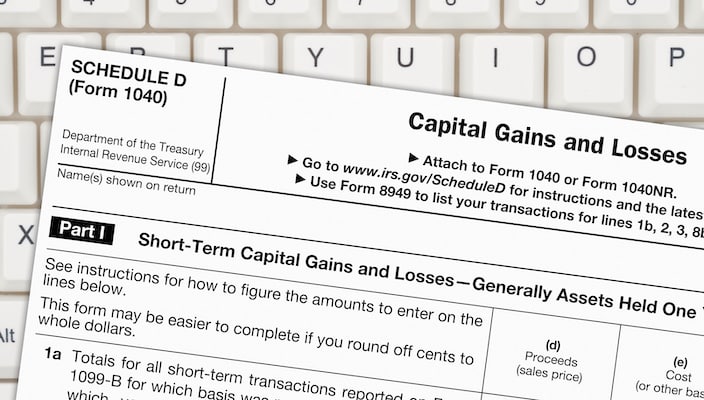
Schedule D (Form 1040) — also sometimes written as Schedule D 1040 — is an IRS form used to report capital gains and losses from the sale or exchange of capital assets.

You’ll typically use Schedule D if you sold things like:

Stocks, bonds, mutual funds, or other investments

Cryptocurrency

Real estate (including investment property)

Business property

Certain collectibles

This tax form works alongside your U.S. individual income tax return (Form 1040) to calculate how gains or losses from such sales affect your overall income tax and tax rate.

In this guide, we primarily focus on individual filers, but small business owners, partnerships, and S corporations may also encounter Schedule D form reporting through related filings, such as Schedule K-1.

Who needs to file Schedule D tax form?

Most taxpayers need to file a Schedule D tax form if they sold or exchanged a capital asset during the tax year. Most personal and investment property qualifies as capital assets, like the stocks, crypto, real estate, etc., we listed above.

When is Schedule D required?

You’ll generally need IRS Form Schedule D if you:

Sold investments reported on Form 1099-B

Reported transactions on Form 8949

Received capital gain distributions from mutual funds

Sold real estate or other investment property

Have a capital loss carryover from a prior year

Sold cryptocurrency or other digital assets reported on Form 1099-DA

Disposed of business property (often reported with Form 4797)

Had casualty or theft gains (Form 4684)

Basically, if you had any of these “dispositions of capital assets,” the IRS requires you to use Form Schedule D to report them. Don’t stress, though — TaxAct can help you determine if you need to file Form Schedule D based on information you provide about your tax situation.

When is Schedule D not required?

You may not need Schedule D if:

You only have qualified dividends reported directly on your tax return.

Your only capital gains are already included on your Form 1099-DIV and meet IRS exceptions.

You didn’t sell or exchange any capital assets during the year.

Exceptions like qualified dividends may sound confusing, but when in doubt, TaxAct can help guide your tax filing to ensure everything gets reported correctly.

Schedule D example

Before you start filling things out, it helps to see what Schedule D looks like. Here’s page 1 (out of 2):

At a high level, Schedule D pulls together:

Transaction details from Form 8949 (or other tax forms, if applicable)

 Your sales price and cost basis (purchase price, plus any adjustments) to determine your gain or loss

Totals for short-term capital gains and long-term capital gains, which are taxed differently

Any capital loss carryover amounts from previous tax years

IRS Form Schedule D essentially acts as a summary sheet for other tax forms. For example, you might report detailed transactions on Form 8949, and the totals from there flow to Schedule D to summarize everything for the IRS on your federal tax return.

Schedule D instructions: How to fill out Schedule D

Now, let’s break down the Schedule D instructions step by step. The form is divided into three main sections: Part I, Part II, and Part III.

Part I: Short-term capital gains and losses

Part I covers short-term capital gains and short-term capital loss amounts. These are assets you held for one year or less. Short-term gains are taxed at your ordinary tax rate, meaning they’re treated just like ordinary income.

Here’s what you’ll do:

Report totals from the short-term section of Form 8949

Include proceeds from Form 1099-B or Form 1099-DA, if applicable

Enter your cost basis and sales price

Calculate your net short-term capital gains or losses

You may also need to include:

TaxAct can help you fill out this section by asking you questions about your short-term gains and pulling info from your other tax forms as needed.

Part II: Long-term capital gains and losses

Part II focuses on long-term capital gains, or gains from assets held for more than one year. Long-term gains are typically taxed at lower tax brackets than ordinary income, which can help reduce your overall income tax bill.

In this section, you’ll do a lot of the same things as Part I (just for long-term transactions), such as:

Report totals from the long-term section of Form 8949

Include capital gain distributions (often reported on Form 1099-DIV)

Enter your cost basis and sales price for long-term transactions

Calculate your net long-term gain or loss

You may also need to include:

Again, TaxAct will walk you through all of the above, so don’t stress!

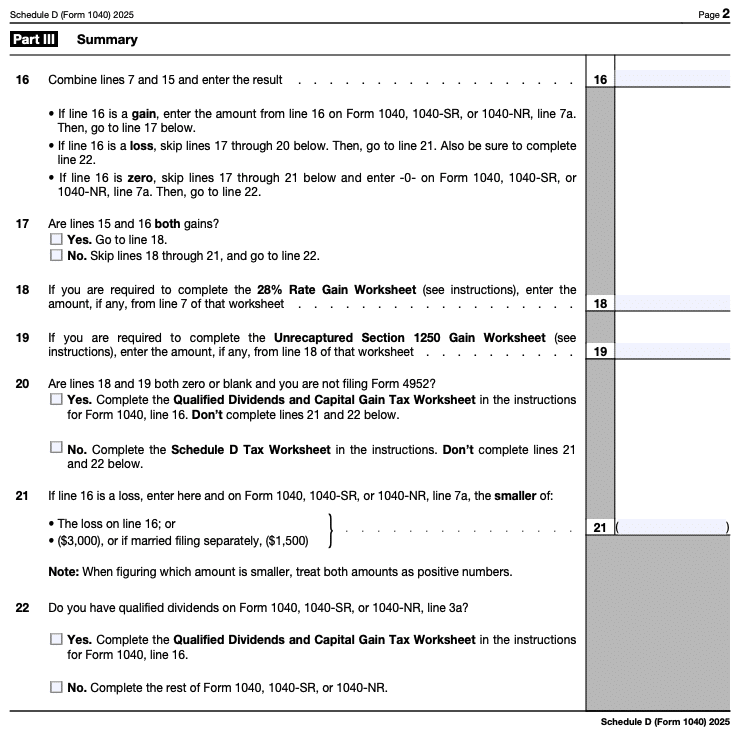
Part III: Summary
Schedule D part III

Part III ties everything together. In this section, you will:

Combine totals from Part I and Part II

Apply any capital gain tax worksheet amounts

Determine your final capital gain or loss

Use the Schedule D tax worksheets to calculate your additional tax (if applicable)

The final number from Part III flows directly into your Form 1040 or Form 1040-NR and can affect your overall tax refund or balance due.

What forms require a Schedule D?

Remember, Schedule D serves as a summary form, using information from other tax forms to neatly summarize different types of capital gains and losses for the IRS.

Here’s how Schedule D connects to some other common tax forms:

FormWhat it doesHow it relates to Schedule DForm 8949Reports details about capital asset sales (a.k.a. dispositions of capital assets), including purchase price, sales price, and type of gainTotals flow into Schedule DForm 1099-BShows investment sales from brokersUsed to complete Form 8949Form 1040Your main U.S. individual income tax returnFinal totals from Schedule D land hereForm 1040-NRFor individuals who are nonresident filersFinal totals from Schedule D land hereForm 4797Reports sales of business propertyCertain gains may carry over to Schedule DForm 4684Casualty and theft losses (including disaster losses) and any applicable gains on reimbursementCertain gains may carry over to Schedule DSchedule K-1Reports income from a partnership (Form 1065), S corporation (Form 1120-S), or estate/trust (Form 1041)May include capital gains to report on Schedule D

TaxAct helps you with your tax preparation by connecting all these capital gains tax forms behind the scenes for you.

Schedule D FAQs


What is a Schedule D used for?

Schedule D is used for reporting capital gains and losses from the sale of capital assets like stocks, real estate, and cryptocurrency on your tax return.


What counts as a capital asset?

Most personal and investment property qualifies as a capital asset, including:

• Stocks and bonds• Cryptocurrency• Real estate (not your primary residence in some cases)•• Collectibles• Investment accounts (not IRAs)


How do you report capital gains?

You report gains by listing transactions on Form 8949, summarizing totals on Schedule D, and including the results on your Form 1040 individual tax return. TaxAct can walk you through reporting your capital gains by asking you detailed questions about your gains and losses during the tax year.


How do capital gains and losses affect Schedule D?

Schedule D is where you report your total capital gains and losses for the year. Capital gains increase your taxable income, while capital losses first offset those gains directly on Schedule D. If your losses exceed your gains, you can deduct up to $3,000 of the remaining loss against other income as a tax deduction, and any leftover losses carry forward to offset gains in future tax years.

It’s possible if you meet certain IRS exceptions. But most of the time, if you sold any capital assets, you generally need to file Schedule D. TaxAct can help you figure out if you need to attach Schedule D to your tax return.


What is the difference between Form 8949 and Schedule D?

Form 8949 is used for detailed transaction reporting, while Schedule D is a summary of those totals for your tax return. You can think of Form 8949 as the “receipts” for your gains and losses, and Schedule D as all those receipt totals combined.

How to file Schedule D with TaxAct

If you sold stocks, bonds, options, or other investments, you’ll need both Form 8949 and Schedule D when filing your federal tax return.

Here’s how TaxAct helps you fill out Schedule D:

First, we’ll ask you to enter your Form 1099-B details directly into the program.You can do this manually, import from a TaxAct-supported brokerage or CSV, or use our Stock Assistant tool.

If you didn’t receive Form 1099-B, that’s okay. You can still report the transaction(s) and note that you didn’t receive the form.

We then automatically transfer that information to Form 8949, Schedule D, and Form 1040 as needed.

Once you enter your transactions, we’ll continue with the filing process. Our tax preparation software walks you through each step so you can file confidently.

The bottom line

If you sold investments or other capital assets during the tax year, you likely need to file Schedule D with your tax return. While the Schedule D tax form might look intimidating at first glance, it’s simply a summary of your short-term capital gains, long-term capital gains, and any losses.

Let TaxAct guide you through reporting your capital gains this year — we’ll connect all the necessary tax forms behind the scenes so you can DIY your capital gains tax reporting with minimal stress.

This article is for informational purposes only and not legal or financial advice.

All TaxAct offers, products and services are subject to applicable terms and conditions.



Source link

Tags: CapitalFormgainsGuideScheduletax
ShareTweetShare
Previous Post

Israel’s CPI rose 0.4% in March

Next Post

Here’s How The US-Iran War Is Affecting The Bitcoin, Ethereum, And Dogecoin Prices

Related Posts

edit post
Payroll control gaps: Lessons from last-minute saves

Payroll control gaps: Lessons from last-minute saves

by TheAdviserMagazine
June 18, 2026
0

When quick fixes become the norm, hidden compliance and operational risks grow Highlights Frequent last‑minute payroll fixes often signal weak...

edit post
What exactly is direct tax?

What exactly is direct tax?

by TheAdviserMagazine
June 18, 2026
0

Highlights Direct tax is paid directly by the taxpayer to the government and commonly includes individual income tax, corporate income...

edit post
5 Assets You MUST Put In Your Trust Right Now |

5 Assets You MUST Put In Your Trust Right Now |

by TheAdviserMagazine
June 18, 2026
0

You spent the time and money to create a living trust. But if you never transfer assets into it, that...

edit post
Are Digital Services Taxes a Viable Solution for the EU Budget?

Are Digital Services Taxes a Viable Solution for the EU Budget?

by TheAdviserMagazine
June 18, 2026
0

Introduction Over the last few years, concerns have been raised that the existing international taxA tax is a mandatory payment...

edit post
How to use AI in audit workflows: A practical guide

How to use AI in audit workflows: A practical guide

by TheAdviserMagazine
June 17, 2026
0

Straightforward answers for applying AI across the audit lifecycle Highlights AI enhances audit efficiency by automating routine confirmation tasks and...

edit post
Florida Property Tax Elimination | Florida Homestead Tax

Florida Property Tax Elimination | Florida Homestead Tax

by TheAdviserMagazine
June 17, 2026
0

Few things unite homeowners more than their shared disdain for rising property taxes. It’s no surprise, then, that Florida Governor...

Next Post
edit post
Here’s How The US-Iran War Is Affecting The Bitcoin, Ethereum, And Dogecoin Prices

Here’s How The US-Iran War Is Affecting The Bitcoin, Ethereum, And Dogecoin Prices

edit post
Trump Will Need Plenty of Inflation to Finance His New War

Trump Will Need Plenty of Inflation to Finance His New War

  • Trending
  • Comments
  • Latest
edit post
Florida Roads Become a Battleground for Illegal Immigration

Florida Roads Become a Battleground for Illegal Immigration

June 9, 2026
edit post
Louisiana’s Age-Tiered Homestead Exemption: 8 Details About the Proposed 2028 Amendment

Louisiana’s Age-Tiered Homestead Exemption: 8 Details About the Proposed 2028 Amendment

June 15, 2026
edit post
5 Pennsylvania Rebate Rules Seniors Should Check Before the Property Tax/Rent Deadline

5 Pennsylvania Rebate Rules Seniors Should Check Before the Property Tax/Rent Deadline

June 18, 2026
edit post
The 8 States That Still Tax Social Security in 2026

The 8 States That Still Tax Social Security in 2026

June 6, 2026
edit post
It’s Time To Talk About Massie

It’s Time To Talk About Massie

May 23, 2026
edit post
A Tax on Social Media – Blue-State Governments’ Newest Ploy

A Tax on Social Media – Blue-State Governments’ Newest Ploy

June 5, 2026
edit post
Vivatech underway in Paris with strong Israeli presence

Vivatech underway in Paris with strong Israeli presence

0
edit post
8 Things You Should Not Store in the Pantry

8 Things You Should Not Store in the Pantry

0
edit post
Broad-Based Growth Drivers Lifted nLIGHT (LASR) in Q1

Broad-Based Growth Drivers Lifted nLIGHT (LASR) in Q1

0
edit post
What Are Special Pricing Agreements (SPA)? A 2026 Channel Guide

What Are Special Pricing Agreements (SPA)? A 2026 Channel Guide

0
edit post
Weekend Reading For Financial Planners (June 20–21)

Weekend Reading For Financial Planners (June 20–21)

0
edit post
Jio IPO: Akash, Isha and Anant Ambani to lead IPO process, says Mukesh Ambani

Jio IPO: Akash, Isha and Anant Ambani to lead IPO process, says Mukesh Ambani

0
edit post
New York Rent-Freeze Rules That Could Lower Housing Pressure for Older Renters

New York Rent-Freeze Rules That Could Lower Housing Pressure for Older Renters

June 19, 2026
edit post
8 Things You Should Not Store in the Pantry

8 Things You Should Not Store in the Pantry

June 19, 2026
edit post
Weekend Reading For Financial Planners (June 20–21)

Weekend Reading For Financial Planners (June 20–21)

June 19, 2026
edit post
CIRO Approves Webull Canada Crypto as Dealer Member, Grants Insurance Relief

CIRO Approves Webull Canada Crypto as Dealer Member, Grants Insurance Relief

June 19, 2026
edit post
24X Files SEC Proposal To Bring Tokenized Russell 1000 Stocks To Regulated Markets

24X Files SEC Proposal To Bring Tokenized Russell 1000 Stocks To Regulated Markets

June 19, 2026
edit post
A Weekly Money Check-In Keeps Your Finances From Running on Autopilot

A Weekly Money Check-In Keeps Your Finances From Running on Autopilot

June 19, 2026
The Adviser Magazine

The first and only national digital and print magazine that connects individuals, families, and businesses to Fee-Only financial advisers, accountants, attorneys and college guidance counselors.

CATEGORIES

  • 401k Plans
  • Business
  • College
  • Cryptocurrency
  • Economy
  • Estate Plans
  • Financial Planning
  • Investing
  • IRS & Taxes
  • Legal
  • Market Analysis
  • Markets
  • Medicare
  • Money
  • Personal Finance
  • Social Security
  • Startups
  • Stock Market
  • Trading

LATEST UPDATES

  • New York Rent-Freeze Rules That Could Lower Housing Pressure for Older Renters
  • 8 Things You Should Not Store in the Pantry
  • Weekend Reading For Financial Planners (June 20–21)
  • Our Great Privacy Policy
  • Terms of Use, Legal Notices & Disclosures
  • Contact us
  • About Us

© Copyright 2024 All Rights Reserved
See articles for original source and related links to external sites.

Welcome Back!

Login to your account below

Forgotten Password?

Retrieve your password

Please enter your username or email address to reset your password.

Log In
No Result
View All Result
  • Home
  • Financial Planning
    • Financial Planning
    • Personal Finance
  • Market Research
    • Business
    • Investing
    • Money
    • Economy
    • Markets
    • Stocks
    • Trading
  • 401k Plans
  • College
  • IRS & Taxes
  • Estate Plans
  • Social Security
  • Medicare
  • Legal

© Copyright 2024 All Rights Reserved
See articles for original source and related links to external sites.