On Friday, the Bureau of Labor Statistics released its consumer price index (CPI) report for March, and price growth surged to highest levels reported in nearly two years. Measured year over year, the CPI was up in March by 3.3 percent, the highest since May of 2025. Measured month to month, the CPI rose by 0.85 percent from February to March, the highest growth rate since June of 2022, 53 months ago. This has all combined to keep overall price inflation above the Fed’s two-percent “inflation target.” The surge in prices inflation included a year-over-year surge of 18.9 percent in gasoline prices, and a 19.4 percent increase in energy commodities overall. On the other hand, used cars and trucks fell by -3.2 percent during this period. Shelter, medical care, and food all remained well above two percent, coming in at 3.0 percent, 3.7 percent, and 2.7 percent, respectively.
Core CPI, which excludes food and energy, came in at 2.6 percent, measured year over year for March. That’s a three-month high. The month-to-month measure, on the other hand was at a nine-month low. In other words, even with gasoline prices removed from the equation, price inflation inched up in March.
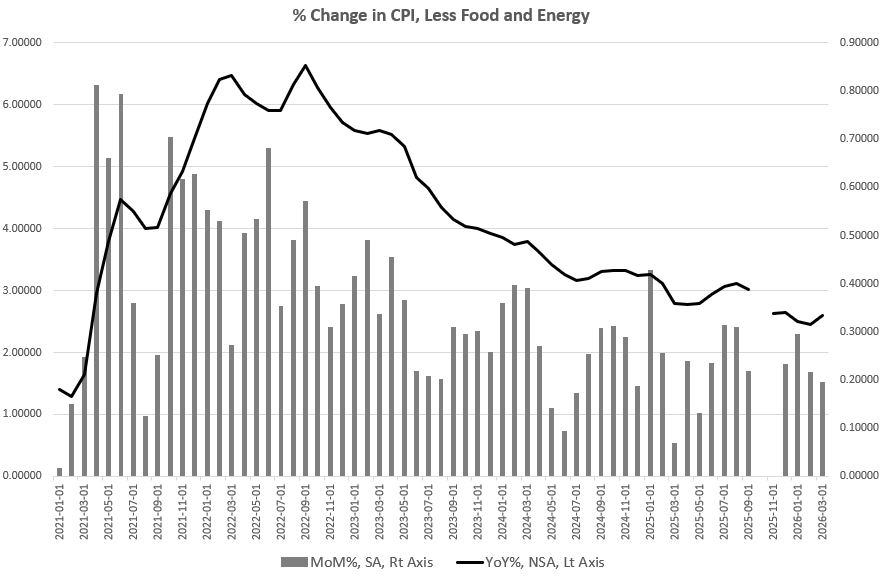
Overall, the trend in consumer prices has stubbornly remained elevated in spite of nearly two years of promises from Federal Reserve officials that price inflation would soon return to the Fed’s two-percent target. Instead, the core CPI has only dipped below 2.5 percent in a single month (February 2026) since 2021. Meanwhile, the most recent print of the Fed’s preferred measure of inflation, PCE, was 2.8 percent (for February). The trend in PCE is overall upward since April of last year.
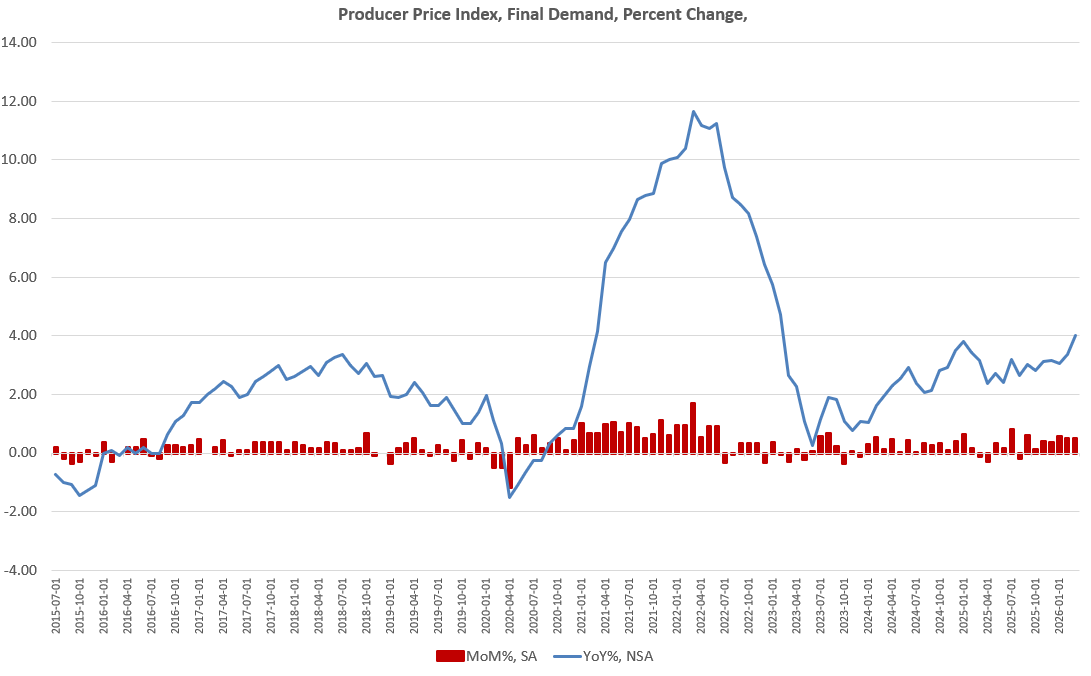
The picture is no better when we look at the producer price index (PPI). In contrast to the CPI, the PPI provides a look at the prices that are paid by producers, and the costs producers must incur in order to produce goods and service. In this area, price growth has been even more pronounced than consumer prices. According to PPI report for March, released yesterday, showed a year-over-year increase of 4.0 percent. That’s the largest increase in 37 months. The month-to-month increase was 0.51 percent, near January’s 31-month high of .55 percent.
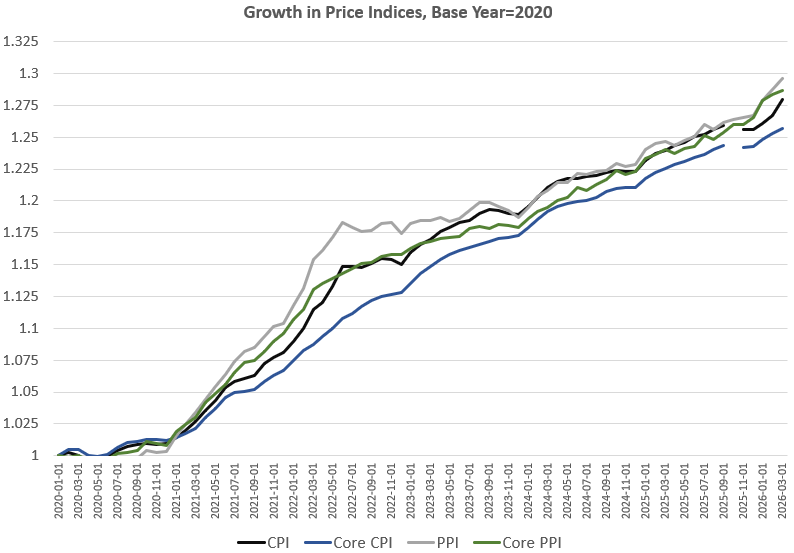
Cumulatively, this all amounts to substantial price increases no matter which index we use. Indexed to January 2020, prices in PPI, core PPI, CPI and core CPI have all increased by at least 25 percent. PPI is up by 29 percent over this period, while the CPI is up by 28 percent. Anyone who has not experienced income growth of at least this much since 2020 is actively getting poorer in real terms. This will not be a problem for many people at the higher levels of income, but for many ordinary people with less glamorous jobs, they are falling well behind in terms of purchasing power.
Now, let us recall that in September 2024, 18 months ago, Jerome Powell justified the Fed’s 100-basis point cut to the federal funds rate on the grounds that the price-inflation rate was rapidly returning to the two-percent target. That was likely a lie, and the Fed knew that wasn’t happening, but needed a non-political reason for why the Fed was cutting rate a few weeks before a federal election. The Fed continued to cut rates into the end of 2024, and has refused to raise the target interest rate, even after more than a year of price-inflation rates well above the target. In effect, the Fed’s policy strongly suggests that the de facto target rate is closer to three percent than two percent.
Although Powell and other Fed officials repeatedly claim that the Fed is “committed” to the two-percent target, there is no actual evidence of this. After all, controlling price inflation—often called “price stability”—is only ever a secondary goal of the central bank. The primary goal of the central bank is always to ensure that the governing elite to which the central bank answers—in this case, those who control the US regime—has easy access to cheap credit. That’s why Napoleon created the current version of the Bank of France, and it’s why the US central bank was created. Central banks are there to finance their governments. All that talk about inflation and government growth are political cover for what is fundamentally a money machine for the elites. The ruse works because most mainstream economists —most of whom have never seriously studies how state power works—are hopelessly naive about how the political system works. Those who aren’t naive are knowlingly complicit in using “economics” as a means of manufacturing consent for monetary policy.
Now, with the United States locked into a new and very expensive war, the US government needs its central bank in a big way. The central bank is needed to help ensure that the US regime continues to have the means to foist the cost of the war onto ordinary people through the inflation tax, and to ensure that interest rates don’t soar as the US Treasury dumps and extra trillion or two in Treasurys onto the market to finance in the war over the next two years.
[Read More: “Federal Spending Rises to Post-Covid High in Wake of DOGE Failure“]
From the state’s perspective, it is fortunate that the Fed began buying up Treasurys to the tune of $40 billion per month since December, with more than $160 billion added since then. It will be surprising if the Fed does not increase this pace of Treasury purchases in coming months, or find other ways to more surreptitiously increase liquidity for the regime. The end result of all of this will be more price inflation for ordinary people, with the worst effects being felt by those at the lower income levels. As the central bank inflates the money supply in favor of the American warfare state, this will lopsidedly benefit the Treasury, and those with first access to the money, such as bond dealers, Wall Street, and weapons manufacturers. Ordinary private-sector workers—of the truly private kind, not the fake “private” workers who get their paycheck from government contracts—will see no net benefit from inflation.
As the economy weakens, however, the overall official inflation rate, as measured by the CPI, could actually go down. The closing of the Strait of Hormuz into an already weakening economy is likely to further push downward on productivity and real wealth growth. Notably, the fourth quarter 2025 GDP estimate for the US was revised down to a paltry 0.5 percent. This weakening of economic activity may show up as falling price inflation. But, ordinary people will still be victims of the regime’s monetary inflation as regular wage workers are robbed of the falling prices that would have occurred in the absence of the coming war-fueled monetary inflation.
Through it all, we can expect to hear all about how price inflation is due to “Iran’s war” or perhaps “the mullah’s price hike.” In other words, the regime and central bank will use a propaganda technique similar to that employed during 2022’s 40-year highs in price inflation when Jerome Powell and others attempted to blame “Putin’s price hike.” That was the chosen deflection when rising prices which had clearly been fueled by the US’s runaway monetary inflation of 2020 and 2021. In other words, we will likely hear the regime and its mouthpieces come up with every reason under the sun to explain rising prices in terms other that the real cause: monetary inflation.
While it’s true that the war will lead to the production of fewer goods and services, and lead to relative scarcity in oil, this will not be the foundational cause of price inflation, which is a general increase in prices. A general increase in prices only occurs because of increases in the money supply. In an inflationary environment, as goods become more scarce, there are also more dollars chasing all goods and services. If we’re looking for someone to blame for the price hikes, the first places to look should be the US Treasury and the Fed, which relentlessly work in tandem to exploit the people to enrich the regime. This is done through both ordinary taxes and through the theft of purchasing power via monetary inflation.