
No Result
View All Result
SUBMIT YOUR ARTICLES
  • Login
Wednesday, April 15, 2026
TheAdviserMagazine.com
  • Home
  • Financial Planning
    • Financial Planning
    • Personal Finance
  • Market Research
    • Business
    • Investing
    • Money
    • Economy
    • Markets
    • Stocks
    • Trading
  • 401k Plans
  • College
  • IRS & Taxes
  • Estate Plans
  • Social Security
  • Medicare
  • Legal
  • Home
  • Financial Planning
    • Financial Planning
    • Personal Finance
  • Market Research
    • Business
    • Investing
    • Money
    • Economy
    • Markets
    • Stocks
    • Trading
  • 401k Plans
  • College
  • IRS & Taxes
  • Estate Plans
  • Social Security
  • Medicare
  • Legal
No Result
View All Result
TheAdviserMagazine.com
No Result
View All Result
Home Market Research Economy

With Its Latest Rate Cut, the Fed Serves Wall Street and the Regime

by TheAdviserMagazine
7 months ago
in Economy
Reading Time: 5 mins read
A A
With Its Latest Rate Cut, the Fed Serves Wall Street and the Regime
Share on FacebookShare on TwitterShare on LInkedIn


On Wednesday, the Federal Reserve’s Federal Open Market Committee cut the target policy rate by 0.25 percent, bringing the target down to 4.25 percent. This cut is the first since the Fed implemented a cutting cycle last year that reduced the target rate from 5.5 percent to 4.5 percent. That series of cuts began with a 50 basis-point cut in September of last year, ending with a 25 basis-point cut in December. 

This month’s meeting is among the most-watched meetings of recent years with the FOMC now being expected to “do something” in response to a clear slowdown in job growth in recent employment data. Since January, the Fed has faced immense public pressure from the White House, from Wall Street, and from many financial-sector pundits demanding that the Fed cut the target interest rate and adopt an even more dovish stance. A frequent criticism of the Fed through this period—made by those who believe more monetary inflation can somehow strengthen an economy—is that the Fed is “too late” in implementing additional rate cuts to stimulate the economy. 

The pressure to cut rates gained additional strength in the wake of new jobs reports, released earlier this month, showing that job growth had substantially weakened during June, July, and August of this year. Moreover, the release of revised benchmark employment data for much of 2024 and early 2025 showed that job growth had not been nearly as strong as previously reported. 

Those pushing for more easy money used this jobs data as an opportunity to demand more rate cuts from the Fed. So, not surprisingly, Fed Chair Jerome Powell and the FOMC this week voted to lower the target rate, and the Fed will accelerate its open market operations, using newly created money, to intervene in the marketplace to further reduce short-term interest rates. 

In this, we also see what really concerns the Fed. The Fed’s concern is not reducing prices and improving the cost of living for ordinary people. What really concerns the Fed is ensuring rising asset prices for Wall Street while pushing cheap credit to finance federal deficits. 

Does the Fed Care about Price Inflation? 

Generally, the mainstream narrative around Fed policy works like this: when inflation is “too high”—as defined by the Fed itself—then the Fed will allow interest rates to rise. This will slow monetary inflation and prices will stabilize. On the other hand, when employment is not sufficiently robust—again, as defined by the Fed itself—then the Fed will lower the target interest rate. That will lead to more monetary inflation which will “stimulate” job growth. This narrative, however, depends on the idea that when employment growth is weak, price inflation will also be weak, and vice versa. 

If a weakening employment situation were the only thing going on right now, then it would be very easy for the Fed to claim right now—using the popularly accepted narrative—that it is necessary for the Fed to cut the target rate to stimulate employment. But, the Fed face a complicating factor right now in that price inflation has been rising in recent months, and shows no signs of returning to the Fed’s arbitrary two-percent inflation target. 

Specifically, core CPI in August rose 3.1 percent, well in excess of the two-percent target. Moreover, the Fed’s preferred inflation measure, personal consumption expenditures, rose by 2.9 percent in July. Powell recent stated that their estimate for PCE growth in August is also 2.9 percent. In other words, price inflation isn’t going away, and by lowering the target rate, the Fed is pushing more monetary inflation which will put further upward pressure on prices. 
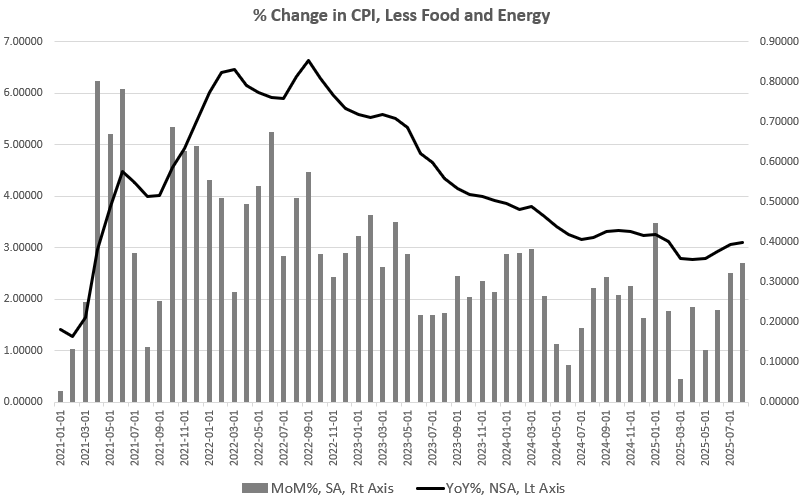
Moreove,r the FOMC’s members now don’t expect the Fed to hit its target price-inflation rate until 2027. At least, that’s what the members are saying according to the Fed’s summary of economic projections (SEP). The SEP, however, can always be counted on the portray the economy as stable and generally improving. It’s the best scenario that Fed voting members think they can get away with predicting. So, if the SEP is telling us that price inflation will not fall to 2 percent until 2027, we can expect that there is plenty of monetary inflation in the works. 

The scenario projected by the SEP is this: that the Fed will wisely manage the economy back to a state of growing employment and moderating price inflation, as the Fed threads the needle of discovering just the right target interest rate to optimize economic conditions. That’s what they want the public to believe. 

If price inflation does come in coming months and years, the more likely scenario is this: the economy will weaken, just as is now suggested by recessionary trends in the index of leading economic indicators, in new home construction, in stagnating job growth, and in delinquency rates. Prices will fall as demand collapses in the face of rising unemployment, falling real wages, and overindebtedness. 

The downside of a recession, of course, is temporary unemployment. But the upside—in the absence of central-bank meddling—is that the many inflationary bubbles that have grown as a result of monetary inflation finally pop and prices fall. Zombie companies that only existed thanks to cheap credit go bankrupt and more efficient owners take over and build a more productive economy out of the rubble of the old Fed-created inflationary economy. This is all to the good in terms of the cost of living because the bubble economy has become unaffordable for ordinary people who are forced to deal with incessantly rising prices and unaffordable homes. 

That’s what would happen if the Fed actually cared about reducing price inflation. Unfortunately, the Fed isn’t going to let that happen. Rather than allow prices to fall substantially, and allow for a new, less wasteful, less frothy and bubbly economy to arise, the Fed will instead continue to force down interest rates and push more monetary inflation as the economy slows. This will prevent a reset in prices, and it will help ensure that the same, wasteful bubble enterprises continue to dominate the economy. 

The Fed will say, as it is already now saying, that it must “balance” its efforts to combat inflation against the need to stimulate employment. 

In other words, as the economy slows, American policymakers have the opportunity to allow home prices to fall and to make homes available to millions of Americans who have been priced out thanks to decades of easy-money-fueled asset price growth. Americans policymakers have an opportunity to allow a flowering of new competition and new efficiency in the economy as the old incumbent firms that now subsist on debt and speculative manias actually make way for new entrepreneurs and new dynamic economy. 

But, as we saw this week, the Fed will do everything it can to stop that from happening. Even as price inflation continues to grow, the Fed is telling us it has to print more money to ensure that “number go up” in terms of asset prices and GDP. 

Sure, the Fed will frame all this as a service to ordinary people, and as a prudent means of ensuring a vibrant job market. In truth, the central bank is serving its most important clients: Wall Street and the US regime. On the one hand, the Fed is intervening to make sure that asset prices—i.e., stocks—continue to rise for the benefit of existing wealthy asset owns. On the other hand, the Fed is lowering interest rates to ensure the Treasury can borrow at low interest rates as the federal debt continues to climb to $40 trillion. 

In contrast to all this central planning from the central bank, what the Fed should be doing right now is nothing. The Fed could simply refrain from taking any action toward meddling in the private economy at all. The Fed could end its open market operations which employ monetary inflation to manipulate interest rates. The Fed could allow markets to function, and could allow the economy to heal. Unfortunately, the Fed was created to do anything but allow the private economy to function. It has always been an instrument of central planning, and we should not expect anything different from it now. 


Source link

Tags: cutFedlatestrateRegimeServesStreetWall
ShareTweetShare
Previous Post

August 28 – September 15, 2025

Next Post

David Tepper says Fed could cut a few more times, but easing too much risks entering ‘danger territory’

Related Posts

edit post
U.S. declares blockade ‘fully implemented,’ cutting off Iran’s seaborne trade ‘completely’

U.S. declares blockade ‘fully implemented,’ cutting off Iran’s seaborne trade ‘completely’

by TheAdviserMagazine
April 15, 2026
0

SPLIT, CROATIA - MARCH 29: A view of the American aircraft carrier USS Gerald Ford arrived in Split as part...

edit post
CEOs are betting AI will augment work rather than displace all workers

CEOs are betting AI will augment work rather than displace all workers

by TheAdviserMagazine
April 14, 2026
0

The effect artificial intelligence will have on the labor market has left workers and job seekers alike worried about their...

edit post
Milei’s Monetary Mistake | Mises Institute

Milei’s Monetary Mistake | Mises Institute

by TheAdviserMagazine
April 14, 2026
0

Argentina is better than it was before Milei’s victory. Argentina is better than it would be if either of the...

edit post
Precious Metals Work | Mises Institute

Precious Metals Work | Mises Institute

by TheAdviserMagazine
April 14, 2026
0

Over the last year, the precious metal markets have seen historic increases and then decreases in price. This, of course,...

edit post
Wholesale prices rose 0.5% in March, much less than expected despite war impact

Wholesale prices rose 0.5% in March, much less than expected despite war impact

by TheAdviserMagazine
April 14, 2026
0

Producer prices rose in March but considerably less than expected as the Iran war's push on energy prices rekindled fears...

edit post
The Danger of Allowing Good Intentions to Override the Constitution

The Danger of Allowing Good Intentions to Override the Constitution

by TheAdviserMagazine
April 14, 2026
0

Walter E. Williams often made the point that a policy should be judged by whether it works, not by its...

Next Post
edit post
David Tepper says Fed could cut a few more times, but easing too much risks entering ‘danger territory’

David Tepper says Fed could cut a few more times, but easing too much risks entering 'danger territory'

edit post
Monthly Dividend Stock In Focus: Mesa Royalty Trust

Monthly Dividend Stock In Focus: Mesa Royalty Trust

  • Trending
  • Comments
  • Latest
edit post
Massachusetts loses billions in income after millionaire tax

Massachusetts loses billions in income after millionaire tax

March 24, 2026
edit post
Illinois’ Paid Leave for All Workers Act Takes Effect — Every Employee Now Gets Guaranteed Time Off

Illinois’ Paid Leave for All Workers Act Takes Effect — Every Employee Now Gets Guaranteed Time Off

March 27, 2026
edit post
Virginia Permits ADULT MIGRANT MEN To Attend High School

Virginia Permits ADULT MIGRANT MEN To Attend High School

March 30, 2026
edit post
A 58-year-old left NYC for Miami to save on taxes — then retired early thanks to hidden savings. Here’s the math

A 58-year-old left NYC for Miami to save on taxes — then retired early thanks to hidden savings. Here’s the math

March 30, 2026
edit post
Tax Flight Accelerates In Massachusetts

Tax Flight Accelerates In Massachusetts

April 6, 2026
edit post
Property Tax Relief & Income Tax Relief

Property Tax Relief & Income Tax Relief

April 1, 2026
edit post
U.S. declares blockade ‘fully implemented,’ cutting off Iran’s seaborne trade ‘completely’

U.S. declares blockade ‘fully implemented,’ cutting off Iran’s seaborne trade ‘completely’

0
edit post
Bitcoin Price Slides 2% as Michael Saylor Hints at More BTC Buys

Bitcoin Price Slides 2% as Michael Saylor Hints at More BTC Buys

0
edit post
Major gold holder launches self-custody wallet

Major gold holder launches self-custody wallet

0
edit post
Hampshire College to close after years-long turnaround effort comes up short

Hampshire College to close after years-long turnaround effort comes up short

0
edit post
Olivia and Liam Remain Most Popular Baby Names for 2024 | Social Security Matters

Olivia and Liam Remain Most Popular Baby Names for 2024 | Social Security Matters

0
edit post
Cómo hacer que un plan de salud con deducible alto funcione para tí

Cómo hacer que un plan de salud con deducible alto funcione para tí

0
edit post
U.S. declares blockade ‘fully implemented,’ cutting off Iran’s seaborne trade ‘completely’

U.S. declares blockade ‘fully implemented,’ cutting off Iran’s seaborne trade ‘completely’

April 15, 2026
edit post
BofA Securities initiates coverage on Groww with ‘buy’ rating; shares rally 4% to record high. Here’s what the brokerage said

BofA Securities initiates coverage on Groww with ‘buy’ rating; shares rally 4% to record high. Here’s what the brokerage said

April 15, 2026
edit post
Elon Musk’s X launches Smart Cashtags for crypto and stock tracking, adds one-tap trading access through Wealthsimple

Elon Musk’s X launches Smart Cashtags for crypto and stock tracking, adds one-tap trading access through Wealthsimple

April 14, 2026
edit post
Debt MF outflows hit record Rs 2.9 lakh crore in March

Debt MF outflows hit record Rs 2.9 lakh crore in March

April 14, 2026
edit post
Faulty Whirlpool Fridge? You May Be Eligible to Get up to 75% Back

Faulty Whirlpool Fridge? You May Be Eligible to Get up to 75% Back

April 14, 2026
edit post
7 Amazon Pill Organizers That Make It Impossible to Miss a Dose

7 Amazon Pill Organizers That Make It Impossible to Miss a Dose

April 14, 2026
The Adviser Magazine

The first and only national digital and print magazine that connects individuals, families, and businesses to Fee-Only financial advisers, accountants, attorneys and college guidance counselors.

CATEGORIES

  • 401k Plans
  • Business
  • College
  • Cryptocurrency
  • Economy
  • Estate Plans
  • Financial Planning
  • Investing
  • IRS & Taxes
  • Legal
  • Market Analysis
  • Markets
  • Medicare
  • Money
  • Personal Finance
  • Social Security
  • Startups
  • Stock Market
  • Trading

LATEST UPDATES

  • U.S. declares blockade ‘fully implemented,’ cutting off Iran’s seaborne trade ‘completely’
  • BofA Securities initiates coverage on Groww with ‘buy’ rating; shares rally 4% to record high. Here’s what the brokerage said
  • Elon Musk’s X launches Smart Cashtags for crypto and stock tracking, adds one-tap trading access through Wealthsimple
  • Our Great Privacy Policy
  • Terms of Use, Legal Notices & Disclosures
  • Contact us
  • About Us

© Copyright 2024 All Rights Reserved
See articles for original source and related links to external sites.

Welcome Back!

Login to your account below

Forgotten Password?

Retrieve your password

Please enter your username or email address to reset your password.

Log In
No Result
View All Result
  • Home
  • Financial Planning
    • Financial Planning
    • Personal Finance
  • Market Research
    • Business
    • Investing
    • Money
    • Economy
    • Markets
    • Stocks
    • Trading
  • 401k Plans
  • College
  • IRS & Taxes
  • Estate Plans
  • Social Security
  • Medicare
  • Legal

© Copyright 2024 All Rights Reserved
See articles for original source and related links to external sites.