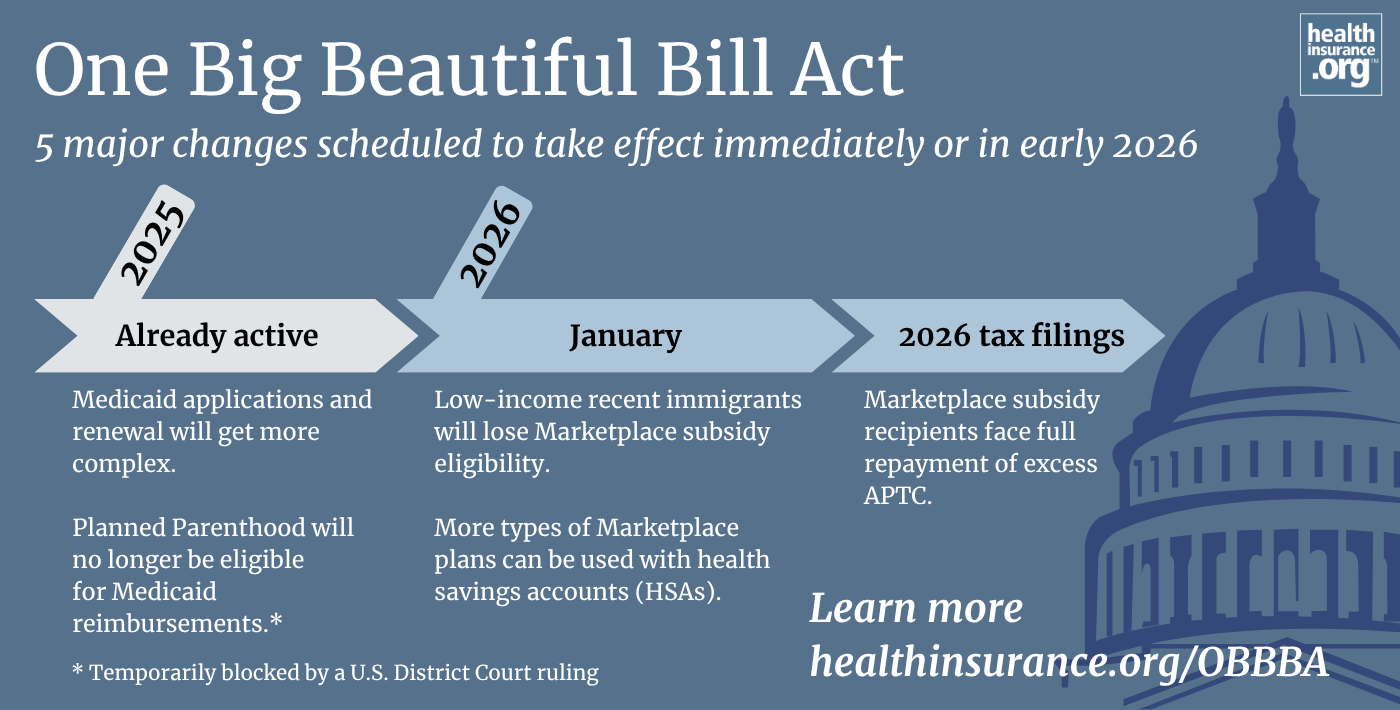
The One Big Beautiful Bill Act (OBBBA) – or H.R. 1 – has set the stage for sweeping changes to U.S. health coverage, many of which won’t take effect until 2027 or later. But some changes are happening much sooner – starting right now, later in 2025 and early 2026 – and will significantly impact Medicaid enrollees, Marketplace consumers, and low-income immigrants.
In this article, we look at five major changes for consumers to watch, some of which take effect immediately.
What is the OBBBA?
President Donald Trump signed into law the OBBBA, which is federal budget legislation, on July 4, 2025. The legislation will have significant implications for health coverage in the United States in the coming years. Millions of people are expected to lose coverage, due in large part to the Medicaid changes that will be implemented in 2027 and future years.
And this is in addition to the millions of people who are expected to lose health coverage due to the anticipated sunsetting of the Marketplace subsidy enhancements at the end of 2025 and the new Marketplace rules that were finalized in 2025. Altogether, the number of uninsured people in the U.S. is expected to increase by about 17 million people in the next decade or so, due to the One Big Beautiful Bill, the expiration of the subsidy enhancements, and the new Marketplace rules.
But although many of the One Big Beautiful Bill’s policy changes won’t take effect until 2027 or later, some of the law’s Medicaid and Marketplace changes will be implemented by the time open enrollment for 2026 coverage begins in November 2025.
Here’s what consumers need to know, and how their health coverage options could be affected:
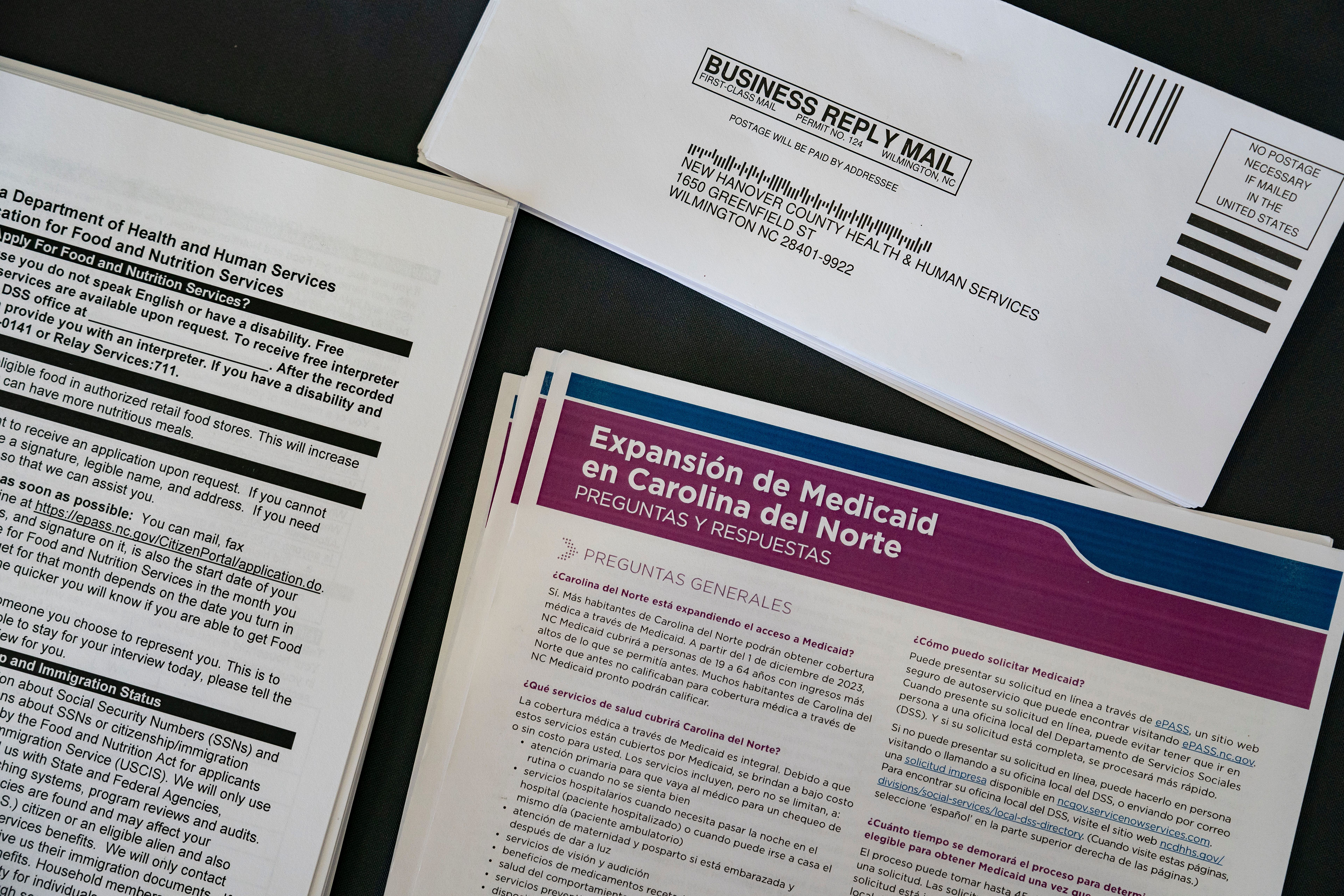
1. Medicaid applications and renewal will get more complex
In a nutshell: Medicaid enrollees will face more administrative hurdles when applying for or renewing coverage.
Who’s affected? Medicaid and CHIP enrollees – including those in Medicare Savings Programs (MSPs) – and especially older adults and people with disabilities.
Takes effect: July 4, 2025
In 2023 and 2024, the Biden administration finalized a two-part rule designed to simplify and streamline the application and renewal process for Medicaid (including Medicare Savings Programs, which help to pay Medicare premiums and out-of-pocket costs for beneficiaries with low incomes and asset levels), the Children’s Health Insurance Program (CHIP), and Basic Health Programs.
The Biden administration’s rule included provisions such as eliminating in-person eligibility interviews for people with disabilities and those 65 or older, changes to ensure that fewer people would lose coverage due to undeliverable mail, and a ban on lock-out periods for children disenrolled from CHIP for failure to pay premiums.
Starting immediately, H.R.1 prohibits the Department of Health and Human Services (HHS) from implementing, administering, or enforcing that rule, at least through September 2034.
As is the case for other Medicaid cuts in the One Big Beautiful Bill, sources project these changes will lead to a decrease in federal Medicaid spending, due to fewer people being enrolled in the program.
What people affected by the change can do: In order to enroll in and renew coverage, people may find that they need to complete additional paperwork or comply with other new rules. If you’re enrolled in Medicaid (including an MSP) or CHIP, it’s essential to make sure that the state Medicaid agency has your correct contact information, and that you quickly respond to any administrative requests related to your eligibility or coverage renewal.
2. Planned Parenthood no longer eligible for Medicaid reimbursements
In a nutshell: Medicaid can no longer reimburse the costs of any health care provided at Planned Parenthood or other “essential community providers” that offer abortion care.
Who’s affected? Planned Parenthood clinics and similar “essential community providers,” and Medicaid enrollees who receive any type of health care at these clinics.
Takes effect: July 4, 2025 (temporarily blocked by a court ruling)
As soon as it was enacted, the OBBBA eliminated Medicaid funding for one year, for entities that are “primarily engaged in family planning services, reproductive health, and related medical care” and that provide abortion services in situations other than rape, incest, or a danger to the mother’s life.
It’s important to note that longstanding federal rules already prevent federal funding from being used to pay for abortion care, except when the abortion stems from rape, incest, or a danger to the mother’s life. (Thus, non-excepted abortions, dubbed “non-Hyde” abortions, cannot be funded with federal money.) So the change under the OBBBA results in federal Medicaid funding being cut for non-abortion care, such as cancer screenings and contraception.
This resulted in some Planned Parenthood clinics notifying patients that they could no longer accept Medicaid.
But Planned Parenthood immediately filed a lawsuit to block the Medicaid funding cut, and a judge issued a 14-day injunction on July 7, temporarily blocking the Department of Health & Human Services from cutting off Medicaid funding to Planned Parenthood.
The governor of Washington announced that if Planned Parenthood’s lawsuit to permanently block the funding cut is unsuccessful, the state of Washington will cover the $11 million in federal Medicaid funding that Planned Parenthood will lose in Washington. As noted above, federal funding cannot be used for non-Hyde abortions, so that $11 million is for other medical services, such as preventive care.
3. Low-income immigrants will lose subsidy eligibility
In a nutshell: Recently arrived low-income immigrants will no longer qualify for subsidies to buy Marketplace health insurance.
Who’s affected? Lawfully present immigrants in their first five years in the U.S. with household incomes below the federal poverty level.
Takes effect: January 1, 2026
In general, Marketplace subsidies are not available to anyone with a household income under the federal poverty level (FPL). But there has always been an exception for recent immigrants who are lawfully present in the U.S. if they are in the five-year waiting period before they can qualify for Medicaid.
To avoid creating a coverage gap for low-income lawfully present immigrants during their first five years in the U.S., the Affordable Care Act (ACA) included a provision to allow them to qualify for Marketplace subsidies so they could meaningfully access the Marketplace.
But the OBBBA ends this provision, starting January 1, 2026. Immigrants with household income under the poverty level who have been in the U.S. for less than five years will no longer qualify for subsidies in the Marketplace.
According to the Congressional Budget Office, about 300,000 people will lose their health coverage as a result of the termination of subsidy eligibility for recent immigrants whose income is below the FPL.
What people affected by the change can do: To qualify for Marketplace subsidies, immigrants who have been in the U.S. for under five years will need a household income for 2026 that is at least equal to the 2025 FPL. In all but Alaska and Hawaii (where the FPL is higher), that’s $15,650 for a single person and $32,150 for a household of four.
When applicants enroll in Marketplace coverage, they’re asked to project their household income for the full year that the coverage will be in effect, so recent immigrants who are enrolling or renewing coverage during the open enrollment period in the fall of 2025 will need to project an income of at least the 2025 FPL when they apply for their 2026 subsidies.
And applicants should be prepared to provide proof of their income when they enroll in or renew their coverage for 2026, as that will be required if the applicant attests to an income that doesn’t match the information the Marketplace gets from other sources like the IRS.
4. Subsidy recipients face full repayment of excess APTC
In a nutshell: Starting with 2026 coverage, there’s no limit on how much excess APTC a Marketplace enrollee might have to repay if their income ends up higher than expected.
Who’s affected? Marketplace enrollees who receive advance premium tax credits (APTC) – especially those with income fluctuations.
Takes effect: Applies to 2026 tax filings (based on 2026 coverage)
Most Marketplace enrollees – 92% in 2025 – qualify for advance premium tax credits (APTC). APTC is based on an applicant’s projected income for the relevant calendar year. The federal government advances the estimated premium tax credit on the applicant’s behalf, to their health insurer, throughout the year.
But the following year, that APTC has to be reconciled when the enrollee files their tax return for the year. If the income an enrollee earns during the year doesn’t match what they projected when they enrolled, the IRS might owe them additional premium tax credit, or the enrollee might have to pay back some of the excess APTC that was paid on their behalf.
Until now, there has been a cap on how much excess APTC people have to repay, as long as their household income was less than 400% of FPL. The specific amounts were indexed each year by the IRS, but the most a person would have to repay in excess APTC for 2024 was $3,150, if their household income was as high as 399% of FPL.
But the One Big Beautiful Bill Act eliminates those caps. Starting with the 2026 plan year, if your income ends up being higher than you projected, there will no longer be a limit on how much excess APTC you have to repay. Instead, you will have to repay all of the excess, regardless of how much that is.
For the 2023 tax year, across all tax returns that had been filed by late July 2024, a total of more than 4.9 million tax filers owed a combined total of more than $6 billion in excess APTC. That’s an average of about $1,224 per filer, although that amount is after applying the repayment caps, which could be as low as $375 for a single filer in 2024.
(To clarify, the repayment caps for 2024 ranged from $375 for a single filer whose household income was under 200% of FPL, to $3,150 for a family with a household income of 399% FPL. The details are shown in Table 5 of the IRS instructions for Form 8962, which is used to reconcile Marketplace premium tax credits.)
What people affected by the change can do: When people enroll in Marketplace coverage for 2026, it will be essential to project income as accurately as possible. The Marketplace will ask for proof of income if the projection you provide doesn’t match what the information the Marketplace gets from data sources like the IRS.
It will also be a good idea to double-check your income projection mid-way through 2026, to see if you’re on track to earn roughly the amount you projected when you enrolled. If not, you can update your income in your Marketplace account, and they’ll adjust your subsidy in real time. This could help to avoid having to repay excess APTC when you file your 2026 tax return, which will be particularly important once there’s no longer a cap on how much excess APTC has to be repaid.
5. More Marketplace plans can be used with health savings accounts (HSAs)
In a nutshell: Millions more people with high-deductible Marketplace plans will become eligible to contribute to health savings accounts.
Who’s affected? Marketplace enrollees with Bronze or Catastrophic plans and consumers using direct primary care (DPC)
Takes effect: January 2026 (for 2026 plan year)
Starting with the 2026 plan year, Marketplace enrollees with Bronze or Catastrophic plans will be eligible to contribute to a health savings account (HSA). Through the end of 2025, HSA contributions can only be made by someone who has an HSA-qualified high-deductible health plan (HDHP), as defined by the IRS. But starting with the 2026 plan year, the HDHP definition will expand to include all Marketplace Bronze and Catastrophic plans.
Prior to 2026, most Bronze plans are not HDHPs, since most Bronze plans do not meet the current IRS HDHP requirements. For example, in Chicago, there are 31 Bronze Marketplace plans available in 2025, but zero HDHPs. In Houston, there are 28 Bronze Marketplace plans available, and only one HDHP (which is one of the Bronze plans).
Through the end of 2025, Catastrophic plans can never be HDHPs, since their out-of-pocket limits are too high and they cover up to three primary care visits pre-deductible. But very few people enroll in Catastrophic plans, largely because Marketplace premium subsidies cannot be used with Catastrophic plans, and people age 30 and older can only enroll in a Catastrophic plan if they obtain a hardship exemption from the Marketplace.
But millions of people have Bronze Marketplace plans. During the open enrollment period for 2025 coverage, about 30% of all Marketplace enrollees selected Bronze plans.
In addition to the revised HDHP definition, H.R.1 also relaxes the rules around HSAs and direct primary care (DPC) arrangements. Starting in January 2026, having a DPC membership (in addition to an HDHP) will no longer disqualify someone from contributing to an HSA. In addition, the DPC membership fee will be considered a qualified medical expense, meaning it can be paid with pre-tax HSA funds.
Why does HSA access matter?
Contributions to an HSA are pre-tax, investment gains or interest earned in the account are also not taxed, and HSA withdrawals are not taxed as long as the money is used for a qualified medical expense.
In addition, HSA contributions reduce a person’s ACA-specific modified adjusted gross income (MAGI), which can affect whether the person qualifies for Marketplace subsidies. This will be particularly important for people to understand starting with the 2026 plan year, as the “subsidy cliff” will return in 2026 unless Congress acts to extend the subsidy enhancements that are scheduled to sunset at the end of 2025.
So a person who is facing the loss of all subsidies in 2026 might find that by contributing to an HSA, they can bring their MAGI into the subsidy-eligible range. Marketplace enrollees should discuss this issue with a financial planner or accountant before selecting a plan for 2026. If contributing to an HSA makes financial sense for them, it will be important to select an HDHP during the open enrollment period, keeping in mind that Bronze and Catastrophic plans will be considered HDHPs as of 2026.
Louise Norris is an individual health insurance broker who has been writing about health insurance and health reform since 2006. She has written hundreds of opinions and educational pieces about the Affordable Care Act for healthinsurance.org.