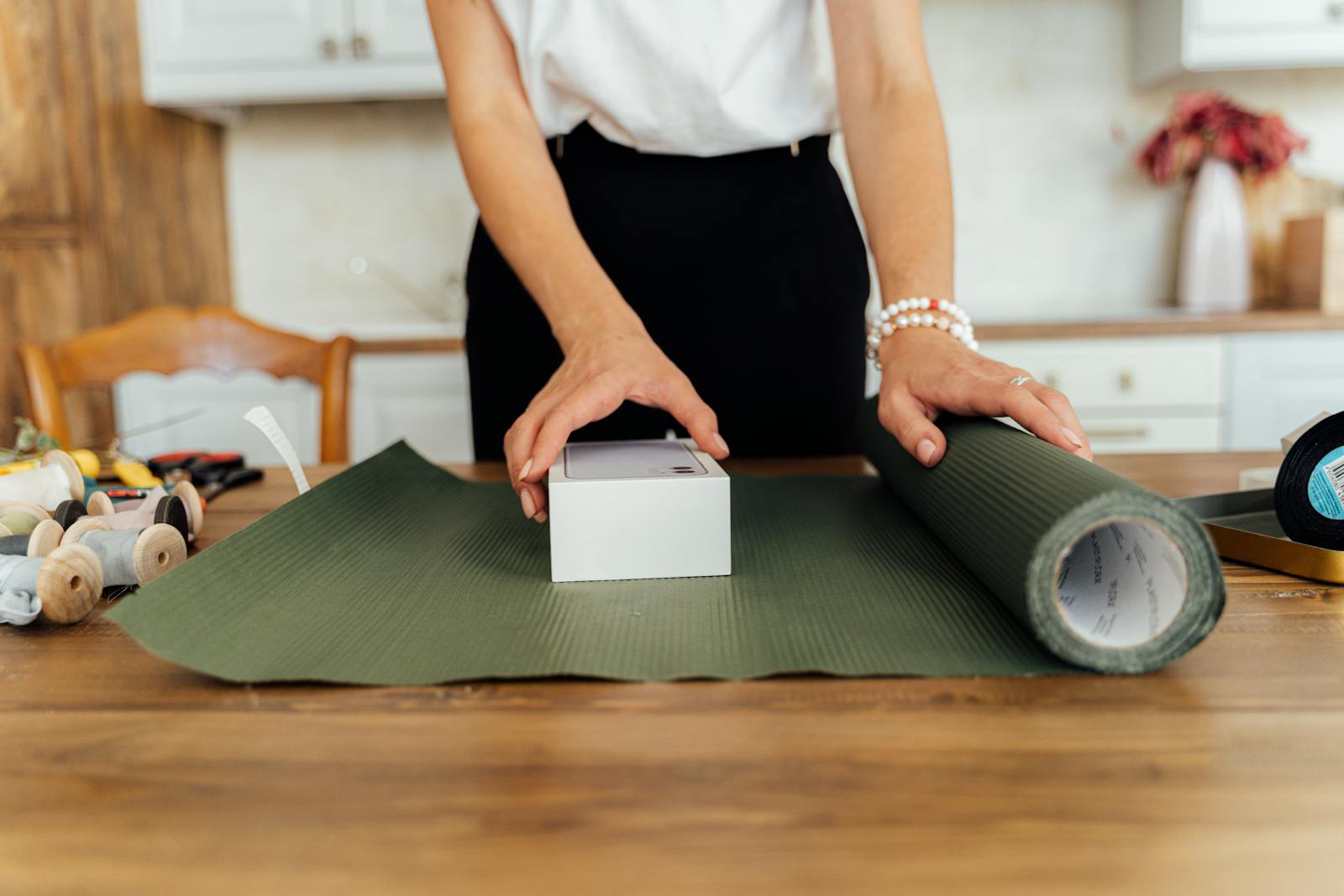
She hands you the box. You smile. You say thank you. And before the ribbon is even off, you’re already doing it: scanning the wrapping for a price clue, weighing the box, running the math on what this person can or can’t afford, calculating whether you owe them dinner or just a thank-you note or something larger you haven’t figured out yet.
Most people would call that thoughtful. Conscientious. Maybe even gracious.
It isn’t. That tally isn’t appreciation. It’s a scan, and the scanner was installed a long time ago, in a house where every gift came with a receipt of a different kind.
I’ve watched this pattern in men I worked alongside for forty years and in myself, longer than I’d like to admit.
The gift that arrived with an invoice
If you grew up in a household where receiving something was followed, sometimes immediately and sometimes weeks later, by a reminder of what it cost, you didn’t learn to receive. You learned to account.
The reminder doesn’t have to be cruel. It rarely is. It can be a sigh at the kitchen table. A passing comment about overtime. A look exchanged between parents when the credit card statement came in. The bicycle was real. So was the message that came with it.
Children are excellent observers and terrible interpreters. They notice everything and they decide what it means with whatever tools they have, which usually isn’t much. So a kid who watches their mother say we really shouldn’t have while handing them a birthday present learns, without anyone meaning to teach it, that gifts are a transaction with a hidden cost, and that cost is measured in someone else’s wellbeing.
What the scan actually is
The cost-calculation an adult does in their head, often before they’ve even fully unwrapped the thing, isn’t ingratitude. It’s a nervous system response. The body learned long ago that receiving was followed by guilt, so it tries to get ahead of the guilt by pricing the gift first.
If I can figure out what this cost you, I can figure out how much I owe you. If I can figure out how much I owe you, I can start paying it back before you have to ask.
That’s the loop.
It runs in the background of birthdays, anniversaries, Christmas mornings, and every casual I picked this up for you from a friend at the door.
Why the brain learned this in the first place
Anxiety in children doesn’t always look like fear. It often looks like vigilance. Anxious kids exist in a state of heightened awareness, scanning their environments for triggers, trying to predict what’s coming so they can prepare for it. They aren’t being difficult. They’re being early-warning systems.
A child whose home runs on financial stress becomes that kind of scanner about money. A child whose parents pair gifts with sacrifice becomes that kind of scanner about gifts.
The scanning doesn’t turn off when the child grows up. It just gets quieter, more practiced, and more invisible to the person doing it. Research on childhood anxiety disorders and cognitive behavioral therapy suggests that patterns from childhood may follow people into adulthood if untreated. The gift table is one of them.
The difference between gratitude and accounting
Gratitude has a different texture than the scan. Gratitude lets the gift land. The scan intercepts it.
A grateful adult opens a present and feels the warmth of being thought of. A scanning adult opens the same present and feels a small spike of dread, followed by a quick mental calculation: this looks expensive, did they really have the money for this, do they expect me to match it next time, what does it mean that they spent this much on me. By the time they say thank you, they’ve already done three rounds of math.
The thank-you is real. But it’s wrapped around a knot.
How conditional love trained the scanner
There’s a deeper layer to this, one that shows up in discussions of narcissistic parenting: in some homes, love itself was conditional. The gift wasn’t really a gift. It was a marker in a long ledger of what you owed in return.
You owed gratitude, performed correctly. You owed achievement that justified the spending. You owed not asking for anything else for a while. You owed a particular kind of behaviour that signalled you understood the sacrifice.
A child raised in this kind of accounting doesn’t learn that they are loved. They learn they are invoiced.
The flinch that doesn’t go away
I wrote recently about people who grew up with money worries and still flinch when a bill lands, even when they could pay it ten times over. The gift-scan is the same wiring, running in the other direction.
The bill comes in. Flinch. The gift comes in. Flinch. Different stimulus, same nervous system, same childhood.
The body doesn’t care that you’re now 45 and solvent and your friend can absolutely afford the bottle of wine she just brought to dinner. The body remembers the kitchen table. And the kitchen table is still running the show.

What it looks like in adulthood
The adult version of this rarely shows up as anything dramatic. It shows up as small, easily missed behaviours.
You ask, before opening the gift, where they got it. Not because you’re curious. Because you’re trying to estimate.
You apologise, slightly, for receiving it. You shouldn’t have. This is too much. You may say this even when it isn’t too much.
You feel a small relief when someone gives you something handmade or inexpensive, and you don’t immediately understand why. The reason is that there’s nothing to scan. The math is over before it starts.
You over-reciprocate. The next gift you give that person is bigger than what you received, because the only way to neutralise the discomfort of receiving is to make sure you’re never the one in debt.
You struggle to ask for things, even small things, because asking creates the conditions in which you might receive, and receiving is what activates the whole loop.
Recognise yourself yet?
Why it isn’t fixed by being told you deserve it
People who notice this pattern in someone they love often try to short-circuit it with reassurance. It wasn’t expensive. I wanted to. Don’t worry about it. Sometimes this helps. Often it doesn’t, because the scan isn’t really about the giver. It’s about the part of the receiver that learned, decades ago, that gifts come with weather attached.
You can tell a person their birthday present didn’t bankrupt you. You can’t tell their nervous system. The nervous system needs evidence, repeated over time, that receiving doesn’t trigger a reckoning.
This is why treating anxiety often emphasises behavioural exposure over reassurance. You can’t talk a body out of a pattern. You can only show it, slowly, that the pattern is no longer needed.
The architecture of endurance, in another form
People who grew up watching their parents stay together unhappily often inherit an architecture of endurance. The gift-scanner inherits a different architecture: one of accounting. They learned that closeness is an exchange, and exchanges have to balance, and unbalanced exchanges are dangerous.
So they keep the books. They’ve kept them for so long they don’t know they’re keeping them.
The damage that’s hardest to see
The cruelty of this pattern is that it makes generosity feel like risk. It makes being loved well feel like being indebted. It makes the gestures that should soften a person’s life feel, instead, like new entries on a balance sheet they’ve been trying to clear since they were eight years old.
Some of the kindest people I’ve known carry this. They give freely and receive badly, and they can’t tell you why.
What undoes it, slowly
You don’t undo this by deciding to. You undo it by practising the small, uncomfortable act of letting a gift be a gift.
That means, sometimes, not asking what something cost. Not over-reciprocating. Not apologising for receiving. Sitting with the discomfort of being given to, without trying to balance the books in real time. Letting the silence after thank you just be silence, instead of filling it with the calculations.
The first few times you do this, it feels wrong. Almost dishonest. Like you’re getting away with something.
That feeling is the residue of the old training, the kitchen table reminding you that nothing comes free.
The quieter recognition
So here’s the question I’d ask you, and I’d ask it gently, but I’d still ask it: how long are you going to keep calling this thoughtfulness?
Because that’s the alibi. That’s the word that lets the scanner keep running. As long as you call it conscientiousness, or being a considerate guest, or just the kind of person who takes gifts seriously, you don’t have to look at what’s underneath. And what’s underneath is a child who learned that being given to was the start of a debt, not the end of one.
The next time someone hands you something — a present, a compliment, a favour, a kindness you didn’t ask for — watch what your mind does in the first three seconds. If it reaches for the price tag, real or imagined, that’s not who you are. That’s who you were trained to be by people who couldn’t separate love from cost.
You can keep the books open. Plenty of people do, for life.
Or you can put the pen down and find out who you are when you’re not the one keeping score.
Feature image by Antoni Shkraba Studio on Pexels