No Result
View All Result
SUBMIT YOUR ARTICLES
  • Login
Saturday, July 25, 2026
TheAdviserMagazine.com
  • Home
  • Financial Planning
    • Financial Planning
    • Personal Finance
  • Market Research
    • Business
    • Investing
    • Money
    • Economy
    • Markets
    • Stocks
    • Trading
  • 401k Plans
  • College
  • IRS & Taxes
  • Estate Plans
  • Social Security
  • Medicare
  • Legal
  • Home
  • Financial Planning
    • Financial Planning
    • Personal Finance
  • Market Research
    • Business
    • Investing
    • Money
    • Economy
    • Markets
    • Stocks
    • Trading
  • 401k Plans
  • College
  • IRS & Taxes
  • Estate Plans
  • Social Security
  • Medicare
  • Legal
No Result
View All Result
TheAdviserMagazine.com
No Result
View All Result
Home Market Research Startups

The habit of buying slightly too much food whenever family visits isn’t overpreparation, for many people it’s a quiet inheritance from a household where abundance on the table was how love got expressed when words weren’t available

by TheAdviserMagazine
2 days ago
in Startups
Reading Time: 6 mins read
A A
The habit of buying slightly too much food whenever family visits isn’t overpreparation, for many people it’s a quiet inheritance from a household where abundance on the table was how love got expressed when words weren’t available
Share on FacebookShare on TwitterShare on LInkedIn


The extra loaf of bread nobody will eat, the second lasagna cooling on the counter, the three kinds of dessert for four guests — this isn’t poor planning or anxious hosting. For a lot of adults, buying too much food when family visits is a form of speech they learned before they had the words to name it, a grammar of care handed down from a kitchen where affection didn’t come out of anyone’s mouth but arrived, reliably, on a plate.

Most people assume overbuying is a logistics problem. A miscalculation. Something to fix with better lists or a firmer stance at the shop.

But the pattern rarely responds to logistics, because it was never logistical to begin with. It’s emotional inheritance dressed up as a grocery run.

The kitchen as a first language

In households where feelings weren’t openly discussed — because the adults didn’t have the vocabulary, or because saying things out loud felt unsafe, or because the culture simply didn’t work that way — food carried the weight that words couldn’t. A full fridge meant you were welcome. A second helping meant you were seen. A packed leftover container pressed into your hands at the door meant you were still loved on the drive home.

Children absorb these codes early. Long before they can articulate what’s happening, they learn that abundance on the table is a signal, and that scarcity on the table means something is wrong.

Decades later, when their own family walks through the door, the body remembers the code before the mind does.

Why the pattern travels through generations

Psychologists have written extensively about how children absorb their parents’ emotional grammar and then repeat it, often without meaning to. A Psychology Today piece on the intergenerational transmission of parenting describes how patterns from childhood households become automatic adult behaviours, even in people who consciously want to do things differently. The behaviour doesn’t need to be dramatic to transmit. It just needs to be repeated.

Setting a full table falls squarely inside that transmission. It’s small, ritualised, and almost invisible as a lesson. Which is exactly why it sticks.

The child who watched a grandmother spend three days cooking for a Sunday lunch didn’t sit through a lecture on how to show love. They watched. They ate. They understood.

The love language nobody named at home

The framework of love languages, popularised by counsellor Gary Chapman in 1992, gave a vocabulary to something families had been doing wordlessly for generations. Acts of service — one of the five — describes exactly what a full pantry before a visit tends to be.

The idea is straightforward: some people primarily give and receive love through practical actions rather than words — a framework that applies well beyond romantic relationships to family dynamics, too.

Taylor Orlandoni, who teaches personality and sexuality at New York University, told a Today piece on the topic that someone whose love language is acts of service is essentially telling their partner they take practical actions as signals of having their back. Practical actions as signals. A stocked fridge is a signal. So is the extra pack of biscuits nobody asked for.

The person doing the buying often can’t explain why they can’t stop. They only know that arriving with less than enough feels intolerable.

Where the intolerance comes from

For many, the intolerance has roots older than the relationship they’re currently hosting. It reaches back into households shaped by real scarcity, or into immigrant kitchens where feeding people was proof the family had made it, or into homes where a parent expressed love only when the table was set and never otherwise.

Silicon Canals has explored how financial scarcity rewires the nervous system in ways that persist long after the wallet has stabilised. The body keeps a memory the bank account doesn’t. Adults who grew up watching parents stretch a small budget to feed guests often carry a physical unease around the idea of running out — even when running out is mathematically impossible.

Two extra bags of groceries settle that unease. Briefly.

Then the visit ends, the leftovers get pushed into the freezer, and the cycle waits for the next family gathering to begin again.

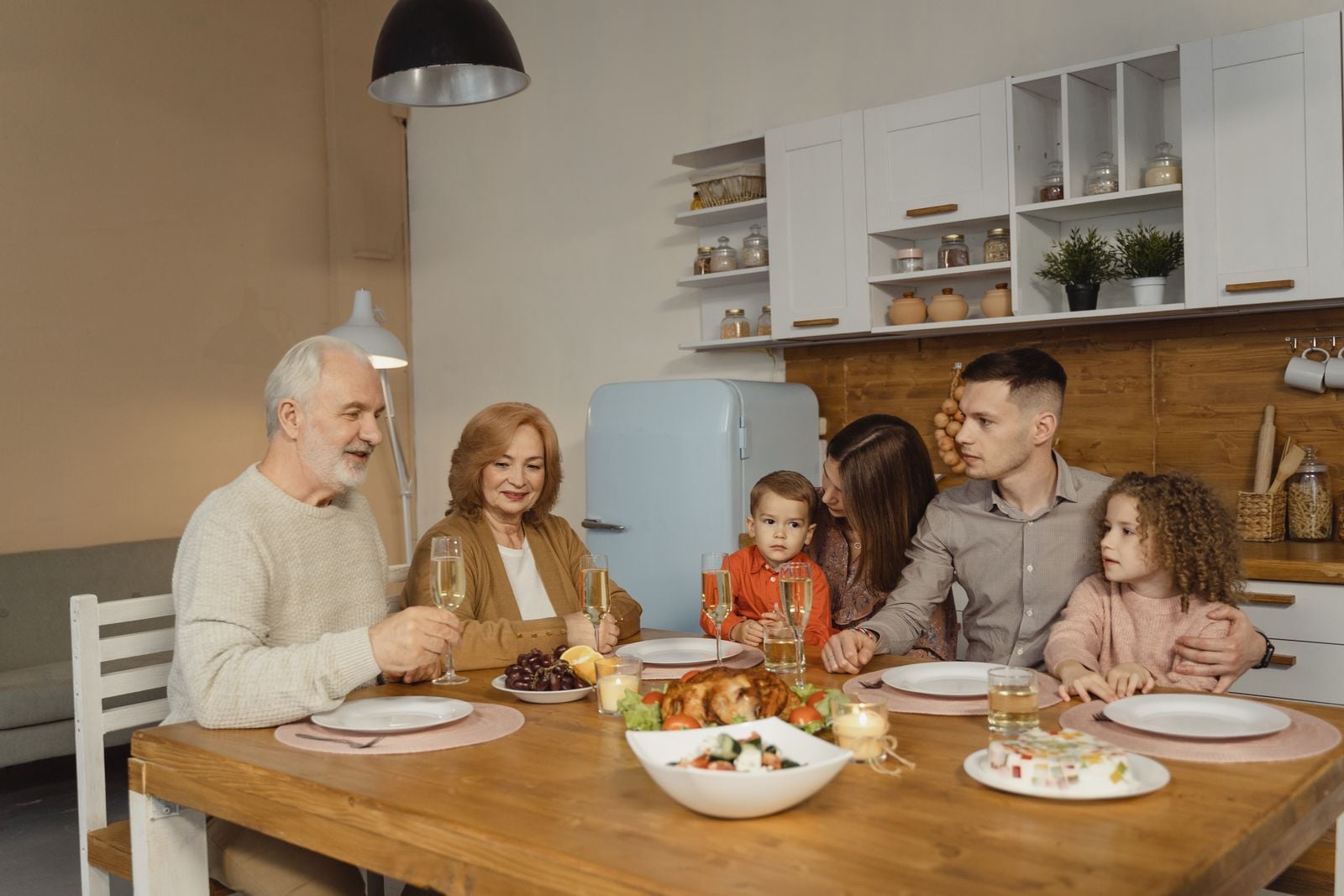
Photo by Ethem Günhan on Pexels

The specific shape of “just in case”

Ask someone who overbuys what they’re afraid of and you’ll rarely get a clean answer. Not because they’re evasive, but because the fear predates their capacity to describe it.

It isn’t really about running out of food. It’s about being caught unprepared to care for someone.

It’s about the specific, textured shame of a guest asking for seconds when there aren’t any. Of a child looking at an empty bowl. Of a parent’s face, remembered from decades ago, when there wasn’t quite enough to go around.

The overbuyer is guarding against a scene they may have witnessed only once, at eight years old, at a table that no longer exists.

When words weren’t available

Plenty of families didn’t talk about feelings, not because they didn’t have them, but because the generation raising them hadn’t been taught to. Post-war households, immigrant households, working households with two exhausted parents, households marked by grief that never got named — in all of them, affection had to find another route.

Food was the route that stayed open.

You could feed someone without confessing anything. You could reconcile after a fight by putting a plate in front of them. You could tell your adult child you were proud of them by making the dish they liked as a teenager. Nothing had to be said.

Children raised inside that grammar don’t unlearn it just because they’ve moved into houses with different rules. They translate.

The tension of being the one who “can’t help it”

Adults who inherit this pattern often describe a specific kind of internal argument, feeling compelled to buy more even when they know it’s excessive.

And they still put the third packet of cheese in the trolley.

This isn’t lack of self-control. It’s a form of care that has become automatic because it was never optional in the household that shaped them. Transmitted behaviours often bypass conscious reasoning entirely. The behaviour arrives before the thought does.

The person at the checkout isn’t choosing to overbuy. They’re completing a sentence that started forty years ago.

What the overbuying is actually saying

Strip the pattern back and it usually translates to one of a small handful of sentences the person can’t quite say out loud.

I want you to feel welcome here.

I want you to know I thought about you before you arrived.

I want you to leave with something.

I want to be the kind of host my mother was, or the kind she wasn’t.

I don’t know how else to say I love you.

The last one is often the truest, and often the least accessible to the person carrying it.

Why partners misread it

A partner who grew up in a different emotional dialect will often see the overbuying as anxiety, or wastefulness, or an unnecessary performance. They might tease. They might push back. They might, gently or not, suggest a shorter list next time.

What they usually miss is that they’re critiquing a love letter written in a language they don’t read.

This is one of the quiet reasons acts of service, as a love language, causes so much friction across couples. The gesture only lands as love if the recipient recognises it as love. Otherwise it lands as excess, or hovering, or misplaced effort.

Being told to buy less can register, for the overbuyer, as being told to love less. Not because it’s rational, but because the wiring underneath doesn’t run on rationality.

The role of the reliable one

Overbuying often clusters with other patterns. The same person who fills the fridge before visits is frequently the one carrying the invisible weight of being the reliable one in the family — the sibling who hosts, remembers birthdays, drives to the airport, coordinates the group chat.

These aren’t separate traits. They’re expressions of the same underlying orientation: love as something you deliver, not something you announce.

The overbuyer and the family fixer are often the same person, because the household that produced them treated care as a task, not a topic.

What changes when the pattern gets named

Naming the inheritance doesn’t dissolve it. Most people who identify with this pattern don’t want to stop, exactly. They want to stop feeling ashamed of it, and they want the people around them to see what the gesture is really doing.

Something shifts when the overbuying gets translated. The partner who used to sigh at the second bag of oranges starts to notice: this is how she was loved. This is how she loves.

The adult child who used to roll their eyes at their mother’s excess food starts to see the third pie for what it actually is — a woman who grew up in a house where saying “I love you” wasn’t done, still trying to say it.

What the fridge remembers

There’s a version of family life where feelings get spoken, and a version where they get plated. Neither is wrong. Both are inheritances.

The people who buy too much food when family comes over aren’t overpreparing. They’re translating an old sentence into a language their loved ones can eat.

And in kitchens where words never came easily, that translation may be the most fluent form of love the family has ever had.




Source link

Tags: AbundancebuyingexpressedFamilyfoodHabithouseholdInheritanceIsntloveoverpreparationpeopleQuietslightlyTableVisitsWerentWords
ShareTweetShare
Previous Post

APAC Bio-LNG Market: Trends, Growth Drivers, and Future Opportunities

Next Post

He baked potato in aluminium foil, and ate it next morning after microwaving. Hours later, he was paralysed, doctor explains why

Related Posts

edit post
Uniti AI Raises M to Put AI Agents in Every Corner of Property Operations – AlleyWatch

Uniti AI Raises $12M to Put AI Agents in Every Corner of Property Operations – AlleyWatch

by TheAdviserMagazine
July 24, 2026
0

Real estate is one of the world’s most operationally intensive industries, yet the work of running a portfolio – answering...

edit post
Singapore’s millionaire density hit 1 in 6 households — and the mental health data is telling a very different story about what that wealth is buying

Singapore’s millionaire density hit 1 in 6 households — and the mental health data is telling a very different story about what that wealth is buying

by TheAdviserMagazine
July 23, 2026
0

One in six households in Singapore now hold at least a million US dollars in investable assets, the highest millionaire...

edit post
People who reply to trivial texts within seconds but go quiet for days when a message actually matters have often built two separate systems: one automated and always open, one with a gate they can only open slowly, and only for themselves

People who reply to trivial texts within seconds but go quiet for days when a message actually matters have often built two separate systems: one automated and always open, one with a gate they can only open slowly, and only for themselves

by TheAdviserMagazine
July 23, 2026
0

The strange thing is not that some people reply quickly. Most of us do, at least when the message is...

edit post
KelAI Raises M to Build an Autonomous Research Engine for Hedge Funds – AlleyWatch

KelAI Raises $5M to Build an Autonomous Research Engine for Hedge Funds – AlleyWatch

by TheAdviserMagazine
July 23, 2026
0

Institutional investing has long operated on a simple but costly constraint: research capacity scales with headcount, and headcount scales slowly....

edit post
The quiet reason some adults keep a drawer of pens, notepads, and unopened stationery they never use may have less to do with clutter and more to do with the self who once believed the right tools would finally make the writing happen

The quiet reason some adults keep a drawer of pens, notepads, and unopened stationery they never use may have less to do with clutter and more to do with the self who once believed the right tools would finally make the writing happen

by TheAdviserMagazine
July 23, 2026
0

A drawer of unused stationery can behave less like household clutter and more like a fossil bed. Each layer records...

edit post
People who take the long way home even when they’re tired may not be wasting time, the drive between work and the front door can be the only stretch of the day that belongs entirely to them

People who take the long way home even when they’re tired may not be wasting time, the drive between work and the front door can be the only stretch of the day that belongs entirely to them

by TheAdviserMagazine
July 23, 2026
0

The journey home can be one of the last relatively unstructured spaces in a working adult’s day. For some people,...

Next Post
edit post
He baked potato in aluminium foil, and ate it next morning after microwaving. Hours later, he was paralysed, doctor explains why

He baked potato in aluminium foil, and ate it next morning after microwaving. Hours later, he was paralysed, doctor explains why

edit post
When to Call an IRS Criminal Tax Investigation Lawyer 

When to Call an IRS Criminal Tax Investigation Lawyer 

  • Trending
  • Comments
  • Latest
edit post
New Jersey Tax-Relief Events: Three July Dates Near Seniors

New Jersey Tax-Relief Events: Three July Dates Near Seniors

July 13, 2026
edit post
Bristlecone pines growing in the White Mountains of California germinated before the Great Pyramid was built, and the oldest one alive today, nicknamed Methuselah, has been quietly adding rings for 4,855 years in soil so poor almost nothing else survives beside it

Bristlecone pines growing in the White Mountains of California germinated before the Great Pyramid was built, and the oldest one alive today, nicknamed Methuselah, has been quietly adding rings for 4,855 years in soil so poor almost nothing else survives beside it

July 8, 2026
edit post
Retail giant exits U.S. fashion after multi-million-dollar scandal

Retail giant exits U.S. fashion after multi-million-dollar scandal

July 1, 2026
edit post
Same Portfolio. Same Retirement. A 10-Mile Move Costs One Couple ,000 A Year

Same Portfolio. Same Retirement. A 10-Mile Move Costs One Couple $10,000 A Year

June 27, 2026
edit post
Top Democrats Are Trapped in a Catch 22

Top Democrats Are Trapped in a Catch 22

July 6, 2026
edit post
2 judges suspended in separate cases after being indicted on criminal charges

2 judges suspended in separate cases after being indicted on criminal charges

July 9, 2026
edit post
Your Credit Utilization Should Stay Below 30%

Your Credit Utilization Should Stay Below 30%

0
edit post
The habit of buying slightly too much food whenever family visits isn’t overpreparation, for many people it’s a quiet inheritance from a household where abundance on the table was how love got expressed when words weren’t available

The habit of buying slightly too much food whenever family visits isn’t overpreparation, for many people it’s a quiet inheritance from a household where abundance on the table was how love got expressed when words weren’t available

0
edit post
Best Partner Enablement Tools for Global Channel Success in 2026

Best Partner Enablement Tools for Global Channel Success in 2026

0
edit post
Why young Americans aren’t relying on homes to build wealth

Why young Americans aren’t relying on homes to build wealth

0
edit post
Trader who successfully shorted Tesla into earnings now sets sights on this high flyer

Trader who successfully shorted Tesla into earnings now sets sights on this high flyer

0
edit post
Guide to IRS Garnishments | Community Tax

Guide to IRS Garnishments | Community Tax

0
edit post
Best Partner Enablement Tools for Global Channel Success in 2026

Best Partner Enablement Tools for Global Channel Success in 2026

July 24, 2026
edit post
CLARITY Act Delay Shows Crypto Market Structure Fight Is Not Over

CLARITY Act Delay Shows Crypto Market Structure Fight Is Not Over

July 24, 2026
edit post
Moody’s: AI spending threatens credit quality of Amazon, Meta, Alphabet

Moody’s: AI spending threatens credit quality of Amazon, Meta, Alphabet

July 24, 2026
edit post
Duo Made .7M Selling Over 6 Million Fake USPS Stamps, Feds Allege

Duo Made $1.7M Selling Over 6 Million Fake USPS Stamps, Feds Allege

July 24, 2026
edit post
Liberty Global targets B year-end corporate cash while advancing Ziggo Group spin to mid-’27 (NASDAQ:LBTYA)

Liberty Global targets $2B year-end corporate cash while advancing Ziggo Group spin to mid-’27 (NASDAQ:LBTYA)

July 24, 2026
edit post
Why young Americans aren’t relying on homes to build wealth

Why young Americans aren’t relying on homes to build wealth

July 24, 2026
The Adviser Magazine

The first and only national digital and print magazine that connects individuals, families, and businesses to Fee-Only financial advisers, accountants, attorneys and college guidance counselors.

CATEGORIES

  • 401k Plans
  • Business
  • College
  • Cryptocurrency
  • Economy
  • Estate Plans
  • Financial Planning
  • Investing
  • IRS & Taxes
  • Legal
  • Market Analysis
  • Markets
  • Medicare
  • Money
  • Personal Finance
  • Social Security
  • Startups
  • Stock Market
  • Trading

LATEST UPDATES

  • Best Partner Enablement Tools for Global Channel Success in 2026
  • CLARITY Act Delay Shows Crypto Market Structure Fight Is Not Over
  • Moody’s: AI spending threatens credit quality of Amazon, Meta, Alphabet
  • Our Great Privacy Policy
  • Terms of Use, Legal Notices & Disclosures
  • Contact us
  • About Us

© Copyright 2024 All Rights Reserved
See articles for original source and related links to external sites.

Welcome Back!

Login to your account below

Forgotten Password?

Retrieve your password

Please enter your username or email address to reset your password.

Log In
No Result
View All Result
  • Home
  • Financial Planning
    • Financial Planning
    • Personal Finance
  • Market Research
    • Business
    • Investing
    • Money
    • Economy
    • Markets
    • Stocks
    • Trading
  • 401k Plans
  • College
  • IRS & Taxes
  • Estate Plans
  • Social Security
  • Medicare
  • Legal

© Copyright 2024 All Rights Reserved
See articles for original source and related links to external sites.