For the 48 million Americans living with hearing loss, a phone call has never been a private act: for decades, every conversation required a relay operator, interpreter, or family member on the line, turning routine calls to a doctor or bank into three-way exchanges. The problem compounds as a nationwide shortage of certified ASL interpreters leaves the Deaf community waiting for access that hearing people take for granted, even as AI speech recognition has finally matured enough to handle live conversation reliably. Rylo, the AI-powered communication platform formerly known as Nagish, removes the human intermediary entirely, delivering real-time captioning and text-to-speech for phone calls and in-person conversations at no cost to users through a federally administered program. The company holds one of only six FCC licenses for captioned telephone service in the United States and operates the only one that runs fully on technology rather than human-staffed relay centers, supporting more than 50 languages with automatic language detection. Its 2025 acquisition of AI research company Sign.mt now powers Rylo Sign, a platform translating between dozens of signed and spoken languages in real time, extending the company’s reach from the phone into classrooms, workplaces, and everyday encounters.
AlleyWatch sat down with Rylo CEO and Cofounder Tomer Aharoni to learn more about the business, its future plans, recent round of funding, which brings the company’s total funding raised to over $100M, and much, much more…
Who were your investors and how much did you raise?
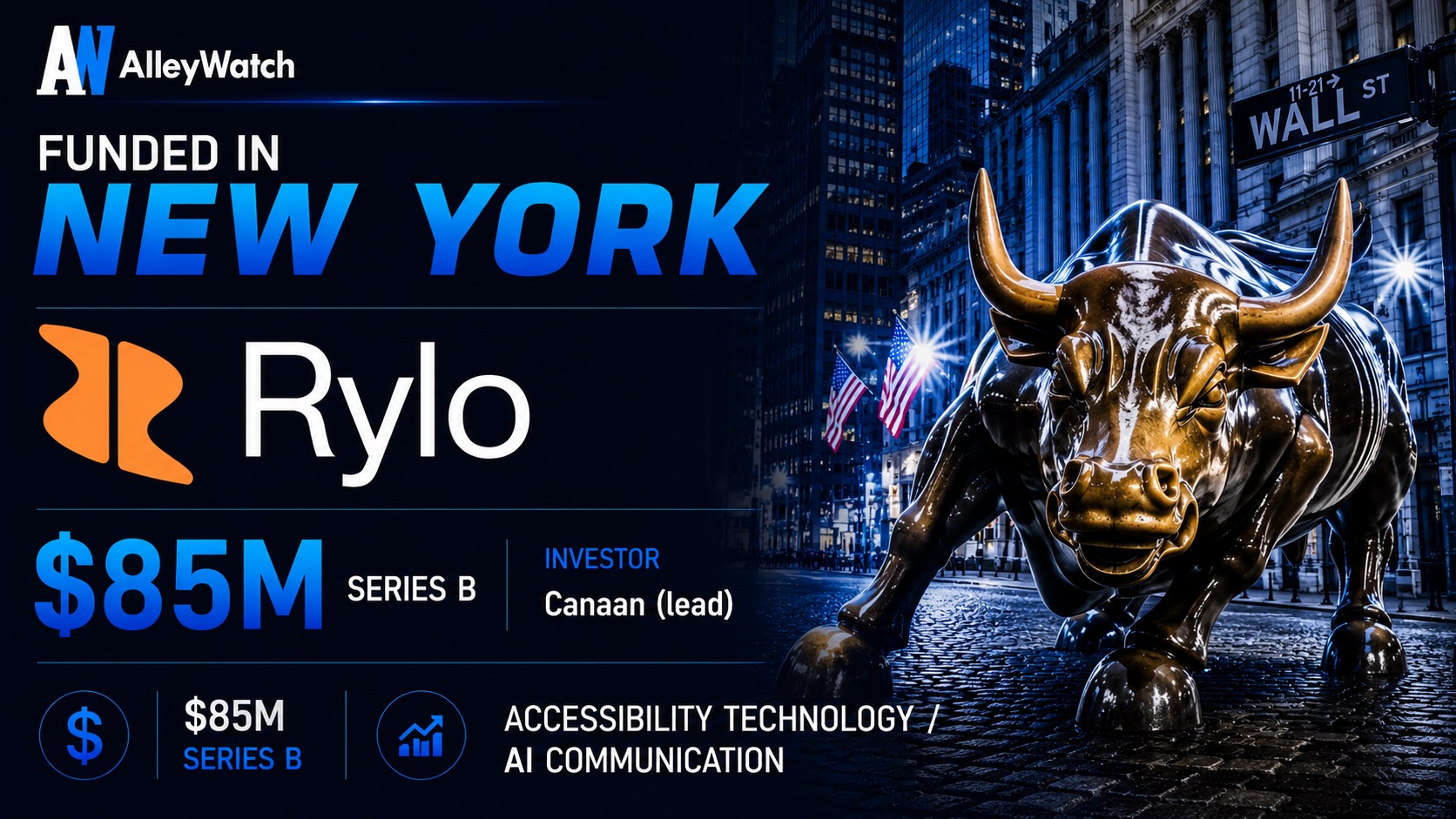
In its recent Series B round, Rylo (formerly Nagish) raised $85M in new capital, bringing the company’s total financing to date to over $100M. The financing includes growth funding from General Catalyst’s Customer Value Fund (CVF) alongside a new investment led by Canaan, with continued participation from existing investors Vertex Ventures and Contour.
Tell us about the product or service that Rylo offers.
Rylo delivers essential components that Deaf and hard-of-hearing users depend on daily: real-time captioning and text-to-speech of phone calls and in-person communication, all done utilizing AI.
Advanced AI features include:
The Rylo Phone app will continue providing its essential daily tools: AI-driven, real-time captioning and text-to-speech for both phone calls and in-person conversations.
Rylo is also introducing a suite of unique, advanced AI features designed to give users an experience equivalent to the experience of hearing people on a traditional phone call.
New and upcoming tools include workplace accessibility features, network improvements, speaker characteristics, and sentiment analysis to help users better interpret tone.
To help users navigate conversations safely, the app integrates real-time fraud and scam detection, allowing for a more independent and confident communication experience.
What inspired the start of Rylo?
Back in 2019, while attending Columbia University, I was sitting in class when I received a call. Unable to speak or hear during the lecture, I found myself wondering, “How can someone have a phone call when they can’t speak or hear?” After class, I shared this thought with Alon Ezer, my co-founder and Nagish’s CTO. His immediate response was, “How do Deaf people communicate?” That moment opened our eyes to a significant gap: the Deaf and hard-of-hearing community did not have the ability to have private conversations. They were forced to rely on interpreters, stenographers, captioners, friends, family, or others to communicate. We knew we had to change that.
How is Rylo different?
What sets Rylo apart isn’t just the technology, but the community that serves as its foundation and focus. While many companies shy away from niche markets, my team at Rylo leaned into this space, building a communication bridge from the ground up. Unlike traditional alternatives, Rylo rejects the community’s dependence on outdated transcription tools and third-party interpreters, leveraging AI to provide users with complete independence, privacy, and real-time communication without barriers.
Rylo was built in direct partnership with members of the Deaf community to shape and refine the product. This commitment is reflected in our hiring strategy: We always aim to hire from the communities we’re serving and we have intentionally grown a diverse team of Deaf and hard-of-hearing team members.
What market does Rylo target and how big is it?
Rylo’s mission is to build the most reliable, accurate, and accessible communication tools for the billion+ individuals living with hearing loss.
We are driven by a lean team of only 32 members, all united by this shared mission and goal.
What’s your business model?
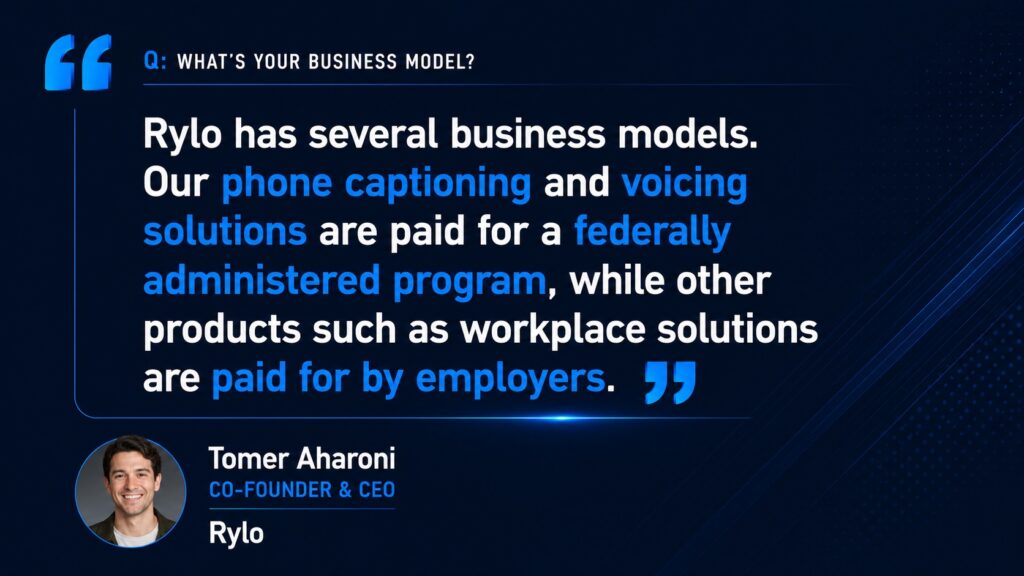
Rylo has several business models. Our phone captioning and voicing solutions are paid for a federally administered program, while other products such as workplace solutions are paid for by employers.
How are you preparing for a potential economic slowdown?
We are diversifying our revenue stream, relying heavily on AI and are doing everything we can to keep the team lean.
What was the funding process like?
Throughout the journey, we faced pushback from candidates, other founders, and investors who viewed the product as a “cute project” rather than a serious, scalable business opportunity. Many investors questioned the size and validity of the hearing-loss market.
To counter the “noble project” stigma, we explicitly rejected meetings with Impact Funds. We wanted to prove that accessibility is a highly lucrative sector and ultimately brought on prominent venture capital firms like General Catalyst, Canan, K5 Global, Precursor, Vertex, Cardumen and others.
What are the biggest challenges that you faced while raising capital?
When we raised our Seed round, we faced rejection 77 times before we finally got a “yes.” For two and a half years, we operated without generating revenue, working tirelessly to show that Rylo (then Nagish) could become a sustainable and impactful business. Those ups and downs kept me grounded, constantly reminding me that the most important thing is serving our users, and the rest will naturally follow.
What factors about your business led your investors to write the check?
Investors were driven to back Rylo because the company moved faster than anything they’ve seen before. Our ability to constantly deliver on our promises and successfully leverage AI to address a critical, historically underserved need in communication accessibility with a product that deeply resonates with its users, was a clear mark that we’re doing things differently here.
Investors were driven to back Rylo because the company moved faster than anything they’ve seen before. Our ability to constantly deliver on our promises and successfully leverage AI to address a critical, historically underserved need in communication accessibility with a product that deeply resonates with its users, was a clear mark that we’re doing things differently here.
What are the milestones you plan to achieve in the next six months?
We have aggressive goals for the rest of the year, but our main milestone is expanding the team by bringing in the brightest people out there.
What advice can you offer companies in New York that do not have a fresh injection of capital in the bank?
More than anything, and especially in today’s landscape, don’t get distracted by external factors like how much another company has raised or who the competition is. Those factors don’t matter as much as they seem. A competitor’s new product launch doesn’t mean they know better than you, as long as you stay close to your users and trust your instincts. Only two things truly matter: revenue growth and user impact, and neither happens in the spotlight.
Where do you see the company going now over the near term?
Over the near term, I see Rylo evolving into an essential communication companion that is accessible anytime and anywhere communication takes place. While we currently focus heavily on over-the-phone communication, we already have an in-person solution built right into our app, and we plan to launch a dedicated workplace solution next. Following our recent $85 million funding raise, we are aggressively using this capital to educate the public and scale the company, with the ultimate goal of making Rylo a known household name. Part of this next chapter includes deep innovation; following our acquisition of SignMT, we are actively researching the possibility of leveraging AI to achieve real-time sign language translation with absolutely no humans in the loop. Ultimately, our vision is to build an entire ecosystem that removes every single piece of communication friction, whether that means completing a routine task like ordering a coffee, placing an emergency call to 911, or seamlessly talking to a doctor.
What’s your favorite spring destination in and around the city?
My favorite spot during the spring is the West Village. Everyone is out, the weather is amazing. A walk, an early coffee in the sun, or a sunset drink at Bar Pisellino always makes me happy.