
Mental health care faces a paradox: demand has surged to record levels, yet the infrastructure supporting clinicians remains fundamentally broken. While physical medicine embraced data integration and continuous monitoring decades ago, behavioral health providers still operate on outdated EHR systems designed for billing rather than care delivery. The result is staggering: 62% of behavioral health providers report moderate to severe burnout, with administrative burden consuming hours that could be spent on patient care. Legacy systems force clinicians to juggle multiple logins, manual documentation, and fragmented workflows while mental health diagnoses rely heavily on subjective recall rather than measurable data. Oasys addresses this crisis by building the first AI-native operating system specifically for behavioral health, unifying practice management, clinical decision support, and physiological data from wearables like Apple Watch, Oura Ring, Strava, and Flo into a single intelligent platform. The system automates core workflows like documentation, scribing, billing, scheduling, and insurance reimbursements, saving clinicians 10+ hours weekly while transforming therapy from reactive to proactive through continuous monitoring of sleep, activity, heart rate, and other health signals. With partnerships spanning more than 25 health clinics nationwide and the ability to onboard new practices in just 48 hours, Oasys demonstrates measurable impact: significant reductions in claim denials, faster reimbursements, and improved patient engagement through data-driven insights that enable early risk detection and preventive interventions.
AlleyWatch sat down with Oasys Founder and CEO Hashem Abdou to learn more about the business, the company’s strategic plans, and recent funding round, and much, much…
Who were your investors and how much did you raise?We raised $4.6M total, including a $4M seed round led by Pathlight Ventures, with participation from Twine Ventures and Better Ventures, and $600K in pre-seed funding from 1984 Ventures.
Tell us about the product or service that Oasys offers.Oasys is the first AI-native operating system for behavioral health. We unify practice management, clinical decision support, and physiological data into a single intelligent platform. The system automates core workflows—documentation, scribing, billing, scheduling, and insurance reimbursements—while seamlessly syncing with leading wearables and health apps such as Apple Watch, Oura Ring, Strava, and Flo. By bridging behavioral and physical health data, we help clinicians save 10+ hours each week on administrative tasks while turning fragmented notes and wearable data into actionable insights that inform care and enable proactive interventions.
What inspired the start of Oasys?Two of our three founders were raised by psychologists, which gave us a front-row seat to the challenges therapists face daily. We watched our parents spend countless hours on paperwork, which could have been spent on patient care. With that foundation, we all recognized a huge disconnect within mental health care: every other area of medicine has been embracing data, automation, and continuous monitoring—but mental health remains largely analog. For decades, therapy has been a subjective, session-based practice built on intuition and recall rather than measurable evidence—despite existing technology to track heart rate, sleep, and activity continuously. We founded Oasys to close that gap and create a world where physiological data unlocks the full potential of therapy and catalyzes better health outcomes.
How is Oasys different?While competitors optimize a slice of behavioral health workflows, Oasys unifies AI, automation, and physiological data into a single system. Legacy EHR platforms were built for billing, not care—they run on disconnected, decades-old infrastructure. Companies like Headway and Growtherapy did an amazing job of expanding access. We’re focused on what happens after a patient gets through the door: how good is the care, how continuous, how measurable?We built Oasys from the ground up as an AI-native operating system. Other point solutions focus on patient acquisition, single biomarkers, or phenotyping, but Oasys powers the full practice. We’re the connective tissue that transforms therapy from reactive to proactive, measurable, and continuous. Our competitive advantage deepens over time: as we collect more therapist-labeled data tied to real outcomes, our clinical decision support and predictive models become more powerful, creating a defensible data moat.
What market does Oasys target and how big is it?We target enterprise-scale mental health organizations that value clinical precision, operational efficiency, and data-driven care. This includes large clinics and group practices, hospital systems and behavioral health centers, Managed Service Organizations (MSOs) overseeing multiple mental health entities, and universities and schools investing in campus mental health infrastructure.The global behavioral health market is massive and growing rapidly. In the U.S. alone, it was valued at more than $89 billion in 2024 and is expected to reach $165.4 billion by 2034 (see Becker’s Behavioral Health). Global rates of anxiety, depression, and burnout are also at record highs, yet timely, high-quality care remains inaccessible. The demand for data-driven, scalable solutions has never been greater.
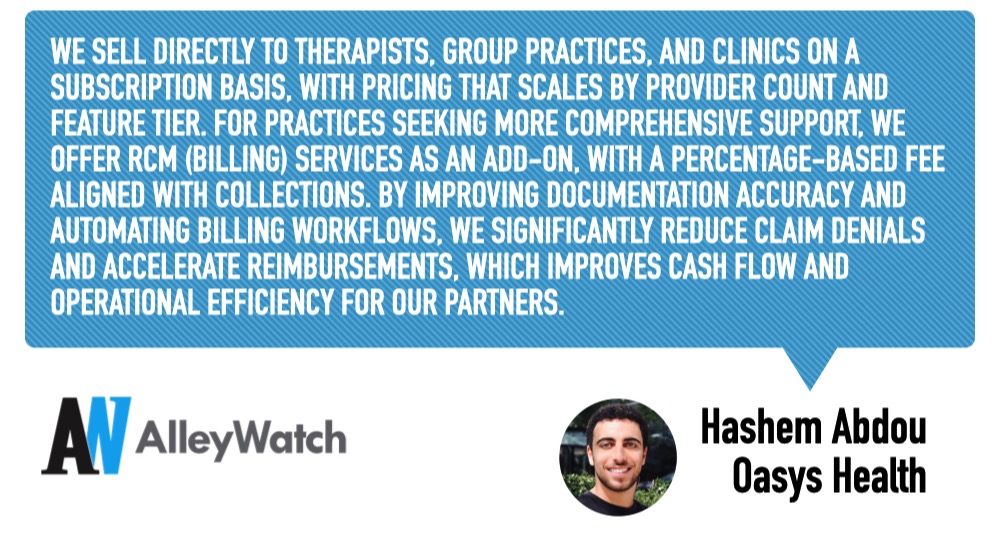
What’s your business model?We sell directly to therapists, group practices, and clinics on a subscription basis, with pricing that scales by provider count and feature tier. For practices seeking more comprehensive support, we offer RCM (billing) services as an add-on, with a percentage-based fee aligned with collections. By improving documentation accuracy and automating billing workflows, we significantly reduce claim denials and accelerate reimbursements, which improves cash flow and operational efficiency for our partners.
How are you preparing for a potential economic slowdown?Healthcare is one of the most resilient sectors during economic downturns. In fact, mental health demand tends to increase during periods of economic stress. Our value proposition becomes even more critical in tighter markets: we help practices reduce costs by consolidating multiple disconnected tools into one platform, we save clinicians 10+ hours per week, which directly improves their throughput and work-life balance, and we unlock new revenue opportunities through RPM billing codes. We’re focused on delivering immediate, measurable ROI so that our platform becomes essential infrastructure rather than a discretionary expense.
What was the funding process like?
It was fast, focused, and very operator-driven. We didn’t run a broad spray-and-pray process. We spoke with a small set of investors who deeply understood healthcare, mental health, or infrastructure, and we spent most of the time showing real usage, real clinics, and real problems we were already solving.
What helped most was that we weren’t pitching a vision in the abstract. We had paying customers, active pilots, and clear signals around where value was being created (time saved, administrative burden reduced, better operational visibility). That made the conversations concrete and practical.
The process itself was intense but efficient: tight feedback loops, rapid iteration on the story, and a lot of diligence around product, roadmap, and market depth. We optimized for alignment over hype and ended up with partners who think long-term and are genuinely excited to build with us.
What are the biggest challenges that you faced while raising capital?The biggest challenge was educating investors on why now is the inflection point for AI-native infrastructure in mental health. We had to prove that this isn’t a feature, it’s a fundamental reimagining of how behavioral health operates. Another challenge was demonstrating product-market fit at an early-stage company. We addressed this by showing real traction: 25+ health clinics already using the platform, measurable time savings, reduced claim denials, and strong retention rates. There’s always the question of differentiation in a crowded market, and we had to articulate not just what we do, but why our AI-native approach creates a compounding advantage that legacy systems can’t replicate.
What factors about your business led your investors to write the check?Three factors stood out. First, our founding team: we combine deep technical expertise with a personal connection to the mission. Two of us were raised by psychologists, and our technical backgrounds, Harvard biomedical engineering, Duke computer science, and Harvard applied math, gave us credibility to build at the intersection of AI and clinical care. Second, our early traction validated that we weren’t solving a theoretical problem. Clinics were onboarding in 48 hours, providers were consistently reporting 10+ hours of weekly time savings, and our integrations with wearables demonstrated that the market was ready for this level of data integration. Third, our vision for building a data moat. Investors understood that as we collect more therapist-labeled data tied to real outcomes, our models improve, our clinical insights deepen, and we become increasingly difficult to displace.
Three factors stood out. First, our founding team: we combine deep technical expertise with a personal connection to the mission. Two of us were raised by psychologists, and our technical backgrounds, Harvard biomedical engineering, Duke computer science, and Harvard applied math, gave us credibility to build at the intersection of AI and clinical care. Second, our early traction validated that we weren’t solving a theoretical problem. Clinics were onboarding in 48 hours, providers were consistently reporting 10+ hours of weekly time savings, and our integrations with wearables demonstrated that the market was ready for this level of data integration. Third, our vision for building a data moat. Investors understood that as we collect more therapist-labeled data tied to real outcomes, our models improve, our clinical insights deepen, and we become increasingly difficult to displace.
What are the milestones you plan to achieve in the next six months?In the next six months, we’re focused on enhancing our AI-powered platform, deepening integrations with leading wearables and health apps, growing our engineering and data science teams, and expanding our network of partnerships with health clinics, behavioral health centers, Managed Service Organizations (MSOs), and universities and schools investing in long-term campus mental health infrastructure.By end of year, Oasys also plans to launch a robust outcomes measurement framework, providing clinicians with standards to track patient progress and prove therapy effectiveness over time.
What advice can you offer companies in New York that do not have a fresh injection of capital in the bank?
Be ruthlessly focused on survival and momentum. In New York, especially, it’s easy to get pulled into expensive optics (office space, headcount, brand polish) before the fundamentals are solid. If you don’t have fresh capital, your job is to buy time by creating real leverage. The companies that survive dry spells aren’t the loudest. They’re the ones quietly shipping, selling, and compounding trust until capital becomes an accelerant—not a lifeline.
Where do you see the company going now over the near term?In the near term, we’re focused on proving that AI can meaningfully improve therapist well-being and patient outcomes—not just efficiency. We’re rapidly emerging as the new infrastructure layer for modern behavioral health, and we want to become the most trusted AI-powered platform that clinicians rely on daily. We’ll continue expanding our network of health clinic partners, refining our product’s design and user experience, and strengthening our data integrations. We’re also investing heavily in Oasys Labs, our research and development arm, where we’re operationalizing predictive modeling to identify early indicators of mental health decline. Our momentum reflects a fundamental turning point for mental health care, where data and AI empower, rather than replace, clinicians.
What’s your favorite winter destination in and around the city?Wei’s in Williamsburg — low-key, cozy, and unfussy. Great comfort Chinese, generous portions, and zero hype, which somehow makes it perfect in the winter.
You are seconds away from signing up for the hottest list in NYC Tech!
Sign up today