Hugh Grosvenor inherited the title 7th Duke of Westminster in 2016 at the age of 25, and with it a property empire valued today at around £9.9 billion, including roughly 300 acres of central London — the Georgian squares of Mayfair and the white-stucco terraces of Belgravia — that his family has held, unbroken, since 1677. The freehold beneath Grosvenor Square, the American Embassy’s former home, still belongs to him. So does the ground under most of Eaton Square, where hedge fund managers pay millions for leases on flats they will never truly own.
The Grosvenors do not sell. They lease. That single decision, made and re-made across eleven generations, is why a man born in 1991 walked into adulthood as one of the richest people in Britain.
A marriage in 1677 that never stopped paying
The story begins with a young baronet named Sir Thomas Grosvenor marrying a wealthy heiress called Mary Davies. Her dowry included substantial acreage of swampy pasture west of the City of London — land nobody particularly wanted at the time. It sat between the village of Charing and the river, muddy and unfashionable.
Within a century, London had swallowed it. The Grosvenors began granting long building leases in the 1720s, allowing developers to put up townhouses on ground the family retained. When the leases expired, the buildings reverted. The rent rolls compounded. The family kept the dirt.
That legal instrument — the long leasehold on ground the freeholder never surrenders — is the quiet machine underneath the fortune. It is not glamorous. It does not appear on magazine covers. It simply runs, decade after decade, through wars, tax reforms, and property crashes.
What 300 acres of Mayfair and Belgravia actually contains
The Grosvenor Estate’s central London holdings cover the area bounded roughly by Oxford Street to the north, Park Lane to the west, Piccadilly to the south, and Regent Street to the east — that is Mayfair — plus the whole of Belgravia south of Hyde Park Corner, running down to Pimlico Road.
Inside that footprint sit some of the most expensive addresses in Europe. Grosvenor Square. Berkeley Square. Mount Street, with its red-brick Queen Anne facades and its Michelin-starred restaurants. Eaton Square, where flats routinely trade for tens of millions of pounds. Chester Square, where Margaret Thatcher lived after leaving office.
The estate does not own every building on every street. Some plots were sold off over the centuries — occasionally by necessity, more often by strategic pruning. But the core is intact, and the leases keep coming back.
The inheritance that arrived without warning
Hugh’s father, Gerald Cavendish Grosvenor, the 6th Duke, died suddenly of a heart attack in 2016 while walking on the family’s Abbeystead estate in Lancashire. He was 64. Hugh, then 25, was working at a sustainability startup and living what friends described as a deliberately low-key life in London.
The title passed instantly. So did the trust structures that hold the property. Because the estate is held in a series of family trusts rather than by the Duke personally, it was largely shielded from the 40 percent inheritance tax that would have applied to a direct bequest — a legal arrangement that generated considerable public argument in 2016 and remains one of the sharpest examples of how high-net-worth families structure their affairs to survive generational transfer.
The trusts have been refined over roughly a century, ever since estate planning around death duties began in earnest in the early twentieth century. Each generation has tightened them.
Why the family will not sell the ground
Selling freeholds in Mayfair would produce an enormous one-time payment and end the story. Leasing them produces a smaller annual income that never ends. Compounded across three centuries, the second option has produced something no cash sale could have matched.
There is also the matter of control. As freeholder, the Grosvenor Estate sets covenants — rules about what tenants can and cannot do with the buildings. It has used these covenants to keep Mount Street from becoming a strip of chain stores, to preserve the tree canopy in Belgravia’s garden squares, and to require certain shopfronts to maintain their original proportions.
Walk down Mount Street today and the reason it looks the way it does — the terracotta, the awnings, the absence of neon — is that one landlord, invisible but constant, has been saying no for a hundred and fifty years.

The wider portfolio
Central London is the jewel, but the Grosvenor Group operates across four continents. The company reports property holdings in North America, continental Europe, and Asia-Pacific, with investments in Vancouver, San Francisco, Tokyo, and Hong Kong. There is a rural estate business too — substantial acreage of British countryside, including farmland in Cheshire around the family seat at Eaton Hall, plus the Abbeystead grouse moor in Lancashire and holdings in Scotland and Spain.
The Cheshire holdings alone are large enough that the family effectively owns the villages of Aldford, Eccleston, and Pulford. Cottage rents there run at a fraction of the Belgravia numbers, but the freeholds are the same instrument, doing the same work.
A 25-year-old inheriting the machine
Hugh Grosvenor did not build any of this. He was handed it. He has largely avoided public commentary since his inheritance.
He studied countryside management at Newcastle University. He worked at Bio-bean, a startup turning coffee grounds into biofuel. He is Prince George’s godfather. He married Olivia Henson in 2024 at Chester Cathedral in a ceremony attended by Prince William, and the couple’s first child was born in 2025.
The public appearances are sparse. The photographs, when they appear, show a man who looks like a slightly nervous rugby prop. The billions accumulate around him, largely without his intervention, because that is what the trusts and the lease structure are designed to do.
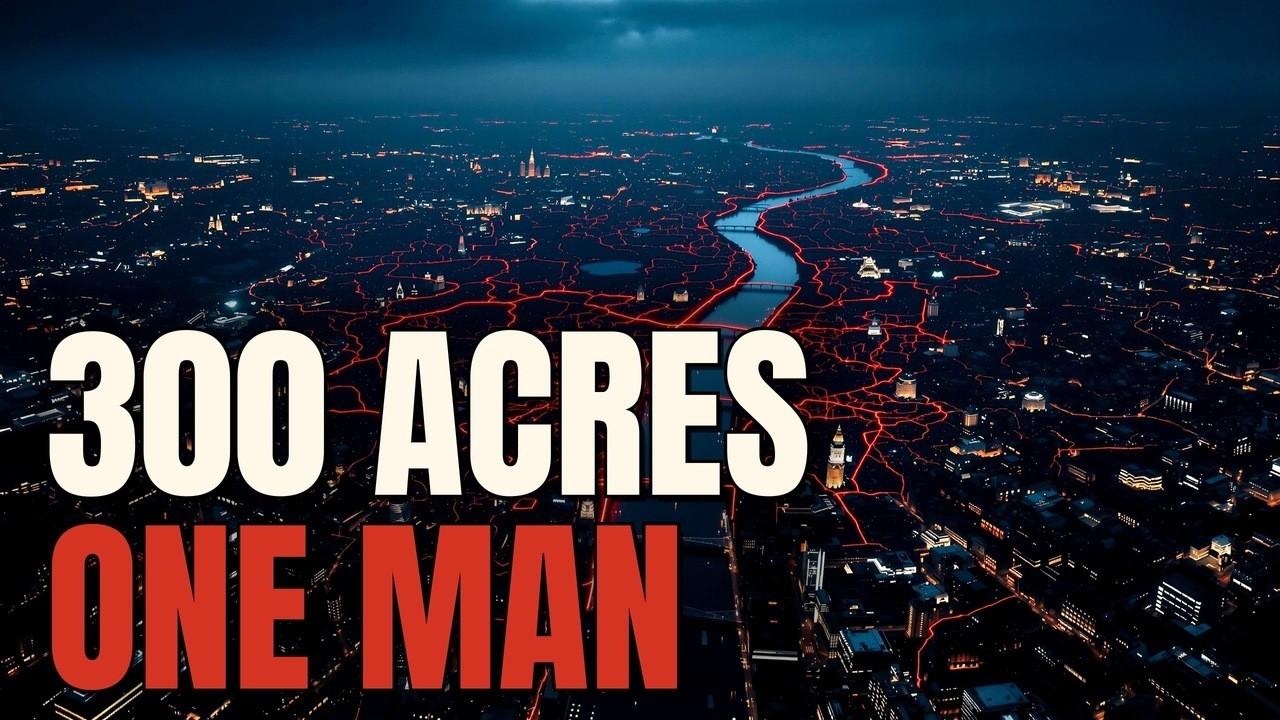
► Watch · Silicon Canals He Owns Half of London and You’ve Never Heard His Name Silicon Canals traces how a 17th-century marsh and a 12-year-old bride’s dowry became the quiet, multi-billion-pound property empire at the center of modern London.
What happens when a fortune arrives fully formed
The pattern is familiar among heirs of very large estates: difficulty in finding motivation when the financial rewards for effort are effectively zero. A 2026 Forbes piece on the erosion of adult motivation explored how work disconnected from meaningful reward tends to lose its pull over time. Many heirs of very large estates have described something similar in memoirs and interviews.
Grosvenor has spoken publicly about the mental weight of the inheritance, and the family has poured substantial sums into the Westminster Foundation, which funds youth work and rural regeneration projects. Whether that counts as purpose or as a well-designed coping mechanism is a question the family probably asks itself.
The great wealth transfer, in one household
The financial services industry has spent the last five years talking about what it calls the great intergenerational wealth transfer — the tens of trillions expected to move from baby boomers to their children over the next two decades. Advisors now spend considerable energy trying to hold onto the heirs once the parents die, as many heirs change their family’s advisors after inheritance.
The Grosvenors solved that problem in 1677 by refusing to become clients of anyone. They built their own estate office, their own legal team, and their own set of rules. Younger inheritors today often experiment with crypto and private equity; the Grosvenor answer has been to keep collecting rent on the same fields Mary Davies brought to her wedding.
Why the numbers keep growing
The Sunday Times Rich List has tracked the Grosvenor fortune for decades. It has fluctuated with London property prices, but has shown steady long-term growth. The 2025 list placed it at around £9.9 billion, down slightly from roughly £10.1 billion the year before. Independent property analysts have suggested the true figure, if the freeholds were ever marked to full open-market value, could be considerably higher.
Ground rents on 999-year leases sound trivial — a few hundred pounds a year, sometimes a peppercorn — but the reversionary value is where the wealth sits. When a 125-year lease approaches expiry, the leaseholder must negotiate an extension, and those negotiations produce enormous premium payments to the freeholder. Every year, somewhere in Mayfair or Belgravia, a lease is being extended and a cheque is being written to the estate.
That is the machine. It does not require Hugh Grosvenor to do anything. It has not required any Duke of Westminster to do very much since the Georgian building booms ended. The relationship between wealth and wellbeing gets complicated at this altitude — the numbers become abstract, the responsibility becomes generational, and the person at the top becomes, in some sense, a caretaker rather than an owner.
Three centuries and counting
Stand at the corner of Grosvenor Square today. The plane trees are old but not as old as the lease structure beneath them. The American Embassy has moved to Nine Elms; the old building is being converted into a luxury hotel. The freehold is still Grosvenor’s.
In 2177 — 500 years after Sir Thomas Grosvenor’s wedding — someone will still be signing lease extensions on this ground, and unless something extraordinary intervenes, that person will share his surname.