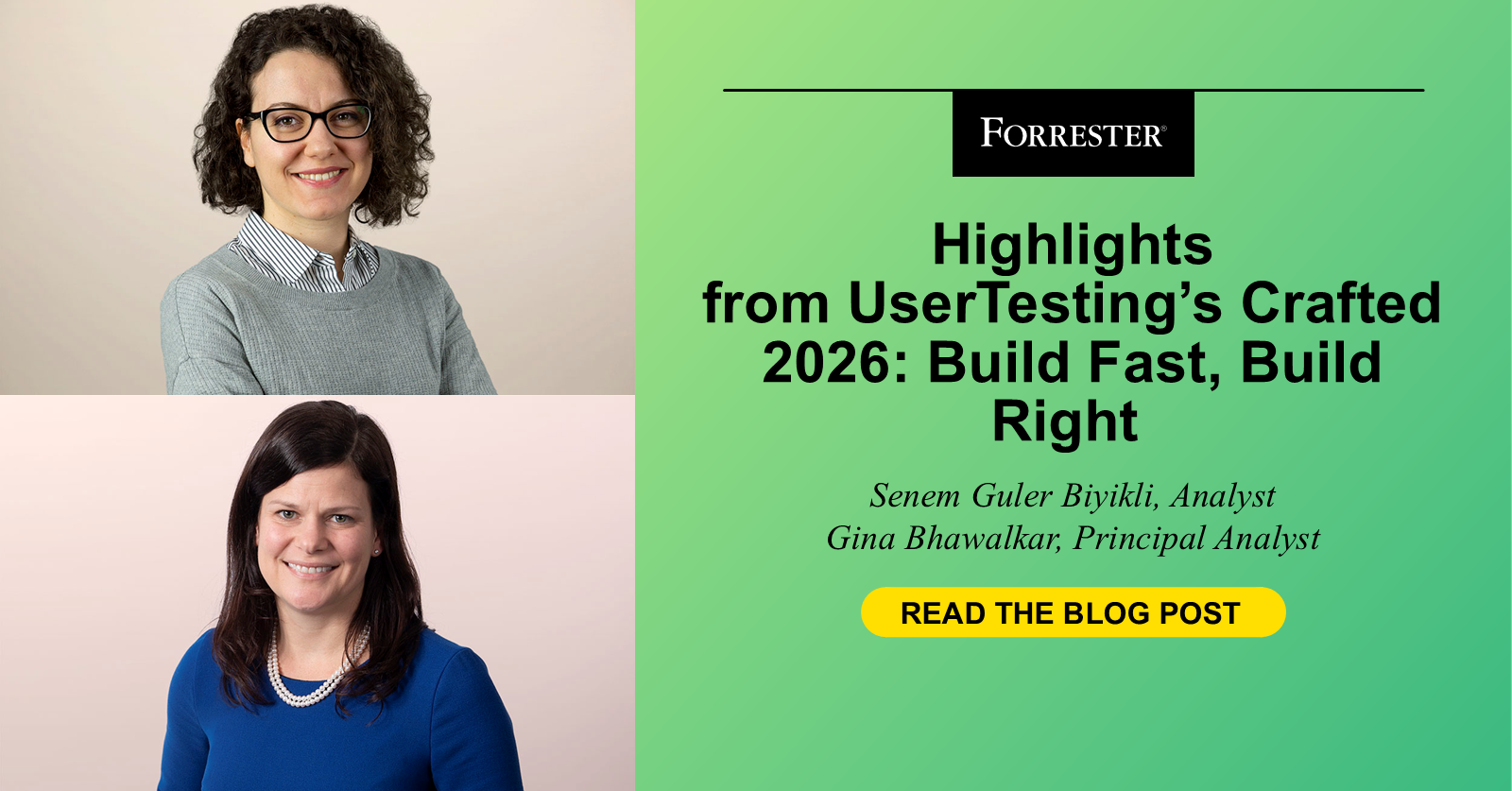
On May 28, we joined the research community at UserTesting’s Crafted event in Seattle. The energy was palpable, with passionate researchers and designers eager to evolve their craft responsibly and effectively in the age of AI. A clear takeaway of the event was that building fast doesn’t matter if you’re not building the right thing. As AI makes creation easier, decisions grounded in research and insights become the true differentiator.
Here’s our other takeaways and what they mean for experience research:
UserTesting is meeting builders where they work. Before AI, experience research platforms were trending toward all-in-one platforms designed to serve all research needs. That trajectory is shifting. As AI transforms how work gets done and how information flows across organizations, the future is in integrated systems that embed insights directly into workflows. UserTesting’s newly announced MCP servers reflect this shift — enabling builders from research to design to launch tests from the AI tools that they use, such as Claude. Similarly, its Figma plugin allows teams to initiate studies without leaving the Figma canvas. These moves expand access to insights to a broader group of “builders” — not only researchers and designers but also product managers, marketers, and anyone who builds experiences.
Data quality is a competitive advantage. AI can scale value — but also dysfunction if it operates on the wrong foundations. That’s why high-quality human data matters even more in the age of AI: It deepens customer understanding and provides the right context for AI to scale. As organizations increasingly train internal LLMs and build synthetic personas, continuous access to real human data is critical to keeping those systems accurate and relevant. UserTesting reinforces this by expanding its panel and platform capabilities: It already had a strong participant panel, recently acquired User Interviews to grow it further, and announced plans to add AI-moderated interviews to the platform soon.
Designer and researcher roles are evolving. As AI takes on execution-heavy tasks, designer and researcher roles are shifting upstream and toward strategy. As Jason Giles, VP of product design at UserTesting, put it, “If you see your work as producing reports or building prototypes only, you’re at risk.” The real power lies in asking strategic questions and protecting human-centered design principles while integrating AI responsibly and effectively. Baran Erkel, chief strategy officer at UserTesting, said, “When anyone can build anything, the winners will be the ones who know what to build.” In this era, the value of researchers and designers increasingly comes from their ability to guide organizations strategically, bringing empathy, context, creativity, judgment, and taste to decision-making.
Strong relationships remain the bedrock of success. Another key message from the keynotes: Focus on mindset — not tools — to drive transformation. Amid all the discussion of AI and automation, Brad Carrera, senior manager of design research at McDonald’s, pointed out that relationships still matter most. He emphasized the importance of returning to fundamentals. As his team increasingly offloads monotonous, repetitive work to AI, he encourages them to reinvest that time in strengthening existing relationships and cultivating new ones across the organization. In large, complex organizations, influence, not just research and data, drives impact.
What’s Next?
AI is helping organizations move faster, but it’s time to change the focus from speed to value. The real opportunity lies in how teams reinvest the time AI gives back to create better experiences. It was great to meet passionate researchers and designers who were thoughtful of this need and eager to learn how to transform the craft.
We discuss these themes further in our latest report, Build Your AI-Enabled Research And Design Workflow. AI is transforming the design workflow by compressing phases, blurring roles, and reshaping how teams collaborate.
If you would like to compare notes from Crafted or discuss our report, we’d love to connect. You can set up a conversation with us. You can also follow or connect with us (Gina Bhawalkar and Senem Guler Biyikli) on LinkedIn if you’d like.