No Result
View All Result
SUBMIT YOUR ARTICLES
  • Login
Friday, August 7, 2026
TheAdviserMagazine.com
  • Home
  • Financial Planning
    • Financial Planning
    • Personal Finance
  • Market Research
    • Business
    • Investing
    • Money
    • Economy
    • Markets
    • Stocks
    • Trading
  • 401k Plans
  • College
  • IRS & Taxes
  • Estate Plans
  • Social Security
  • Medicare
  • Legal
  • Home
  • Financial Planning
    • Financial Planning
    • Personal Finance
  • Market Research
    • Business
    • Investing
    • Money
    • Economy
    • Markets
    • Stocks
    • Trading
  • 401k Plans
  • College
  • IRS & Taxes
  • Estate Plans
  • Social Security
  • Medicare
  • Legal
No Result
View All Result
TheAdviserMagazine.com
No Result
View All Result
Home Market Research Investing

Book Review: Can’t Deny It

by TheAdviserMagazine
12 months ago
in Investing
Reading Time: 4 mins read
A A
Book Review: Can’t Deny It
Share on FacebookShare on TwitterShare on LInkedIn


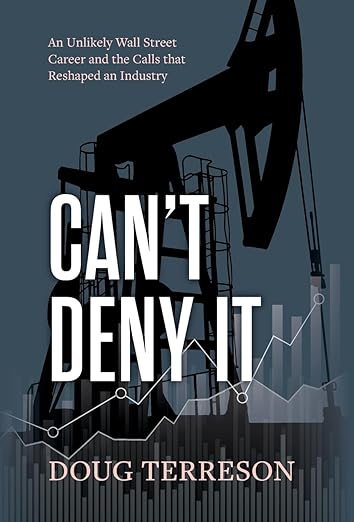
Can’t Deny It: An Unlikely Wall Street Career and the Calls that Reshaped an Industry. 2024. Doug Terreson. Seminole LLC.

In Can’t Deny It, Doug Terreson, former head of Energy Research at Evercore ISI and Morgan Stanley, provides a fascinating memoir in which readers are taken on a journey through the worlds of the Gulf of Mexico oil patch, global oil markets, and Wall Street. He describes the inside stories behind his notable market calls in such chapters as “The Era of the Super-Major,” “The Golden Age of Refining,” and “The Pledge.” Terreson was ranked as the #1 or #2 Integrated Oil Analyst in the Institutional Investor poll for 20 years and was a member of the All-America Research Team (II) 24 times.

In the chapter “Cutting My Teeth in the Oil Patch,” the author shares that prior to his Wall Street career, he worked as an engineer for Schlumberger (now SLB). He explains how his firsthand experience with evolving technologies and processes in the oil industry gave him a significant advantage in his finance career.

Acquiring geological and technological expertise, as well as extensive field experience, was a rarity among his Wall Street peers, who typically came from economics or finance with Ivy League degrees and worked in investment banks, asset management, or private equity. For younger practitioners, Terreson’s early career path offers a reminder that working in a selected industry can provide valuable experience prior to embarking on a finance or Wall Street career.

As a real estate finance practitioner, I found Terreson’s summary of crude oil and the chaos of 2008 during his time at Morgan Stanley to be the most interesting part of Can’t Deny It. His oil price forecast of $95/bbl for 2008, made on 14 March 2008, was in stark contrast to the prevailing Wall Street consensus, which was raising forecasts daily to align with rising market prices. In March 2008, the West Texas Intermediate crude oil price got as high as $110/bbl.

Goldman Sachs indicated a likelihood of $150–$200/bbl over the next six to 24 months, while other competitors asserted that oil could rise to $200 or even $300/bbl, which highlighted the bullish sentiment at the time. Terreson left Morgan Stanley on 8 July 2008, just three days prior to the all-time peak oil price of $147/bbl on 11 July 2008. The price eventually plunged to $37/bbl by December 2008 and for the year as a whole averaged $98/bbl, within 3% of his $95/bbl projection for 2008. This experience taught him to trust his instincts and the value of rigorous analysis, as well as to be willing to stand apart from the crowd, even when it is uncomfortable.

The chapter on privatizations highlights the important role that Terreson played in the initial public offerings of Sinopec in China, Statoil in Norway (now Equinor), and Conoco in the United States and explores the heartbreaking story of PDVSA, Venezuela’s national energy company. The author summarizes how Morgan Stanley’s proposal to privatize PDVSA was rejected by the new government after Hugo Chávez won the presidential election in December 1998.

The result was an economic disaster in Venezuela as oil production plummeted due to mismanagement, corruption, economic sanctions, and such flawed policies as currency and price controls. In thinking about the potential trajectory of PDVSA and Venezuela, the author correctly stresses how the country had the opportunity to mirror Norway’s success with its massive sovereign wealth fund, benefiting current citizens as well as future generations.

My favorite chapter is the final one, in which the author highlights current trends in the industry, including those that led him to leave Evercore ISI in July 2021. A key factor for his departure involved the broader changes occurring within Wall Street research and investment banking as firms began to increasingly compete more with financial capital rather than intellectual capital.

A key shift in sell-side research resulted from the European Union’s 2014 Markets in Financial Instruments Directive (MiFID), which introduced new regulations aimed at enhancing competitiveness. Under these new rules, financial institutions must unbundle the cost of research from other services and directly charge clients for it. This new system does not favor older business models that allowed analysts like Terreson the time, focus, resources, and freedom to make substantial, multi-year strategic forecasts. Another important trend is rapidly evolving artificial intelligence (AI), which has the potential to disrupt the financial industry and the work of Wall Street research analysts.

The author skillfully incorporates personal stories — including how his 48-foot boat named “Can’t Deny It” and crew won the Emerald Coast Blue Marlin Classic — to explain the business lessons he has learned. This memoir, written by one of the most decorated research analysts in recent decades, covers many relevant topics and will appeal to all finance practitioners and energy industry specialists.


Source link

Tags: bookdenyReview
ShareTweetShare
Previous Post

Nice rises then plunges on Q2 results

Next Post

How accounting firms can break out of comfort zones

Related Posts

edit post
Those That Were Considered To Be “Dirt Poor” In 1987 Would Be Considered To Be Very Wealthy In 2026

Those That Were Considered To Be “Dirt Poor” In 1987 Would Be Considered To Be Very Wealthy In 2026

by TheAdviserMagazine
August 6, 2026
0

by MichaelAmericans are facing the longest and most painful affordability crisis in our entire history, and young people are being...

edit post
The Lows Are In… Get Ready for ,000 Gold

The Lows Are In… Get Ready for $7,000 Gold

by TheAdviserMagazine
August 6, 2026
0

via gainspainscapitalOn July 27th, 2026, I penned an article proclaiming, “Gold may have just bottomed.”I missed the exact lows by...

edit post
Could Treasury Yields Break the AI Boom?

Could Treasury Yields Break the AI Boom?

by TheAdviserMagazine
August 4, 2026
0

Skip to contentInvestment Watch Blog Menu Menu HomeAboutSubscribeMonthly Subscription6-Month SubscriptionYearly SubscriptionMember’s AreaMember HubLoginAccountPrivacy PolicyDisclaimerAugust 5, 2026, 1:17 am by Alex...

edit post
Conversations with Frank Fabozzi, Featuring Kari Vatanen

Conversations with Frank Fabozzi, Featuring Kari Vatanen

by TheAdviserMagazine
August 4, 2026
0

Key discussion pointsBeyond the traditional 60/40 portfolio: Why investors are rethinking the role of bonds, diversification, and portfolio objectives.Total portfolio...

edit post
2026’s “Discounted” Properties Aren’t the Bargain They Look Like

2026’s “Discounted” Properties Aren’t the Bargain They Look Like

by TheAdviserMagazine
August 4, 2026
0

James:Deals are often evaluated on what they could make, but sometimes it’s more important to question on what they could...

edit post
Warning: Japan Is About to Break

Warning: Japan Is About to Break

by TheAdviserMagazine
August 3, 2026
0

via gainspainscapitalThe Great Debt Crisis of our lifetimes may be just around the corner.Japan is the grandfather of debt and...

Next Post
edit post
How accounting firms can break out of comfort zones

How accounting firms can break out of comfort zones

edit post
MHA reports 47.4% income growth in FY25

MHA reports 47.4% income growth in FY25

  • Trending
  • Comments
  • Latest
edit post
Georgia Senior SNAP and Meal Resources Older Adults Can Use

Georgia Senior SNAP and Meal Resources Older Adults Can Use

July 24, 2026
edit post
New Jersey Tax-Relief Events: Three July Dates Near Seniors

New Jersey Tax-Relief Events: Three July Dates Near Seniors

July 13, 2026
edit post
Judge Who Helped Violent Illegal Alien Evade ICE Faces New Test

Judge Who Helped Violent Illegal Alien Evade ICE Faces New Test

July 31, 2026
edit post
2 judges suspended in separate cases after being indicted on criminal charges

2 judges suspended in separate cases after being indicted on criminal charges

July 9, 2026
edit post
Driving the Noncitizen Voting Scandal: Registration With License

Driving the Noncitizen Voting Scandal: Registration With License

July 26, 2026
edit post
Bristlecone pines growing in the White Mountains of California germinated before the Great Pyramid was built, and the oldest one alive today, nicknamed Methuselah, has been quietly adding rings for 4,855 years in soil so poor almost nothing else survives beside it

Bristlecone pines growing in the White Mountains of California germinated before the Great Pyramid was built, and the oldest one alive today, nicknamed Methuselah, has been quietly adding rings for 4,855 years in soil so poor almost nothing else survives beside it

July 8, 2026
edit post
The Return of ‘Medicare for All’

The Return of ‘Medicare for All’

0
edit post
Partial Retreat: Ten Months of § 101 Data After the Surge

Partial Retreat: Ten Months of § 101 Data After the Surge

0
edit post
How understanding brain science can boost advisors’ business

How understanding brain science can boost advisors’ business

0
edit post
Food Inflation, Jimmy Carter’s Sweater, and  Burritos

Food Inflation, Jimmy Carter’s Sweater, and $20 Burritos

0
edit post
Copper jumps to its highest level ever. What the metal is telling us

Copper jumps to its highest level ever. What the metal is telling us

0
edit post
Do Widows Pay Taxes on Life Insurance Payouts? 

Do Widows Pay Taxes on Life Insurance Payouts? 

0
edit post
Food Inflation, Jimmy Carter’s Sweater, and  Burritos

Food Inflation, Jimmy Carter’s Sweater, and $20 Burritos

August 7, 2026
edit post
Why “Albert Einstein’s ‘Why Socialism?’”?

Why “Albert Einstein’s ‘Why Socialism?’”?

August 7, 2026
edit post
The barrier to starting a conversation is usually a bad forecast, not a lack of charm: people underestimate how much others like them, and commuters made to talk to a stranger enjoyed the trip more than those left alone, the opposite of what they predicted

The barrier to starting a conversation is usually a bad forecast, not a lack of charm: people underestimate how much others like them, and commuters made to talk to a stranger enjoyed the trip more than those left alone, the opposite of what they predicted

August 7, 2026
edit post
LIC gains 3% after Q1 earnings. Here’s what Morgan Stanley and Motilal Oswal recommend

LIC gains 3% after Q1 earnings. Here’s what Morgan Stanley and Motilal Oswal recommend

August 7, 2026
edit post
The Countries That Will Pay For The UN Tax Experiment

The Countries That Will Pay For The UN Tax Experiment

August 7, 2026
edit post
How to get the most from Erasmus+

How to get the most from Erasmus+

August 6, 2026
The Adviser Magazine

The first and only national digital and print magazine that connects individuals, families, and businesses to Fee-Only financial advisers, accountants, attorneys and college guidance counselors.

CATEGORIES

  • 401k Plans
  • Business
  • College
  • Cryptocurrency
  • Economy
  • Estate Plans
  • Financial Planning
  • Investing
  • IRS & Taxes
  • Legal
  • Market Analysis
  • Markets
  • Medicare
  • Money
  • Personal Finance
  • Social Security
  • Startups
  • Stock Market
  • Trading

LATEST UPDATES

  • Food Inflation, Jimmy Carter’s Sweater, and $20 Burritos
  • Why “Albert Einstein’s ‘Why Socialism?’”?
  • The barrier to starting a conversation is usually a bad forecast, not a lack of charm: people underestimate how much others like them, and commuters made to talk to a stranger enjoyed the trip more than those left alone, the opposite of what they predicted
  • Our Great Privacy Policy
  • Terms of Use, Legal Notices & Disclosures
  • Contact us
  • About Us

© Copyright 2024 All Rights Reserved
See articles for original source and related links to external sites.

Welcome Back!

Login to your account below

Forgotten Password?

Retrieve your password

Please enter your username or email address to reset your password.

Log In
No Result
View All Result
  • Home
  • Financial Planning
    • Financial Planning
    • Personal Finance
  • Market Research
    • Business
    • Investing
    • Money
    • Economy
    • Markets
    • Stocks
    • Trading
  • 401k Plans
  • College
  • IRS & Taxes
  • Estate Plans
  • Social Security
  • Medicare
  • Legal

© Copyright 2024 All Rights Reserved
See articles for original source and related links to external sites.