Many who do not understand markets, the division of labor, production, exchange, and profit—whether willingly or unwillingly—see no justification for unequal wealth and income because inequality can only result from nefarious activity or random luck.
Many mock Adam Smith’s “invisible hand,” but they themselves seem to believe that another invisible hand of random luck or chance unevenly distributes benefits and deficits such that greater wealth and income are illegitimate. This invisible hand of luck is also determinative to the point that it is independent of purposeful action. Therefore, those who think this way want the very visible hand of the state to rearrange wealth in a way that makes sense to them since the invisible hand of luck distributed wealth unequally.
Rothbard writes about this briefly in Man, Economy, and State, “A common criticism of free-market decisions is that ‘luck’ plays too great a role in determining incomes.” After declaring that such outcomes are largely due to this mysterious force called luck, many leap to the conclusion that such outcomes are illegitimate and that rearrangement of resources, even by coercion, is legitimate. Rothbard continues, “After charging that the market confers undue laurels on the lucky, the critic goes on to call for expropriation of the ‘rich’ (or lucky) and subsidization of the ‘poor’ (or unlucky).” These may be called luck egalitarians.
Robert H. Frank writes the following in his book, Under the Influence,
Because successful people often fail to appreciate the importance of seemingly minor random events in life, they tend to develop an exaggerated sense of entitlement to the enormous material rewards they command in the marketplace. To be sure, most successful people work hard and are highly talented. But at critical junctures, they must also have been lucky. There are plenty of others, after all, who were equally talented and hardworking, yet didn’t earn nearly as much. The problem is that when people think their success was entirely their own doing, they often become more reluctant to support taxes necessary for the investments that would create similar opportunities for the next generation. (emphasis added)
In Frank’s assessment, equal hard work and talent are both presumed among individuals, but the determinative factor is that of luck. Luck is treated as the key independent variable, without which success becomes failure. Do successful people, as Frank alleges, fail to appreciate the importance of luck or do Frank and other luck egalitarians fail to appreciate what contributes to success?
As another example, G.A. Cohen wrote in Rescuing Justice and Equality,
People with greater-than-average talents and abilities should not in justice receive more wealth and income than others, even if their work is more productive and valuable than their less-fortunately-endowed coworkers. People do not deserve the abilities by which they surpass others, and my own animating conviction…[is] that an unequal distribution whose inequality cannot be vindicated by some choice or fault or desert on the part of (some of) the relevant affected agents is unfair, and therefore, pro tanto, unjust, and that nothing can remove that particular injustice.
In other words, instead of property, wealth, and income being presumed legitimate until proven otherwise, Cohen and other luck egalitarians believe that these are suspect until vindicated to their satisfaction.
The problems with the arguments of luck egalitarians have to do with misunderstandings of uncertainty, risk, and human action, the knowledge problem and unquantifiable nature of “luck,” and the assumption that luck—to the extent it exists—necessarily implies that all success that can be attributed to it is illegitimate.
Luck, Chance, Uncertainty, and Human Action
If “luck” or “chance” or chaos are truly the paradigm of human existence, then there is no such thing as meaningful human action. What we do have to appreciate is that human experience and action always take place within a changing world of inherent uncertainty. In fact, uncertainty is necessary for human action. However, while acknowledging uncertainty and the unknown variables which we often call “chance,” there are certain other preexisting realities to make human action meaningful.
There is a nexus of presuppositions that underlies the action axiom. In order to study economics (or anything for that matter) there are several things that must be presupposed as true already including the law of causality, meaningful connections between means and ends, causes and effects, induction and the uniformity principle (UP), the laws of logic, unchanging laws that operate in a changing world, the semi-predictability of the world juxtaposed against the uncertainty about outcomes of an action, the basic reliability of sense perception, the basic reliability of memory, the connection of the mind and body, the distinction between material factors—physics, biology, and chemistry working according to natural processes—from purposeful human judgement and action. Here are a few examples from Mises on the necessity of these presuppositions and their attendant epistemological challenges,
In a universe lacking this regularity there could not be any thinking and nothing could be experienced. For experience is the awareness of identity in what is perceived; it is the first step toward a classification of events. And the concept of classes would be empty and useless if there were no regularity.
In a world without causality and regularity of phenomena there would be no field for human reasoning and human action. Such a world would be a chaos in which man would be at a loss to find any orientation and guidance. Man is not even capable of imagining the conditions of such a chaotic universe.
No thinking and no acting would be possible to man if the universe were chaotic, i.e., if there were no regularity whatever in the succession and concatenation of events. In such a world of unlimited contingency nothing could be perceived but ceaseless kaleidoscopic change. There would be no possibility for man to expect anything. All experience would be merely historical, the record of what has happened in the past.
According to Mises, human thought, action, and experience could not exist in a world of true chance-chaos, in fact, man is so used to regularity that he is not even capable of imagining true random chaos. This connects with the issue of luck because, if luck or chance are truly determinative, then purposeful human action is undermined, which even the most staunch luck egalitarians do not claim. However, even if they did claim that luck or chance are the ultimate determinant and that purposeful human action is thereby undermined, then luck would also thwart the purposeful actions of any would-be wealth rearrangers and state elites.
When most people refer to “luck” or “chance” they often do not mean true random chance-chaos or some unpredictable force that intrudes into a situation, but that there is an element of the unknown, uncertainty, or risk in every action and outcome. This can be readily admitted, but it does not overthrow purposeful human action, the connection between choices and outcomes, or delegitimize property rights.
The Knowledge Problem and Luck Distribution
As with modern arguments regarding “equity”—the argument for unequal treatment of individuals, especially facilitated by the state, with the goal of achieving equal opportunities and/or outcomes for disparate individuals—there is the fundamental issue of the Hayekian knowledge problem. Over the last several years, a popular image has been presented which purports to demonstrate the obvious justice of egalitarian equity:
Unlike equality, equity means treating people uniquely to compensate for different circumstances and needs to achieve fair outcomes. Regarding luck, the above image is basically an illustration of disparate luck—uneven heights—and equity is presented as the fair, just, and obvious solution. The more one believes opportunities and outcomes to be determined by luck, the more obvious equity seems.
The problems that such an outlook faces—besides the ethical problems—are the assumption that a person or group can 1) possess the tacit, qualitative, and ever-changing knowledge of all the relevant ways in which people are different and unequal, lucky or unlucky, 2) know the exact, specialized, unique treatment each individual should receive to equalize them, and then 3) have the power to dextrously implement this unequal treatment in order to achieve equal opportunities or results.
The equity image only shows one variable of luck—uneven heights—among three individuals in one situation. Add additional unique situations, other aspects of diverse luck and inequality, different subjective preferences, and changes that might take place. Also, consider that, even if the state or another entity is given vast powers to equalize opportunities or outcomes, elites cannot possess all this knowledge nor can their most stringent actions undue or control luck. Now, instead of three individuals of different heights, standing on equal size boxes to try to see over a fence, consider the Intersectionality Wheel of Privilege:
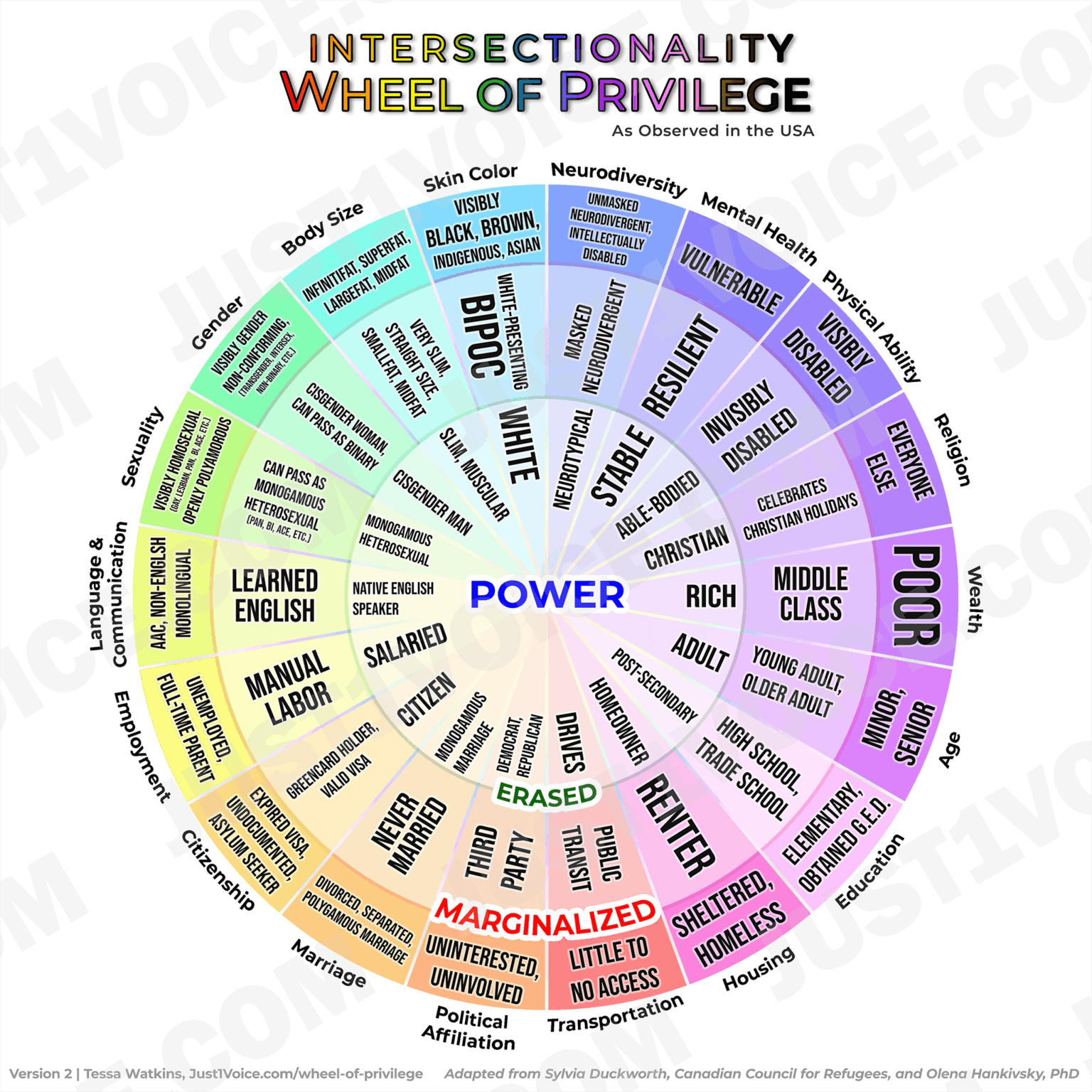
While we may spot several issues with this wheel in what it presupposes and concludes, it does unintentionally serve a true point—humans are vastly different in so many intersecting ways, calculable and incalculable, chosen and unchosen. Thomas Sowell, in The Quest for Cosmic Justice, makes the case that all the factors that make humans unequal are so various, specific, and unquantifiable that omniscience would be required to know and calculate the impact of all these factors on each individual. Therefore, the promise of egalitarian equalism is impossible.
Turning back to the concept of luck, while the quantifiability of certain variables is debatable, and while there may be many other relevant unquantifiable variables, luck is not calculable and quantifiable. What is the percentage distribution of luck in a given case of success or failure? Rothbard puts his finger on this issue,
Yet how can luck be isolated and identified? It should be evident that it is impossible to do so. In every market action luck is interwoven inextricably and is impossible to isolate. Consequently, there is no justification for saying that the rich are luckier than the poor…. No one can say what the distribution of luck is; hence, there is no justification here for a “redistribution” policy.
If success is attributed to luck, and luck is a sufficient justification for seizure and redistribution, then the claimants ought to at least be able to isolate the variable of luck and show the extent to which luck contributed to the success. Blaming luck is just an accusation asserted without justification.
So What? Luck, Property, and the Statist Non Sequitur
Even if a desirable outcome can be attributed to luck or chance—in part or in whole—that does not mean that the outcome is unjust. Since luck—to the extent that such a thing truly exists—cannot be measured or controlled, and since diversity and inequality are natural realities and fundamental to human nature, the focus should be on whether property has been legitimately acquired through production or exchange.
This argument regarding luck is a classic example of the statist non sequitur. Rothbard’s statement illustrates this, “[Presupposition]: After charging that the market confers undue laurels on the lucky, [unjustified logical leap:] the critic goes on to call for expropriation of the ‘rich’ (or lucky) and subsidization of the ‘poor’ (or unlucky).” Property rights are allegedly irrelevant or at least suspect due to this mysterious force called luck. It does not follow that someone’s property can be legitimately expropriated because someone produced or received it due to an unquantifiable amount of luck or chance.
David Gordon expresses this in a simple rhetorical question: “Even if luck is responsible for inequality, so what? What is the matter with that?” If—to all appearances—one receives a positive benefit due to pure luck, that does not mean that others have a higher claim to his property. Were that the case, just the accusation of another’s luck would be enough to rob someone of his property and call it redistributive justice.
Even if we grant that luck is to blame for the unequal distribution of property and wealth, it does not follow that the force of the state ought to be used to expropriate it. Again, David Gordon writes, “Even if you do not morally deserve to profit from your natural talents, you are entitled to your superior wealth and income, so long as you obtain these through a just system of property acquisition and transfer.”
Conclusion
A philosophy that views luck or chance as the independent, determining variable in disempowers people and encourages envy and coveting because it disconnects results from actions. If a causal connection between means and ends cannot be meaningfully established, even if the outcome is always uncertain, because of this indeterminate concept of luck, then action is meaningless.
Blaming luck—to whatever extent it exists—for success is just an attempted declaration of illegitimacy without evidence. Advocacy of luck egalitarianism comes from the ignorant and/or envious seeing outcomes they misunderstand and of which they disapprove. Blaming luck opens the possibility for the expropriation of the “lucky” and allows luck egalitarians to believe that the only meaningful difference between them and the successful whom they resent is an uncontrollable, mysterious force called luck.