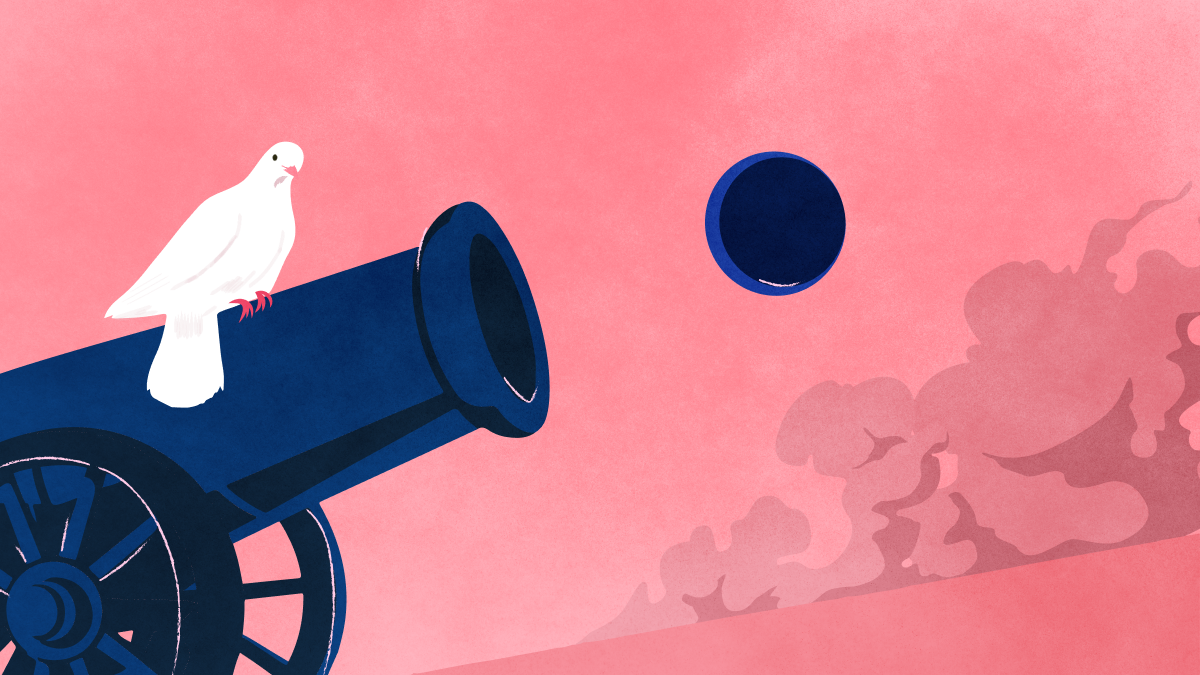
America was born in war. The American Revolution and subsequent constitution of the newly-formed United States reflected some of the key ideas of liberalism—natural rights, government by consent, and limits on state power. The Revolution, however, was just the beginning of war as part of the American identity. Between 1798 and 2023, the United States engaged in 469 acknowledged military interventions—or 2.08 military interventions per year on average.
The U.S. government’s subsequent military adventures, however, are fundamentally different from the initial revolutionary effort to gain independence. These conflicts did not represent efforts to throw off the rule of a foreign king, but instead involved the projection of state military power to shape and influence the world—often in the name of spreading or safeguarding liberty. The 250th anniversary of the signing of the Declaration of Independence provides an opportunity to reflect on the risks that war poses to the liberal principles at the foundation of the American project.
The dangers of war were emphasized by leading figures from America’s earliest days. Writing in 1795, James Madison noted:
Of all the enemies to public liberty, war is perhaps the most to be dreaded, because it comprises and develops the germ of every other. War is the parent of armies; from these proceed debts and taxes; and armies, and debts, and taxes are the known instruments for bringing the many under the domination of the few. In war, too, the discretionary power of the Executive is extended; its influence in dealing out offices, honors, and emoluments is multiplied; and all the means of seducing the minds, are added to those of subduing the force, of the people.… No nation could preserve its freedom in the midst of continual warfare.
A year later, in his 1796 farewell address, President George Washington cautioned against “overgrown military establishments which, under any form of government, are inauspicious to liberty, and which are to be regarded as particularly hostile to republican liberty.”
What Madison and Washington recognized was that warmaking posed a threat to the very things that the American revolutionaries had fought to secure. These warnings have been largely forgotten or ignored, even by many classical liberals.
Through time what was viewed as the acceptable reach of the American government expanded, as did the concomitant warmaking powers. While the history is nuanced, this expansion can be understood in three general phases. The first is the continental expansion in the early to mid nineteenth century. This included the Louisiana Purchase, the Florida Purchase, the annexation of Texas, the Oregon Treaty, and the Mexican cession in 1848. The second phase began with the Spanish-American War in 1898 and entailed the projection of American military power on the Western Hemisphere. This included the Roosevelt Corollary to the Monroe Doctrine which indicated that the U.S. government would intervene militarily in the Western Hemisphere as determined by U.S. policymakers. The third phase begins with World War II and marks the beginning of America as a global hegemon, the U.S. government’s attempt to serve as the world’s policeman.
Regardless of the benefits of these various expansions or the intentions behind U.S. military interventions, these actions generate significant costs, both immediately and in the long-term. As Madison and Washington warned, war affects both the scale, or size, of government and the scope, or range of activities and powers undertaken by the state. Let’s consider each in turn.
War is expensive–and the bill is often paid long after the conflict is over. The United States spends more on defense than the next ten countries combined including China, Russia, and Saudi Arabia. About 17 percent of all federal spending goes to issues related to “defense.” Throughout America’s history, warmaking has led to the implementation of new taxes, many of which remain well after war remains. The fiscal costs do not end there. Sarah Kreps, a political scientist, documents how the American way of financing wars has shifted through time. Starting with the Korean War, she notes, the American government shifted away from taxes and toward debt-financing to conceal the full costs of war from the public. In addition to contributing to growing public debt, she argues that this shift undermined democratic norms and processes by limiting the accountability of political leaders.
Military conflict is costly in other ways as well. The Department of Defense reports some 1,151,012 battle deaths over the course of the “principal wars” in which the United States has participated, an additional 857,000 conflict-related deaths, and more than 2.5 million wounded.
The pernicious effects of warmaking on democratic values go well beyond these immediate effects. One of the defining features of war is the centralization of state power. War and foreign intervention require the use of resources and the ability to make choices about how to use them. As national governments are responsible for planning, implementing, and overseeing war and other foreign intervention, war necessarily draws peripheral political units (e.g., state and local authorities) toward the political center. As the political scientist Bruce Porter noted, “a government at war is a juggernaut of centralization determined to crush any internal opposition that impedes the mobilization of militarily vital resources. This centralizing tendency of war has made the rise of the state throughout much of history a disaster for human liberty and rights” (19).
This consolidation contributes to a process of bureaucratization, in which government agencies gain more influence and resources. Moreover, in times of conflict, new bureaus are often created, staffed, and endowed with government funds. As “the nation” comes together to fight a common external enemy, more of the resources and activities formerly undertaken by citizens is subsumed by the goals of the state. For example, during World War II, the Office of Price Administration (OPA) limited the types and amounts of goods and services people could buy and also implemented price controls. The United States Department of Agriculture (USDA) encouraged citizens to divert their labor toward growing “victory gardens.” The Office of War Information (OWI) controlled what information was distributed to the public. It also dictated when and by whom information would be released. The War Powers Acts of 1941 and 1942 gave the president sweeping authority to make changes to the government, censor mail, and confiscate land for military purposes. Of course, more than 10.1 million were forced to provide their labor to the U.S. Armed Forces via the draft.
This bureaucratization of life, the drawing of peripheral units of government toward the political center, effectively erodes the pluralism of democratic governments. Instead of working to provide a check or counterbalance to the central government, peripheral political units become aligned with the goals of the central government.
The unifying effect of war shifts the focus of citizens from the domestic contest between government and freedom to an external enemy that must be fought by a strong centralized government. One effect, as noted by the economist Robert Higgs, are long-lasting changes in ideology regarding the appropriate role of the state in relation to citizens. These ideological changes take place both in how the citizenry perceive the appropriate role of government and in how the elite see their role in governing over the citizens. Consider an example of each.
Current airport security, implemented as part of the war on terror following the terrorist attacks on September 11, 2001, would have been unconscionable to a traveler in 1999. To support the government’s goal of stamping out terrorism, civilians are subject to search of their property as well as their person at the hands of federal agents every time they go to board an aircraft. Americans have and still do largely support this measure in the name of “national security” despite the intrusion (and the abysmal performance of the Transportation Security Administration (TSA)). Citizens who were young at the time of the 9/11 attacks, and those born after, have no knowledge of the pre-9/11 situation which means that they see the current status quo as normal.
Also in the context of the war on terror, officials have greatly expanded what they consider appropriate surveillance. The Bush administration, for example, greatly expanded their surveillance powers with the passage of the USA PATRIOT Act and other policies making it easier for government agencies to collect immense amounts of data. Under the Obama administration, surveillance expanded further with the granting of extended powers to the National Security Administration (NSA) to share the contents of the private phone and email communications it collects with other law enforcement agencies—including the information of citizens—without a warrant. But it’s not just federal authorities. It was recently revealed that police in New Orleans have been utilizing facial recognition technology as a tool of general surveillance around the city, in spite of laws that should prohibit it.
Other, more hidden, costs are also worthy of note. Winston Churchill famously noted that, “In wartime, truth is so precious that she should always be attended by a bodyguard of lies.” While a benevolent government might delicately balance truth and deception to maximize the “national interest,” the historical record indicates that governments abuse their monopoly control over information to deceive citizens. This is particularly pernicious within the context of war and foreign intervention. Officials oversell the severity of threats, the purported benefits of war, and are not forthcoming about the status of war (e.g., President George W. Bush’s infamous “Mission Accomplished” speech regarding Iraq in 2003).
The broader effect of this control over foreign policy narratives is that it erodes critical checks on government. Even if citizens want to be informed about the actions of policymakers and the effects of military intervention, they are effectively prevented from doing so. As we have written elsewhere, citizens become an obstacle for officials to overcome to achieve their objectives, not the source of policymakers’ authority. Further, the control over information within the context of foreign intervention effectively neuters the media as an effective check on government.
It is important to note that these changes, and the costs to liberty, do not happen overnight. While some changes during war or conflict are readily observable (e.g., conscription, rationing, etc.), others are not. This insight is not new. In his writing on war, Alexis de Tocqueville recognized this very danger, emphasizing that
There is no long war that, in a democratic country, does not put liberty at great risk. It is not that you must fear precisely to see, after each victory, conquering generals seize sovereign power by force, in the manner of Sylla or of Cesar. The danger is of another kind. War does not always deliver democratic peoples to military government; but it cannot fail to increase immensely, among these people, the attributions of civil government; it almost inevitably centralizes in government’s hands the direction of all men and the use of everything. If it does not lead suddenly to despotism by violence, it goes softly by habits. All those who seek to destroy liberty within a democratic nation should know the surest and shortest means to succeed in doing so is war. That is the first axiom of the science (volume 2, pp. 1160–1162).
Taken together, these changes in both scale and scope are critical for understanding the true costs of warmaking. While some costs are immediate and readily observable, many others are not. Many have suggested that proactive intervention on the part of the United States is beneficial to both the U.S. and to other countries around the globe. Critically, the issues we have highlighted suggest that a military-forward U.S. foreign policy erodes the very principles policymakers purport to protect.
Our Founders recognized and anticipated these problems associated with war and intervention. They spoke clearly of these dangers and attempted to place constraints on government actors. But these constraints have been limited in preventing the expansion of government power in times of war. As we’ve mentioned above and discussed in other work, however, war allows government to sidestep, ignore, or eliminate existing constraints. There is little—if any—incentive for contemporary policymakers to work to constrain themselves. Even if they did, future conflicts would predictably serve as the catalyst for the erosion of those constraints.
Readers may reasonably feel unease–the Revolutionary War did utilize illiberal means to achieve liberal ends. What are liberal-minded individuals to make of this tension? There are two relevant points to consider. First, the American Revolution was unique in the context of other wars and interventions. The Revolution was endogenous to the colonies rather than an exogenous intervention. There is a profound difference between individuals rising up to throw off the control of external forces and intervening in an external society. Second, although the American Revolution highlights that it is possible to obtain liberal ends through illiberal means, there is little reason to believe that those responsible for planning and implementing war and foreign intervention have the knowledge or the incentives to achieve these goals consistently. In fact, for the reasons discussed above and others, we should be immensely skeptical of such interventions in their ability to spread and maintain liberty.
So, what is to be done for those interested in spreading liberty? If the foreign policies of the United States have failed to result in the germination of liberal ideas, what is the alternative?
The answer may lie in the ideas of our Founding Fathers and the ideals that shaped them. Instead of looking to “fix” other nations and control the world, we might instead look to domestic policy and embrace the freedoms upon which our country was founded. We may adopt a default skepticism of government and recognize that peaceful cooperation in a self-governing society is generated from the bottom-up as opposed to the top-down. We can consider policies that allow for the freer movement of goods and services as well as the people who offer them.
Most of all, we should recognize that engaging in intervention or war for the sake of liberty and freedom is inherently contradictory. The supposed protection and expansion of liberal ideas through illiberal means—domestically and abroad—is wholly antithetical to the ideals that motivated those in the American Revolution.
Endnotes
[1] “Principal Wars” in these figures include the Revolutionary War, War of 1812, Mexican War, the U.S. Civil War, World War I, World War II, the Korean War, the Vietnam War, and the Persian Gulf War.
This post first appeared as an essay at A Call to Liberty It has been reposted here as part of Econlib’s celebration of the 250th anniversary of the Declaration of Independence.