
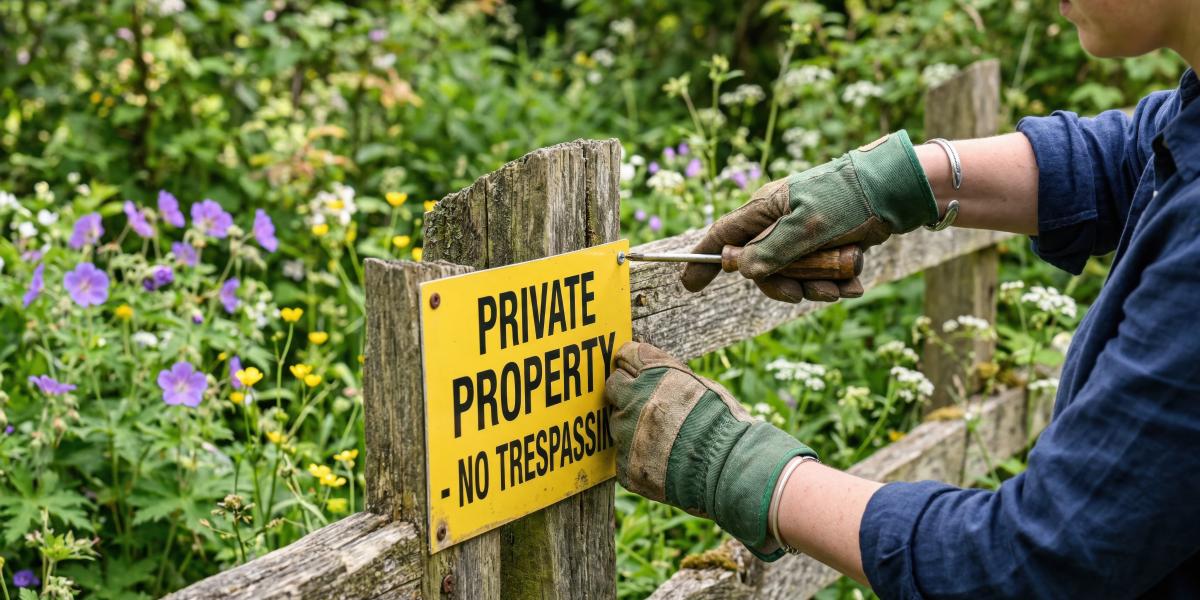
Though the modern state successfully frames itself as the ultimate guarantor of positive rights, it is the opposite: a systematic violator of negative property rights. This is possible because the modern state is associated with the advent of the rule of law. To understand why society remains so blind to the ever-expanding “legal spoliation” by the state (to use Bastiat’s expression), it is necessary to look at the inherent duality between the psychological universality of property and its messy historical reality.
As Rothbard and others have noted, there is an instinctive sense of self-ownership of one’s own body, which led even die-hard communists to implicitly recognize private property. Human beings naturally feel they “own” something they have built or created, and they feel wronged when something they “possess” is taken from them without their consent. Such universal feelings led long ago to precepts such as the Decalogue and the development of the concepts of natural rights. Empirical evidence confirms these instincts even in toddlers and small children.
Yet, it is important to remember that property rights were never a given. In other words, human society has often been run according to the “principle” that “might makes right,” and efforts towards establishing rule of law have never been completely successful. As Ludwig von Mises wrote in Human Action:
Private property is a human device. It is not sacred. It came into existence in early ages of history, when people with their own power and by their own authority appropriated to themselves what had previously not been anybody’s property. Again and again proprietors were robbed of their property by expropriation. The history of private property can be traced back to a point at which it originated out of acts which were certainly not legal. Virtually every owner is the direct or indirect legal successor of people who acquired ownership either by arbitrary appropriation of ownerless things or by violent spoliation of their predecessor.
In other words, though there is an innate instinct of property rights in humans, throughout history this instinct has gone constantly and naturally unheeded. “Homo homini lupus,”as the saying goes. Even in societies in which property rights were recognized, these rights have often been honored in the breach. Incidentally, the state was more easily able to become the prime violator of property rights as private property violations declined.
There is thus a duality inherent in the advent of property rights: on the one hand, the psychological universality of property instincts in the human being, and on the other hand the historical reality of constant property right violations. The history of the uneven development of liberty can be seen through this lens; freedom progresses during periods when society recognizes the importance of respecting property rights, for the benefit of all.
Voluntary Unlearning and Conscious Revaluation
In this context of duality, the political fight for property rights can seem daunting, of course. Yet, such a battle is inevitable if freedom is to progress in society, as Mises clearly understood. It should at least begin with an understanding that the primary violator of property in modern society is the state itself, which means a voluntary unlearning and a conscious revaluation of the statist views among the majority.
It is, of course, in the state’s interest to prevent its property rights violations from being acknowledged, since such an understanding is a sine qua non condition to win this fight for freedom. Many such violations, like taxation or inflation—to name only the most egregious ones—are not recognized or felt as such by the majority. Indeed, there is no fight against the state’s rights violations in the same way that has been a constant fight for positive rights, and the state can continue with impunity to take advantage of its monopoly of legal violence; to seize, redistribute, and control property that does not belong to it.
Inflation is often not considered a violation of such rights because fiat currency devaluation and the Cantillon effect are poorly understood among the majority, at best. Taxation is not perceived to be equivalent to violation of private property, despite thinkers like Bastiat and Spooner making precisely this point more than a century ago. Paying taxes has even been presented as a moral act instead of the spoliation it is. In several countries, proactive state policies have existed for a long time to increase the majority’s consent to pay taxes. Notably France, but also the Nordics and the Anglosphere countries have government programs to increase tax consent, such as improving voluntary compliance, increasing trust in tax authorities, increasing fiscal transparency, and perceived fairness of taxation.
What is to be done?
Because property is a natural human instinct, a common mistake by defenders of freedom is to assume that it doesn’t need to be actively fought for. The duality described above shows that it is not enough to treat property as a default state of nature that will eventually assert itself and merely needs to be intellectually explained. The statists acted more strategically: they understood that positive rights are entirely artificial constructs and made efforts over the long term in order to build the institutional infrastructure—from central banks to public school curricula—necessary to create and sustain them. Antonio Gramsci called this the “long march through the institutions.”
What form shall the fight for property rights then take? Using the ballot box every few years is hardly the answer. Democratic majorities have helped the establishment of positive rights, contributing to hollowing out society’s private property beyond even what the state would have expected or demanded. This is the result of the tragedy of the commons that is representative democracy.
Instead, the state must be condemned morally: the state must be seen as a violator of negative rights and not a guarantor of positive rights. As Etienne de la Boëtie already understood long ago, the power of the state relies largely on the psychological compliance of the public. A new education is therefore necessary that dissolves the euphemisms of statist vocabulary. Currency devaluation should be presented as counterfeiting, taxation as spoliation, and regulation as violation. If a majority could finally view the state’s violation with the same moral clarity it reserves for petty thieves and hardened criminals, the role and purpose of the state could be seriously challenged by public opinion.
The fight for property rights should also incite as many of society’s property owners to protect themselves from the state, thereby helping to weaken it. For instance, a majority could relatively easily use decentralized technologies to evade tax, and parallel structures (e.g., private arbitration, smart contracts, micro-schools), to reduce its exposure to the state.
It is necessary to recognize that freedom is not as much a political destination to be reached, but rather a continuous, active process of resistance. It requires political mobilization in many different forms, in order to turn public opinion against the state. It is time for the fight for negative rights in the 21st century to become as popular as the fight for positive rights was in the 20th.

























