No Result
View All Result
SUBMIT YOUR ARTICLES
  • Login
Wednesday, April 22, 2026
TheAdviserMagazine.com
  • Home
  • Financial Planning
    • Financial Planning
    • Personal Finance
  • Market Research
    • Business
    • Investing
    • Money
    • Economy
    • Markets
    • Stocks
    • Trading
  • 401k Plans
  • College
  • IRS & Taxes
  • Estate Plans
  • Social Security
  • Medicare
  • Legal
  • Home
  • Financial Planning
    • Financial Planning
    • Personal Finance
  • Market Research
    • Business
    • Investing
    • Money
    • Economy
    • Markets
    • Stocks
    • Trading
  • 401k Plans
  • College
  • IRS & Taxes
  • Estate Plans
  • Social Security
  • Medicare
  • Legal
No Result
View All Result
TheAdviserMagazine.com
No Result
View All Result
Home Market Research Economy

The Lasting Economic Scars of War

by TheAdviserMagazine
6 months ago
in Economy
Reading Time: 5 mins read
A A
The Lasting Economic Scars of War
Share on FacebookShare on TwitterShare on LInkedIn


Yves here. This post usefully estimates how deep and durable the costs of war really are. The subtext is that they are more severe than commonly assumed.

By Efraim Benmelech, Harold L. Stuart Professor of Finance and Director, Guthrie Center for Real Estate Research, Kellogg School of Management by Northwestern University Northwestern University and Joao Monteiro, Einaudi Institute for Economics and Finance (EIEF). Originally published at VoxEU

Wars leave deep and lasting scars on economies. Using data for 115 conflicts across 145 countries over the past 75 years, this column documents large and persistent declines in output, investment, and trade following the onset of war, with no evidence of recovery even a decade later. Government revenues collapse while spending remains stable, forcing reliance on inflationary finance and short-term debt. The findings show that the true cost of war extends far beyond the battlefield, reshaping fiscal and monetary stability for years to come.

The world is once again mobilising for war. Military budgets have surged to levels unseen since the Cold War, driven by Russia’s invasion of Ukraine, renewed Middle East and East Asian tensions, and a widespread belief that peace can no longer be taken for granted. Governments are scrambling to raise defence spending while facing already-strained public finances, stubborn inflation, and rising interest rates. The fiscal and macroeconomic consequences of this new age of rearmament are likely to be profound – yet research offers surprisingly little systematic evidence on how wars affect economies.

Some recent contributions have started to fill the gap. For example, a VoxEU column by Yuriy Gorodnichenko and Vittal Vasudevan estimates that Russia’s invasion of Ukraine may cost around US$2.4 trillion and inflict permanent output losses of at least fifteen percent in the belligerent countries (Gorodnichenko and Vasudevan 2025). Another (Federle et al. 2024a) shows that major conflicts reduce GDP by over 30% within five years and generate lasting inflationary pressures (VoxEU, 2024). A related piece (Harrison 2023) details how governments financed total wars through debt, inflation, and coercive state action. These columns build on a broader academic literature documenting the heavy economic toll of conflict – from Abadie and Gardeazabal (2003) on the Basque Country, Collier (1999) on civil wars, and Cerra and Saxena (2008) on deep and persistent growth losses, to Blattman and Miguel (2010) on war’s long-run scars, Barro (1987) and Harrison (1998) on war finance, Hall and Sargent (2014, 2022) on fiscal-monetary consequences, and Federle et al. (2024b) on the international spillovers of conflict.

A New Global Dataset on the Economics of War

In our recent research (Benmelech and Monteiro 2025), we provide the first large-scale, cross-country evidence on the macroeconomic consequences of war for the belligerents. We construct a dataset covering 115 conflicts and 145 countries over the past 75 years, including both interstate wars (state versus state) and intrastate wars (state versus non-state).

We use a stacked event-study design: for each conflict we compare belligerent countries (that are not simultaneously involved in other conflicts) to never-treated control countries, include conflict-country fixed effects to absorb time-invariant determinants and conflict-region-year fixed effects to capture regional time trends.

GDP Collapses – and Does Not Recover

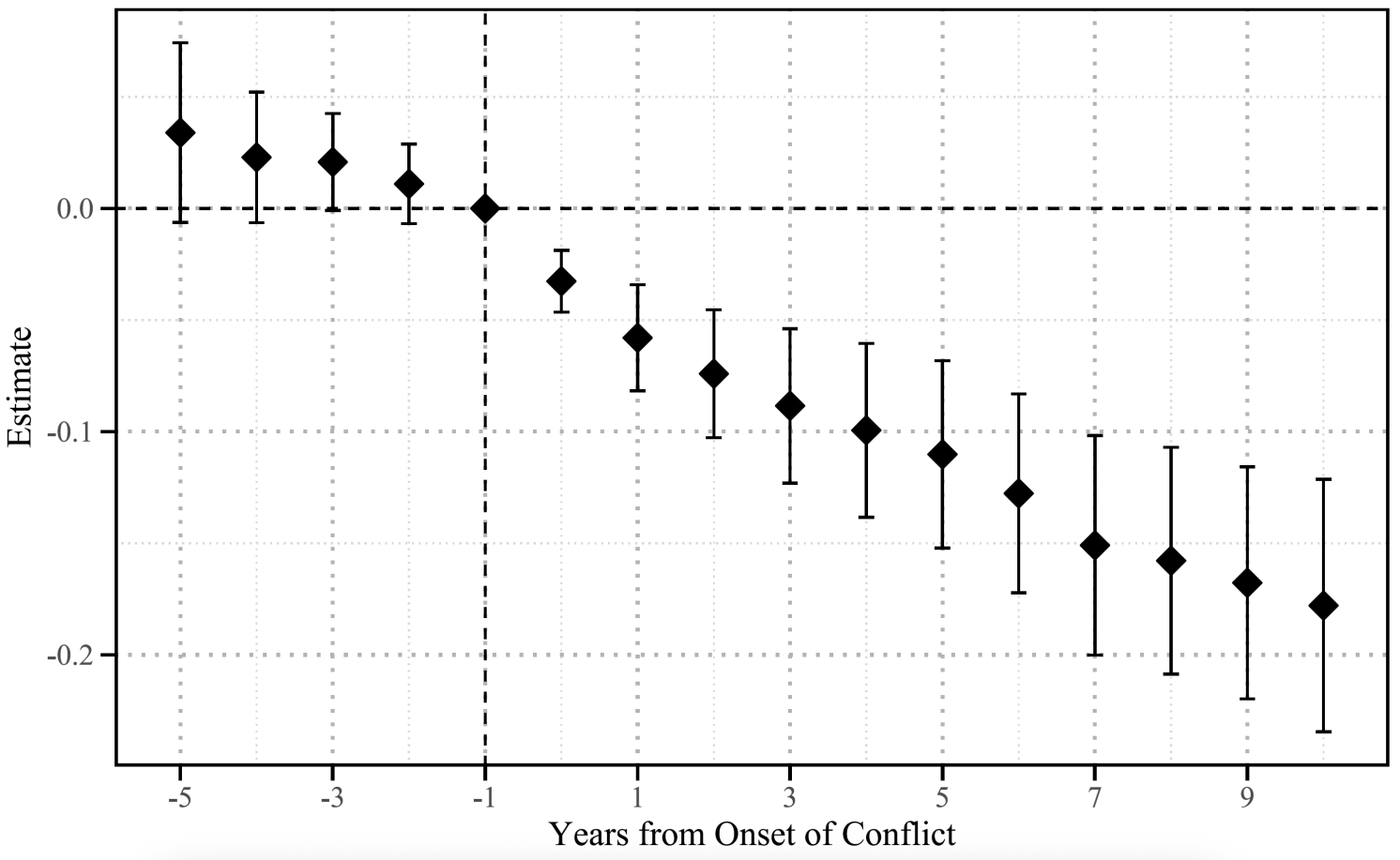
On average, we find that real GDP falls by about 12% (on average) over ten years for treated countries relative to control countries, corresponding to an absolute loss of more than $28 billion (in 2015 prices). At the onset of conflict, the drop is modest (≈3.3%), but then the contraction deepens to about 16% after ten years. Consumption and investment fall sharply; exports fall by 12% and imports by 7%; and the current account deteriorates by around US $2.1 billion.

Figure 1 Effect of conflict on GDP

Conflict is associated with a destruction of capital stock. Consequently, one might expect investment to bounce back due to the higher marginal productivity of capital. Instead, we observe a collapse: real investment falls by around 13%, and real domestic credit drops by 20% – larger than the output loss. Lending rates do not fall, ruling out weak demand and pointing instead to tightening credit supply.

We interpret this as evidence that war erodes collateral values and constrains borrowing, particularly in lower-income economies with shallow financial markets. We also find that the adverse effects are much stronger for low-income countries: investment falls more, trade disruptions are larger, and the import-intensive nature of capital goods in such economies magnifies the shock.

Fiscal Collapse and the Short-Term Debt Trap

War also puts enormous strain on public finances. We document that real government revenues fall by about 14%, while real government debt declines by around 9%, despite nominal debt rising in local-currency terms. Meanwhile, government expenditures remain roughly stable – so the debt-to-GDP ratio stays constant – but the underlying real dynamics reveal fiscal fragility.

We also show that the share of long-term debt falls by about 2.2 percentage points (≈1.2% of GDP) as governments shift toward short-term debt to deal with risk and constrained access. This shift is economically significant – governments shift 1.2% of GDP from long-term to short-term debt – and is associated with a higher rollover risk, which makes these already depressed economies more vulnerable to financial crises.

Inflation: The Silent Tax of War Finance

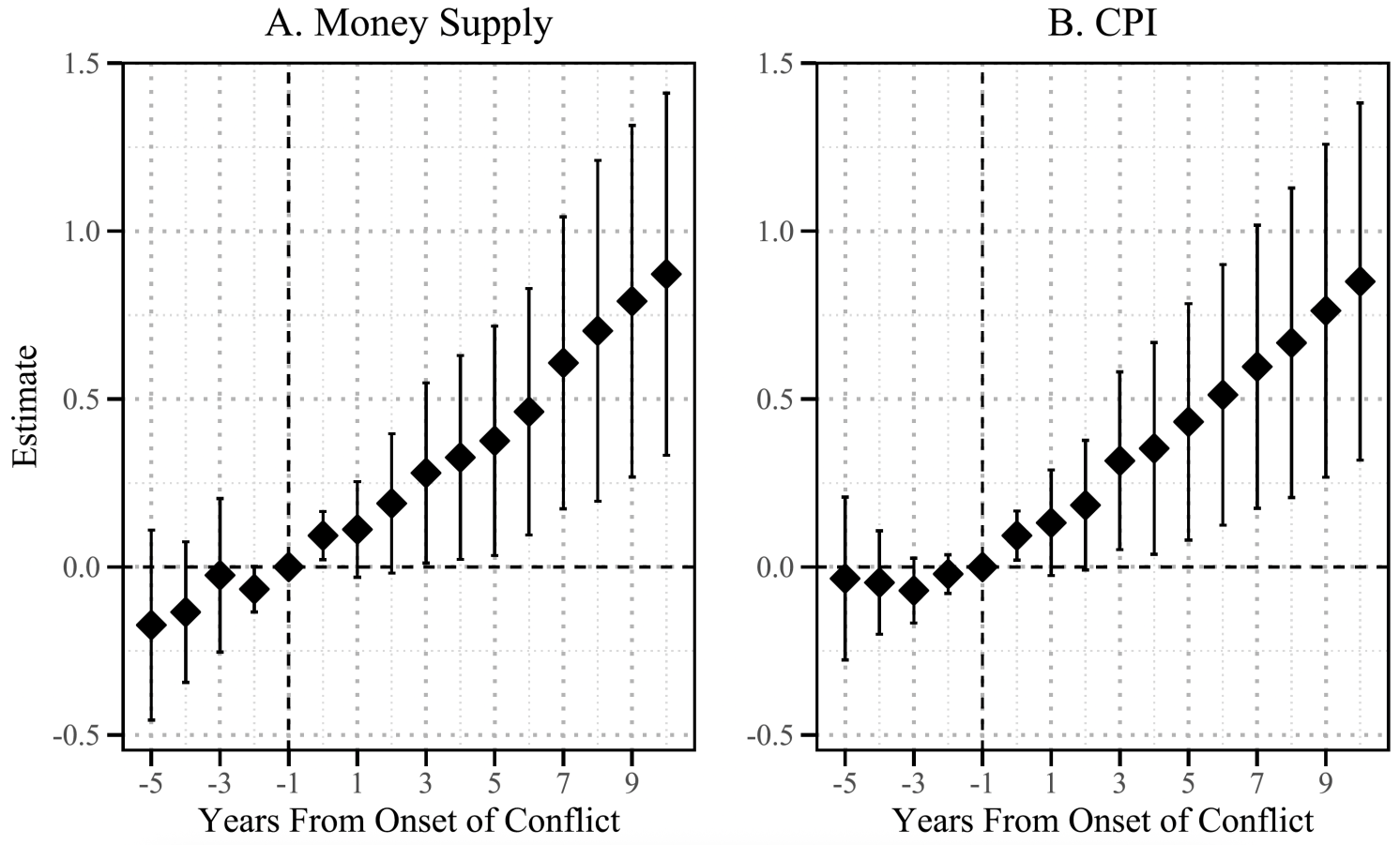
In the decade following the onset of conflict, we observe that the consumer price level rises by about 62%. In comparison, the nominal money supply increases by about 67%, yet real money balances remain unchanged. This pattern is consistent with inflationary financing of government deficits rather than real cash hoarding. War thus triggers a regime of fiscal dominance: deficits, monetisation, and inflation feed into each other.

Figure 2 Effect of conflict on CPI and money supply
Policy Lessons: The True Cost of War

The main takeaway is this: the costs of war are not temporary disruptions; they are large, persistent, and multi-dimensional. Wars do not simply destroy capital and infrastructure; they undermine the very financial and monetary foundations on which modern economies rest.

For policymakers facing rising geopolitical risk and a return to major military mobilisation, two points stand out:

Maintaining credible fiscal and monetary frameworks matters even – or especially – in wartime, because the legacy of war depends on how it is financed.
Reconstruction is not automatic: without access to credit, stable institutions, and affordable capital goods, economies may remain in the slump for a decade or more.

In short, war may end with treaties, but its economic scars endure long after. Recognising the persistence of these scars should shape both how we wage and how we recover from conflict.

See original post for references

Israel Dominant Issue in Michigan Democratic Senate Primary


Source link

Tags: economicLastingscarsWar
ShareTweetShare
Previous Post

Debate Grows as EU Considers Giving ESMA Direct Oversight of Crypto and Stock Markets

Next Post

Bitcoin November sell-off worsens as investors reduce risk

Related Posts

edit post
Israel Dominant Issue in Michigan Democratic Senate Primary

Israel Dominant Issue in Michigan Democratic Senate Primary

by TheAdviserMagazine
April 22, 2026
0

Michigan is on the frontlines of the American Democratic Party’s internal battles over Israel, canceling streamers, a competitive U.S. Senate...

edit post
Rothbard Was Right: Libertarians Must Never Warm to the Warfare State

Rothbard Was Right: Libertarians Must Never Warm to the Warfare State

by TheAdviserMagazine
April 22, 2026
0

In 1977, Murray Rothbard wrote an article in response to an issue of Reason Magazine where the main feature of...

edit post
Markets shrug at Trump’s Iran ceasefire extension

Markets shrug at Trump’s Iran ceasefire extension

by TheAdviserMagazine
April 22, 2026
0

US President Donald Trump speaks during the NCAA Collegiate National Champions Day event at the White House in Washington, DC,...

edit post
Pokémon Go — The Largest Mapped Data Collection Ploy In History

Pokémon Go — The Largest Mapped Data Collection Ploy In History

by TheAdviserMagazine
April 22, 2026
0

When Pokémon Go was released, it appeared to be a harmless game encouraging people to go outside and explore, yet...

edit post
Bank Of Korea Vows To Create CBDC

Bank Of Korea Vows To Create CBDC

by TheAdviserMagazine
April 22, 2026
0

  The Bank of Korea has now made its position unmistakably clear, and this is precisely what I have been...

edit post
Market Talk – April 21, 2026

Market Talk – April 21, 2026

by TheAdviserMagazine
April 21, 2026
0

ASIA: The major Asian stock markets had a mixed day today: • NIKKEI 225 increased 524.28 points or 0.89% to...

Next Post
edit post
Bitcoin November sell-off worsens as investors reduce risk

Bitcoin November sell-off worsens as investors reduce risk

edit post
The Augmented LP: 6 Ways AI Can Enhance the Allocator’s Workflow

The Augmented LP: 6 Ways AI Can Enhance the Allocator’s Workflow

  • Trending
  • Comments
  • Latest
edit post
Massachusetts loses billions in income after millionaire tax

Massachusetts loses billions in income after millionaire tax

March 24, 2026
edit post
Illinois’ Paid Leave for All Workers Act Takes Effect — Every Employee Now Gets Guaranteed Time Off

Illinois’ Paid Leave for All Workers Act Takes Effect — Every Employee Now Gets Guaranteed Time Off

March 27, 2026
edit post
Virginia Permits ADULT MIGRANT MEN To Attend High School

Virginia Permits ADULT MIGRANT MEN To Attend High School

March 30, 2026
edit post
A 58-year-old left NYC for Miami to save on taxes — then retired early thanks to hidden savings. Here’s the math

A 58-year-old left NYC for Miami to save on taxes — then retired early thanks to hidden savings. Here’s the math

March 30, 2026
edit post
Tax Flight Accelerates In Massachusetts

Tax Flight Accelerates In Massachusetts

April 6, 2026
edit post
Property Tax Relief & Income Tax Relief

Property Tax Relief & Income Tax Relief

April 1, 2026
edit post
The Hospital Exit: 7 US Cities Where ER Response Times Are Skyrocketing

The Hospital Exit: 7 US Cities Where ER Response Times Are Skyrocketing

0
edit post
Bearish Tesla analyst has good news for Rivian stock investors

Bearish Tesla analyst has good news for Rivian stock investors

0
edit post
The Missing Link That Could Trigger a Robotics Boom

The Missing Link That Could Trigger a Robotics Boom

0
edit post
India denies cash, crypto payments to Iran for Hormuz passage

India denies cash, crypto payments to Iran for Hormuz passage

0
edit post
Rothbard Was Right: Libertarians Must Never Warm to the Warfare State

Rothbard Was Right: Libertarians Must Never Warm to the Warfare State

0
edit post
Women’s Casual Jumpsuit only .99!

Women’s Casual Jumpsuit only $11.99!

0
edit post
The Hospital Exit: 7 US Cities Where ER Response Times Are Skyrocketing

The Hospital Exit: 7 US Cities Where ER Response Times Are Skyrocketing

April 22, 2026
edit post
Women’s Casual Jumpsuit only .99!

Women’s Casual Jumpsuit only $11.99!

April 22, 2026
edit post
Meet M&A firm founder spreading the gospel of retainer fees

Meet M&A firm founder spreading the gospel of retainer fees

April 22, 2026
edit post
Meet ‘Ace,’ the paddle-wielding robot who just beat humans at ping pong in AI breakthrough

Meet ‘Ace,’ the paddle-wielding robot who just beat humans at ping pong in AI breakthrough

April 22, 2026
edit post
CRCL, BMNR, and COIN Stocks Price Prediction as CLARITY Act Hits April Roadblock

CRCL, BMNR, and COIN Stocks Price Prediction as CLARITY Act Hits April Roadblock

April 22, 2026
edit post
Could You Fund Your Kid’s Tuition Just by Investing 0 on Every Birthday?

Could You Fund Your Kid’s Tuition Just by Investing $100 on Every Birthday?

April 22, 2026
The Adviser Magazine

The first and only national digital and print magazine that connects individuals, families, and businesses to Fee-Only financial advisers, accountants, attorneys and college guidance counselors.

CATEGORIES

  • 401k Plans
  • Business
  • College
  • Cryptocurrency
  • Economy
  • Estate Plans
  • Financial Planning
  • Investing
  • IRS & Taxes
  • Legal
  • Market Analysis
  • Markets
  • Medicare
  • Money
  • Personal Finance
  • Social Security
  • Startups
  • Stock Market
  • Trading

LATEST UPDATES

  • The Hospital Exit: 7 US Cities Where ER Response Times Are Skyrocketing
  • Women’s Casual Jumpsuit only $11.99!
  • Meet M&A firm founder spreading the gospel of retainer fees
  • Our Great Privacy Policy
  • Terms of Use, Legal Notices & Disclosures
  • Contact us
  • About Us

© Copyright 2024 All Rights Reserved
See articles for original source and related links to external sites.

Welcome Back!

Login to your account below

Forgotten Password?

Retrieve your password

Please enter your username or email address to reset your password.

Log In
No Result
View All Result
  • Home
  • Financial Planning
    • Financial Planning
    • Personal Finance
  • Market Research
    • Business
    • Investing
    • Money
    • Economy
    • Markets
    • Stocks
    • Trading
  • 401k Plans
  • College
  • IRS & Taxes
  • Estate Plans
  • Social Security
  • Medicare
  • Legal

© Copyright 2024 All Rights Reserved
See articles for original source and related links to external sites.