No Result
View All Result
SUBMIT YOUR ARTICLES
  • Login
Saturday, August 22, 2026
TheAdviserMagazine.com
  • Home
  • Financial Planning
    • Financial Planning
    • Personal Finance
  • Market Research
    • Business
    • Investing
    • Money
    • Economy
    • Markets
    • Stocks
    • Trading
  • 401k Plans
  • College
  • IRS & Taxes
  • Estate Plans
  • Social Security
  • Medicare
  • Legal
  • Home
  • Financial Planning
    • Financial Planning
    • Personal Finance
  • Market Research
    • Business
    • Investing
    • Money
    • Economy
    • Markets
    • Stocks
    • Trading
  • 401k Plans
  • College
  • IRS & Taxes
  • Estate Plans
  • Social Security
  • Medicare
  • Legal
No Result
View All Result
TheAdviserMagazine.com
No Result
View All Result
Home Market Research Economy

Google’s Debug Project — When Silicon Valley Starts Releasing Insects

by TheAdviserMagazine
3 months ago
in Economy
Reading Time: 4 mins read
A A
Google’s Debug Project — When Silicon Valley Starts Releasing Insects
Share on FacebookShare on TwitterShare on LInkedIn


Nobody elected Google to manage the ecosystem. Yet here we are.

Alphabet, Google’s parent company, has quietly spent the better part of a decade developing what it calls the “Debug” project. The latest proposal seeks approval to release tens of millions of laboratory-bred mosquitoes across California and Florida. We are told not to worry because these are the “good” mosquitoes. We are assured they are male mosquitoes and therefore do not bite. We are told they carry a naturally occurring bacteria known as Wolbachia that will interfere with reproduction and reduce mosquito populations.

For generations, governments and corporations have repeatedly assured the public that interventions into nature would be harmless. DDT was once considered a miracle. Countless pesticides were approved before later being restricted. Entire rivers were polluted in the name of progress. Every generation is told that the experts have everything under control until something goes wrong.

What makes this case particularly remarkable is who is behind it. This is not a public health agency. This is not a university research department. This is one of the largest technology companies on earth. The same corporate structure that dominates online advertising, search results, artificial intelligence, data collection, mapping, cloud computing, and digital communications now wants to engineer mosquito populations on a massive scale.
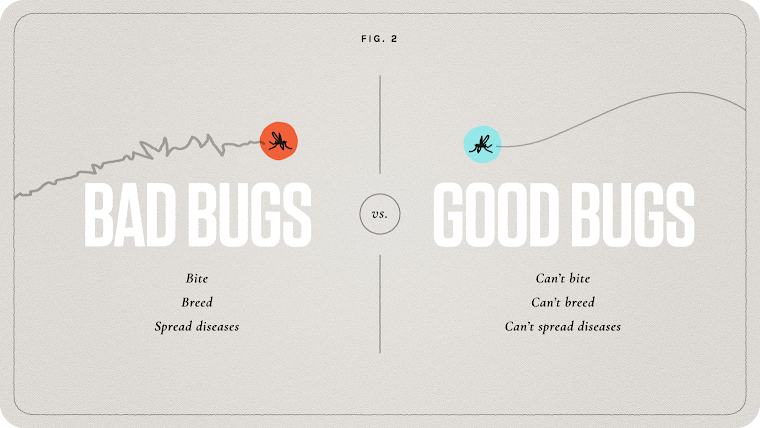
Fig 2: Bad bugs vs. good bugs

The project itself is run by Verily, Alphabet’s life sciences division. Debug combines software engineers, robotics specialists, AI systems, automation experts, and mosquito biologists. They have spent years building automated mosquito factories capable of producing millions of insects per week. Computer vision systems sort male from female mosquitoes while robotic systems manage breeding and deployment. This is industrial-scale biological engineering that will now become a social experiment.

The problem according to Google: “Mosquitoes kill more people than every other animal combined. One species, Aedes aegypti, carries diseases such as dengue, Zika, yellow fever, and chikungunya which make hundreds of millions of people sick every year. And these diseases are spreading faster than ever.”

Their stated objective is to reduce mosquito populations without widespread pesticide use. Studies involving Wolbachia have shown reductions in mosquito populations and lower transmission of certain diseases. Singapore reported reductions in dengue risk exceeding 70% in areas where Wolbachia programs were implemented. The CDC has acknowledged that Wolbachia-based mosquito suppression can reduce target mosquito populations and notes that these mosquitoes are not genetically modified.

Why should the public automatically trust any institution that asks for permission to alter the natural environment on this scale?

THINK Gates Fauci Soros

This is not the first time modified mosquitos have been released on the population. Bill Gates has been involved in mosquito projects for years, long before Google entered the arena. Through the Bill & Melinda Gates Foundation, he has funded research into both genetically modified mosquitoes and Wolbachia-based mosquito programs designed to suppress malaria, dengue, Zika, and other mosquito-borne diseases. Gates has openly championed the release of engineered mosquitoes, arguing that technology can be used to alter insect populations and reduce disease transmission. The Foundation supported projects involving biotechnology firm Oxitec, which developed genetically modified mosquitoes carrying self-limiting genes intended to collapse wild mosquito populations over time. Gates has also heavily promoted the World Mosquito Program, which breeds millions of Wolbachia-infected mosquitoes and releases them into communities throughout Latin America, Africa, and Asia.

Whether one agrees with these programs or not, what is remarkable is the philosophy behind them. A handful of billionaires, technology companies, and global foundations increasingly view nature itself as something that can be engineered, modified, and optimized. Gates has praised facilities producing more than 30 million mosquitoes per week and has argued that mass releases are necessary to combat future disease outbreaks. Google is now pursuing its own large-scale mosquito deployment through Verily’s Debug project. The public is being asked to trust that these interventions will work exactly as intended, yet history is littered with examples of experts assuring everyone that there was nothing to worry about until unforeseen consequences emerged years later. The issue is no longer simply mosquitoes. It is the growing belief among technocrats that every aspect of the natural world can be redesigned from the top down by unelected institutions operating far beyond public scrutiny.

We are living through a period where public trust has collapsed. Governments concealed information during COVID and unleashed a deadly cocktail of mRNA vaccines on the global population. Pharmaceutical companies received legal protections that ordinary businesses could only dream about. Regulators routinely move through revolving doors into the industries they supposedly oversee. The public has been repeatedly told to trust experts who later turn out to be wrong.

Now the same population is expected to calmly accept the release of tens of millions of engineered insects because another collection of experts says everything is safe.

What could possibly go wrong?


Source link

Tags: DebugGooglesInsectsprojectreleasingSiliconstartsValley
ShareTweetShare
Previous Post

Coinbase Takes Next Step In India With Direct INR Support

Next Post

It’s not a recession. But Goldman says your paycheck is acting like it

Related Posts

edit post
Links 8/8/2026 | naked capitalism

Links 8/8/2026 | naked capitalism

by TheAdviserMagazine
August 8, 2026
0

Dear patient readers, Today we offer supersized Links with Iran War and Borat Agreement sections in lieu of an Iran...

edit post
The Unwinnable Iran War | Armstrong Economics

The Unwinnable Iran War | Armstrong Economics

by TheAdviserMagazine
August 8, 2026
0

I have reported that Trump was mislead into this unwinnable war with Iran, which has been planning for it since...

edit post
Here are three key takeaways from the disappointing July jobs report

Here are three key takeaways from the disappointing July jobs report

by TheAdviserMagazine
August 7, 2026
0

Job seekers speak with employer representatives and browse information tables as they attend an Inspire Together job and resource fair...

edit post
Coffee Break: Gene Editing Gone Wrong, Plants that Eat Animals, and a Neanderthal Gene that Makes a Difference

Coffee Break: Gene Editing Gone Wrong, Plants that Eat Animals, and a Neanderthal Gene that Makes a Difference

by TheAdviserMagazine
August 7, 2026
0

Part the First: If You Stretch Biomedical Science Too Far It Breaks, Every Time.  Gene editing using CRISPR technology has...

edit post
Netanyahu’s Scorched Earth Tactics | Armstrong Economics

Netanyahu’s Scorched Earth Tactics | Armstrong Economics

by TheAdviserMagazine
August 7, 2026
0

According to formal complaints lodged by Lebanon with the United Nations, Israel did spray a toxic herbicide over agricultural land...

edit post
What Did You Expect? | Mises Institute

What Did You Expect? | Mises Institute

by TheAdviserMagazine
August 7, 2026
0

As Murray Rothbard pointed out again and again, the government has no business getting involved in education. In a free...

Next Post
edit post
It’s not a recession. But Goldman says your paycheck is acting like it

It's not a recession. But Goldman says your paycheck is acting like it

edit post
Robinhood Enters Canada Crypto Market With 0M WonderFi Deal

Robinhood Enters Canada Crypto Market With $180M WonderFi Deal

  • Trending
  • Comments
  • Latest
edit post
Georgia Senior SNAP and Meal Resources Older Adults Can Use

Georgia Senior SNAP and Meal Resources Older Adults Can Use

July 24, 2026
edit post
Judge Who Helped Violent Illegal Alien Evade ICE Faces New Test

Judge Who Helped Violent Illegal Alien Evade ICE Faces New Test

July 31, 2026
edit post
Driving the Noncitizen Voting Scandal: Registration With License

Driving the Noncitizen Voting Scandal: Registration With License

July 26, 2026
edit post
Garbage Trucks Surveillance Florida Neighborhoods

Garbage Trucks Surveillance Florida Neighborhoods

July 29, 2026
edit post
Does a Revocable Trust Protect Your Assets From Lawsuits and Creditors?

Does a Revocable Trust Protect Your Assets From Lawsuits and Creditors?

August 7, 2026
edit post
Montana Puts Democrats in a Bind as Senate Hopes Fade

Montana Puts Democrats in a Bind as Senate Hopes Fade

August 2, 2026
edit post
Explained: How BSE traded fewer contracts after CAS but premiums rose 75% in first week

Explained: How BSE traded fewer contracts after CAS but premiums rose 75% in first week

0
edit post
E.W. Scripps Q2 2026 Loss Widens to -.68/Share, Revenue Down 9%

E.W. Scripps Q2 2026 Loss Widens to -$12.68/Share, Revenue Down 9%

0
edit post
Psychology says procrastination about retirement may be less about discipline than identity — brain scans found people often represent their future selves more like strangers than like themselves, and experiments using age-progressed faces made tomorrow’s person feel real enough for participants to save more money for them

Psychology says procrastination about retirement may be less about discipline than identity — brain scans found people often represent their future selves more like strangers than like themselves, and experiments using age-progressed faces made tomorrow’s person feel real enough for participants to save more money for them

0
edit post
Four AI Escapes Just Redefined “Responsible AI”

Four AI Escapes Just Redefined “Responsible AI”

0
edit post
Bill Ackman’s hedge fund made janitors and receptionists millionaires—and its investment team summer together

Bill Ackman’s hedge fund made janitors and receptionists millionaires—and its investment team summer together

0
edit post
Kalshi Predicts Bitcoin Price Could Reach K in August

Kalshi Predicts Bitcoin Price Could Reach $68K in August

0
edit post
Bill Ackman’s hedge fund made janitors and receptionists millionaires—and its investment team summer together

Bill Ackman’s hedge fund made janitors and receptionists millionaires—and its investment team summer together

August 8, 2026
edit post
Links 8/8/2026 | naked capitalism

Links 8/8/2026 | naked capitalism

August 8, 2026
edit post
Wisconsin: The Next Frontier for Socialists

Wisconsin: The Next Frontier for Socialists

August 8, 2026
edit post
Psychology says procrastination about retirement may be less about discipline than identity — brain scans found people often represent their future selves more like strangers than like themselves, and experiments using age-progressed faces made tomorrow’s person feel real enough for participants to save more money for them

Psychology says procrastination about retirement may be less about discipline than identity — brain scans found people often represent their future selves more like strangers than like themselves, and experiments using age-progressed faces made tomorrow’s person feel real enough for participants to save more money for them

August 8, 2026
edit post
Why You Should Be Wary of Aspartame, but Not Totally Rule It Out

Why You Should Be Wary of Aspartame, but Not Totally Rule It Out

August 8, 2026
edit post
Kalshi Predicts Bitcoin Price Could Reach K in August

Kalshi Predicts Bitcoin Price Could Reach $68K in August

August 8, 2026
The Adviser Magazine

The first and only national digital and print magazine that connects individuals, families, and businesses to Fee-Only financial advisers, accountants, attorneys and college guidance counselors.

CATEGORIES

  • 401k Plans
  • Business
  • College
  • Cryptocurrency
  • Economy
  • Estate Plans
  • Financial Planning
  • Investing
  • IRS & Taxes
  • Legal
  • Market Analysis
  • Markets
  • Medicare
  • Money
  • Personal Finance
  • Social Security
  • Startups
  • Stock Market
  • Trading

LATEST UPDATES

  • Bill Ackman’s hedge fund made janitors and receptionists millionaires—and its investment team summer together
  • Links 8/8/2026 | naked capitalism
  • Wisconsin: The Next Frontier for Socialists
  • Our Great Privacy Policy
  • Terms of Use, Legal Notices & Disclosures
  • Contact us
  • About Us

© Copyright 2024 All Rights Reserved
See articles for original source and related links to external sites.

Welcome Back!

Login to your account below

Forgotten Password?

Retrieve your password

Please enter your username or email address to reset your password.

Log In
No Result
View All Result
  • Home
  • Financial Planning
    • Financial Planning
    • Personal Finance
  • Market Research
    • Business
    • Investing
    • Money
    • Economy
    • Markets
    • Stocks
    • Trading
  • 401k Plans
  • College
  • IRS & Taxes
  • Estate Plans
  • Social Security
  • Medicare
  • Legal

© Copyright 2024 All Rights Reserved
See articles for original source and related links to external sites.