
The core of this argument is that the American Founding set the United States on a unique path that made it one of the richest and freest places in the world. Yet, this causal connection requires a leap of faith. Few have attempted to conjure a counterfactual in which America remained a British colony or became independent in ways similar to later British Dominions (e.g., Canada, Australia, New Zealand, and South Africa). Serious causal inference generally requires the use of large datasets to infer the effects of important policy changes or some large exogenous shocks. For nations, especially in the more distant past, this is even more challenging because of data paucity, limited numbers of observations, and other confounding factors. It may even be impossible. A possible alternative course is to rely on analytical narratives to construct a theory, laying out assumptions and predictions. Then one takes the list of predictions and assumptions and checks to see if they hold up using both quantitative and qualitative sources.
Many have tried to deploy this practice with regard to the American Revolution by asking what really led to the Revolution (e.g., burdensome elements of British imperial policy such as the Navigation Acts) or what the British Empire would have looked like had they retained the American colonies (notably the decision to abolish slavery in the West Indies). However, to the best of our knowledge, very few attempts to construct a counterfactual regarding economic growth in the United States without the Revolution have been undertaken. This is an unfortunate omission as American prosperity is not just a by-product of the ideas of the Revolution. Asking what would have occurred had the Revolution failed is asking a question that goes to the root of why America sought its independence. Notice we say “failed” rather than “never happened,” because we are asking if the institutional changes that emerged from the Revolution’s success were beneficial. This is what we seek to do here, attempting to create a reasonable counterfactual of American economic growth until the Civil War.
Strangely enough, the first step in constructing a counterfactual lies north—in the Canadian province of Quebec. In 1759, when the French army was defeated outside Quebec City, Quebec was still a French colony with an almost exclusively Catholic population. By 1760, French forces had capitulated at Montreal and, three years later, the colony was formally and permanently ceded to Britain. Moreover, and this is also relevant for the purpose of constructing a counterfactual, the colonists in Quebec were invited to join the American Revolution, an offer that was rejected. As such, we have an example of a group of colonists in North America that both became British subjects and chose to remain British subjects.
Recent research about colonial Quebec’s economic growth suggests three key facts that are of use in setting up a counterfactual. First, the colony was the poorest place in all of North America—by a wide margin. Second, it enjoyed no increases in living standards (wages, incomes) until the 1760s. Third, the colony most likely enjoyed mild economic growth until the 1850s.
This can be contrasted with evidence from economic historians regarding economic growth in the United States before, during, and after the American Revolution. Currently, the consensus is that economic growth prior to 1776 could not have been below 0.05% per annum (which is a powerful finding given the rapid population growth) and not higher than 0.5% per annum for all the thirteen colonies (even though there were important variations regionally). The extent of the decline in living standards during the war was substantial and it is relatively well-documented. A reasonable figure would be that incomes fell 20% during the period (with larger declines in the southern states). As such, when the war ended and economic growth resumed, it started from a lower floor. From there, the data about economic growth is far more solid and it suggests that, from 1790 to 1860, the average income of Americans grew between 1.07% and 1.41% per annum (the latter being estimated from 1800 to 1860)—astoundingly fast growth rates in economic history up to that point.
The tendency of many in constructing a counterfactual would be to assume that growth rates pre-Revolution would have continued even had the Revolution failed. This suggests a trend such as depicted in the two top panels of Figure 1 below, where the dashed lines can be seen as the counterfactual (with incomes in 1700 being set equal to 1 so that a value of 2 on the y-axis implies that incomes were twice as high as in 1700). The difference between the counterfactual and the actual growth rates—the solid black line—can be seen as the “effect” of the Revolution’s success. In that graph, we assume the 1.07% figure of per capita growth from 1790 to 1860, which suggests that Americans were 59% richer in 1860 than they would have been (assuming that growth continued at 0.5% per annum) or 87% richer in 1860 than they would have been (assuming that growth continued at 0.05% per annum) without the positive effects of the Revolution.
Figure 1
However, this is the wrong counterfactual in that it falls into the post hoc ergo propter hoc fallacy. The better counterfactual, as outlined above, is the Canadian colony of Quebec. Taking a mid-range value of 0.6% per annum growth in Quebec as the counterfactual suggests the trend in the bottom two panels of Figure 1. There, it can be seen that the “net total effect” of the Revolution is far smaller. Instead of being between 59% and 87% wealthier, they are somewhere between 39% and 48%. This use of Quebec and Canada essentially allows us to set plausible high and low bounds to the counterfactual of the United States failing to win the Revolutionary War.
The second step we can take is to assess the benefits as a residual by subtracting the main costs of the Revolution from the “total net effect” (which we obtained in the first step and illustrated in Figure 1). The list of proposed costs is, fortunately, not too long. Few historians seem to believe that slavery would have ended sooner had it not been for the Revolution. There are more serious discussions of whether the welfare of Native Americans would have been greater but given their demographic weight and the differences in living standards, it is hard to see that their welfare had a large economic cost to the United States as a whole (there was, obviously, a large and varied cost to Native Americans). The remaining costs fall into the broad category of trade disruption.
Recent research has shown that natural trade barriers imposed by the ocean were not as detrimental to international trade and market integration as generally thought. Trade policy (i.e., tariffs) seems to have been a far stronger determinant. Pre-Revolution, there are strong signs of market integration between the colonies and Britain. In the period from 1760 to 1775 when Canada, the British West Indies, the thirteen colonies, and Britain were essentially in the same political union, annual price data for wheat suggests there were also strong trends in favor of market integration. It is unsurprising that the period leading up to the Revolution is marked by strong gains in shipping productivity and rising trade volumes per capita. The American colonies were essentially already participating in a global economy. The Revolution’s success—unfortunately—meant that trade policy barriers would be erected. The Americans no longer had preferential access—under the Corn Laws—to British grain markets. Numerous goods were heavily taxed. Similarly, trade with the West Indies and Canada became subject to more tariff barriers. As a result, trade volumes took a long time to return to their pre-Revolutionary levels.
Canada’s preferential access to British grain markets and the fact that the United States and Canada had similar transport costs with Britain essentially delayed the First Age of Globalization across the North Atlantic. The first age of globalization—where economies grew increasingly intertwined—is tied to serious gains in economic growth. Since the American Revolution meant the heightening of tariff barriers across the North Atlantic, its success also meant the delay of the first age of globalization was one of the costs.
How big was that cost? This is where we can again look north to Quebec. Between 1760 and 1775, it was part of the same political entity as the United States. Using monthly price data for wheat for Quebec City, Boston, Philadelphia, New York and a large number of British cities, we can assess the level of market integration between these economies using multiple metrics—the most common and easiest to understand is the coefficient of variation. That coefficient, because it divides the deviation in prices by the mean prices across all areas, gives a standardized measure of price spreads across space and time. The lower the coefficient, the more integrated markets were. In Figure 2 below, we show the coefficient of variation across North American cities from 1760 to 1775. The red dashed line shows the coefficient of variation averaged over the entire post-Revolutionary period. The difference between the black and red lines is the “difference in market integration” before and after the Revolution. As can be seen, except within the first months of British rule over Quebec, markets were always better integrated during the colonial era. We also replicate this figure for the integration between all of North America and London from 1770 (the first point in time where continuous monthly prices are available). As can be seen, the same pattern is true—markets were better integrated before the Revolution.
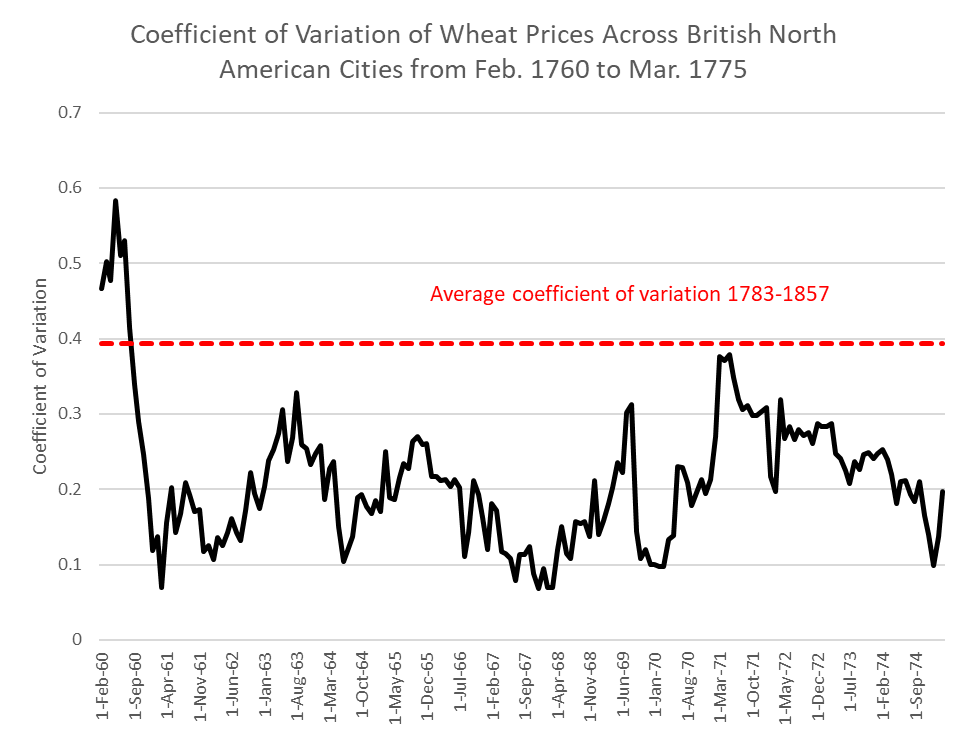
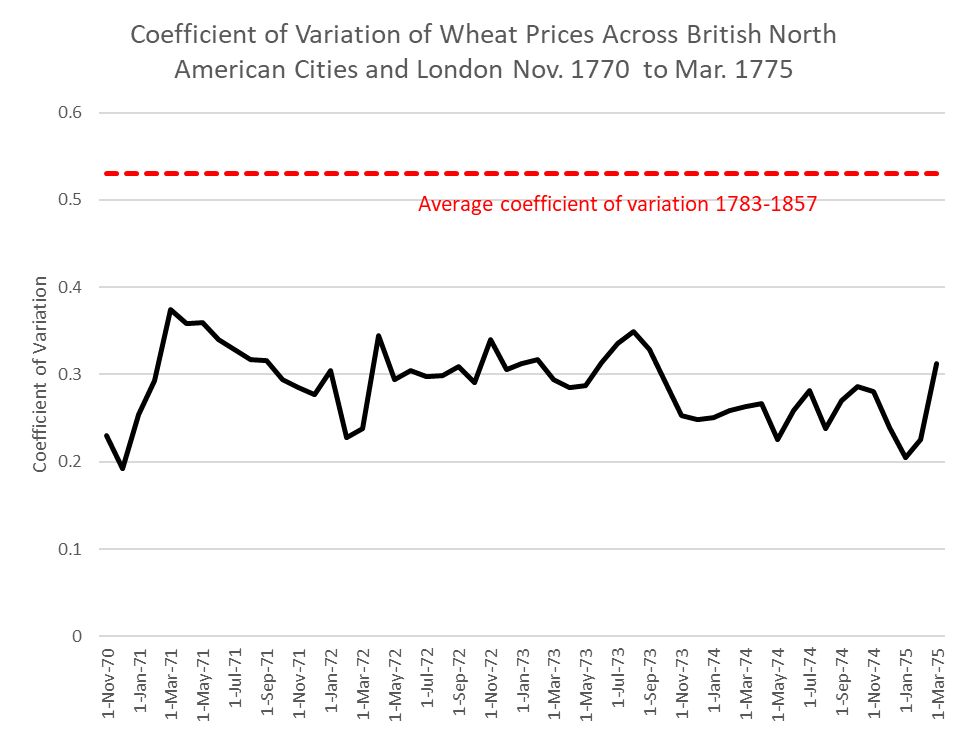
Figure 2
How much does this matter? It is hard to arrive at a measure without using economic modeling. However, some works of economic history may help us ballpark the cost.
Using data for Mexican grain market integration following the expansion of railroads from 1880 to 1910, we can see there was a halving of the coefficient of variation. That halving, it is argued, explained half of the growth in Mexico during the period. Given the growth rate in Mexico during the period, this means that a halving of the coefficient of variation increases growth by roughly 0.8% per annum. Transposing this to the American case suggests that the rough doubling of the coefficient of variation within the north Atlantic slowed down growth by 0.8% per annum. Obviously, this is a ballpark and future efforts are needed to more precisely assess the benefits of market integration. Nevertheless, even a halving of that proportion to 0.4% per annum implies a major cost from the Revolution. Indeed, it is close to half of the growth observed in the data from 1790 to 1860.
Some might take our article as a form of devaluing the American Revolution since we claim that its economic gains were not as large as some think. However, we see the exact opposite—it is a vindication of the American Revolution. Revolutionaries knew there would be costs. It might have been impossible for them to predict that Britain would tighten its Corn Laws from the 1790s onwards or that the French Wars would engulf the North Atlantic from 1792 to 1815. After all, these factors were largely out of their control. However, even that uncertainty about the true cost is something they would have considered as well. This means, costly as it might have seemed, the Revolutionaries knew that the benefits were so much larger. This, we believe, is a testimony to the magnitude of the fruits of the revolution. That is saying that there truly is something historically exceptional about America’s founding moment.
References
Dobado, Rafael and Merraro, Gustavo, “Corn Market Integration in Porfirian Mexico,” The Journal of Economic History. Vol. 65 (2005).Egnal, Marc. New World Economies: The Growth of the Thirteen Colonies and Early Canada. Oxford University Press, 1998.Figueiredo, Ruj. J.P., Jr.; Rakove, Jack; and Weingast, Barry, “Rationality, Inaccurate Mental Models, and Self-Confirming Equilibrium: A New Understanding of the American Revolution,” Journal of Theoretical Politics. Sage Journals. October, 2006.Garmon, Frank W., Jr., “Population density and the accuracy of the land valuations in the 1798 federal direct tax,” Historical Methods: A Journal of Quantitative and Interdisciplinary History. Vol. 53 (2020).Geloso, Vincent, “Distinct within North America: living standards in French Canada, 1688-1775.” Cliometrica. Vol. 13 (2019).Geloso, Vincent, “Toleration of Catholics in Quebec and British Public Finances, 1760-1775. Essays in Economic and Business History. Vol. 33 (2015).Hummel, Jeffrey Rogers, “Benefits of the American Revolution: An Exploration of Positive Externalities,” at Econlib, July 2, 2018.Lindert, Peter H. and Williamson, Jeffrey G., “American colonial incomes, 1650-1774,” The Economic History Review. Vol. 69 (2016).Mancall, Peter and Weiss, Thomas, “Was Economic Growth Likely in Colonial British North America?” The Journal of Economic History. Vol. 59 (1999).Reid, Joseph D. “Economic Buren: Spark to the American Revolution? The Journal of Economic History. Cambridge University Press. May 11, 2010.Sharp, Paul and Weisdorf, Jacob, “Globalization revisited: Market integration and the wheat trade between North America and Britain from the eighteenth century,” Explorations in Economic History. Vol. 50 (2013).Shepherd, James F. and Walton, Gary M., “Economic change after the American Revolution: Pre- and post-war comparisons of maritime shipping and trade,” Explorations in Economic History. Vol. 13 (1976).Walton, Gary M., “Sources of Productivity Change in American Colonial Shipping, 1675-1775,” The Economic History Review. Vol. 20 (1967).
Endnotes
[1] Probate records – which allow for wealth estimations that can be converted into income under some assumptions – suggest per capita growth rates of wealth ranging somewhere between 0.38% to 0.96% per annum from 1792 to 1835. Improvements to price indexes (in order to deflate nominal wealth into inflation-adjusted wealth) suggest somewhat slower growth (0.33% to 0.83%). Different estimation techniques over the period 1822 to 1850 suggests growth rates ranging from 0.17% to 0.53%. Finally, real wage data for the period suggests that there were gradual improvements until the 1820s at which point things plateaued until the 1850s. If the wage data are taken as the measure of growth averaged over the period from 1760 to 1850, the growth rate in living standards is somewhere between at 0.36% to 0.72% per year.
This post first appeared at Liberty Matters as the lead essay in the series: Did the American Colonies Pay Too High a Price for Revolution? It has been reposted here as part of Econlib’s celebration of the 250th anniversary of the Declaration of Independence.