
In 1935, Roosevelt introduced “The Social Security Act,” which passed in Congress. However, the act was described as “Old Age, Survivors, and Disability Insurance.” At first, the Act covered only industry and commerce. It was later extended to include farm operators in 1955. The SS tax was to be 3% of income up to an established limit.
The Amish pay taxes because the Bible said: “paying unto Caesar what is Caesar’s.” In 1956, the IRS informed the Amish that they were now subject to Social Security and would have to pay. One Amishman was quoted in a November 1962 Reader’s Digest article: “Allowing our members to shift their interdependence on each other to dependence upon any outside source would inevitably lead to the breakup of our order.” The constitutional question that has never been decided is what happens when the taxing power of government violates the First Amendment and Freedom of Religion? It clearly states: “Congress shall make no law respecting an establishment of religion, or prohibiting the free exercise thereof…”
In 1802, Jefferson wrote to the Danbury Baptists of Connecticut that there should be “a wall of separation between church and state.” They feared that a minority religion could be subjugated by the Federal Government, acknowledging a national religion. The Johnson Amendment, named for Lyndon Johnson, is a provision in the U.S. tax code that prohibits all 501(c)(3) non-profit organizations from endorsing or opposing political candidates. If churches involve themselves in politics, then indeed that creates a reverse problem where the state can be taken over by one religion and oppress all others; so it can go both ways. Historically, religions have often seized governments and outlawed all other religions.
In this instance, concerning taxation in direct conflict with religion, a group of Amish presented a petition to Congress, with 14,000 signatures. Naturally, Congress ignored them. The Amish reasonably questioned what possible harm they could do by not paying into Social Security. “We do not want to be burdensome, but we do not want to lose our birthright to everlasting glory, therefore we must do all we can to live our faith!”
The IRS moved to go after the Amish and seize their bank accounts. The problem was – they had none! The IRS then sought to go after anyone buying milk from the Amish and attach their payments to divert them to the IRS. Most simply refused for such a scheme would happen just once and end the business. The IRS, refusing to consider any religious principle, moved in to seize property. In this case of the Amish, that meant cows and horses. They would rather have the Amish die than respect anyone’s rights to religion.
Valentine Byler of the Amish community in Pennsylvania owed four years of IRS taxes. The IRS, of course, added interest and penalties to raise it to $308.96. Byler argued his religion forbade paying for insurance. The IRS said that was a “technicality” and that it was really just a tax. Vyler has no bank account to seize, so they issued a summons to appear in court for a charge of contempt. The judge in Federal District Court in Pittsburgh, Pa, according to a Reader’s Digest article, “angrily demanded of the IRS agents, ‘Don’t you have anything better to do than to take a peaceful man off his farm and drag him into court?’” The Judge then dismissed the case.
The IRS never gives up. The IRS had to issue a statement on April 18, 1961, in which they said:
Since Mr. Byler had no bank account against which to levy for the tax due, it was decided as a last desperate measure to resort to seizure and sale of personal property.
The IRS seized three of Byler’s six horses while he was actually plowing the ground for the spring planting. The IRS then sold the three horses at auction on May 1, 1961, getting $460. They then used this to satisfy the $308.96 and then charged him $113.15 in expenses and graciously returned $37.89. The incident made national news and was being used by the Communists to show how capitalism was ruthless. The New York Herald Tribune, reported the story with the bold headline: “Welfarism Gone Mad.”
The IRS Chief of Collections was forced to respond claiming he was unaware of the plowing situation. “Plowing never occurred to me. I live in an apartment.” To show the mentality of those who are bureaucrats, he then said: “We don’t ask people their race or religion when we administer the tax laws. People have no right to use their religion as an excuse not to pay taxes.”
The IRS was then compelled to issue a press release in 1961, stating the Amish stance that “Social Security payments, in their opinion, are insurance premiums and not taxes. They, therefore, will not pay the ‘premium’ nor accept any of the benefits.”
The Amish met with the IRS Commissioner in September 1961 in Washington, DC. They cited several Bible passages, including I Timothy 5:8, which says, “But if any provide not for his own, and especially for those of his own house, he hath denied the faith and is worse than an infidel.”
The public outrage at the conduct of the IRS was international. The Amish argued they were entitled to an exemption based on the First Amendment. The IRS agreed to cease further seizures until the case was settled. Now, senators promised to try to pass a bill in Congress and everything stopped. The Amish hired a lawyer to challenge this conflict between the taxing power and the First Amendment. However, as the court date approached, they realized that if they lost in court, it would be over. They then looked to Congress to pursue a legislative exemption. Finally, in 1965, the Medicare bill was passed by Congress. Congress realized that if the Amish went to court and won, then others could challenge the right to tax conflicting with the First Amendment. Congress quietly put in on page 138 a clause exempting the Old Order Amish, and any other religious sect that conscientiously objected to insurance, from paying Social Security payments, providing that the sect had been in existence since December 31, 1950. The Senate approved in July, and President Lyndon B. Johnson signed it into law on August 13, 1965.
The open question remains simply this; the first explicit references to the tithe appear in Genesis 14, where Abraham tithes to Melchizedek, and in Genesis 28, where Jacob promises to give God “a full tenth.” But where did the idea to tithe come from? Many argue Abraham and Jacob were simply following the customs of the surrounding nations. But Scripture points in a different direction. In Genesis 26:5, God says, “Abraham obeyed my voice and kept my charge, my commandments, my statutes, and my laws.” In the New Testament, Jesus upholds the tithe in Matthew 23:23 (cf. Luke 11:42). He condemns the Pharisees for their tedious commitment to one part of God’s law, the tithe, while neglecting “the weightier matters of justice, mercy, and faithfulness.” Then he states, “These you ought to have done, without neglecting the others.”
One of the Five Pillars of Islam, zakat is a religious obligation for all Muslims who meet the necessary criteria of wealth. This too is not a charitable contribution, but is considered to be an obligatory tax or alms. The payment and disputes on zakat have also been controversial in the history of Islam. The zakat is based on income and the value of all of one’s possessions or property. It has been traditionally set at 2.5% above a minimum amount known as nisab, which has also been greatly debated.
In Judaeo-Christianity, the “tithe” was a one-tenth of annual produce or earnings, formerly taken as a tax for the support of the church and clergy in Christianity. The question is, does exceeding the level prescribed as a “tithe” violate the First Amendment? If true, then any income tax imposed beyond 10% would violate the First Amendment. Since the Ten Commandments also prohibits coveting anything that belonged to a neighbor including his wife or property, it would appear that Socialism championed by Karl Marx violates the First Amendment and any tax should not exceed 10%. Hence, progressive taxation would be unconstitutional if not a flat tax. Some argue it also violates Equal Protection of the laws. The Tax at the time of Jesus’s statement to give to Caesar what is Caesar’s was less than 5%.
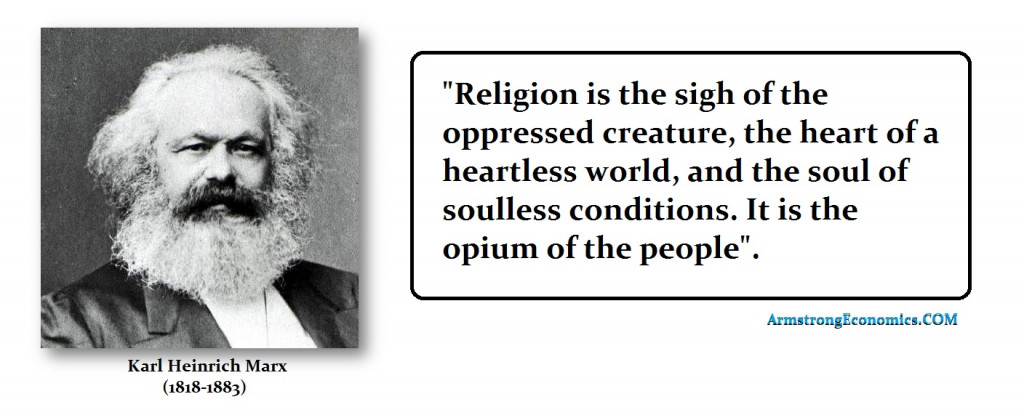
 Historically, during the Roman Republic, the tax imposed was 1%. During times of war, the taxes would rise to 3%. Ever since Karl Marx, who said religion is the opium of the masses, politicians have loved Marxism and used it to exploit the people to the point governments are averaging now 40% of the entire economy. They have outpaced all other businesses beating the bankers and multinational corporations. They have become the 800 pound gorilla in the corner of the room nobody notices is even there. Politicians always preach against the “rich” which increases the wealth of government. As the IRS commented: “We don’t ask people their race or religion when we administer the tax laws. People have no right to use their religion as an excuse not to pay taxes.” This is obviously the spirit of Karl Marx.