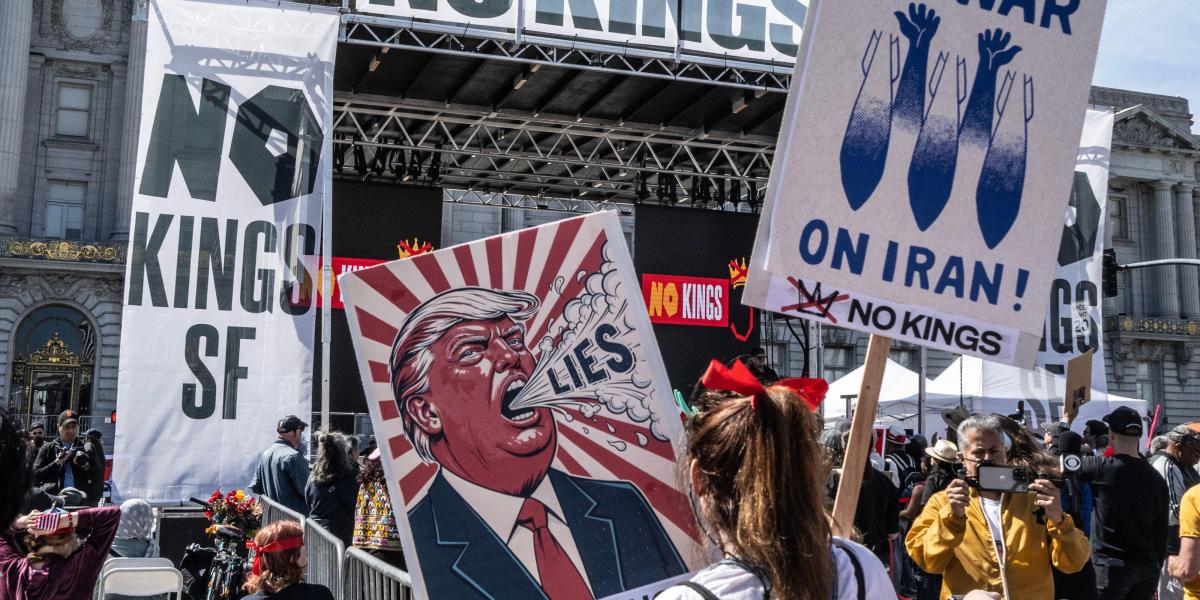
Last Saturday, the third so-called “No Kings” protest took place in cities across the US. Left-leaning protestors again took to the streets to show everyone how much they oppose Trump.
Going all the way back to 2017, the center-left and progressive opposition to Trump has always been, at best, highly flawed. Because it has rested on the idea that he represents a sharp and unique departure from the governmental status quo. Trump is characterized as a wannabe dictator corrupting what had been a sound democratic system that, while not perfect, was largely mobilizing the federal government to benefit the American people.
That was never accurate. The American political system is not, and has never been, designed even with the intention of benefiting the American people. Its purpose, from the beginning, has been to concentrate an ever-increasing amount of power in DC and then, using that power, to transfer as much of the public’s wealth as possible into the pockets of government officials and their well-connected friends.
The real problem with Trump has always been that he is not enough of a meaningful departure from this terrible status quo. The reason the political establishment had been so anxious to get rid of him, despite his failure to meaningfully change the system, was that his bombastic style, occasional moments of honesty, and lack of concern about charging ahead with policies the rest of the political class found imprudent threatened to give away the game.
So Trump’s center-left critics, like those who show up to these mass protests, have it backwards. What’s made the Trump presidency unique is not all the supposed changes he’s made to our system but how his rhetoric and behavior have made it a lot harder for our elites to hide how the system actually works.
That said, the narrative that No Kings pushes has, on its face, become a lot more believable after Trump unilaterally launched an aggressive war with Iran against the wishes of the majority of the population. A war that has quickly thrown the global economy into disarray, while bringing a serious risk of deadly energy and food shortages in the coming months, and a rising civilian death toll.
As violence grips the region, thousands of pounds of bombs fall across Iran, nightly missile barrages rain down on Israel, explosive drones strike popular luxury hotels in neighboring Gulf countries, and a major supply shock slams important global commodities like oil, fertilizer, and helium it is remarkable to remember that one man had the power to kick this all off.
But to call this power king-like is to greatly understate the problem. Our problem is not with a rogue president acting like a king but with the presidency itself. Or, more specifically, with a massive, self-amplifying executive branch that makes deranged presidents far more dangerous than an actual, literal king could ever be.
People like to imagine kings as these old bearded men who got to lounge around on a throne all day possessing the power to command anyone to do anything for any reason. That kind of unlimited, unquestioned, absolute power works well for fiction, but the power of real kings was far more limited.
That is largely because, for most of human history, power wasn’t concentrated exclusively in the hands of the crown but was spread across multiple social classes of elites that would compete with and check each other. This social power wasn’t always spread equally, but it was certainly not monopolized in the way we see with modern states.
That said, in Europe, in the centuries after the fall of the Roman Empire—the period we usually picture when we think of kings—power was highly dispersed between the crown, the nobility, the merchants, and the Church. The meritocratic and competitive environment this created within the Western elite was one of the main reasons the West grew so dominant compared to the rest of the world. It also greatly constrained what kings could do or get away with.
Another major constraint, especially when it came to waging wars, was the fact that the material cost of starting some big new project like a war fell directly on the king himself. If a king wanted to start a military campaign, it was up to him to first gather the men, resources, and money necessary to see it through.
Kings obviously had more power to collect or seize these resources than your average merchant or noble. But they still had to either have everything they needed in their possession before they started or had to convince some external benefactor that the expedition was just and winnable enough to secure loans for that specific campaign. That was a major constraint. It was not unusual for kings to be forced to abandon military campaigns because they simply ran out of money.
But, over the past few hundred years—and especially in the last eight or so decades—those constraints have largely gone away.
That began with the rise of the modern state. Over time, the power that had been spread across multiple distinct elite social classes began to get concentrated in a single class that took on the monopolistic characteristics we now associate with modern states.
There’s no single event that alone marks that transformation—although the Thirty Years’ War and World War I get close. But the sharp difference we see between Western political institutions in the Middle Ages and today reveals how dramatic a transformation it was and demonstrates that the political entity that Rothbard was writing about in “Anatomy of the State” is, in a literal sense, a relatively recent historical phenomenon.
In an American context, the United States was, of course, founded as a union of thirteen separate countries. It was only after a war was fought to prevent several of those countries from leaving the union that the US became the single large state we know today—with provinces that we, confusingly, call states.
But the founders also clearly envisioned the US would primarily be run by the legislature. That can be seen in the space they devoted to Congress in the Constitution compared to the other two branches. But that also did not last.
Over time, power became concentrated primarily in the executive branch. That began with civil service reforms of the late 1800s, which made it much harder for elected officials to fire and replace the unelected bureaucrats who made up the early executive agencies. Then, that so-called administrative state exploded in size as the world grew more bureaucratic during and between the world wars. And in the decades since, as the federal government’s many interventions at home and abroad led to easily predictable bad consequences, those issues were used to justify expanding the federal bureaucracy.
But perhaps the most important factor in the growth and ascension of the administrative state comes from one often-neglected corner of it—the Federal Reserve.
From its founding in 1913, the government-backed banking cartel known as the Federal Reserve system engineered a slow but deliberate government takeover of money. The government used the Fed’s power over the banking system to transform the dollar from a currency defined as a specific weight of gold into a fiat money whose value is determined and controlled by government officials.
That transformation—or better, corruption—of the dollar gave the federal government the essentially unchecked power to fund its projects with newly-printed currency. It decoupled government expenditures from revenues and, in doing so, effectively removed the monetary constraint that had been the bane of so many supposedly “absolutist” kings during the Middle Ages.
That is how we’ve arrived at our current situation where the executive branch is made up of over three million permanent government officials, administering larger, and more intrusive state projects than the monarchs of the past could have even dreamed of.
It’s important to understand that this massive, largely faceless bureaucracy is, in fact, where the bulk of federal power is concentrated in our current political system. Although on paper the president is the leader of all these departments and agencies making up the executive branch, modern American presidents are, in actuality, merely figureheads—or, as Paul Gotfried has called them, the “photogenic front men for a managerial dictatorship.”
Presidential candidates will be deemed acceptable by the political establishment, and serving presidents will be permitted to remain in office with little to no trouble if they obediently serve the interests of the administrative state. But, as recent history has shown, if a president tries to do anything that meaningfully threatens the permanent bureaucracy, they’ll find themselves either constrained by recent, establishment-protecting legal precedents or quietly blocked by the faceless bureaucrats who actually control how government programs are carried out.
The one major exception to this is foreign policy.
As Commander-in-Chief, the president’s total control over the military is enshrined in the Constitution. And, since Congress has effectively abdicated its role in declaring wars since WWII, the president is now in complete control of when and where the country goes to war.
And so it is with war that presidents are able to unilaterally exert their will on the world and, in doing so, act—as many see it—like a king. But presidents are not constrained like the kings of the past were.
The American military itself is far larger and more powerful than any army a king could have realistically raised. And it’s bolstered by its adjacent agencies in the massive federal bureaucracy, such as the “intelligence community,” the State Department, Homeland Security, and more.
The president doesn’t need to recruit or call up this enormous war-making apparatus. It’s ready and available to him the second he’s sworn into office. And all of this—the soldiers, weapons, spies, diplomats, staffers, and the wars themselves—all of this can only exist at these current colossal levels because of the Federal Reserve.
Unlike the kings in history, modern American presidents do not have to worry about how to pay for their wars. The central bank helps provide the funds and then quietly spreads the cost around to the rest of the American people. Modern wars are significantly more expensive than any that came before, but the cost no longer falls directly on those launching them.
And so it was the unique characteristics of the modern American executive branch that gave Trump the power to single-handedly push the Middle East into major regional war, and the wider world to the brink of an economic catastrophe.
In other words, the president is no king. He is far more dangerous.