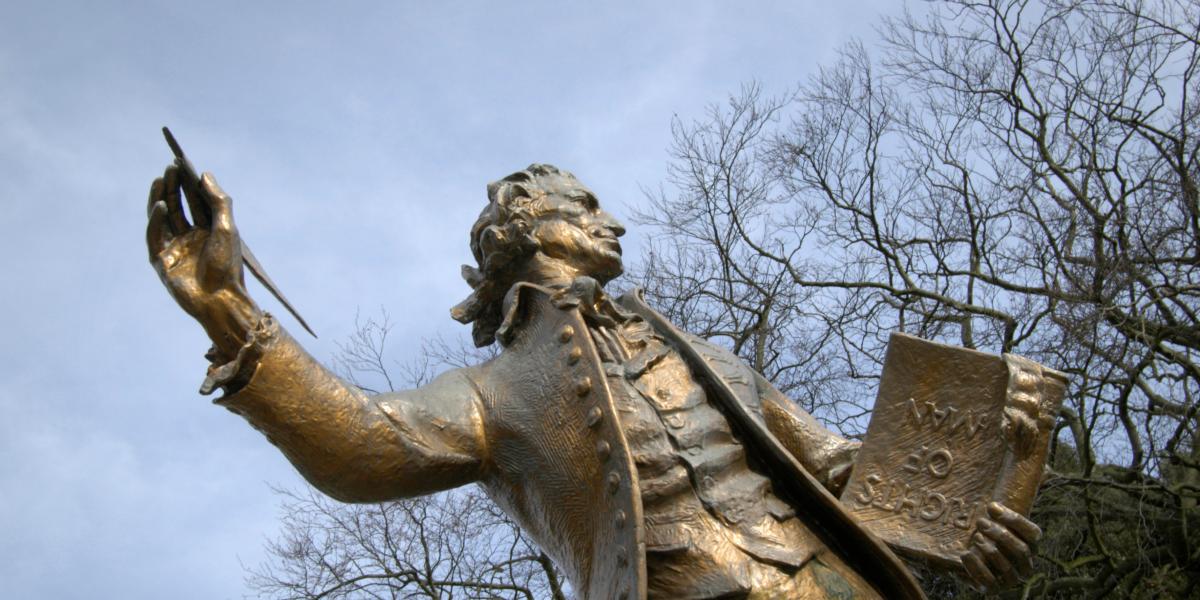
On July 4, 2026 Americans celebrated various people for their role in founding this country. We can start with Washington, Jefferson, Adams, Madison, Franklin, Henry, and continue debating into the night. Somewhere on the list would be Paine—Robert Treat Paine, a Harvard graduate and signer of the Declaration. And, grudgingly for some, another Paine but without a middle name—Thomas Paine—who lacked any of the usual credentials to be considered a founder.
Thomas Paine did not sign any of the founding documents, either the Declaration or the Constitution. Yet there is strong evidence he drafted the Declaration. He was not a Harvard graduate, a successful lawyer, a prominent landowner, or a wealthy banker. He was not a member of the Continental Congress. He never held political office at any level. His only military experience was as an aide-de-camp for Major General Nathanael Greene.
Thomas Paine was “a man who had failed as a skilled craftsman, as a teacher, as a shopkeeper, as a street preacher, as a petty customs official in the Excise, dismissed more than once and a sometime debtor and bankrupt.” In short, a nobody. At his death in 1809 he was one of the most despised people in the country.
Yet, without Thomas Paine, America might have become like Canada—a self-governing dominion under the Crown rather than an independent republic. Without Paine, we don’t get Common Sense and his clarion call for independence from England.
Even at the time of its publication in January 1776, most colonists still considered themselves loyal British subjects fighting for their rights as Englishmen. Neither words nor arms had changed that conviction. In Jefferson’s A Summary View of the Rights of British America published in July, 1774 he repeatedly (58 times) refers to King George III as “his majesty” while repeatedly criticizing his policies and hoping for a restoration of colonial rights as British subjects. He ends his essay with this plea:
. . .that you will be pleased to interpose with that efficacy which your earnest endeavours may ensure to procure redress of these our great grievances, to quiet the minds of your subjects in British America, against any apprehensions of future encroachment, to establish fraternal love and harmony through the whole empire, and that these may continue to the latest ages of time, is the fervent prayer of all British America!
In other words, we are on our knees begging you for relief. Whoever Jefferson’s words might have moved, it didn’t include Parliament, the king, or most American colonists.
By April 19, the longstanding quarrel with England had erupted into armed conflict on the Lexington Common, and, on June 17, the British pyrrhic victory at Bunker’s Hill had convinced Americans that their militia—led by Colonel William Prescott, a man who would fight you to the gates of hell—could stand against British regulars.
The Continental Congress—largely through the persistence of John Dickinson—adopted the Olive Branch Petition in July 1775. The petition affirmed colonial loyalty to the Crown and asked George III to intervene against Parliament’s policies and restore harmony. The language of the petition was again dutifully servile: “We, your Majesty’s faithful subjects. . .entreat your Majesty’s gracious attention to this our humble petition.”
But the king had already issued the Proclamation of Rebellion on August 23, 1775, declaring the colonies to be in open rebellion and ordering loyal subjects to suppress it. He refused to even read Dickinson’s appeal.
The atmosphere was ripe for further combat, but to what end? Colonists were British subjects and deserved to be treated as such. They had turned to the king for protection but had been written off as rebels.
Then Paine came along. When the first edition of Common Sense hit the streets on January 10, 1776, it was a pamphlet written “by an Englishman.” In hiding his identity he turned readers “to the doctrine itself, not the man.”
He was also saying, “I was born in England and know first-hand what I’m talking about.” Paine eventually put his name on the pamphlet, but by then most politically-active Americans knew he had written it.
Among later editions was an essay called To the Quakers. Raised by a Quaker father and Anglican mother, Paine advised the Quakers in America to avoid “mingling religion with politics” and to support the Revolution, since in Paine’s view the British had started the war. “[It is] the invasion of our country by fire and sword, which conscientiously qualifies the use of arms.” He was advising Quakers to make an exception to their pacifism.
The Argument of Common Sense
“The cause of America is in a great measure the cause of all mankind,” Paine writes in his opening.
After arguing that government is a “necessary evil,” since only “Heaven is impregnable to vice” and “some form of government [is necessary] to supply the defect of moral virtue,” Paine discusses how kings came to be “exalted above the rest, and distinguished like some new species.”
Later still, after disposing of the idea of hereditary succession, he says if we could
. . .take off the dark covering of antiquity and trace them [kings] to their first rise, we should find the first of them nothing better than the principal ruffian of some restless gang, whose savage manners of pre-eminence in subtilty obtained him the title of chief among plunderers . . . .
No once in his pamphlet does he refer to the king as “his majesty.”
Paine draws on his knowledge of English political history and the Bible to anchor his arguments. “In short, monarchy and succession have laid (not this or that kingdom only) but the world in blood and ashes. ’Tis a form of government which the word of God bears testimony against, and blood will attend it.” He concludes:
In England a King hath little more to do than to make war and giveaway places; which, in plain terms, is to empoverish the nation and set it together by the ears [set people against one another]. A pretty business indeed for a man to be allowed eight hundred thousand sterling a year for, and worshipped into the bargain! Of more worth is one honest man to society, and in the sight of God, than all the crowned ruffians that ever lived.
He then offers his view on what the American colonies should do in their current state of war. He suggests a manifesto:
Were a manifesto to be published, and despatched to foreign Courts, setting forth the miseries we have endured, and the peaceful methods which we have ineffectually used for redress; declaring at the same time that not being able longer to live happily or safely under the cruel disposition of the British Court, we had been driven to the necessity of breaking off all connections with her; at the same time, assuring all such Courts of our peaceable disposition towards them, and of our desire of entering into trade with them; such a memorial would produce more good effects to this Continent than if a ship were freighted with petitions to Britain.
He urges the reader to consider an opportunity few if any nations ever have: To form itself into a government.
Most nations have let slip the opportunity, and by that means have been compelled to receive laws from their conquerors, instead of making laws for themselves.
He concludes:
Nothing can settle our affairs so expeditiously as an open and determined declaration for independence.
Conclusion
A pamphlet stretching to almost 19,000 words is not easily digested in every detail. Yet the bold points it made served to motivate the colonists and congress to get serious about independence. It must have been an exhilarating realization that the young nation could be free from foreign dominance. All they had to do was win the war.
As history tells us, it wasn’t easy nor did the idea of the Declaration’s “self-evident truths” appear in his pamphlet. The one sovereign is “the King of Heaven,” not the individual or even the separate states.
Paine left no documented evidence of his view of Shays’s Rebellion, an event that came only ten years after Common Sense and which was exploited by nationalists to form a stronger government. One can infer he would have been sympathetic to the farmers who fought for independence but were now being mistreated by distant authorities in Boston as much as London once did. The country badly needed one more Paine critique.