No Result
View All Result
SUBMIT YOUR ARTICLES
  • Login
Wednesday, July 8, 2026
TheAdviserMagazine.com
  • Home
  • Financial Planning
    • Financial Planning
    • Personal Finance
  • Market Research
    • Business
    • Investing
    • Money
    • Economy
    • Markets
    • Stocks
    • Trading
  • 401k Plans
  • College
  • IRS & Taxes
  • Estate Plans
  • Social Security
  • Medicare
  • Legal
  • Home
  • Financial Planning
    • Financial Planning
    • Personal Finance
  • Market Research
    • Business
    • Investing
    • Money
    • Economy
    • Markets
    • Stocks
    • Trading
  • 401k Plans
  • College
  • IRS & Taxes
  • Estate Plans
  • Social Security
  • Medicare
  • Legal
No Result
View All Result
TheAdviserMagazine.com
No Result
View All Result
Home Market Research Economy

Coffee Break: Armed Madhouse – RAND Alarms the China Hawks

by TheAdviserMagazine
7 months ago
in Economy
Reading Time: 5 mins read
A A
Coffee Break: Armed Madhouse – RAND Alarms the China Hawks
Share on FacebookShare on TwitterShare on LInkedIn


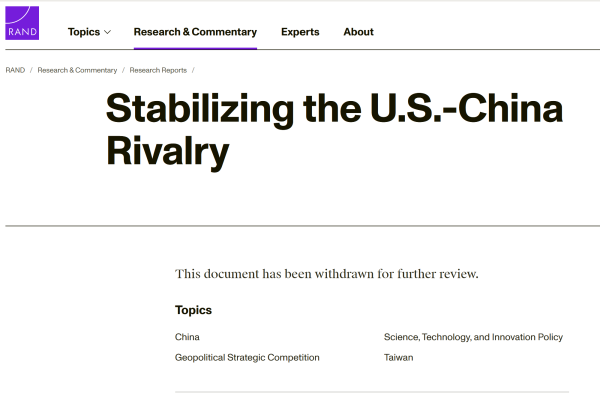
In October of 2025, the RAND Corporation published a report titled “Stabilizing the U.S.–China Rivalry“. Within weeks, the study disappeared from RAND’s website. No explanation. No revision notice. No reupload. For a prominent think tank, whose research pipeline is structured to avoid public missteps, withdrawal of a report is uncommon, and silence more so. The unusual disappearance of this report raises questions about internal disagreement within U.S. strategy-making circles.

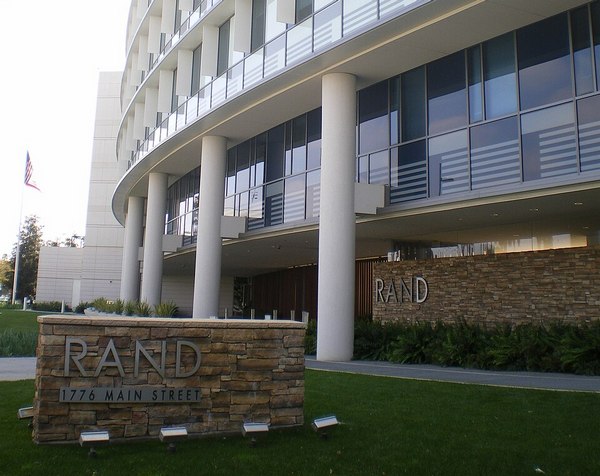
RAND headquarters

The timeline itself suggests a struggle. The study appeared on RAND’s website in mid-October 2025 and was not removed until nearly two weeks later. This is far too slow for a routine correction and far too fast for a scheduled revision. Such a delay is characteristic of an internal contest: the report was vetted, approved, published, and allowed to circulate — until opposition within the policy structure hardened sufficiently to demand its removal. The RAND report was not suppressed because it was mistaken, but because its implications became intolerable after they were recognized. The structural characteristics of the withdrawn report are shown below.
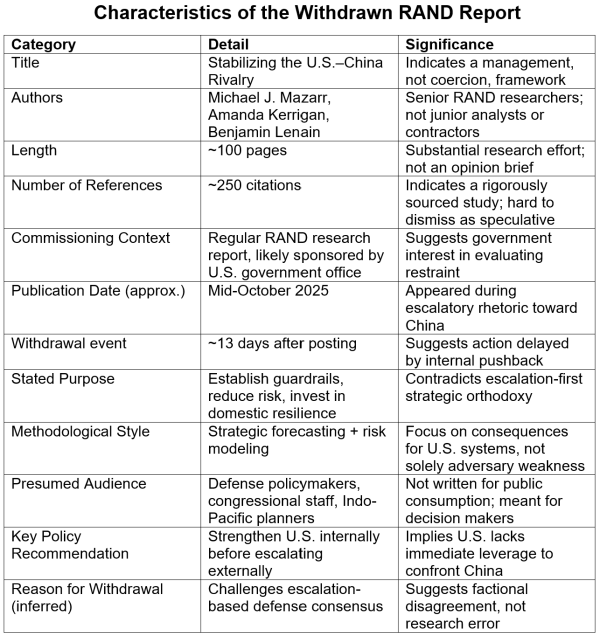
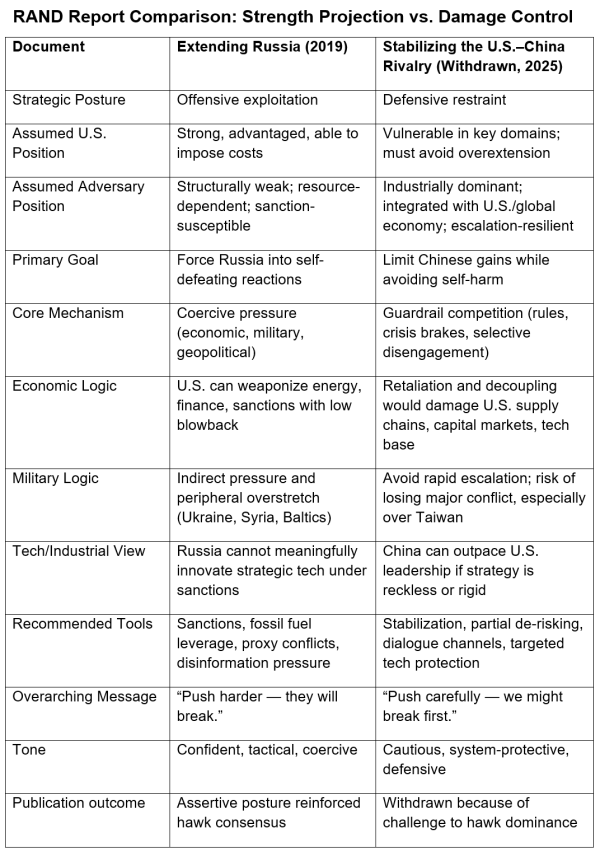
To understand why this document was retracted, it is useful to examine it alongside another historically important RAND study: “Extending Russia: Competing from Advantageous Ground” (2019). The contrast between the two offers a rare, unfiltered glimpse into an evolving, and contested, U.S. strategic worldview.

Russia as a Target of Pressure

“Extending Russia” was explicitly about Washington’s ability to impose costs on Moscow. The study recommended strategies to “extend” Russian vulnerabilities—essentially stressing the state until it faces difficult internal trade-offs. Tools included:

energy leverage
financial sanctions
information pressure
peripheral military competition.

The underlying assumption was straightforward: the U.S. possesses structural power, Russia does not. As a result, coercive measures appear low-risk and high-return. The report offers a plan for managing an adversary from a position of strategic confidence. Some foreign policy analysts have considered this report to be a blueprint for the assertive U.S. posture that preceded the Ukraine war.

China Policy as Management of Systemic Constraint

By contrast, “Stabilizing the U.S.–China Rivalry” adopts a cautionary tone unusual in U.S. strategic literature. Rather than identifying Chinese weaknesses to exploit, its central concern is avoiding actions that might weaken the United States itself. Where the Russia report encourages escalation to impose costs, the China study warns that escalation may produce asymmetric blowback affecting:

Global supply chains
Industrial capacity
Technology platforms
Capital markets

In short, costs cannot be imposed on China without risking significant retaliatory actions against the U.S. economy and defense base. (This was demonstrated recently when China responded to increased U.S. import tariffs by restricting the export of essential rare-earth materials.) The study’s recommendations center on restraint, crisis-management channels, selective “de-risking,” and internal capability rebuilding. This contrasts markedly with the confrontational approach presented in the “Extending Russia” report, and this strategic shift was likely seen as a direct challenge by Washington’s China hawks.
Why the RAND Report Withdrawal Matters

RAND reports do not pass easily into public view. Prior to publication they undergo internal peer review; methodological review; sponsor liaison and approval; and editorial and classification screening. A report cleared through these steps represents a professionally accepted line of analysis, not a personal opinion. When such a document is withdrawn after clearance, the likely cause is not faulty research, but political pressure.

The China report’s framing challenged the prevailing policy assumptions of the China hawks. U.S. defense contractors, naval lobbying circles, and military planners benefit from a narrative of unrestrained U.S. capability and open-ended escalation. A report suggesting that U.S. power is limited, particularly vis-à-vis a peer industrial economy, undermines the logic of increasing defense appropriations and escalation-oriented military planning. In other words, the report’s realism made it politically untimely.
A Strategic Debate, Not a Conspiracy

The withdrawal of the report should not be read as an incident of simple censorship. It signals something more important: a deepening institutional debate over how to position the United States in a geopolitical environment where the coercive instruments that were applied against Russia may be counterproductive against China. The China study represents a realist faction arguing that the U.S. must invest in industrial, technological, and financial resilience before pursuing aggressive competition. Its warning is less about China’s strength than America’s vulnerabilities. These include dependency on foreign manufacturing inputs; exposure to retaliatory capital controls; eroding technological monopolies; and fragile defense supply chains. The report stated the politically inconvenient truth: policy must converge with economic arithmetic.

Report Withdrawal as a Setback for the China Hawks

The quiet removal of “Stabilizing the U.S.–China Rivalry” did not simply protect a policy consensus; it exposed its fragility. The hawkish approach to China—based on the assumption that escalation will successfully impose coercive leverage—now faces practical constraints that are increasingly difficult to deny. The RAND report’s realism was unacceptable not because it was provocative, but because it was evidence-based at a moment when the dominant position is ideological.

For China hawks, escalation is a tool for restoring deterrence through fear. Yet “Stabilizing the Rivalry” presented a scenario in which escalation erodes deterrence by exposing American vulnerabilities. In that framework, the China hawk position begins to resemble what economists call a moral hazard: an actor takes on greater risk because it expects another party—here the broader U.S. economy—to absorb the costs.

This tension reveals why a defensive strategy is politically unwelcome. It requires acknowledging that the United States cannot “manage” China primarily through military signaling, sanctions, export controls, or alliance pressure. Those instruments still matter, but in the RAND analysis they function as supplements to industrial and technological renewal, not as substitutes. The hawkish model reverses that order by treating industrial weakness as an incidental issue rather than a key problem to solve.

In practical terms, the RAND report withdrawal signals a deteriorating political position for China hawks, not because their agenda lacks influence, but because its strategic justification is becoming harder to defend without suppressing research that contradicts it. The inability to allow a vetted, internally approved study from a prominent think tank to remain public demonstrates the growing incongruity between hawkish anti-China sentiment and economic constraints on China policy.

Conclusion

If the U.S. continues to debate China policy without confronting its industrial dependencies, the disagreement will not be between hawks and realists but between narrative and arithmetic. RAND’s withdrawn report was not an ideological provocation but a forecasting exercise arriving at a forbidden conclusion: the U.S. cannot pursue hegemonic competition without first rebuilding its economic capacity to compete. Refusing to say so does not reduce the cost of escalation with China. It only postpones the reckoning.

Print Friendly, PDF & Email


Source link

Tags: AlarmsArmedBreakChinacoffeeHawksMadhouseRand
ShareTweetShare
Previous Post

Anatomy of an AI Trade: How I Use AI to Make Money in Stocks

Next Post

10 Prescription Errors Older Adults Face Without Realizing It

Related Posts

edit post
Market Talk – July 7, 2026

Market Talk – July 7, 2026

by TheAdviserMagazine
July 7, 2026
0

ASIA: The major Asian stock markets had a negative day today: • NIKKEI 225 decreased 1,480.73 points or -2.12% to...

edit post
Coffee Break: Armed Madhouse – From Spy Satellites to Peace Satellites

Coffee Break: Armed Madhouse – From Spy Satellites to Peace Satellites

by TheAdviserMagazine
July 7, 2026
0

Modern warfare has produced a remarkable paradox. Never before have governments possessed such detailed knowledge of events unfolding across the...

edit post
Israel Kirzner and the Entrepreneurial Market Process

Israel Kirzner and the Entrepreneurial Market Process

by TheAdviserMagazine
July 7, 2026
0

Recently, the Independent Institute published a new collection of essays on relatively obscure economists. Both professionals and lay people alike...

edit post
Don’t Confuse the Declaration of Independence with the Constitution

Don’t Confuse the Declaration of Independence with the Constitution

by TheAdviserMagazine
July 7, 2026
0

What is the Mises Institute? The Mises Institute is a non-profit organization that exists to promote teaching and research in...

edit post
How the Lack of Housing Affordability Harms Europe’s Citizens

How the Lack of Housing Affordability Harms Europe’s Citizens

by TheAdviserMagazine
July 7, 2026
0

Yves here. Note that this article originally had the unduly anodyne headline, “Housing affordability is reshaping Europe’s social fabric.” What...

edit post
A Mutual Sympathy of Sentiments

A Mutual Sympathy of Sentiments

by TheAdviserMagazine
July 7, 2026
0

In The Theory of Moral Sentiments, Adam Smith explains that we want to establish a “mutual sympathy of sentiments.” We...

Next Post
edit post
10 Prescription Errors Older Adults Face Without Realizing It

10 Prescription Errors Older Adults Face Without Realizing It

edit post
Nvidia pushes back on charges that AI investment is a bubble

Nvidia pushes back on charges that AI investment is a bubble

  • Trending
  • Comments
  • Latest
edit post
Mass Fraud in Massachusetts Committed by Illegal Immigrants Discovered

Mass Fraud in Massachusetts Committed by Illegal Immigrants Discovered

June 22, 2026
edit post
New York Seniors: 6 STAR Tax Relief Rules That Could Put a Bigger Check in Your Mailbox

New York Seniors: 6 STAR Tax Relief Rules That Could Put a Bigger Check in Your Mailbox

June 20, 2026
edit post
5 Pennsylvania Rebate Rules Seniors Should Check Before the Property Tax/Rent Deadline

5 Pennsylvania Rebate Rules Seniors Should Check Before the Property Tax/Rent Deadline

June 18, 2026
edit post
Retail giant exits U.S. fashion after multi-million-dollar scandal

Retail giant exits U.S. fashion after multi-million-dollar scandal

July 1, 2026
edit post
Florida Roads Become a Battleground for Illegal Immigration

Florida Roads Become a Battleground for Illegal Immigration

June 9, 2026
edit post
Same Portfolio. Same Retirement. A 10-Mile Move Costs One Couple ,000 A Year

Same Portfolio. Same Retirement. A 10-Mile Move Costs One Couple $10,000 A Year

June 27, 2026
edit post
Secret Network Proposes SCRT Move From Cosmos to Arbitrum

Secret Network Proposes SCRT Move From Cosmos to Arbitrum

0
edit post
The Summer Travel Scam Retirees Should Watch Before Booking a Last-Minute Trip

The Summer Travel Scam Retirees Should Watch Before Booking a Last-Minute Trip

0
edit post
Don’t Confuse the Declaration of Independence with the Constitution

Don’t Confuse the Declaration of Independence with the Constitution

0
edit post
Traders on Kalshi think the Nasdaq-100 will end 2026 above 30,000

Traders on Kalshi think the Nasdaq-100 will end 2026 above 30,000

0
edit post
Nvidia inaugurates expanded Beersheva R&D center

Nvidia inaugurates expanded Beersheva R&D center

0
edit post
Financial services AI dangers highlighted by regulator’s review

Financial services AI dangers highlighted by regulator’s review

0
edit post
Secret Network Proposes SCRT Move From Cosmos to Arbitrum

Secret Network Proposes SCRT Move From Cosmos to Arbitrum

July 7, 2026
edit post
SpaceX’s biggest bull sees valuation soaring above  trillion

SpaceX’s biggest bull sees valuation soaring above $10 trillion

July 7, 2026
edit post
68% of clients would switch advisors for one who offers estate planning

68% of clients would switch advisors for one who offers estate planning

July 7, 2026
edit post
Kalshi traders give low odds the U.S. takes a stake in OpenAI in 2026

Kalshi traders give low odds the U.S. takes a stake in OpenAI in 2026

July 7, 2026
edit post
The “Widow Penalty” Budget: Why Expenses Don’t Always Drop After One Spouse Dies

The “Widow Penalty” Budget: Why Expenses Don’t Always Drop After One Spouse Dies

July 7, 2026
edit post
Someone Stole M From BonkDAO Without Hacking Anything

Someone Stole $21M From BonkDAO Without Hacking Anything

July 7, 2026
The Adviser Magazine

The first and only national digital and print magazine that connects individuals, families, and businesses to Fee-Only financial advisers, accountants, attorneys and college guidance counselors.

CATEGORIES

  • 401k Plans
  • Business
  • College
  • Cryptocurrency
  • Economy
  • Estate Plans
  • Financial Planning
  • Investing
  • IRS & Taxes
  • Legal
  • Market Analysis
  • Markets
  • Medicare
  • Money
  • Personal Finance
  • Social Security
  • Startups
  • Stock Market
  • Trading

LATEST UPDATES

  • Secret Network Proposes SCRT Move From Cosmos to Arbitrum
  • SpaceX’s biggest bull sees valuation soaring above $10 trillion
  • 68% of clients would switch advisors for one who offers estate planning
  • Our Great Privacy Policy
  • Terms of Use, Legal Notices & Disclosures
  • Contact us
  • About Us

© Copyright 2024 All Rights Reserved
See articles for original source and related links to external sites.

Welcome Back!

Login to your account below

Forgotten Password?

Retrieve your password

Please enter your username or email address to reset your password.

Log In
No Result
View All Result
  • Home
  • Financial Planning
    • Financial Planning
    • Personal Finance
  • Market Research
    • Business
    • Investing
    • Money
    • Economy
    • Markets
    • Stocks
    • Trading
  • 401k Plans
  • College
  • IRS & Taxes
  • Estate Plans
  • Social Security
  • Medicare
  • Legal

© Copyright 2024 All Rights Reserved
See articles for original source and related links to external sites.