
No Result
View All Result
SUBMIT YOUR ARTICLES
  • Login
Thursday, August 6, 2026
TheAdviserMagazine.com
  • Home
  • Financial Planning
    • Financial Planning
    • Personal Finance
  • Market Research
    • Business
    • Investing
    • Money
    • Economy
    • Markets
    • Stocks
    • Trading
  • 401k Plans
  • College
  • IRS & Taxes
  • Estate Plans
  • Social Security
  • Medicare
  • Legal
  • Home
  • Financial Planning
    • Financial Planning
    • Personal Finance
  • Market Research
    • Business
    • Investing
    • Money
    • Economy
    • Markets
    • Stocks
    • Trading
  • 401k Plans
  • College
  • IRS & Taxes
  • Estate Plans
  • Social Security
  • Medicare
  • Legal
No Result
View All Result
TheAdviserMagazine.com
No Result
View All Result
Home Market Research Economy

Big Money and the Maine Election: Round 2

by TheAdviserMagazine
3 weeks ago
in Economy
Reading Time: 6 mins read
A A
Big Money and the Maine Election: Round 2
Share on FacebookShare on TwitterShare on LInkedIn


Yves here. Graham Platner may be dead as a political candidate, but the debate about his run and what happens to the campaign for the Senate seat now held by Susan Collins is very much alive. Like Bernie Sanders, Platner’s funding came overwhelmingly from small donors. Despite Maine Democrats earnestly claiming that the new candidate will be chosen to reflect Maine interest, the Maine Democratic Party in fact gets very considerable large contributions from out-of-state sources, putting paid to the idea that it can operate independently.

By Thomas Ferguson, Research Director for the Institute for New Economic Thinking, Professor Emeritus, University of Massachusetts, Boston; Paul Jorgensen, Associate Professor, School of Interdisciplinary Program and Community Engagement, University of Texas Rio Grande Valley; and Jie Chen, University Statistician, University of Massachusetts. Originally published at the Institute for New Economic Thinking website

The upheaval in Maine’s Senate race has focused attention on candidates and party leaders. Less noticed is what the campaign finance data reveal about the state’s Democratic Party and its structural dependence on national organizations and large out-of-state donors.

Barely a fortnight ago, Maine’s Senate election showed all the hallmarks of a classic match-up between David and Goliath. In the giant’s role stood incumbent Republican Senator Susan Collins, backed by a tidal wave of outside money mostly from very big donors, including almost a 100 billionaires or their spouses. The David challenging her was Democrat Graham Platner, who had already forced the withdrawal of Maine Governor Janet Mills, who had also sought the nomination. Platner’s campaign financing profile was the polar opposite of both Collins’ and establishment leaders in both parties: Essentially no large donations, quite like the distinctive profile of Vermont Senator Bernie Sanders we have analyzed before. See Figures 1 and 2 and for Sanders, Figure 4.

Figure 1: Big Money in Maine Senate Elections Round 1
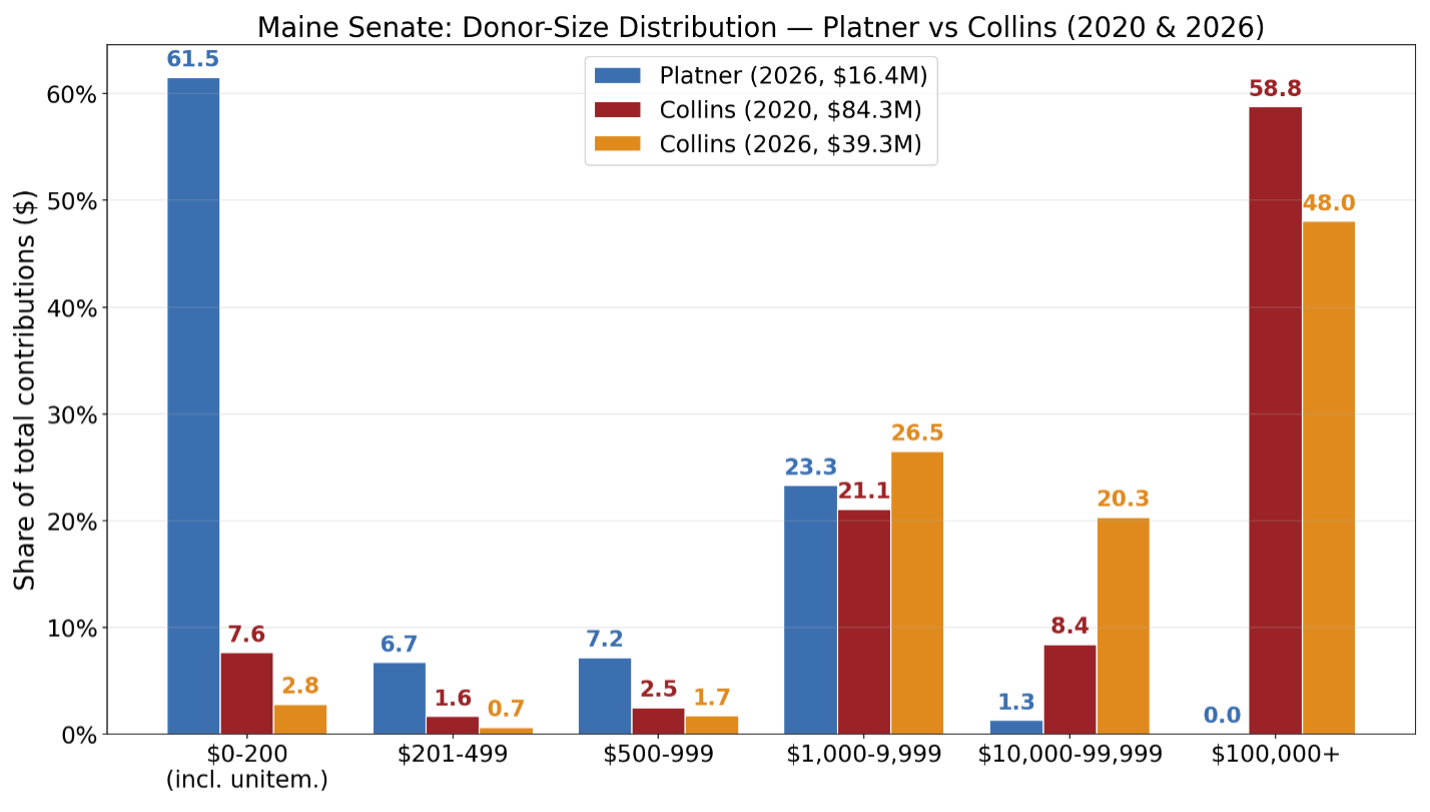
Source: Ferguson, Jorgensen, Lalisse, and Chen, 2026

But that was then; this is now. As a blockbuster movie about a legendary Greek hero starts swallowing midsummer America’s cultural space, Maine suddenly one-upped Hollywood. The state borrowed from another celebrated Greek sage, Heraclitus: A scandal broke, and suddenly everyone discovered that you could not step twice into the same Senate election.

The bitter debates occasioned by Platner’s 11th hour withdrawal have dominated media coverage ever since. Meanwhile the New York Times and other media report that Maine Democrats are firmly resolved to reject efforts by out of state leaders of the national Democratic establishment, such as Senate Minority Leader Charles Schumer to influence the choice of a new nominee. But we were interested to see that, rather like another famous 2024 case, party leaders decided against a quick “firehouse” primary to let the voters decide. Instead, the leaders chose to select a new candidate at a convention of 601 people, that would include 101 members of the Maine State Democratic Committee.

We have no special insight into the mindsets of Maine Democratic leaders. But after seeing the Times article about how unwelcome Senator Schumer is said to be, we thought the financing of the Maine Democratic Party might merit closer inspection. As ever, we make the move that other political money analyses don’t: we sum contributions from the same people and organizations to show the true shape of donor profiles. At a glance, one can see the extent to which big or small money dominates.[1]

State parties are somewhat different animals from election campaigns of individual candidates. The former, for example, are likely to show at least some small donations. But virtually every case we have scrutinized also shows inflows of really large sums of money, from donors both in and out of state. The size of those donations vary by circumstance and urgent need, with money from national party organizations often critically important, especially in peripheral states like Maine, that does not have Wall Streets or casinos or much high tech of its own to tap.

We are not exactly astonished, accordingly, to discover that the two largest inflows of money into the Maine party come from organizations affiliated with the Democratic National Committee and the Democratic Senatorial Campaign Committee. See Figure 2.

Figure 2: Contributions by Donor Size – Maine Democratic Party 2025-2026 Election Cycle
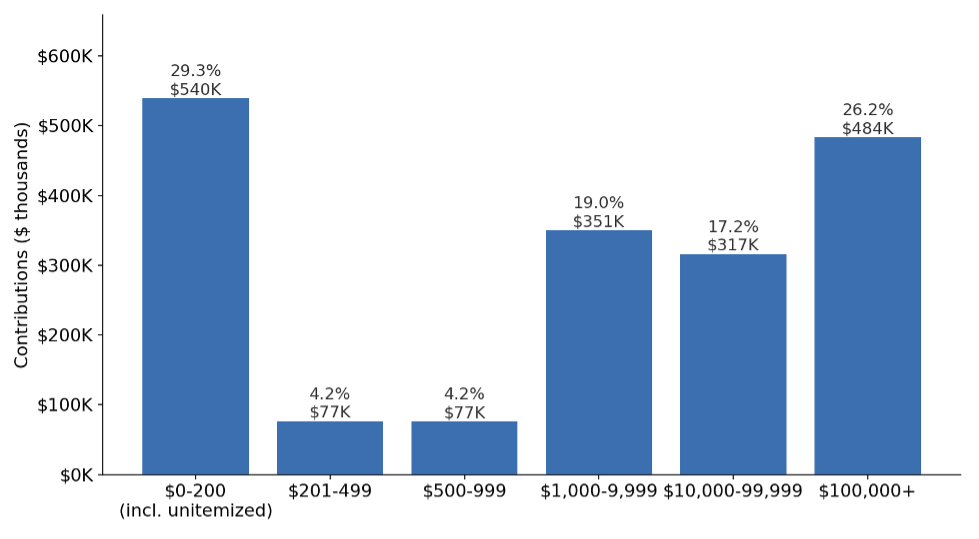
Source: Authors’ calculations from Federal receipts of the Maine Democratic Party (FEC committee C00179408), 2026 cycle, covering January 1, 2025, through May 31, 2026. Bars show net giving per donor; refunds are subtracted from the donor’s total. Eight donors whose giving nets to $0 or less are excluded. The entire $100,000+ bin consists of two national party committees: the DNC ($272,687) and the DSCC ($211,758). Total: $1,847,198.72.

These are, of course, essentially out of state contributions, like most of the rest of the big money taken in by the party, as Figure 3 shows.

Figure 3: Contributions by Donor Size and Origin – Maine Democratic Party 2025-2026
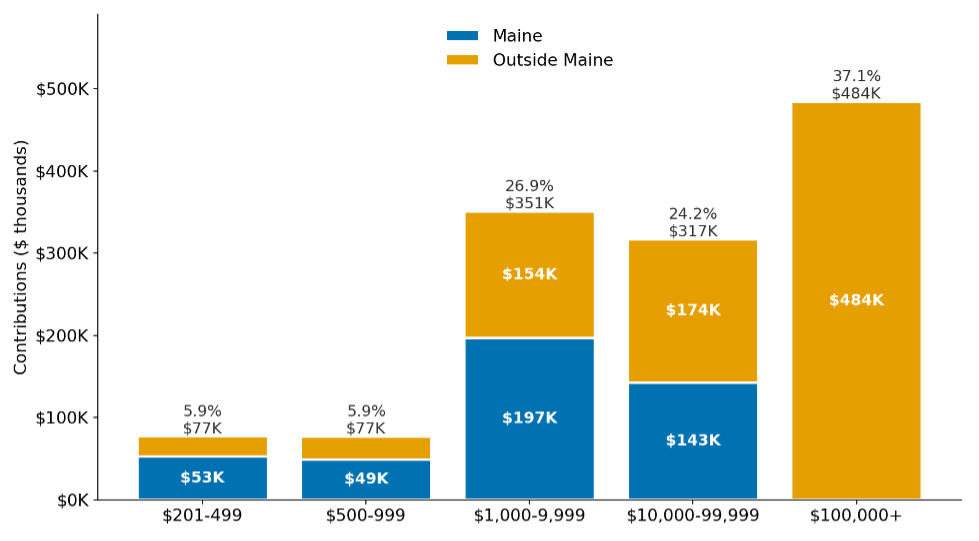
Source: Authors’ calculations from Federal receipts of the Maine Democratic Party (FEC committee C00179408), 2026 cycle, covering January 1, 2025, through May 31, 2026. Bars show net giving per donor, split by the donor’s state; party committees are included. A donor is coded Maine if ANY of their records carry a Maine address. The $0–200 bin is excluded because it is dominated by $522,582.52 in unitemized money, which carries no geography, so a state split of that bin would describe only its small, itemized sliver and mislead. Among the $1,306,772.21 given by donors above $200, Maine accounts for $441,305.75 (33.8%) and out-of-state donors $865,466.46 (66.2%). The share flips with size: the $201–999 bins run roughly two-to-one Maine, while the entire $100,000+ bin is out-of-state — the DNC ($272,687) and the DSCC ($211,758).

It is obvious that the party leans far more heavily on big donors than Platner did, even if the degree of dependence pales by comparison with parties in other, richer states. The dependence on out-of-state funds is equally evident.

But a real cluster of small donor contributions also shows. We are not dealing with a Northeastern cognate of, for example, Senator Mitch McConnell or Senator Schumer himself. See Figure 4, from our earlier analysis of leaders of both parties in 2016. Like Donald Trump in 2016, the Maine Democratic Party’s campaign finance profile displays a “barbell” construction, with a mix of small and large donations piling up at both ends of the money scales.

Figure 4: Dominance of Big Money

Size of Contributions of American Political Leaders 2016
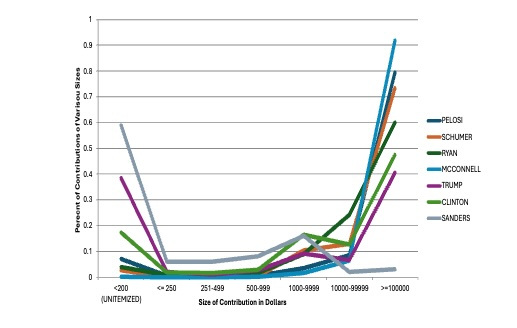
Adapted from Ferguson, Jorgensen, and Chen Structural Change and Economic Dynamics 2022

The conclusion has to be that talk of the party distancing itself from the national Democratic establishment needs to be taken with buckets, not grains, of salt. The state party’s dependence on outside big money is structural, in the absence of a candidate who can capture the imagination of ordinary Maine citizens. Rather like the Odyssey, public discussion mixes poetry and truth, with the difference that Homer was blind, while American journalists and voters need not be.

1. For methods, see the discussion in Ferguson, Jorgensen, and Chen, “How Money Drives US Congressional Elections: Linear Models of Money and Outcomes,” Structural Change and Economic Dynamics 61, No. 2, 527-45; https://www.sciencedirect.com/science/article/pii/S0954349X19302012?via%3Dihub For the data on this piece, see also Ferguson, Jorgensen, Lalisse, and Chen, “Big Money and the Maine Senate Race: A Tale in Two Pictures,” Institute for New Economic Thinking, June 30, 2026; https://www.ineteconomics.org/perspectives/blog/big-money-the-maine-senate-race-and-us-party-competition-a-tale-in-two-pictures

The Ceuta Psyop Shows the Seams of the European Far Right


Source link

Tags: bigelectionMaineMoney
ShareTweetShare
Previous Post

US home builder sentiment falls in July amid affordability challenges

Next Post

Trade Short Squeezes With 100% Discipline & Zero Greed

Related Posts

edit post
The July jobs numbers are due out Friday. Here’s what to expect

The July jobs numbers are due out Friday. Here’s what to expect

by TheAdviserMagazine
August 6, 2026
0

Job seekers wait in line for free resume preparation services as they attend a Inspire Together job and resource fair...

edit post
The Ceuta Psyop Shows the Seams of the European Far Right

The Ceuta Psyop Shows the Seams of the European Far Right

by TheAdviserMagazine
August 6, 2026
0

70,000 people illegally swimming from Morocco to Ceuta would surely raise all alarms in Europe. The “territorial integrity” of an...

edit post
When Death Is Cheaper Than Care: Mutual Aid for the Developing World

When Death Is Cheaper Than Care: Mutual Aid for the Developing World

by TheAdviserMagazine
August 6, 2026
0

As the WHO warns of a 30 percent drop in external health aid to low-income countries, Rwanda’s community-based Mutuelle de...

edit post
The Global Outlook | Armstrong Economics

The Global Outlook | Armstrong Economics

by TheAdviserMagazine
August 6, 2026
0

This year’s Institutional Report is an eyeopener. The world is undergoing a shift in preparation for 2032. We are witnessing a...

edit post
Human Flourishing and Marginal Utility

Human Flourishing and Marginal Utility

by TheAdviserMagazine
August 6, 2026
0

The law of diminishing marginal utility is one of the foundational principles of economics, but its significance extends far beyond...

edit post
Science, Religion, and Political Omens: The Meaning of Eclipses in Ancient Rome

Science, Religion, and Political Omens: The Meaning of Eclipses in Ancient Rome

by TheAdviserMagazine
August 6, 2026
0

Yves here. We’ve had a run of war-related stories, so a change in programming is in order. Eclipses are significant...

Next Post
edit post
Mortgage Rates Today, Thursday, July 16: A Little Higher

Mortgage Rates Today, Thursday, July 16: A Little Higher

edit post
Star analyst Dan Ives forms Yorkville Ives merchant bank after leaving Wedbush

Star analyst Dan Ives forms Yorkville Ives merchant bank after leaving Wedbush

  • Trending
  • Comments
  • Latest
edit post
Georgia Senior SNAP and Meal Resources Older Adults Can Use

Georgia Senior SNAP and Meal Resources Older Adults Can Use

July 24, 2026
edit post
New Jersey Tax-Relief Events: Three July Dates Near Seniors

New Jersey Tax-Relief Events: Three July Dates Near Seniors

July 13, 2026
edit post
Bristlecone pines growing in the White Mountains of California germinated before the Great Pyramid was built, and the oldest one alive today, nicknamed Methuselah, has been quietly adding rings for 4,855 years in soil so poor almost nothing else survives beside it

Bristlecone pines growing in the White Mountains of California germinated before the Great Pyramid was built, and the oldest one alive today, nicknamed Methuselah, has been quietly adding rings for 4,855 years in soil so poor almost nothing else survives beside it

July 8, 2026
edit post
Judge Who Helped Violent Illegal Alien Evade ICE Faces New Test

Judge Who Helped Violent Illegal Alien Evade ICE Faces New Test

July 31, 2026
edit post
2 judges suspended in separate cases after being indicted on criminal charges

2 judges suspended in separate cases after being indicted on criminal charges

July 9, 2026
edit post
Driving the Noncitizen Voting Scandal: Registration With License

Driving the Noncitizen Voting Scandal: Registration With License

July 26, 2026
edit post
TripleDot buys Israeli game publisher Supersonic

TripleDot buys Israeli game publisher Supersonic

0
edit post
SmartStop Self Storage REIT Crushes Q2 2026 Profit Estimates

SmartStop Self Storage REIT Crushes Q2 2026 Profit Estimates

0
edit post
How Lawyers Know What You Own Before They Sue |

How Lawyers Know What You Own Before They Sue |

0
edit post
Do college students need renters insurance?

Do college students need renters insurance?

0
edit post
The July jobs numbers are due out Friday. Here’s what to expect

The July jobs numbers are due out Friday. Here’s what to expect

0
edit post
One Day Left as Senate Faces Final Push for CLARITY Act Crypto Vote

One Day Left as Senate Faces Final Push for CLARITY Act Crypto Vote

0
edit post
One Day Left as Senate Faces Final Push for CLARITY Act Crypto Vote

One Day Left as Senate Faces Final Push for CLARITY Act Crypto Vote

August 6, 2026
edit post
Trump signs order setting 15% tariff, price floors on polysilicon imports (FSLR:NASDAQ)

Trump signs order setting 15% tariff, price floors on polysilicon imports (FSLR:NASDAQ)

August 6, 2026
edit post
The Myers-Briggs test is described everywhere as being based on Carl Jung, but its two authors had no training in psychology, one of its four dimensions was their own extension of his theory, and about half of people who retake it do not receive the same four-letter type

The Myers-Briggs test is described everywhere as being based on Carl Jung, but its two authors had no training in psychology, one of its four dimensions was their own extension of his theory, and about half of people who retake it do not receive the same four-letter type

August 6, 2026
edit post
What You Can Learn From the Nerds’ Home Improvement Projects

What You Can Learn From the Nerds’ Home Improvement Projects

August 6, 2026
edit post
7 Warning Signs an Older Adult May Be Under Financial Pressure

7 Warning Signs an Older Adult May Be Under Financial Pressure

August 6, 2026
edit post
Following Primary Loss, Crypto PACs Invest .5M in 3 US State Races

Following Primary Loss, Crypto PACs Invest $1.5M in 3 US State Races

August 6, 2026
The Adviser Magazine

The first and only national digital and print magazine that connects individuals, families, and businesses to Fee-Only financial advisers, accountants, attorneys and college guidance counselors.

CATEGORIES

  • 401k Plans
  • Business
  • College
  • Cryptocurrency
  • Economy
  • Estate Plans
  • Financial Planning
  • Investing
  • IRS & Taxes
  • Legal
  • Market Analysis
  • Markets
  • Medicare
  • Money
  • Personal Finance
  • Social Security
  • Startups
  • Stock Market
  • Trading

LATEST UPDATES

  • One Day Left as Senate Faces Final Push for CLARITY Act Crypto Vote
  • Trump signs order setting 15% tariff, price floors on polysilicon imports (FSLR:NASDAQ)
  • The Myers-Briggs test is described everywhere as being based on Carl Jung, but its two authors had no training in psychology, one of its four dimensions was their own extension of his theory, and about half of people who retake it do not receive the same four-letter type
  • Our Great Privacy Policy
  • Terms of Use, Legal Notices & Disclosures
  • Contact us
  • About Us

© Copyright 2024 All Rights Reserved
See articles for original source and related links to external sites.

Welcome Back!

Login to your account below

Forgotten Password?

Retrieve your password

Please enter your username or email address to reset your password.

Log In
No Result
View All Result
  • Home
  • Financial Planning
    • Financial Planning
    • Personal Finance
  • Market Research
    • Business
    • Investing
    • Money
    • Economy
    • Markets
    • Stocks
    • Trading
  • 401k Plans
  • College
  • IRS & Taxes
  • Estate Plans
  • Social Security
  • Medicare
  • Legal

© Copyright 2024 All Rights Reserved
See articles for original source and related links to external sites.