Yves here. This post gives a cautiously negative finding on AI implementation in Germany. If one reads carefully, one can infer that a significant part of the survey population is in factory or related settings, such as logistics management, particularly given the comment on lower physical effort and reduction in time spent.
We have pointed out that narrow, non-LLM applications of AI can be highly productive. But the US is rife with stories and even analyses of white collar workers experiencing reduced productivity thanks to AI, since they have to oversee the AI and correct its errors. A 2024 survey found a whopping 77% reported AI lowered their output. Of course, many establishments are not so careful and are willing to risk that they will have to eat AI liability or bear the cost of correcting its errors and so shove unchecked AI results out the door.
In addition, survey respondents in Germany report no increase in anxiety about employment security as a result of the introduction of AI. The authors of the report below point out that this response may be due to very strong labor protections in Germany. This is not the case in the US, where “employment at will” dominates and the media regularly brays about how AI is coming for your job. An ADP survey earlier this year found that over 30% of US employees are worried about AI-created livelihood loss. This anxiety has to have a mental health impact, even if not large on average.
By Osea Giuntella, Associate Professor of Economics University Of Pittsburgh, Luca Stella, Associate Professor of Economics University Of Milan, and Johannes König. Originally published at VoxEU
Artificial intelligence may reduce the need for physically demanding tasks, but it could also erode job satisfaction, intensify cognitive load, and amplify anxiety. This column reports research on survey data from Germany, which finds no evidence that AI exposure has harmed workers’ mental health or subjective wellbeing. But looking at self-reported use of AI tools in the workplace, there are indications of declining life and job satisfaction. This suggests the need to expand current debates beyond AI’s impact on employment, productivity and wages: if it transforms work in ways that affect stress, autonomy, purpose, or health, these dimensions must become central to technology policy and labour regulation.
As governments and firms race to integrate artificial intelligence (AI) into the workplace, a crucial policy question has emerged: how will this new wave of automation affect the wellbeing of workers?
While much of the academic and policy debate has focused on employment and productivity effects (e.g. Acemoglu et al. 2022, Brynjolfsson et al. 2025), there is a growing concern about the quality of work itself. AI may reduce the need for physically demanding tasks, but it could also erode job satisfaction, intensify cognitive load, and amplify anxiety. These risks are increasingly at the centre of public discourse and recent policy proposals – including those around AI governance and worker protections.
Recent VoxEU contributions have examined how AI is reshaping macroeconomic productivity (Cerutti et al. 2025), altering the structure of employment (Ilzetzki and Jain 2023) and creating tensions between innovation and regulation (Frey et al. 2025). But what remains less understood is how AI is affecting workers’ everyday personal experiences – their health, job satisfaction, and psychological wellbeing.
In recent work (Giuntella et al. 2025), we seek to address this gap using rich longitudinal survey data from Germany. Our central finding is cautiously optimistic: so far, there is no evidence that AI exposure has harmed workers’ mental health or subjective wellbeing. In fact, we observe small improvements in self-reported physical health and health satisfaction.
But this picture changes when we look at self-reported use of AI tools in the workplace. Here, we find a modest but consistent decline in life and job satisfaction, suggesting that the way in which workers experience AI is as important as the tasks it automates.
From Job Loss to Job Quality: Broadening the Lens
Existing studies have documented the economic impact of AI – from labour market polarisation to sectoral productivity shifts. Felten et al. (2021) and Bonfiglioli et al. (2025) show that AI adoption varies widely across occupations and geographies. Acemoglu et al. (2022) and Brynjolfsson et al. (2025) demonstrate that AI can displace certain roles while creating others. But as Gihleb et al. (2022) and Nazareno and Schiff (2021) argue, technological change also has profound implications for physical and mental health – dimensions often missing from macroeconomic models.
AI may differ from past automation waves. While industrial robots substituted for manual routine tasks, AI targets cognitive and communicative functions. It can enhance productivity and reduce tedious tasks, but it may also undermine workplace autonomy or increase cognitive demands. How these changes affect workers’ wellbeing is a question that deserves more attention.
Measuring Exposure to AI
We use data from the German Socio-Economic Panel (SOEP), a representative longitudinal dataset tracking workers’ health, satisfaction, and job characteristics over two decades (2000-20). Germany offers a particularly relevant case: it has a strong vocational training system, robust labour protections, and a gradually accelerating rate of AI adoption.
To assess the impact of AI on workers’ wellbeing and health, we employ two complementary measures of AI exposure. Our primary measure, developed by Webb (2019), quantifies how susceptible an occupation is to AI, based on overlap between job tasks and AI-related patents.
Our secondary measure is a self-reported exposure measure from the 2020 SOEP wave, where workers were asked how often they use AI-related systems (e.g. natural language processing, image recognition, or information evaluation) on the job. By restricting our sample to individuals who entered the labour market before 2010 (prior to the widespread adoption of AI in Germany), we limit the potential bias from sorting into occupations based on AI exposure.
Evidence on AI Adoption and Workers’ Wellbeing
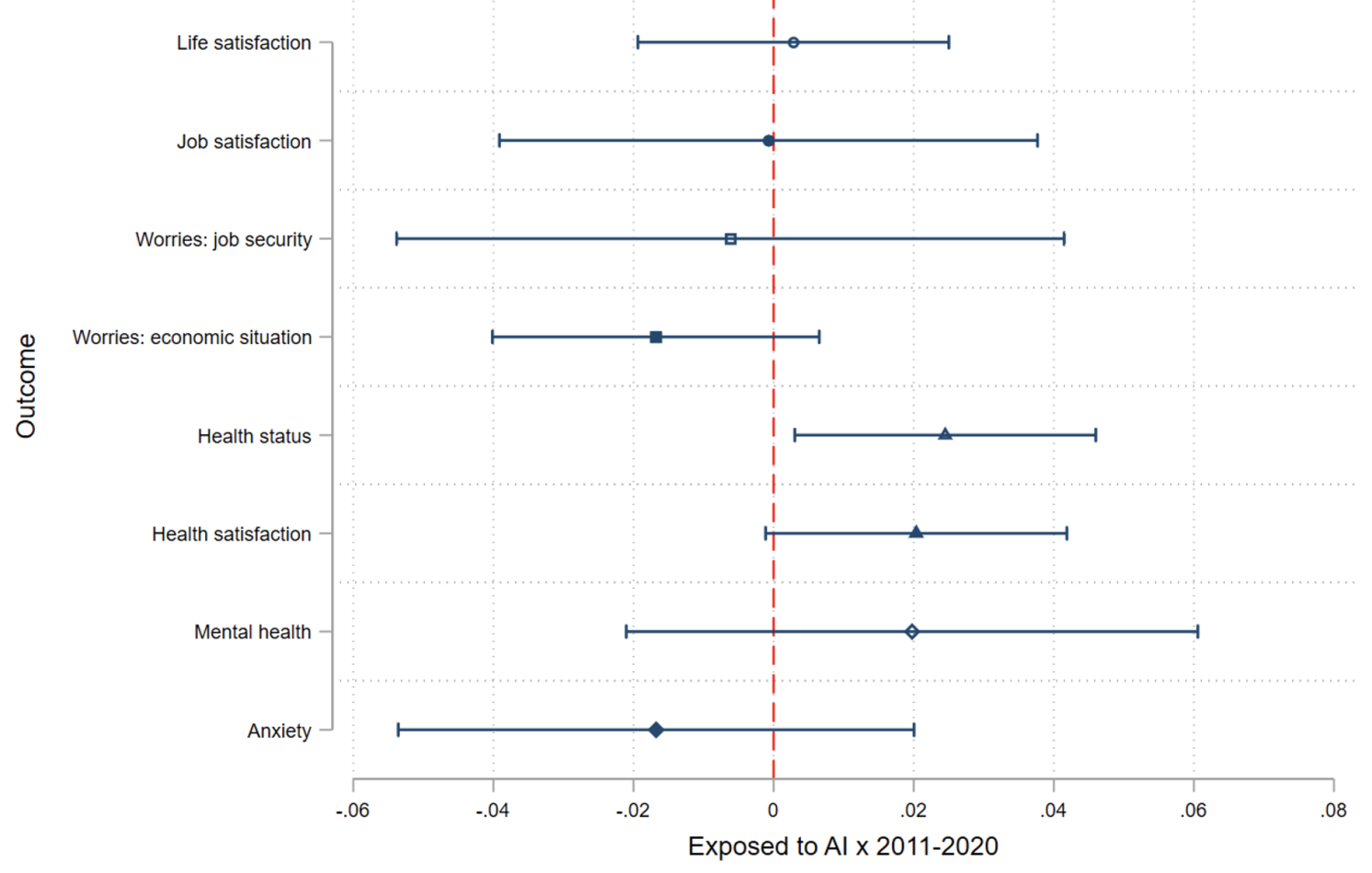
Our findings diverge depending on how AI exposure is measured. Using the task-based exposure measure (Webb 2019), we find: (1) no significant change in life or job satisfaction after 2010 among AI-exposed workers; (2) no significant increase in economic anxiety or reported job insecurity; and (3) small but significant improvements in self-rated health and health satisfaction.
These results are summarised in Figure 1. In particular, the physical health gains are consistent with a concurrent decline in the physical burden of jobs among AI-exposed workers.
Figure 1 Impact of AI on workers’ wellbeing and health: Webb measure of AI
We also find a slight decline in weekly working hours (approximately 30 minutes) without offsetting reductions in income or employment. Overall, these results suggest that AI may be reducing physical strain without compromising employment stability – at least in the early years of adoption.
But the picture changes when we consider self-reported exposure to AI systems. Workers who reported using AI tools in the workplace at least weekly were more likely to report declines in life and job satisfaction. These negative effects are relatively small in magnitude (about 0.05 standard deviations). The results of this analysis are presented in Figure 2.
Figure 2 Impact of AI on workers’ wellbeing and health: SOEP-based measure of AI
This divergence points to an important insight: how workers perceive and interact with AI tools may matter more for their wellbeing than how ‘objectively’ exposed to AI their occupation is. This reasoning aligns with arguments made in De Vries and Erken (2023) that perception and adaptation shape AI’s productivity potential – and suggests that communication and workplace design are essential to successful AI integration.
Early-Stage Caution
Several caveats should be considered when interpreting our findings. First, our data extend only to 2020. Since then, the development of generative AI (e.g. large language models) has dramatically expanded the potential reach of AI into white-collar and creative domains.
Second, our sample focuses on middle-aged and older workers who entered the labour market before AI diffusion began. Younger cohorts may experience AI adoption very differently – particularly if it shapes their initial job experiences or career trajectories.
Third, Germany’s strong labour market institutions may have buffered the disruptive effects of AI. Thus, our findings may not generalise to countries with more flexible labour institutions.
Conclusion and Policy Implications
The AI transition is underway – but its long-term implications remain uncertain. Early evidence from Germany suggests that AI can be integrated into the workplace without harming worker wellbeing and may even reduce physical job intensity. But subjective experience matters. If workers feel overwhelmed, deskilled or surveilled, the psychological costs of AI could emerge well before the economic ones.
As the global AI policy agenda evolves – from privacy and competition to skills and taxation – labour and wellbeing should not be afterthoughts. As with previous industrial revolutions, it is not the technology itself, but the way it is implemented, governed and experienced that will shape its legacy.
What Should Policymakers Take away From These Findings?
First, our findings underline the need to expand the conversation beyond employment and wages. If AI transforms work in ways that affect stress, autonomy, purpose or health, these dimensions must become central to technology policy and labour regulation. As noted by Martin and Hauret (2022), job quality includes not just income but also working time, safety and wellbeing.
Second, the evidence from Germany supports the idea that institutions matter. Works councils, co-determination, and employment protections may have helped Germany to integrate AI more smoothly, with fewer psychological costs to workers. Countries without such institutions may need to explore alternative safeguards – whether through regulation, collective bargaining, or ethical design standards.
Third, while fears of mass job loss may be overstated, concerns about degraded job quality are real and already observable. In this sense, policies that focus narrowly on reskilling or job matching may miss the broader human effects of AI integration.
Finally, we need better data. The divergence between objective and self-reported exposure points to the need for richer task-level surveys and real-time indicators of AI use and worker outcomes.
See original post for references













-1024x683.jpg "Congress Is Back – Again – But Can It Clear the Legislative Logjam?")