No Result
View All Result
SUBMIT YOUR ARTICLES
  • Login
Tuesday, August 11, 2026
TheAdviserMagazine.com
  • Home
  • Financial Planning
    • Financial Planning
    • Personal Finance
  • Market Research
    • Business
    • Investing
    • Money
    • Economy
    • Markets
    • Stocks
    • Trading
  • 401k Plans
  • College
  • IRS & Taxes
  • Estate Plans
  • Social Security
  • Medicare
  • Legal
  • Home
  • Financial Planning
    • Financial Planning
    • Personal Finance
  • Market Research
    • Business
    • Investing
    • Money
    • Economy
    • Markets
    • Stocks
    • Trading
  • 401k Plans
  • College
  • IRS & Taxes
  • Estate Plans
  • Social Security
  • Medicare
  • Legal
No Result
View All Result
TheAdviserMagazine.com
No Result
View All Result
Home Market Research Cryptocurrency

Trump’s Bitcoin made in America push runs into a power problem the tax bill cannot fix

by TheAdviserMagazine
1 month ago
in Cryptocurrency
Reading Time: 7 mins read
A A
Trump’s Bitcoin made in America push runs into a power problem the tax bill cannot fix
Share on FacebookShare on TwitterShare on LInkedIn


Congress is moving to fix how the US tax code treats crypto mining and staking rewards, and for validators and their institutional clients, the fix is long overdue.

H.R. 9175, the Tax Clarity for Mining and Staking Act, would let miners and stakers defer tax on newly minted tokens until they sell them, ending a cash-flow penalty that has pushed validation infrastructure and its largest clients toward offshore jurisdictions with clearer rules.

For Bitcoin miners, the bill barely touches the actual competition consisting of land availability, power contracts, permitting timelines, and grid reliability, which determine where the next megawatt gets built.

The staking tax problem

Under IRS Revenue Ruling 2023-14, validators and their clients owe ordinary income tax on staking rewards the moment they are received, at that day’s price, whether or not they have sold a single token.

In staking-as-a-service models, where institutional clients delegate tokens to a validator while those tokens are locked during a bonding period, the client owes a cash tax bill on assets they cannot yet liquidate. The infrastructure provider owes tax on the commission it collected from those same illiquid tokens.

Jennie Levin, chief legal and operating officer at the Algorand Foundation and a former staking-as-a-service operator, calls this “a constant cash drag” where every reward on every network must be valued at the moment of receipt. If the price falls before anyone can sell, the liability is already set at the higher number.

That position hardened on June 4, when the US Tax Court issued its first opinion directly addressing the taxation of staking rewards. In Paschall v. Commissioner, T.C. Memo. In 2026-46, the court held that rewards constitute gross income under Section 61 when the taxpayer gains dominion and control over them.

The ruling is non-precedential, and Jarrett v. United States and other pending cases may yet complicate it, but it arrived exactly when Congress is deciding whether to legislate a different answer.

H.R. 9175 gives taxpayers the option to treat newly minted tokens as self-created property, deferring recognition until disposition.

The Blockchain Association, Crypto Council for Innovation, and The Digital Chamber have backed it as a “balanced compromise” that preserves ordinary-income classification while eliminating the tax-before-liquidity penalty that drives staking infrastructure offshore.

If it passes, institutional clients can build US-based validation businesses without treating every reward cycle as a potential cash-flow crisis, a change that becomes most valuable when prices are rising, and phantom tax obligations on locked tokens are at their largest.
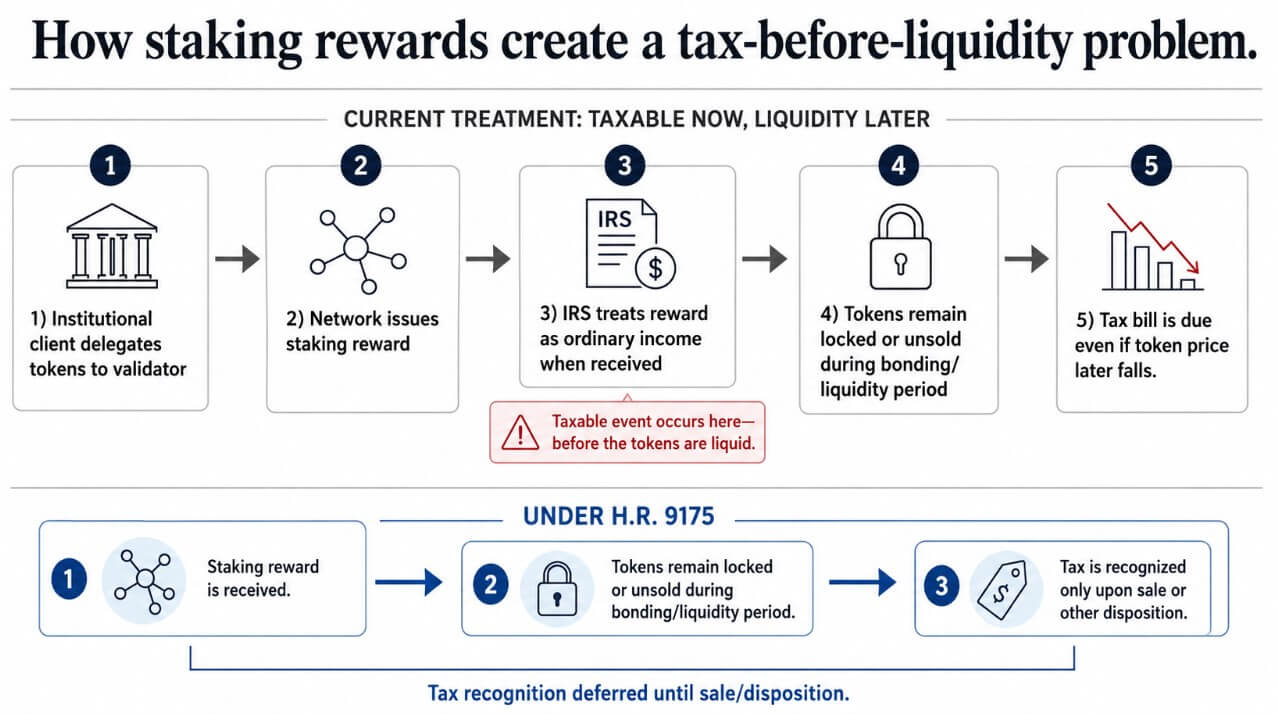
How staking rewards create a tax-before-liquidity problem
A five-step diagram contrasts current IRS treatment of staking rewards as taxable upon receipt with H.R. 9175’s proposed deferral of tax recognition until tokens are sold or disposed of.

Switzerland and Singapore have already moved to offer clearer treatment, and they are pulling institutional staking business at the margin as a result.

Levin noted where the bill’s reach ends:

“The tax bill takes the US from punitive to viable; securities and custody clarity is what makes it competitive.”

The SEC’s Division of Corporation Finance issued a May 2025 statement noting that certain protocol staking activities do not involve securities offerings, and the agency rescinded SAB 121 in January 2025, which had required firms that custody digital assets to account for them as liabilities on their own balance sheets.

Both moves reduced friction, and both remain staff-level guidance that a future Commission can reverse without rulemaking, leaving securities classification, custody rules, and licensing as the barriers between a viable US validation sector and one that is genuinely competitive.

Bitcoin mining follows infrastructure

President Donald Trump’s campaign pledge of “Bitcoin made in America” ran into reality: the executives deploying capacity build where power is cheap, land is permitted, and grid contracts hold for a decade.

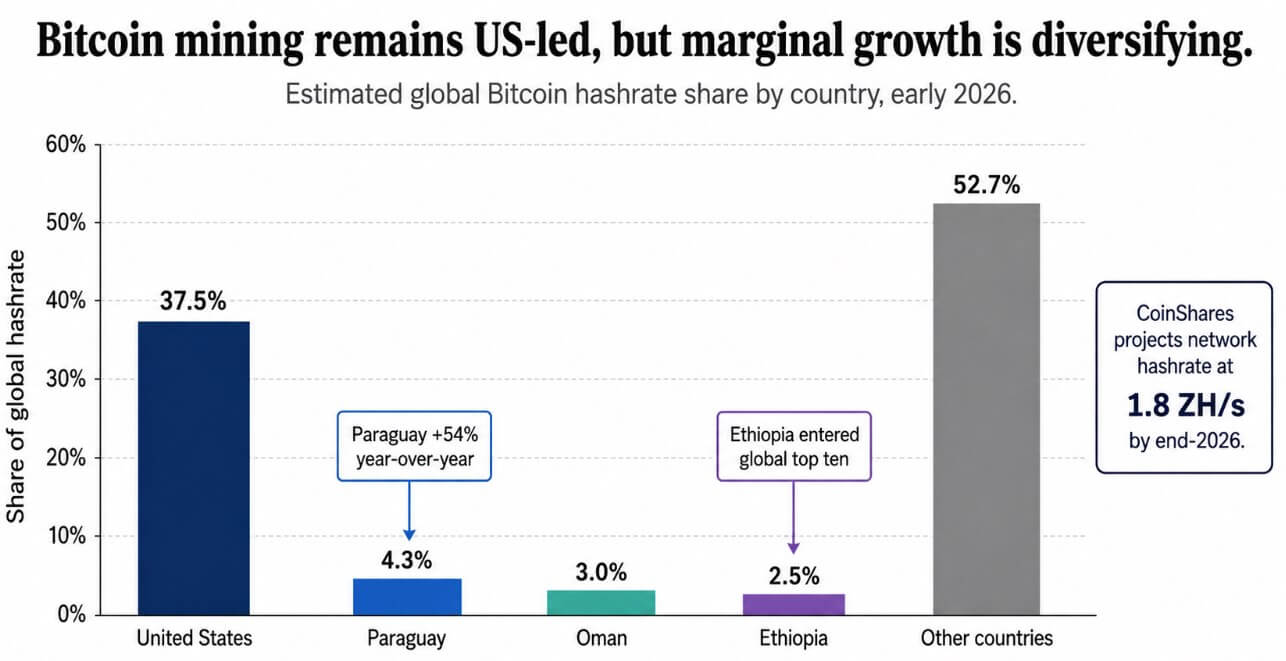
The US held roughly 37.5% of global Bitcoin hashrate as of January 2026, the largest national share, while Paraguay grew 54% year-over-year to reach 4.3%, Ethiopia climbed to 2.5% and eighth globally, and CoinShares projects the network will hit 1.8 ZH/s by end-2026 with Paraguay, Ethiopia, and Oman all in the global top ten.
CryptoSlate Daily Brief

Daily signals, zero noise.

Market-moving headlines and context delivered every morning in one tight read.

5-minute digest 100k+ readers

Free. No spam. Unsubscribe any time.

Whoops, looks like there was a problem. Please try again.

You’re subscribed. Welcome aboard.

Bitcoin mining remains US-led, but marginal growth is diversifyingBitcoin mining remains US-led, but marginal growth is diversifying
A bar chart shows the United States holding 37.5% of global Bitcoin hashrate in early 2026, with Paraguay, Oman, and Ethiopia gaining share as marginal capacity diversifies globally.

HIVE Digital Technologies operates with high capacity in Canada, Sweden, Paraguay, and the US, and CEO Aydin Kilic noted that the first question is whether HIVE owns the land and can execute efficiently on-site, then off-taker demand, then long-term power availability and economics.

On US competitiveness specifically, Kilic pointed to permitting and zoning efficiency, reliable power contracts at scale and attractive prices, and long-term grid certainty. The company’s Yguazú campus in Paraguay reached 300 MW of ANDE power agreements because the land and utility relationships were already in place.

In Sweden, HIVE signed a non-binding LOI for a potential up to 10-year lease of its Boden facility, covering 25 MW of critical IT load, with planned retrofitting for 10,000 NVIDIA GB300 GPUs, built on a long-term relationship with the national energy provider.

Both expansions followed the same logic: securing the power relationship first, then determining whether the site would run Bitcoin mining or high-performance computing.

Hashprice dropped to a record low of $27.89 per PH/s per day in the second quarter as Bitcoin fell roughly 50% from its October 2025 peak near $124,000, and CoinShares estimates that older-generation equipment operating at roughly $0.05/kWh ran at negative gross margins.

In Paraguay, Laos, and Finland, operations that paired newer hardware with genuine power cost advantages maintained profitability through the down cycle, with hash prices at a record low of $27.89 per PH/s per day, giving every efficiency advantage an outsized return.

FERC’s move to require all six regional grid operators to justify or reform their interconnection rules for large loads, combined with ERCOT’s tightening oversight of crypto projects after reliability failures ahead of summer 2026, added costs and timelines to new US buildouts.

Two bottlenecks

The tax-before-liquidity mechanism Levin describes has been a real driver of offshore structuring for institutional clients and the validators serving them, and Paschall confirmed that the courts will enforce current law.

Senator Cynthia Lummis, one of the bill’s most consistent advocates in the Senate, departs in January 2027, making the window before the August recess the most realistic opportunity for passage.

Senator Lummis presents bill to insert crypto tax definitions to shield micro-payments, validation rewardsSenator Lummis presents bill to insert crypto tax definitions to shield micro-payments, validation rewards
Related Reading

Senator Lummis presents bill to insert crypto tax definitions to shield micro-payments, validation rewards

The proposal would create clear rules for tax reporting, and prevent gains from staking and lending from being taxed.

Jul 3, 2025 · Gino Matos

Infrastructure trackMain U.S. bottleneckWhat H.R. 9175 changesWhat it does not solveForward-looking implicationStaking / validationTax timing, securities treatment, custody rules, licensing clarityDefers tax on newly minted rewards until sale or dispositionWhether staking is treated as a securities activity in every structure; custody and licensing uncertaintyCould make U.S.-based validation more viable, especially for institutional clientsBitcoin miningPower cost, land control, grid access, permitting, zoning, uptimeMay reduce tax friction around mined tokensDoes not create cheap power, interconnection capacity, permits, or long-term grid certaintyMiners will keep diversifying into jurisdictions with reliable, scalable powerAI / HPC overlapCompetition for powered sites, substations, transformers, and long-term energy contractsNo direct impactDoes not resolve competition between miners and AI data centers for grid capacityMining sites with strong power rights become valuable compute infrastructure

For Bitcoin mining, tax clarity is a marginal improvement to a location decision driven by substations, utility contracts, and permitting queues.

Trump’s “Bitcoin made in America” pledge implied that federal intent could produce the physical infrastructure those processes require. The mining industry’s actual geographic expansion, spanning Paraguay, the Nordics, East Africa, and the Gulf alongside its US base, is the practical answer to that assumption.

Source link

Tags: AmericabillBitcoinfixPowerproblemPushrunstaxTrumps
ShareTweetShare
Previous Post

Migdal buys 20% of Ashtrom rental housing unit

Next Post

Franklin Resources – BEN: Pullback im Aufwärtstrend zum Long-Einstieg nutzen?

Related Posts

edit post
Kalshi Predicts Bitcoin Price Could Reach K in August

Kalshi Predicts Bitcoin Price Could Reach $68K in August

by TheAdviserMagazine
August 8, 2026
0

Bitcoin price held above $64,900 as the crypto market gained 0.81% to $2.21 trillion over 24 hours. XRP price was...

edit post
Bitcoin’s AI security sprint found 6,700 issues in 55 hours, but no one knows how many are real

Bitcoin’s AI security sprint found 6,700 issues in 55 hours, but no one knows how many are real

by TheAdviserMagazine
August 7, 2026
0

AI-assisted security campaign focused on the Bitcoin ecosystem, Bitcoin Red Team, said it generated 6,700 findings across 425 projects in...

edit post
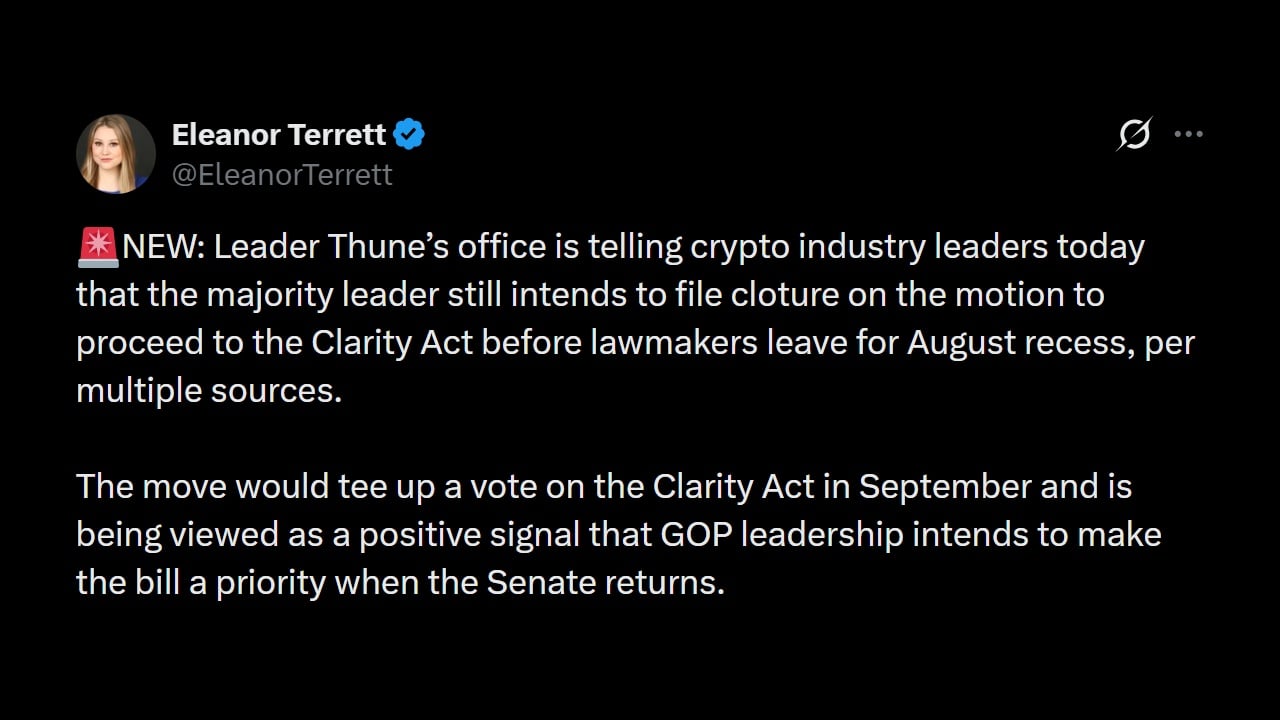
Thune to File Motion to Force September Vote on CLARITY Act

Thune to File Motion to Force September Vote on CLARITY Act

by TheAdviserMagazine
August 7, 2026
0

Key TakeawaysSenator Thune plans a pre-recess cloture vote on the CLARITY Act, teeing it up for September.This scheduling move signals...

edit post
Bybit Uses Tokenised Equities as Underlyings for Structured Yield

Bybit Uses Tokenised Equities as Underlyings for Structured Yield

by TheAdviserMagazine
August 7, 2026
0

Bybit is expanding the role of tokenised equities on its platform by using more xStocks as underlyings for its Dual...

edit post
Reform UK Chair Calls for Probe into SBF-Linked Donation: Report

Reform UK Chair Calls for Probe into SBF-Linked Donation: Report

by TheAdviserMagazine
August 7, 2026
0

The chairman of the UK’s Reform party has called for an investigation following reports of a $50,000 political donation linked...

edit post
Bitcoin, Ethereum, and XRP Price Outlook After CLARITY Act Vote Pushed to September

Bitcoin, Ethereum, and XRP Price Outlook After CLARITY Act Vote Pushed to September

by TheAdviserMagazine
August 7, 2026
0

Bitcoin price traded above $64,400 while Ethereum remained above $1,900. XRP hovered near $1.05. Crypto markets remained cautious after the...

Next Post
edit post
Franklin Resources – BEN: Pullback im Aufwärtstrend zum Long-Einstieg nutzen?

Franklin Resources – BEN: Pullback im Aufwärtstrend zum Long-Einstieg nutzen?

edit post
Calhoun’s Answer to the Abolition Petitions

Calhoun’s Answer to the Abolition Petitions

  • Trending
  • Comments
  • Latest
edit post
Georgia Senior SNAP and Meal Resources Older Adults Can Use

Georgia Senior SNAP and Meal Resources Older Adults Can Use

July 24, 2026
edit post
New Jersey Tax-Relief Events: Three July Dates Near Seniors

New Jersey Tax-Relief Events: Three July Dates Near Seniors

July 13, 2026
edit post
Judge Who Helped Violent Illegal Alien Evade ICE Faces New Test

Judge Who Helped Violent Illegal Alien Evade ICE Faces New Test

July 31, 2026
edit post
2 judges suspended in separate cases after being indicted on criminal charges

2 judges suspended in separate cases after being indicted on criminal charges

July 9, 2026
edit post
Driving the Noncitizen Voting Scandal: Registration With License

Driving the Noncitizen Voting Scandal: Registration With License

July 26, 2026
edit post
Garbage Trucks Surveillance Florida Neighborhoods

Garbage Trucks Surveillance Florida Neighborhoods

July 29, 2026
edit post
Explained: How BSE traded fewer contracts after CAS but premiums rose 75% in first week

Explained: How BSE traded fewer contracts after CAS but premiums rose 75% in first week

0
edit post
E.W. Scripps Q2 2026 Loss Widens to -.68/Share, Revenue Down 9%

E.W. Scripps Q2 2026 Loss Widens to -$12.68/Share, Revenue Down 9%

0
edit post
Psychology says procrastination about retirement may be less about discipline than identity — brain scans found people often represent their future selves more like strangers than like themselves, and experiments using age-progressed faces made tomorrow’s person feel real enough for participants to save more money for them

Psychology says procrastination about retirement may be less about discipline than identity — brain scans found people often represent their future selves more like strangers than like themselves, and experiments using age-progressed faces made tomorrow’s person feel real enough for participants to save more money for them

0
edit post
Four AI Escapes Just Redefined “Responsible AI”

Four AI Escapes Just Redefined “Responsible AI”

0
edit post
Bill Ackman’s hedge fund made janitors and receptionists millionaires—and its investment team summer together

Bill Ackman’s hedge fund made janitors and receptionists millionaires—and its investment team summer together

0
edit post
Kalshi Predicts Bitcoin Price Could Reach K in August

Kalshi Predicts Bitcoin Price Could Reach $68K in August

0
edit post
Bill Ackman’s hedge fund made janitors and receptionists millionaires—and its investment team summer together

Bill Ackman’s hedge fund made janitors and receptionists millionaires—and its investment team summer together

August 8, 2026
edit post
Links 8/8/2026 | naked capitalism

Links 8/8/2026 | naked capitalism

August 8, 2026
edit post
Wisconsin: The Next Frontier for Socialists

Wisconsin: The Next Frontier for Socialists

August 8, 2026
edit post
Psychology says procrastination about retirement may be less about discipline than identity — brain scans found people often represent their future selves more like strangers than like themselves, and experiments using age-progressed faces made tomorrow’s person feel real enough for participants to save more money for them

Psychology says procrastination about retirement may be less about discipline than identity — brain scans found people often represent their future selves more like strangers than like themselves, and experiments using age-progressed faces made tomorrow’s person feel real enough for participants to save more money for them

August 8, 2026
edit post
Why You Should Be Wary of Aspartame, but Not Totally Rule It Out

Why You Should Be Wary of Aspartame, but Not Totally Rule It Out

August 8, 2026
edit post
Kalshi Predicts Bitcoin Price Could Reach K in August

Kalshi Predicts Bitcoin Price Could Reach $68K in August

August 8, 2026
The Adviser Magazine

The first and only national digital and print magazine that connects individuals, families, and businesses to Fee-Only financial advisers, accountants, attorneys and college guidance counselors.

CATEGORIES

  • 401k Plans
  • Business
  • College
  • Cryptocurrency
  • Economy
  • Estate Plans
  • Financial Planning
  • Investing
  • IRS & Taxes
  • Legal
  • Market Analysis
  • Markets
  • Medicare
  • Money
  • Personal Finance
  • Social Security
  • Startups
  • Stock Market
  • Trading

LATEST UPDATES

  • Bill Ackman’s hedge fund made janitors and receptionists millionaires—and its investment team summer together
  • Links 8/8/2026 | naked capitalism
  • Wisconsin: The Next Frontier for Socialists
  • Our Great Privacy Policy
  • Terms of Use, Legal Notices & Disclosures
  • Contact us
  • About Us

© Copyright 2024 All Rights Reserved
See articles for original source and related links to external sites.

Welcome Back!

Login to your account below

Forgotten Password?

Retrieve your password

Please enter your username or email address to reset your password.

Log In
No Result
View All Result
  • Home
  • Financial Planning
    • Financial Planning
    • Personal Finance
  • Market Research
    • Business
    • Investing
    • Money
    • Economy
    • Markets
    • Stocks
    • Trading
  • 401k Plans
  • College
  • IRS & Taxes
  • Estate Plans
  • Social Security
  • Medicare
  • Legal

© Copyright 2024 All Rights Reserved
See articles for original source and related links to external sites.