
No Result
View All Result
SUBMIT YOUR ARTICLES
  • Login
Thursday, July 9, 2026
TheAdviserMagazine.com
  • Home
  • Financial Planning
    • Financial Planning
    • Personal Finance
  • Market Research
    • Business
    • Investing
    • Money
    • Economy
    • Markets
    • Stocks
    • Trading
  • 401k Plans
  • College
  • IRS & Taxes
  • Estate Plans
  • Social Security
  • Medicare
  • Legal
  • Home
  • Financial Planning
    • Financial Planning
    • Personal Finance
  • Market Research
    • Business
    • Investing
    • Money
    • Economy
    • Markets
    • Stocks
    • Trading
  • 401k Plans
  • College
  • IRS & Taxes
  • Estate Plans
  • Social Security
  • Medicare
  • Legal
No Result
View All Result
TheAdviserMagazine.com
No Result
View All Result
Home Market Research Cryptocurrency

America’s $31.27 trillion in debt now exceeds GDP

by TheAdviserMagazine
2 months ago
in Cryptocurrency
Reading Time: 9 mins read
A A
America’s .27 trillion in debt now exceeds GDP
Share on FacebookShare on TwitterShare on LInkedIn


Make CryptoSlate preferred on

U.S. public debt has crossed the size of the U.S. economy on a calculation from the Committee for a Responsible Federal Budget, giving Bitcoin’s hard-money case a live fiscal benchmark as investors weigh scarce assets against Washington’s debt path.

CRFB said debt held by the public reached $31.27 trillion at the end of the first quarter of 2026, compared with $31.22 trillion of trailing 12-month nominal GDP. That puts the ratio at 100.2%, using the Bureau of Economic Analysis advance estimate for first-quarter output.

For Bitcoin, the threshold turns an abstract scarcity argument into a current macro question: whether a fixed-supply, non-sovereign asset becomes more attractive when confidence in sovereign balance sheets weakens. Debt is the narrative input. Liquidity, rates, ETF demand, and risk appetite are the transmission mechanism.

The move above 100% of GDP strengthens the case investors can make for Bitcoin as scarce monetary insurance. It still leaves open whether those investors will add exposure while Treasury yields, reserve conditions, and volatility keep setting the price of risk.

What the debt threshold changes

CRFB’s calculation uses debt held by the public, the federal debt owed to outside investors and other non-government holders. That measure carries a different market meaning than total public debt outstanding, which also includes intragovernmental holdings.

That distinction is essential because the Bitcoin comparison works only if the fiscal metric is clear. Treasury’s Debt to the Penny data, including its March 31 API record, separates debt held by the public from intragovernmental holdings and total public debt outstanding.

The peg sits on the public-debt measure, rather than the larger figures often used in political debate.

CRFB also placed the threshold in historical context. Outside the brief early-COVID GDP crash, it said debt only exceeded GDP for two years at the end of World War II.

A debt ratio near wartime extremes changes the language investors use around fiscal credibility, even when the U.S. Treasury market remains the center of global collateral.

The GDP side of the ratio also needs care. BEA’s first-quarter release was an advance estimate.

It showed real GDP rising at a 2.0% annualized pace and current-dollar GDP rising 5.6%, but the next estimate is scheduled for May 28. That means the exact ratio can move.

The fiscal signal is still clear enough for market debate, while the precise denominator remains provisional.
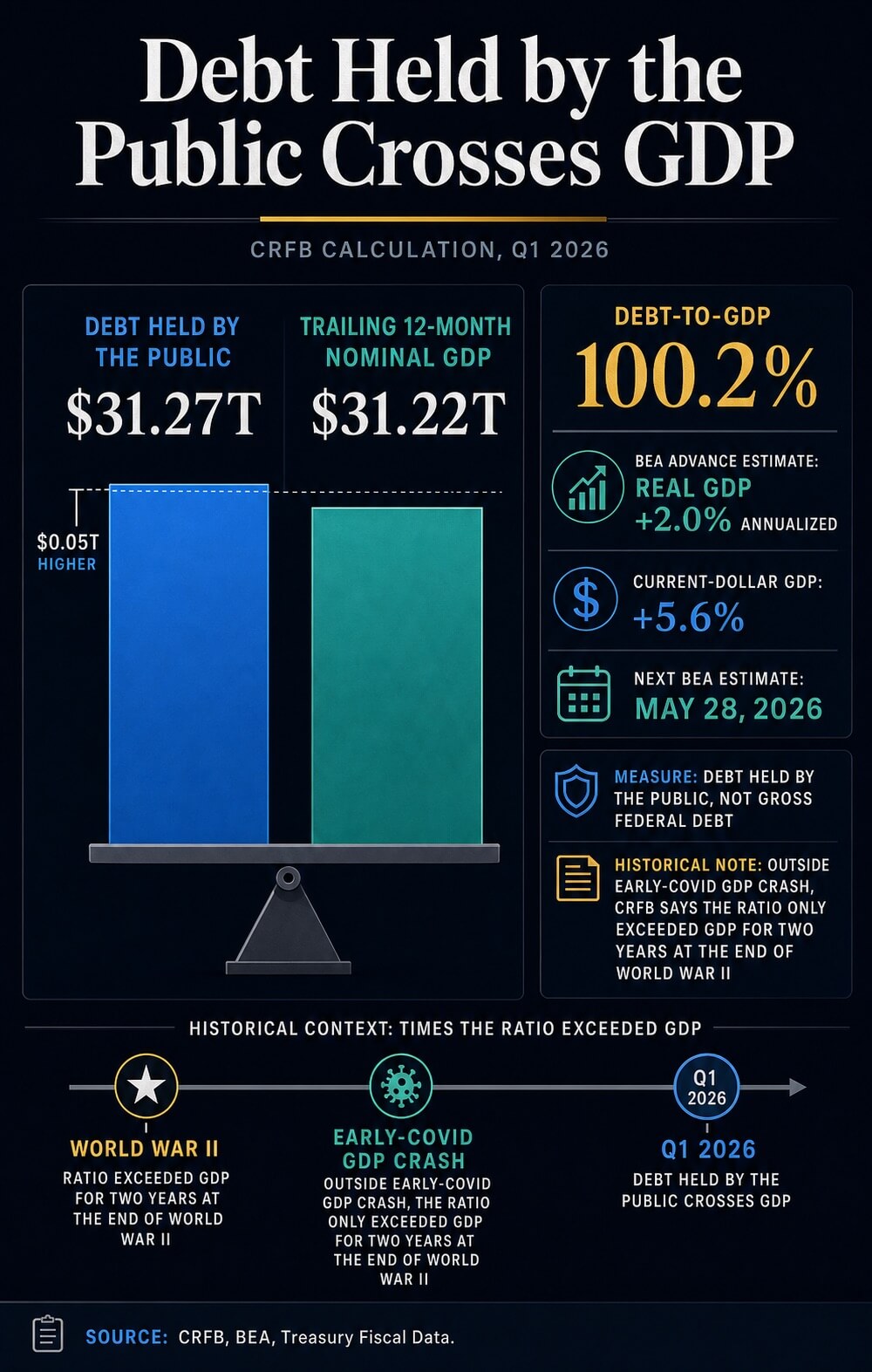
Infographic comparing Q1 2026 public debt of $31.27 trillion with trailing nominal GDP of $31.22 trillion and CRFB's 100.2% debt-to-GDP calculation.

Bitcoin enters this discussion because its supply schedule offers a contrast with fiscal expansion. CryptoSlate’s Bitcoin market page showed about 20.02 million BTC circulating on May 1, 2026, against a maximum supply of 21 million.

That fixed cap is the core monetary contrast with a fiscal system that can issue more debt.

BlackRock has given the institutional version of that argument. In its Bitcoin diversifier paper, the asset manager described Bitcoin as scarce, non-sovereign, decentralized, and global.

It also said long-term adoption could be shaped by concerns over monetary stability, geopolitical stability, U.S. fiscal sustainability, and U.S. political stability.

That fiscal language puts CRFB’s debt marker inside Bitcoin’s investment case. Allocators now have a current U.S. reference point for a thesis that can otherwise sound abstract.

The argument is simple: if sovereign debt keeps growing faster than the economy, a credibly scarce settlement asset earns more attention in the debate over monetary hedges.

CryptoSlate’s broader market dashboard and Bitcoin page show BTC near $77,000 on May 1, with a market cap of around $1.55 trillion, dominance near 60%, and a price roughly 39% below its Oct. 6, 2025, all-time high.

A scarcity asset can still trade like a risk asset when liquidity tightens.

Infographic showing Bitcoin's 21 million cap, about 20.02 million circulating BTC, market snapshot, and liquidity, rates, ETF demand, risk appetite, and volatility transmission tests.Infographic showing Bitcoin's 21 million cap, about 20.02 million circulating BTC, market snapshot, and liquidity, rates, ETF demand, risk appetite, and volatility transmission tests.

Liquidity still decides the transmission

Recent CryptoSlate coverage shows why the debt milestone has to be separated from near-term price behavior. A debt-and-liquidity analysis argued that U.S. debt growth, Treasury issuance, reserve balances, and bank-credit conditions can tighten the plumbing that moves liquidity into risk assets, even when broad money is expanding.

That view is important for Bitcoin because the asset sits at the intersection of two different trades. In the long run, it can be bought as monetary insurance against fiscal and currency risk.

In the medium term, it still responds to the cost of capital, leverage, ETF flows, and the level of yields available on Treasuries.

CryptoSlate Daily Brief

Daily signals, zero noise.

Market-moving headlines and context delivered every morning in one tight read.

5-minute digest 100k+ readers

Free. No spam. Unsubscribe any time.

Whoops, looks like there was a problem. Please try again.

You’re subscribed. Welcome aboard.

A separate CryptoSlate piece on Treasury yields and Bitcoin liquidity made the same point through the rates channel. Higher long-end yields raise the hurdle for assets with no coupon or dividend.

Bitcoin can have a stronger monetary narrative while still facing a tougher comparison against Treasury income.

US Treasury yields spike to highest levels in a year adding new problem for Bitcoin liquidityUS Treasury yields spike to highest levels in a year adding new problem for Bitcoin liquidity
Related Reading

US Treasury yields spike to highest levels in a year adding new problem for Bitcoin liquidity

Bitcoin’s next move now runs through Treasury yields, oil pressure, and Fed liquidity as markets test whether risk demand can hold near resistance.

Apr 30, 2026 · Liam ‘Akiba’ Wright

The result is a two-layer market. The debt-to-GDP break improves the macro setup for Bitcoin.

The funding environment decides whether that setup becomes actual demand. Investors using the milestone as a price signal need evidence from flows, yields, reserves, and volatility before the allocation case becomes more than a narrative upgrade.

Bitcoin’s next risk is hiding in the gap between debt and liquidityBitcoin’s next risk is hiding in the gap between debt and liquidity
Related Reading

Bitcoin’s next risk is hiding in the gap between debt and liquidity

US debt is growing faster than M2, leaving Bitcoin trapped between a bullish liquidity thesis and tighter market plumbing that keeps capping risk.

Apr 30, 2026 · Gino Matos

Evidence layerWhat it supportsWhat remains openCRFB debt-to-GDP markerPublic debt has crossed GDP on CRFB’s calculation, reviving a World War II-era comparison.The exact ratio can shift as GDP estimates revise.CBO baselineDebt held by the public is projected to rise from 101% of GDP in 2026 to 120% in 2036.Faster nominal GDP growth or policy changes could alter the path.BlackRock Bitcoin thesisFiscal sustainability concerns fit the institutional case for a scarce, non-sovereign asset.Adoption logic and short-term price behavior remain separate tests.CryptoSlate market contextBTC still trades with liquidity, yields, ETF demand, and volatility in view.A debt milestone alone leaves flow confirmation unresolved.

Two paths for the thesis

The Congressional Budget Office’s February outlook keeps the fiscal pressure in view. It projects debt held by the public rising from 101% of GDP in 2026 to 120% in 2036, above the 106% high recorded in 1946.

It also projects wider deficits, with rising net interest costs driving much of the increase.

That path gives Bitcoin’s hard-money thesis a durable macro backdrop. If deficits stay large, interest costs rise, and investors become more sensitive to the supply of Treasuries, demand for assets outside sovereign issuance can grow.

In that scenario, the debt milestone becomes a symbol of the constraint Bitcoin was designed to sit outside.

CBO’s own uncertainty work adds the needed restraint. In a February follow-up on how outcomes could differ from its baseline, CBO said economic and budgetary results could land above or below its central estimate, including under paths with faster nominal GDP growth.

The fiscal trajectory is serious, but it is still a forecast path rather than a settled destination.

CryptoSlate’s prior coverage has been building toward the same test from other angles. A February analysis of the decade-long debt path framed the issue through term premium, dollar vulnerability, and Bitcoin’s hard-asset role.

A November piece measured U.S. debt in BTC terms, showing how quickly fiscal expansion can overwhelm Bitcoin’s issuance schedule. CRFB’s new marker changes the timing: the ratio has crossed the threshold now.

US debt now worth 368M BTC: American debt machine adds a century of new Bitcoin supply this year aloneUS debt now worth 368M BTC: American debt machine adds a century of new Bitcoin supply this year alone
Related Reading

US debt now worth 368M BTC: American debt machine adds a century of new Bitcoin supply this year alone

Mapping US debt in BTC exposes a fiscal expansion no blockchain would want to keep up with.

Nov 14, 2025 · Liam ‘Akiba’ Wright

That leaves Bitcoin with two likely outcomes. In the constructive version, inflation cools, reserve conditions improve, Treasury supply becomes easier to absorb, and the debt milestone strengthens the case for a modest allocation to scarce monetary assets.

In the restrictive version, issuance stays heavy, yields remain elevated, and Bitcoin keeps trading as a high-beta liquidity asset despite the stronger long-run narrative.

U.S. public debt crossing GDP gives Bitcoin’s scarcity thesis a sharper macro anchor.

It supports the argument that some investors will keep looking for non-sovereign monetary assets as fiscal ratios worsen. It leaves the harder market proof ahead: whether liquidity, rates, and flows align enough for that thesis to become durable demand rather than another macro slogan.


Source link

Tags: AmericasdebtExceedsGDPTrillion
ShareTweetShare
Previous Post

Oracle (ORCL) Bets $50 Billion on AI Infrastructure as OpenAI Miss Clouds the Investment Case

Next Post

US stocks today: S&P 500, Nasdaq end higher, notch weekly gains after earnings-heavy week

Related Posts

edit post
Sam Altman’s Worldcoin cuts WLD unlocks by 43% but 4.9B tokens still need to prove demand

Sam Altman’s Worldcoin cuts WLD unlocks by 43% but 4.9B tokens still need to prove demand

by TheAdviserMagazine
July 9, 2026
0

Worldcoin said earlier this year that the WLD unlock rate will drop by 43% on July 24 under existing schedules.It...

edit post
Kraken Wins  Million Arbitration as Arjun Sethi Calls for Clear Crypto Rules

Kraken Wins $22 Million Arbitration as Arjun Sethi Calls for Clear Crypto Rules

by TheAdviserMagazine
July 9, 2026
0

Key TakeawaysPayward won a $22M award and asked Delaware court to enter judgment against Mazars USA.Kraken says Mazars’ exit reflected...

edit post
Fed May Buy Equity ETFs To Support US Stocks, Analyst Says

Fed May Buy Equity ETFs To Support US Stocks, Analyst Says

by TheAdviserMagazine
July 8, 2026
0

Crypto markets could benefit from increased liquidity if the US central bank steps in to support the $75 trillion equity...

edit post
Germany’s Bitcoin Wallet Drawdown Gives Traders A Possible Endgame For Selloff Fears

Germany’s Bitcoin Wallet Drawdown Gives Traders A Possible Endgame For Selloff Fears

by TheAdviserMagazine
July 8, 2026
0

Trusted Editorial content, reviewed by leading industry experts and seasoned editors. Ad Disclosure The German government wallet has been a...

edit post
Fed Minutes Flag AI Demand as Inflation Risk as Rate Hike Remains on the Table

Fed Minutes Flag AI Demand as Inflation Risk as Rate Hike Remains on the Table

by TheAdviserMagazine
July 8, 2026
0

The latest Fed minutes have highlighted the risk that AI demand could have on inflation as the Fed continues to...

edit post
Bitcoin’s ETF comeback is relying on a B futures market betting the rebound holds

Bitcoin’s ETF comeback is relying on a $79B futures market betting the rebound holds

by TheAdviserMagazine
July 8, 2026
0

Bitcoin’s rebound above $63,000 is being helped by renewed ETF inflows, but the harder test will now be whether the...

Next Post
edit post
US stocks today: S&P 500, Nasdaq end higher, notch weekly gains after earnings-heavy week

US stocks today: S&P 500, Nasdaq end higher, notch weekly gains after earnings-heavy week

edit post
Hilton Grand Vacations Q1 2026 Deep Dive: EPS Beats by a Wide Margin

Hilton Grand Vacations Q1 2026 Deep Dive: EPS Beats by a Wide Margin

  • Trending
  • Comments
  • Latest
edit post
Mass Fraud in Massachusetts Committed by Illegal Immigrants Discovered

Mass Fraud in Massachusetts Committed by Illegal Immigrants Discovered

June 22, 2026
edit post
New York Seniors: 6 STAR Tax Relief Rules That Could Put a Bigger Check in Your Mailbox

New York Seniors: 6 STAR Tax Relief Rules That Could Put a Bigger Check in Your Mailbox

June 20, 2026
edit post
5 Pennsylvania Rebate Rules Seniors Should Check Before the Property Tax/Rent Deadline

5 Pennsylvania Rebate Rules Seniors Should Check Before the Property Tax/Rent Deadline

June 18, 2026
edit post
Retail giant exits U.S. fashion after multi-million-dollar scandal

Retail giant exits U.S. fashion after multi-million-dollar scandal

July 1, 2026
edit post
Same Portfolio. Same Retirement. A 10-Mile Move Costs One Couple ,000 A Year

Same Portfolio. Same Retirement. A 10-Mile Move Costs One Couple $10,000 A Year

June 27, 2026
edit post
Louisiana’s Age-Tiered Homestead Exemption: 8 Details About the Proposed 2028 Amendment

Louisiana’s Age-Tiered Homestead Exemption: 8 Details About the Proposed 2028 Amendment

June 15, 2026
edit post
Workers Are Feeling the AI Squeeze: How It Could Define the Next Housing Cycle

Workers Are Feeling the AI Squeeze: How It Could Define the Next Housing Cycle

0
edit post
Current price of oil as of July 9, 2026

Current price of oil as of July 9, 2026

0
edit post
Australia’s quiet achiever: English language colleges at a crossroads

Australia’s quiet achiever: English language colleges at a crossroads

0
edit post
Navigating Tax Transparency | Tax Foundation Events

Navigating Tax Transparency | Tax Foundation Events

0
edit post
PriceSmart Releases Q3 2026 Financial Results

PriceSmart Releases Q3 2026 Financial Results

0
edit post
The Platner Problem: Is Political Vetting Broken?

The Platner Problem: Is Political Vetting Broken?

0
edit post
Current price of oil as of July 9, 2026

Current price of oil as of July 9, 2026

July 9, 2026
edit post
PriceSmart Releases Q3 2026 Financial Results

PriceSmart Releases Q3 2026 Financial Results

July 9, 2026
edit post
Workers Are Feeling the AI Squeeze: How It Could Define the Next Housing Cycle

Workers Are Feeling the AI Squeeze: How It Could Define the Next Housing Cycle

July 9, 2026
edit post
Americans Don’t Care About Climbing the Corporate Ladder Anymore. Instead, These Factors Drive Career Success.

Americans Don’t Care About Climbing the Corporate Ladder Anymore. Instead, These Factors Drive Career Success.

July 9, 2026
edit post
The Cost of the American Revolution

The Cost of the American Revolution

July 9, 2026
edit post
Institutional investors weakening shekel – Globes

Institutional investors weakening shekel – Globes

July 9, 2026
The Adviser Magazine

The first and only national digital and print magazine that connects individuals, families, and businesses to Fee-Only financial advisers, accountants, attorneys and college guidance counselors.

CATEGORIES

  • 401k Plans
  • Business
  • College
  • Cryptocurrency
  • Economy
  • Estate Plans
  • Financial Planning
  • Investing
  • IRS & Taxes
  • Legal
  • Market Analysis
  • Markets
  • Medicare
  • Money
  • Personal Finance
  • Social Security
  • Startups
  • Stock Market
  • Trading

LATEST UPDATES

  • Current price of oil as of July 9, 2026
  • PriceSmart Releases Q3 2026 Financial Results
  • Workers Are Feeling the AI Squeeze: How It Could Define the Next Housing Cycle
  • Our Great Privacy Policy
  • Terms of Use, Legal Notices & Disclosures
  • Contact us
  • About Us

© Copyright 2024 All Rights Reserved
See articles for original source and related links to external sites.

Welcome Back!

Login to your account below

Forgotten Password?

Retrieve your password

Please enter your username or email address to reset your password.

Log In
No Result
View All Result
  • Home
  • Financial Planning
    • Financial Planning
    • Personal Finance
  • Market Research
    • Business
    • Investing
    • Money
    • Economy
    • Markets
    • Stocks
    • Trading
  • 401k Plans
  • College
  • IRS & Taxes
  • Estate Plans
  • Social Security
  • Medicare
  • Legal

© Copyright 2024 All Rights Reserved
See articles for original source and related links to external sites.