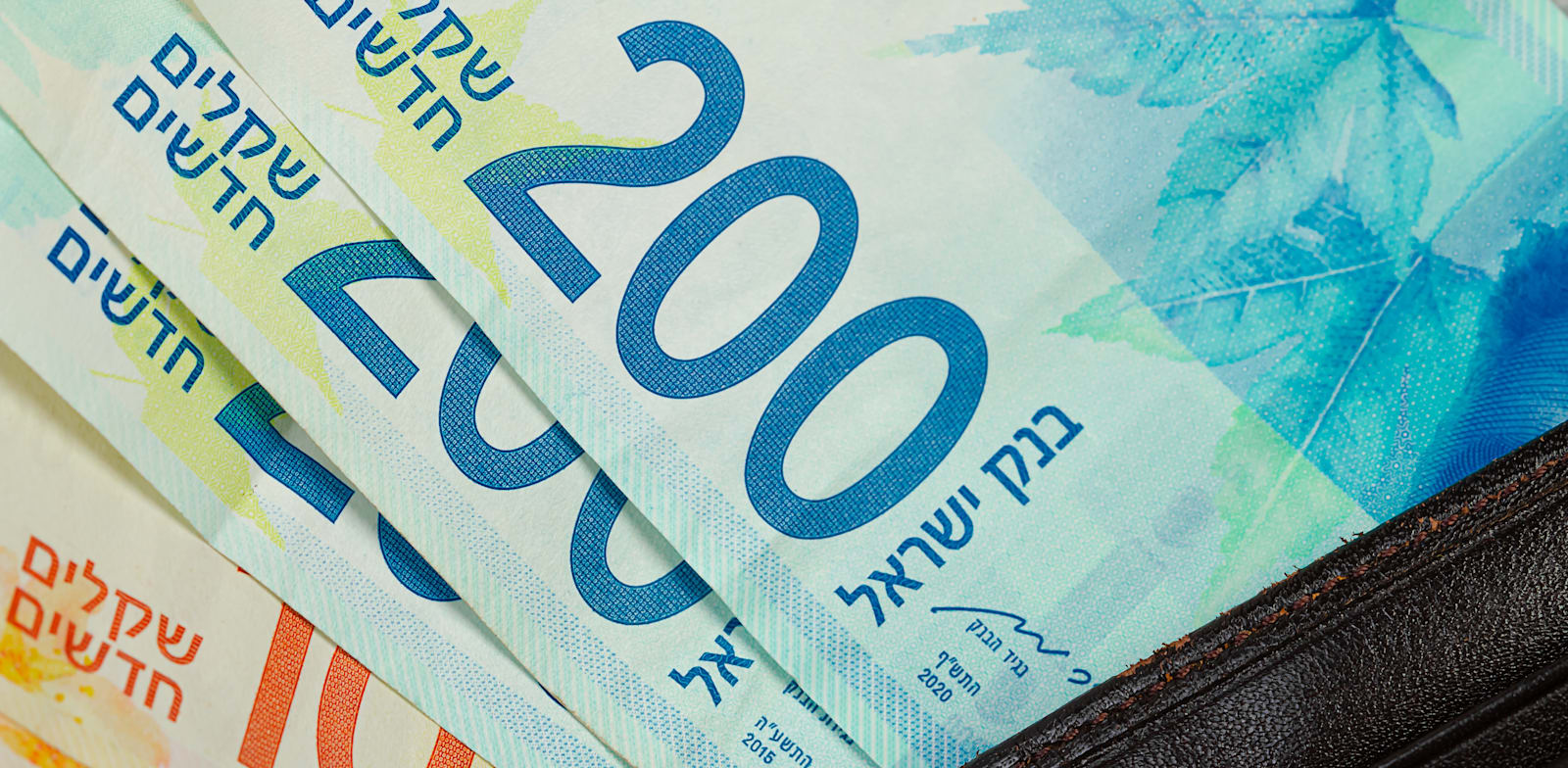
The shekel continues to strengthen to levels not seen since for decades against the world’s major currencies. Yesterday the Bank of Israel set the representative shekel-dollar rate 0.665% higher from Tuesday, at NIS 2.84/$, the shekel-euro rate was set 0.622% lower, at NIS 3.306/€ and the shekel-sterling rate was set 0.878% lower at NIS 3.817/£. In inter bank trading the shekel has gain further since then.
The strong Israeli currency, once a measure of the country’s economic stability, is becoming a heavy burden on the economy at these levels, especially in the industrial and tech sectors. Tech companies, responsible for more than 50% of Israeli exports, are struggling: their dollar revenue is eroding when converted into shekels, wage costs denominated in shekels remain unchanged, and profitability is evaporating. In industry, pressure is mounting on the Ministry of Finance and the Bank of Israel to intervene.
So what could change the current direction and lead to a depreciation of the shekel? Here are four scenarios that are being discussed in the markets – with varying degrees of probability – some are optimistic, and others involve development that nobody wants.
Wall Street tumbles
The force behind the shekel’s appreciation over the past year is not geopolitical but financial: Israeli pension funds, provident funds, and insurance companies are hedging their exposure to foreign markets by selling dollars and buying shekels in unprecedented amounts.
Institutional investors maintain a fixed level of exposure to foreign currency – about 20% on average. Since a huge portion of the public’s money is invested in overseas stocks, an automatic mechanism has been created. Every time Wall Street gains, the value of the institutional investors dollar-denominated stocks rise, which threatens to push their exposure to foreign currency beyond the set target. To balance the portfolio and maintain a stable exposure level of about 20%, the institutions must act in the opposite direction, and buy shekels in the market.
The bottom line is that every 1% increase in the leading Wall Street indices requires the institutions to sell an estimated $1.5 billion to hedge the risk. This constant selling pressure is flooding the local market with dollars, and even more so recently, when since the end of March, the S&P 500 and Nasdaq indices have risen by double digits.
RELATED ARTICLES
Shekel gains sharply despite interest rate cut
BoI governor: The strong shekel is moderating inflation
Bank of Israel cuts interest rate 0.25%
But what will happen in the opposite situation, if the US market changes direction and goes into a sharp correction? “Sharp declines in the stock markets, abroad in general and in the US in particular could be a significant trigger,” says Jonathan Katz, chief economist at Leader Capital Markets. “If we see relatively sharp declines, say 20%, something we saw in the past with Trump’s tariffs in April last year, you could see the shekel reach NIS 3.15-3.2/$.
A potential catalyst for such a scenario would be accelerating inflation in the US, a rise in long-term bond yields, and the US Federal Reserve hiking interest rates contrary to expectations. Katz sees the potential for such a scenario in over a year’s time,
But it wouldn’t end there. The institutional hedges, which are currently boosting the shekel and pushing inflation down, could also work in the opposite direction. A fall in the stock markets might lead to a weakening of the shekel, but it would come at the cost of increasing inflationary forces due to the volume of dollar purchases that would be required of the institutional investors.
Israel’s risk premium would again rise
The decline in Israel’s risk premium is one of the factors that has attracted investors to return to Israel and repatriate funds. This decline is evident in the CDS index (credit default swaps), which has fallen by more than 60% since breaking records in October 2024, due to the escalation in the north at that time. Reversing this trend is possible mainly in extreme cases, after the Israeli economy has already proven resilience in recent rounds with Iran, which did not increase the risk premium as reflected in the CDS over time.
According to market estimates, only a real escalation would change the risk perception of both foreigners and the Israeli public: not another round of fighting with Iran,, but rather horror scenarios that reignite fears about long-term stability.
Aggressive intervention by the Bank of Israel
This is one of the scenarios that policymakers have control over, but there are currently no signs that they will want to exploit it. The Bank of Israel cut interest rates by 0.25% point this week to 3.75%, a move that barely impacted the shekel-dollar exchange rate.
Modi Shafrir, Chief Financial Markets Strategist at Bank Hapoalim, estimates that another moderate interest rate cut would also not be enough to create an impact: “We need to cut relatively sharply, not moderately, to see a trend reversal. In addition, foreign exchange purchases by the central bank can moderate the appreciation of the shekel and curb the trend, but it depends on what volumes they reach, if the Bank of Israel ultimately decides to intervene.”
In other words, the interest rate tools and foreign currency purchases in the hands of the Bank’s Governor, Prof. Amir Yaron, may be effective, but only if they are used aggressively.
There is already a precedent under the same Governor. In early 2021, the Bank of Israel announced a plan to purchase $30 billion, and in fact purchased about $35 billion – an unusual action that curbed a sharp appreciation. As Jonathan Katz points out, the justifications given at the time for the intervention – a current account surplus, direct investments in high-tech, and massive foreign exchange sales by institutions were almost identical to today’s circumstances. The difference is that then interest rates were close to zero and the Covid crisis was a global event. Today, the Bank of Israel is hesitant.
However, there are those in the market who doubt the effectiveness of this type of intervention. The reason is that the massive increase in assets managed by institutions in recent years, due to the sharp increases in stock markets, which has led to the effect of hedging becoming much more dramatic, and which reduces the power of the Bank of Israel’s main lever. In addition, the Governor himself signaled this week after the interest rate decision that he does not plan to make forex purchases at this stage, and he did not define a threshold at which the approach would change.
The institutions are currently managing a portfolio of assets double that they managed in 2021. For the Bank of Israel to truly have an effect, it will have to invest much larger amounts itself than in the past. It can be assumed that due to the market power of the institutions, and the fact that the Bank of Israel’s foreign exchange reserves already stand at about $236 billion, this time $35 billion will no longer be enough.
Shafrir points out another factor that may be at work anyway, without any intervention: “If you look only at the interest rate differentials – the shekel has already strengthened too much, due to the fundamental forces and the foreign exchange sales of the institutions.” In other words, even the pure financial forces, without any announcement, may at some point rebalance.
The Ministry of Finance could hedge its forex debt and another outside the box idea
There is also a theoretical scenario, held by the Ministry of Finance, which does not seem interested in implementing it: hedging the country’s foreign currency debt while taking advantage of the strengthening of the shekel. “The Accountant General’s Department, which issues dollar bonds abroad, among other things, can hedge and actually buy dollars at a low rate,” says Meitav chief economist Alex Zabeshinsky. “In this way, the Ministry of Finance is essentially injecting demand for dollars through the derivatives market.”
According to him, “Any business company that issues a foreign currency loan and sees that the shekel is strengthening, at least examines it. The Ministry of Finance can too.”
The reason the Ministry of Finance is hesitant, according to Zabeshinsky, is twofold: on the one hand, it does not want to be perceived as a “speculator” who changes debt management policy. On the other hand, it is afraid that it will come to the market with billions and end up closing at a bad rate.
Due to the Ministry of Finance’s opposition and the Bank of Israel’s reluctance to intervene aggressively, Zabeshinsky came up with an idea for a combined mechanism that would allow all parties to act without being exposed. The Bank of Israel would establish a mechanism through which the institutions would sell dollars to it directly – instead of “throwing” them into the open market. The central bank, which does not want to accumulate a large foreign exchange exposure, transfers them to the Ministry of Finance, which quietly closes its foreign loans. “This way, the hedging flow of the institutions does not pass through the market and the Ministry of Finance closes its foreign exchange exposure at a good rate,” Zabezhinsky concludes. “This requires everyone to coordinate and agree – but this is a national task.” He also mentions the alternative price, if no active step is taken and the state lets market forces do their thing: “Waiting for factories to close here, high-tech will suffer, there will be a recession and then the shekel will weaken.”
Published by Globes, Israel business news – en.globes.co.il – on May 28, 2026.
© Copyright of Globes Publisher Itonut (1983) Ltd., 2026.