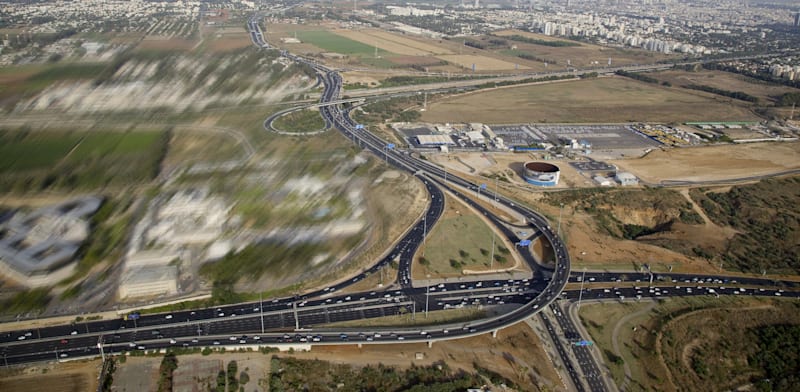
Land contamination is no longer just the problem of developers and apartment buyers in Sde Dov in Tel Aviv. An update issued by the Ministry of Environmental Protection, the Ministry of Health, and the Government Water and Sewage Authority submitted to the Supreme Court in recent days reveals that dozens more sites are suspected of having contaminants in the soil, which could delay construction and marketing for years to come.
These potentially contaminated sites include Herzliya Airport, the Sirkin IDF base in Petah Tikva, and the Glilot area, lands on which thousands of apartments are planned for the coming years.
The state’s response was submitted as part of a petition filed by the Adam Teva V’Din environmental ssociation and Prof. Alon Tal, which demands that the supervision of the use of PFAS compounds (Per- and polyfluoroalkyl substances) chemicals that may be present in those lands, and are considered toxic, be regulated. However, the Israel Lands Authority (ILA), which has marketed and will market most of the land in question, notes that except for Sde Dov, the tests have not yet revealed any findings that turn the sites into contaminated but only make them “suspicious” sites.
4,500 chemicals
PFAS compounds are a group of about 4,500 synthetic chemicals that are considered heat and fat resistant and difficult to break down chemically. That’s why they are found, for example, in the coatings of pans and pots. According to the Ministry of Environmental Protection, PFAS compounds have been discovered in groundwater monitoring wells, wells for drinking water production, in streams, in industrial wastewater, in soil, in wastewater treatment plant effluents (wastewater treatment facilities), and more.
In 2022, Adam Teva V’Din and Tal filed a petition requesting that the Ministry of Environmental Protection monitors the presence of these substances in soils. According to the state’s response, which was sent in recent days, the ministry is currently handling 35 suspicious sites. Some of them, such as the Israel Aerospace Industries site in Yehud, the Caesarstone site and Pi Glilot in Beersheva, have already been found to be clean.
However, according to the state’s response and a letter recently written by Water Authority director general Yechezkel Lifshitz, to ILA business division director Sigal Gabay, among the sites found to be contaminated are huge complexes intended for residential use: the former IDF base at Sirkin in Petah Tikva, Kiryat Haim air terminal, Sde Dov, the Glilot area and many other sites that served or are serving as airfields (Ramat David, fuel storage areas at Ben Gurion Airport, Rosh Pina Airport and Herzliya Airport), fuel storage areas and power plants (Ashdod and Hadera).
RELATED ARTICLES
Court delays Sde Dov land lottery due to contamination
About a month ago, Lifshitz wrote, “The Water Authority is working consistently to detect and map PFAS contamination at sites with potential risk, including the Sde Dov area in Tel Aviv, where the authority conducted groundwater analyses as early as 2022. In recent years, the authority has also detected these compounds at other sites designated for development, such as Pi Glilot Ramat Hasharon, HA 27 and the Sirkin camp.”
The most urgent locations in terms of the presence of contaminants are the Sirkin camp in Petah Tikva, where 8,500 housing units are planned and Herzliya airport, where 1,500 housing units are planned.
No standards yet
One of the problems with determining the extent of contamination with PFAS compounds is that there is still no current standard. The Ministry of Environmental Protection is promoting new standards, but with the publication of a draft for public comments, it has already caused a stir, given what seems like a relative relaxation compared with international standards. According to the state’s update to the High Court, staff work is being carried out to complete the standards.
Adam Teva V’Din warns that the state prefers to ignore the findings. For example, the association notes that although the land in Glilot is suspected of being contaminated, work is underway there under the Metro plan, risking workers, and without any plans to clear the land. The association stated that if the work continues, they will consider petitioning to stop it.
In contrast, the ILA stresses all sites are only “suspected of contamination,” but not those that have actually been proven to be contaminated. ILA inspector Yossi Mizrahi says, “With the exception of Sde Dov, there is no site under investigation for full PFAS. All the sites where contaminants were used in the past have been grouped together in a list, and they are suspected of contamination. Some of them are huge sites, and it is enough for 5% of them to be contaminated for them to be declared as such. We will not approve construction before the land is purified.”
Published by Globes, Israel business news – en.globes.co.il – on July 9, 2026.
© Copyright of Globes Publisher Itonut (1983) Ltd., 2026.