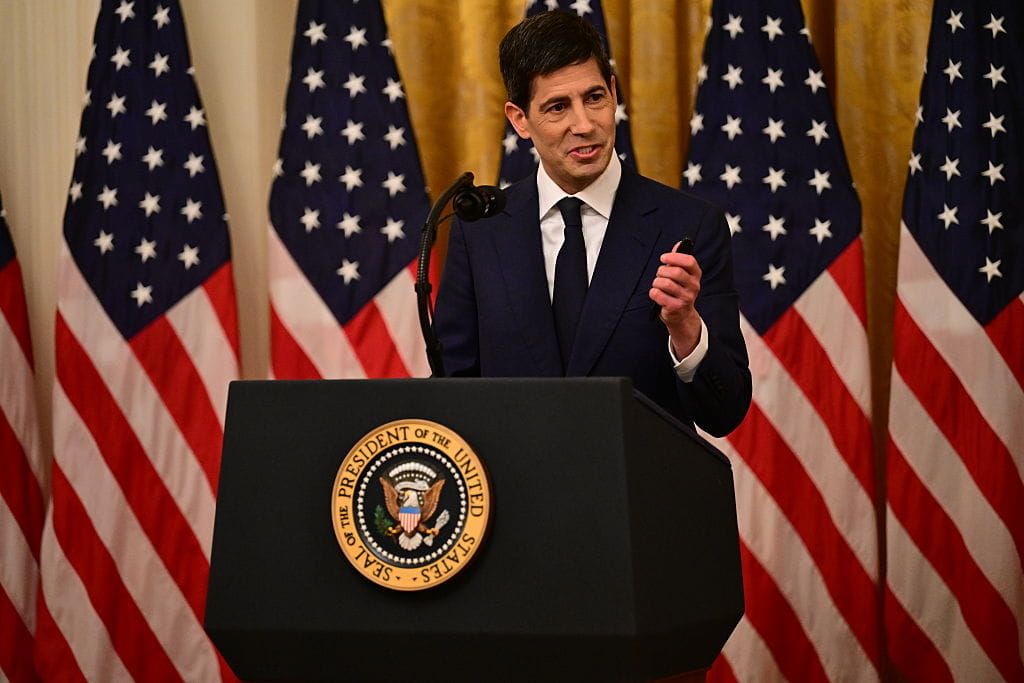
For the first time since August 1987, the White House’s East Room hosted a swearing-in ceremony of an incoming Federal Reserve chairman on May 22. Thirty-nine years ago, then-President Ronald Reagan gave Alan Greenspan the red-carpet treatment. Almost four decades later, President Donald Trump extended the same courtesy to Kevin Warsh. The glitz and glamor are over, and now it is time for Warshonomics to filter through the central bank. Job one? Get interest rates under control.
Kevin Warsh – Mission Impossible
There is a good chance that if the war in Iran ends, yields on US Treasury securities will return to February levels. The global bond market has seen long-dated yields rocket to the moon, functioning like a memecoin. The ten-year topped 4.6% for the first time in a year, the two-year firmed above 4%, and the 30-year reached its highest level since the global financial crisis.
Economists contend that the 13-week-old conflict in the Middle East is considered the culprit for the bond market mayhem. But investors still believe this is a near-term threat. Instead, three primary factors have pushed up yields in the United States and around the world.
The first is higher inflation, the concern that price pressures will persist, even with optimism about artificial intelligence-driven disinflation. The second is the crowding-out effect, meaning the US Treasury has to compete against AI hyperscalers issuing bonds. Finally, the long end of the yield is being fueled by ongoing fiscal risks. Another plausible trend is that investors are optimistic about the US economy’s future and uninterested in holding bonds.
Whatever the case, the Federal Reserve is absent from the list.
While Trump and his predecessors have urged the Fed to lower interest rates to bolster economic growth and boost the labor market, the Eccles Building has ostensibly lost control of interest rates. This was apparent during the initial easing campaign a couple of years ago when the Fed was reducing the benchmark federal funds rate, but Treasury yields were climbing anyway.
The White House thinks that if the Fed loosens policy, debt-servicing payments will be lower. This may have been the case a decade ago, but current economic and fiscal conditions have put this idea to bed.
However, Kevin Warsh might be able to do the unthinkable by focusing on the $7 trillion balance sheet. Critics argue this will be difficult to accomplish, but supporters say it is a necessary reform.
Reforming Balance Sheet Thinking
In his May 22 swearing-in ceremony, Warsh committed to “leading a reform-oriented” Federal Reserve System. So far, it appears that the central bank will adopt a quieter role by communicating less with markets and operating with minimal interference in the grander scheme of things.
Another objective in transitioning to more of a “man behind the curtain” role is to change how the Fed uses its balance sheet. At the onset of the Great Recession, then-Chair Ben Bernanke employed quantitative easing, a new monetary policy tool that consists of purchasing Treasury securities. The objective is to increase demand, lower long-term yields, and reduce interest rates on consumer credit (mortgages, for example).
By the end of the chaos, Bernanke compiled about $1 trillion in assets. At the height of the coronavirus pandemic, it topped $9 trillion, as Jerome Powell bought government debt, mortgage-backed securities, and corporate bonds.
Since then, the Fed has engaged in quantitative tightening, allowing about $2 trillion to roll off the public ledger. The two-year-long crusade came to an end last year, when the central bank altered the pace and mechanics of shrinkage. But May’s Balance Sheet Developments suggested the balance sheet increased by about $49 billion between September 2025 and March 2026.
What does Warshonomics 101 want to do? End this QE practice altogether.
During his April Senate Banking Committee confirmation hearing, Warsh argued that balance sheet expansion has disproportionately helped Wall Street and hurt Main Street. Twenty years of QE (or QE-lite) has suppressed long-term interest rates while also distorting market pricing of duration risk. The only way to achieve lower rates is to put aside the factor causing these distortions.
This is not anything new. One of the reasons he left the board of governors in 2011 was his opposition to “Helicopter Ben” and his expansive monetary initiative.
If Warsh convinces a majority of the Federal Open Market Committee members to move forward with this endeavor, it will inevitably cause short-term pain. Like Argentine President Javier Milei’s idea of “shock therapy,” Warsh would cause agony everywhere. Long-term? Since his efforts are unlikely to remain static but rather dynamic, they could help resurrect discipline and real market functions, making bonds great again.
Put simply, the 10-, 20-, and 30-year yields would trade on fundamentals rather than on how many assets the Fed holds. But this type of reform would likely be introduced gradually and methodically since a seismic adjustment would make the current turbulence a walk in the park.
Convincing his colleagues could be the real challenge, however. Fed Governor Christopher Waller said during a European Central Bank conference last week that returning the balance sheet to pre-2008 levels would be impossible, given the sizable structural transformations. Instead, he believes the Fed could lower the balance sheet by as much as $500 billion.
Others agree.
“I think shrinking the balance sheet is the wrong objective, and many of the proposals to meet this objective would undermine bank resilience, impede money market functioning, and, ultimately, threaten financial stability. Some would actually increase the Fed’s footprint in financial markets,” Fed Governor Michael S. Barr said in a May 14 speech.
Sigh of Relief
The idea of the Fed no longer bailing out the US government or Wall Street could be a relief for even those who advocate abolishing the century-old institution. But Kevin Warsh will be navigating a minefield as he attempts to appease the president, fight inflation, support the economy, and implement much-needed reforms. If he can achieve all of this without so much as a scratch, Warsh’s face might as well be etched onto Mount Rushmore.




-1024x683.jpg "Paxton v. Cornyn – Which Way MAGA?")