Highlights
How AI is being applied in international trade to manage compliance, tariffs, and regulatory complexity
Why AI is becoming essential for helping trade professionals surface insights, reduce risk, and support better decision-making
What organizations should focus on now to prepare for ongoing AI developments in global trade
Artificial intelligence is no longer a future-looking concept in trade. In 2026, AI in international trade is moving from experimentation to practical deployment as trade teams respond to tariff volatility, policy shifts, changing customs requirements, and rising operational pressure. According to the 2026 Global Trade Report from Thomson Reuters Institute, 40% of trade organizations report actively exploring AI or blockchain technologies, up from just 6% in 2024, showing how quickly trade functions are modernizing.
That shift is happening because the trade environment is no longer defined simply by a high volume of updates. It is defined by continuous, interconnected volatility: tariff actions affect sourcing, sourcing affects classification, classification affects landed cost, landed cost affects pricing, and compliance decisions ripple across logistics, finance, procurement, and customs operations.
In that environment, AI in international trade is proving most useful where complexity, speed, and documentation demands collide: product classification, trade research, document handling, anomaly detection, and decision support.
Jump to ↓Why AI in international trade matters now
What are the current AI applications in international trade?
AI in international trade is delivering business value
How do trade professionals feel about AI?
How to keep up with AI news in trade
2026 Global Trade Report
Trade departments experiencing unprecedented strategic elevation amidst tariff challenges
Read white paper ↗
Why AI in international trade matters now
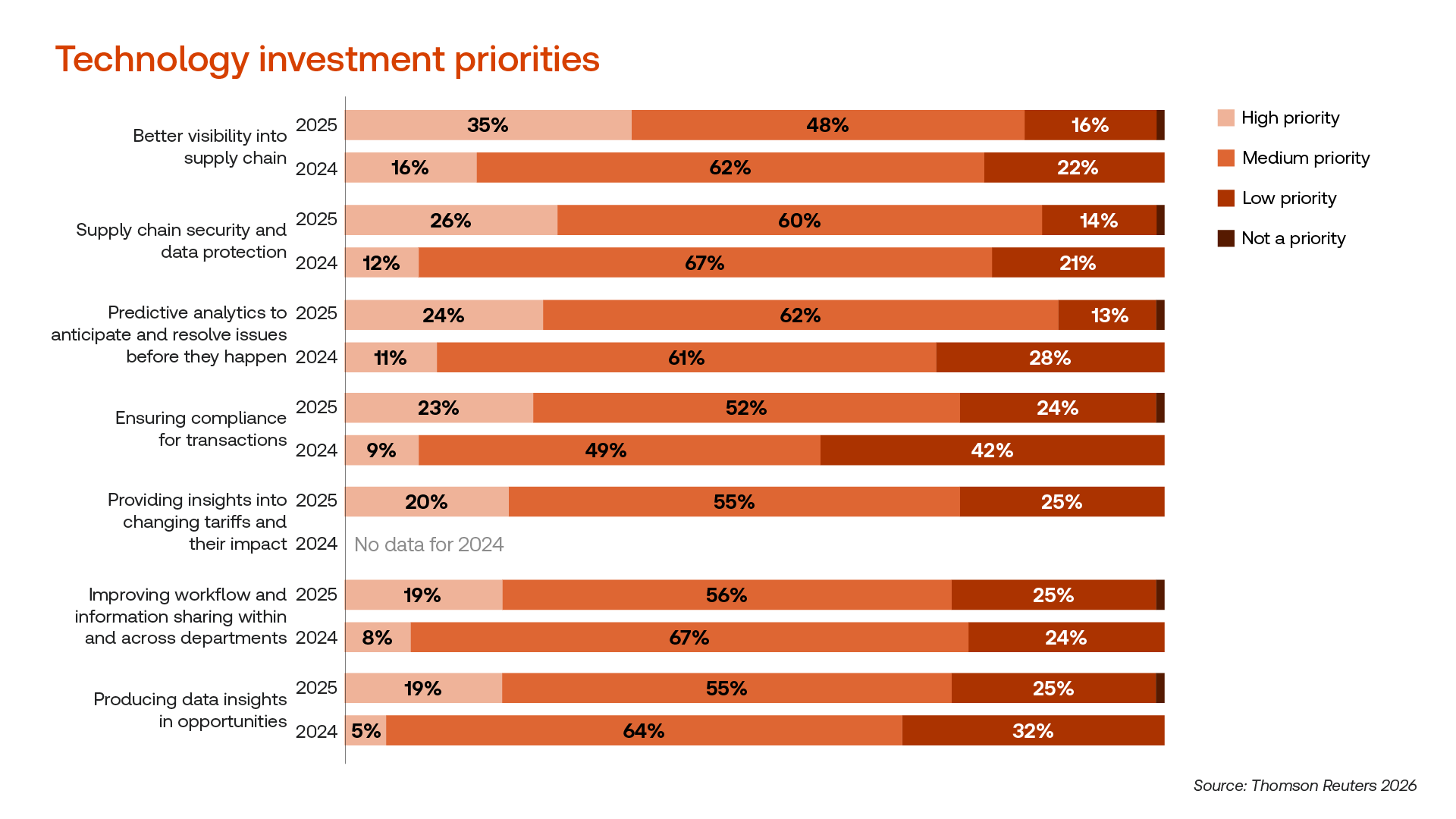
Trade teams are being asked to do more than maintain compliance. They are increasingly expected to provide strategic guidance on sourcing, tariff exposure, route changes, and operating risk. At the same time, organizations are moving away from manual systems and toward more integrated digital trade operations. In the Thomson Reuters Institute report, 24% of respondents said predictive analytics was a “high priority” for tech investment to anticipate and resolve issues before they happen.
Trade work depends on structured reasoning across multiple sources: tariff schedules, section and chapter notes, explanatory notes, rulings, broker guidance, supplier data, engineering details, and internal precedents. Product classification is not a keyword-matching exercise; it is a legal and technical decision-making process.
As a result, companies need tools that can help teams move faster without sacrificing defensibility. That is where AI-powered international trade solutions are creating value.
What are the current AI applications in international trade?
Today, AI in international trade is being used in practical, high-impact ways across compliance and operations. Common applications include:
Product classification support: AI can analyze product descriptions, materials, functions, and historical classification patterns to suggest likely HS or HTS codes and surface relevant supporting content.
Trade research and regulatory analysis: AI tools can help users find relevant customs regulations, tariff provisions, rulings, and country-specific requirements more quickly.
Document analysis and data extraction: AI can review shipping documents, commercial invoices, and related records to identify key trade data, reduce manual entry, and improve completeness.
Data quality monitoring and anomaly detection: AI can flag missing fields, unusual patterns, inconsistencies across records, or data flows that may create compliance risk.
Customs description generation: AI can help create clearer, more customs-compliant product descriptions to support declarations and reduce clearance delays.
Risk assessment and workflow prioritization: AI can identify transactions, products, or jurisdictions that may require added review based on patterns and known risk indicators.
Decision support for trade professionals: AI can help teams evaluate sourcing changes, tariff exposure, and classification implications by bringing together large volumes of information more efficiently.
These use cases are especially valuable because they help trade teams reduce repetitive work and focus more attention on high-value analysis, exception handling, and strategic decisions.
AI in international trade is delivering business value
As adoption rises, the business case for AI in international trade is becoming clearer. A practical example is OMRON Corporation, which used ONESOURCE to centralize Harmonized System code classification across more than 60 global bases after managing HS codes locally in spreadsheets.
Using ONESOURCE Global Classification AI, OMRON built a centralized global HS code database, documented classification logic, and made that reasoning accessible across its import bases. This enabled more consistent classification across regions, centralized master data management, expert oversight before classifications were implemented, and better operational efficiency by replacing manual spreadsheet processes.
The business value went beyond process improvement. OMRON improved transparency by storing supporting documentation for classification decisions and tracking changes over time, while integrated updates on tariff changes and regulatory content helped improve overall data accuracy. OMRON also planned to integrate the solution into its core enterprise systems to embed trade compliance more directly into day-to-day business operations.
How do trade professionals feel about AI?
In general, AI is viewed favorably in the trade industry as a force multiplier for specialized teams working under pressure. A respondent in the 2026 AI in Professional Services Report felt “Hopeful” about AI and wrote:
“I am optimistic about generative artificial intelligence in the field of foreign trade because I believe it can bring more efficiency, agility, and precision to processes. AI tools have the potential to automate repetitive tasks, such as document analysis, data translation, and system data entry, allowing professionals to focus on strategic activities. Furthermore, AI can assist in decision-making by offering predictive analytics and insights into markets, logistics, and compliance, which tends to reduce errors and operational costs. I see this technology as an ally in modernizing and increasing the competitiveness of companies operating in international trade.”
AI is best understood not as a replacement for trade professionals, but as a tool that enables them to focus less on repetitive data handling and more on high-value work such as classification judgment, exception management, and sourcing strategy.
How to keep up with AI news in trade
A practical approach to keeping up with AI news is to track updates from customs authorities, trade technology providers like Thomson Reuters, major logistics organizations, and trusted industry research sources. It also helps to watch for developments in tariff policy, enforcement trends, and digital trade initiatives, since these often shape where AI tools can deliver the most value.
To stay current, many teams combine regular industry reading with internal testing and peer discussion. That way, they are not just hearing about new AI capabilities — they are evaluating which tools are relevant to their products, workflows, and compliance priorities.
The conversation has changed. The issue is no longer whether trade teams should pay attention to AI. It is whether they can afford to manage product classification, regulatory research, and documentation workflows without tools built for constant change.
Learn more about AI’s impact on global trade through our blog series, and see how Thomson Reuters is leading the way with AI-powered classification software and research capabilities.