If you paid for daycare, after-school care, or even a household employee so you could work or look for work, you may qualify for the Child and Dependent Care Credit (also called the Dependent Care Tax Credit). To claim this tax break, you’ll need to familiarize yourself with IRS Form 2441 — the tax form that helps you claim the Dependent Care Credit on your tax return.
Let’s walk through what this form is, who qualifies for the Dependent Care Credit, what expenses qualify for Form 2441, and Form 2441 instructions.
What is Form 2441?
Form 2441, Child and Dependent Care Expenses, is used to report your dependent care expenses and calculate your Dependent Care Credit.
You’ll typically file Form 2441 if you paid for care for a qualifying child (usually under age 13) or another qualifying person so that you (and your spouse, if applicable) could work or look for work.
This form connects directly to your Form 1040 and helps determine how much of a tax credit you can claim based on your qualifying expenses. Don’t worry, though — if you’re using TaxAct®, our tax software does all the calculating for you.
Before diving too deep into the specifics, it’s sometimes helpful to understand the credit’s limits. We asked a tax expert (and a parent currently paying for daycare) what to expect:
“I think some parents are surprised that it only applies up to two dependent children. Once you have more than two, you’re still capped at $6,000 total expenses that count toward the credit calculation.” — Andrew Oswalt, Manager of Tax Development at TaxAct
We cover the gist of claiming child care expenses in this article, but for a full breakdown of qualifying expenses, limits, and how the Dependent Care Credit is calculated, check out our detailed guide: Are Daycare Expenses Tax-Deductible? Understanding the Child and Dependent Care Credit.
Who qualifies for Form 2441?
To claim the Dependent Care Credit, both you and the dependent must meet specific eligibility requirements set by the IRS.
Qualifications for the person claiming the credit
You paid childcare expenses or other dependent care expenses for at least one qualifying individual.
The care allowed you (or your spouse, if filing a joint return) to work or look for work.
You (and your spouse, if applicable) had earned income.
Your filing status is single, head of household, or married filing jointly.
You generally don’t qualify if:
Your filing status is married filing separately (with limited exceptions).
You didn’t find a job and had no earned income (unless you or your spouse was a full-time student or disabled).
You paid the care expenses to your spouse, the child’s parent, or someone else you can claim as a dependent.
Qualifying person requirements
A qualifying child under age 13 whom you can claim as a dependent
If the child turned 13 during the year, they qualify only for the portion of the year they were under age 13.
A spouse who was physically or mentally unable to care for themselves and lived with you for more than half the year
Another disabled dependent who was unable to care for themselves and lived with you for more than half the yearIf this person filed a joint return or had a gross income of $5,200 or more (in 2025), they don’t qualify.
If you or your spouse could be claimed as a dependent during that year, you cannot claim the credit.
The good news is, if you’re using TaxAct to file, we’ll take out the guesswork and help you determine if you qualify for the credit based on the information you provide.
Form 2441 examples of qualifying expenses
Expenses claimed on this form must be work-related and tied directly to caring for a qualifying individual to count toward your tax credit.
Some common examples:
Paying for daycare or preschool for your child while you work
Hiring a nanny or household employee to care for your child at home
Sending your child to day camp (overnight camps do not qualify)
Paying a babysitter for after-school care
Covering costs for an adult daycare or in-home caretaker for a disabled person or elderly parent who qualifies as your dependent
Note: If you receive dependent care benefits (like an FSA) from your employer, you can still qualify for the Dependent Care Credit, but those benefits may reduce your final credit amount. You’ll report those details later in Part III of Form 2441, which we explain later.
Form 2441 instructions: How to fill out Form 2441
To fill out this form, you will need:
Your qualifying person’s name and SSN
Your care provider’s details (name, address, taxpayer identification number)
Your total amount of childcare expenses paid during the tax year
Any dependent care benefits from your employer (from Form W-2)
Your earned income and adjusted gross income (AGI)
Note: If you’re using TaxAct to file your return, you won’t have to fill out the form line by line. We translate everything into simple questions and fill out the form for you behind the scenes. This section is meant to help you understand how the IRS calculates the credit and why our software asks for this information.
Before you start filling anything out, it helps to see what you’re working with. Here’s what Form 2441 (page 1) looks like:
Right at the top of Form 2441, you’ll see two checkboxes:
First checkbox: Check only if you meet the exception to claim the credit while married filing separately (this only applies in specific situations outlined by the IRS).
Second checkbox: Check if you or your spouse was a full-time student or disabled during the year. In this situation, you are considered to have worked and earned income based on IRS rules.
These boxes make sure special situations, like filing separately or having a spouse who can’t work, don’t automatically disqualify you from the Dependent Care Credit.
Part I: Persons or Organizations Who Provided the Care
In Part I, you’ll list each care provider you paid. Be sure to include:
The care provider’s name and address
Their SSN or employer identification number (EIN)
Whether the provider was a household employee
The total amount you paid them
Tax Tip: If you’re missing this info, ask your provider to complete Form W-10.
Part II: Credit for Child and Dependent Care Expenses
Part II is where your credit amount gets calculated — you’ll list your care expenses in this section.
Enter:
Each qualifying child or qualifying individual and their SSN
Your total amount of qualifying expenses for each qualifying person
Your earned income (and spouse’s earned income if filing married filing jointly)
Your adjusted gross income (AGI) from Form 1040 (line 11a)
The IRS uses this info (along with rules from Publication 503) to determine your Dependent Care Credit and how much it reduces your tax liability.
“It’s not a refundable credit, so it’s only going to reduce tax owed. And you can’t count expenses while you’re out having fun (a.k.a. babysitter fees); you have to be working for expenses to count.” — Andrew Oswalt
Part III: Dependent Care Benefits
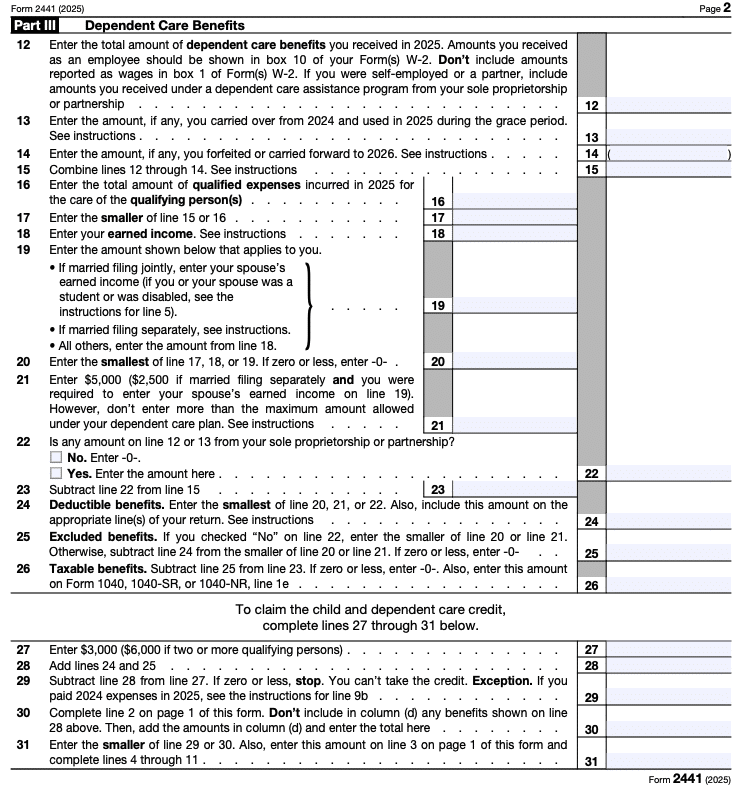
If your employer offers a dependent care FSA or similar benefit, you’ll report that in Part III. If you didn’t receive dependent care benefits, you can skip this section!
Here you’ll report:
Dependent care benefits from your Form W-2 (Box 10)
Unused amounts from the previous tax year carried forward (if applicable)
Total qualified care expenses for your qualifying person(s) during the year
Adjustments to avoid “double-dipping” on the same expenses
The IRS uses this info to compare your total dependent care benefits from your employer to your eligible dependent care expenses. Some benefits can be tax-exempt up to the annual limit (generally $5,000 for married filing jointly or $2,500 for married filing separately). Any excess benefits may be added back to your taxable income, and your remaining eligible expenses are used to calculate your final credit amount.
Example: Say you paid $5,000 in childcare expenses but used $3,000 in employer-provided benefits. Only the remaining $2,000 could qualify for the Dependent Care Credit.
“I feel like some parents expect a larger credit because of how high daycare costs are. For example, we paid about $14,000 for one child, but our credit was only $600 due to income limits. It doesn’t always make a big dent. It’s more valuable for low-income earners, but still capped at 35% of eligible expenses [for 2025].” — Andrew Oswalt
TaxAct’s software accounts for all this automatically when you enter your Form W-2 details, and we can help walk you through any adjustments in this section.
Form 2441 FAQs
How to file Form 2441 with TaxAct
If you’re using TaxAct, our tax software will help you complete the form automatically based on your answers to our interview questions. We’ll then calculate your tax credit for you.
To complete Form 2441 in TaxAct (dashboard view), follow these steps:
In your TaxAct return, click Deductions & Credits in the left sidebar menu. On smaller devices, click the menu at the top left corner of your screen, then make your selection.
Scroll down. Click the You & Your Family drop-down.
Click Add beside Dependent Care Credit, as shown below.

Click + Add Form 2441 Care Provider to create a new copy of the form (as shown below), or click Edit to edit or update an existing form.

Continue with the interview process to enter the provider information and answer any relevant questions.
On the How much of the [amount] paid to care providers in [tax year] was spent for each dependent’s care? screen, click Start beside the first dependent’s name to enter how much of the total paid was for that dependent, as shown below.
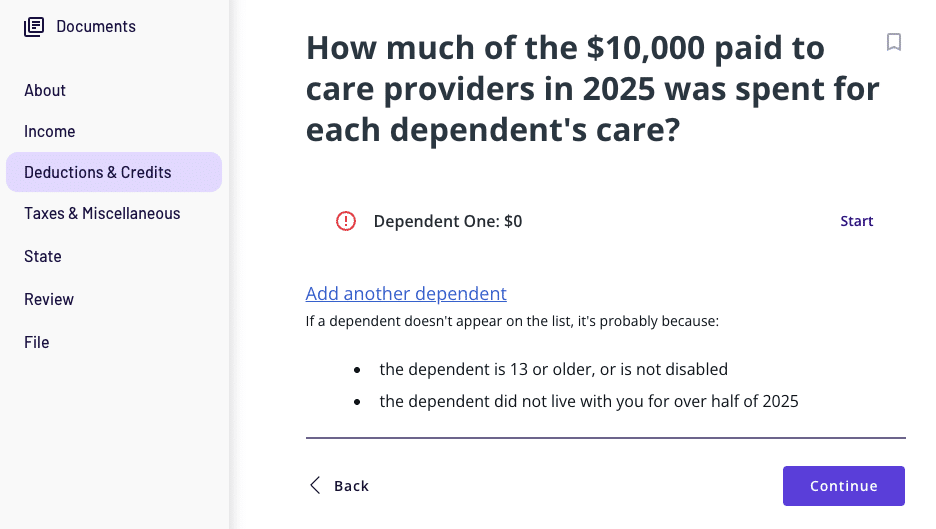
If none of the amount paid to a provider was for that dependent, check the Child is a qualified dependent, but did not incur expenses box on the following page and click Continue.
Once you have added amounts or checked the box for each dependent, click Continue again to proceed.
A summary page will display the results of the credit calculation.
If the credit is not allowed, a reason is shown.
If the credit is allowed, the amount will be displayed. The credit carries to Form 2441, and Form 1040, Schedule 3, line 2.
For more info about entering child and dependent care expenses in the TaxAct program, see our Help Center page.
The bottom line
You can use Form 2441 to report your dependent care expenses and claim the Child and Dependent Care Tax Credit. If you paid for care so you can work or look for work, this form may help you reduce your tax bill. Let TaxAct help you determine whether you qualify this year — we’ll walk you through the filing process step by step and help ensure everything is reported accurately and without hassle.
This article is for informational purposes only and not legal or financial advice.
All TaxAct offers, products and services are subject to applicable terms and conditions.