Financial advisors can help families protect hundreds of billions of dollars in property wealth — but doing so will require a strong grasp of heirs’ property, a specialized area of estate planning.
Processing Content
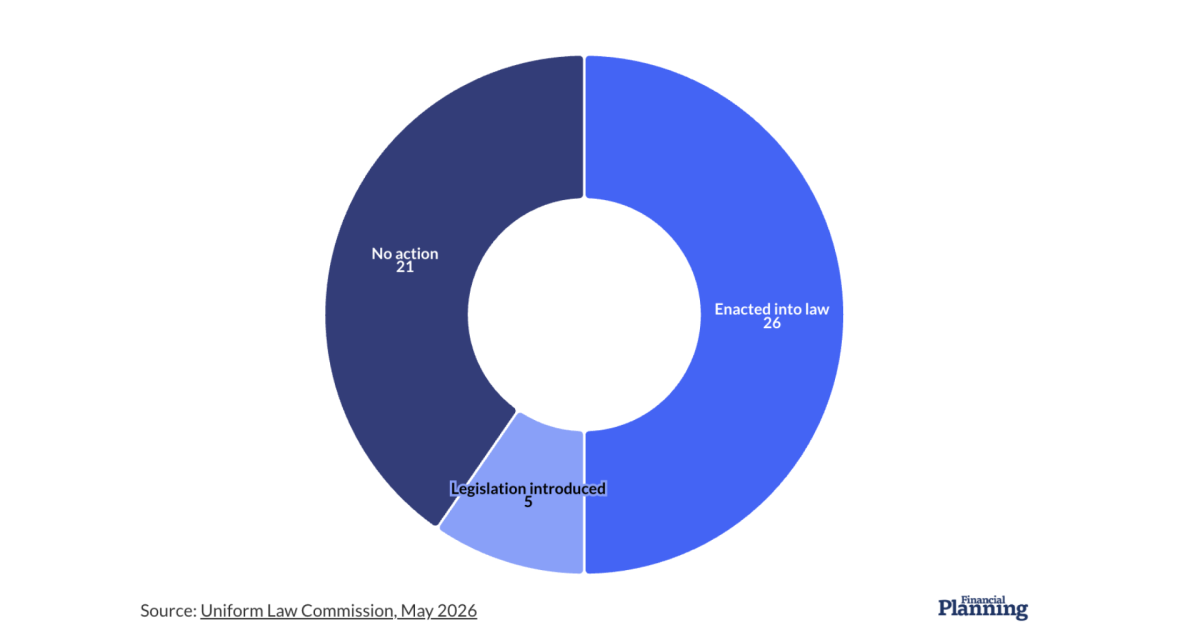
In recent years, awareness has grown around the risks to real estate (land and home assets) that transfers to multiple heirs, usually due to a lack of a will and the property’s subsequent so-called tangled title. At least two dozen states, plus the District of Columbia and the U.S. Virgin Islands, have passed legislation called the Uniform Partition of Heirs’ Property Act (UPHPA) to ensure families get protections against forced sales at below-market rates.
But many states haven’t followed suit. And in states that have adopted the laws, families with heirs’ property — who are disproportionately low-income, Black or Hispanic — continue to face threats to their generational wealth due to the complexity of estate planning for those assets, according to a report last month by the Urban Institute, a nonprofit research organization focusing on policies that increase economic opportunities.
Wills for the People
Financial planners who learn about the legislation and how to spot the common signs of heirs’ property can assist families in preserving their wealth by collaborating with lawyers with expertise in this aspect of estate planning, according to Whitney Knox Lee, founder of Wills for the People, a law firm that represents families in the lengthy, specialized proceedings.
“I’ve had many people tell me, ‘I want to leave my land to my five children,’ and I have to tell them, ‘No, that is creating heirs’ property,'” Knox Lee said in an interview. “It’s rife for conflict, and the moment one of those people dies, then what? We do have to be very intentional in our planning. It’s not enough to have a will.”
READ MORE: UBS to pay $1.2M for placing client in annuity, securities-backed loan
The scale of the heirs’ property problem
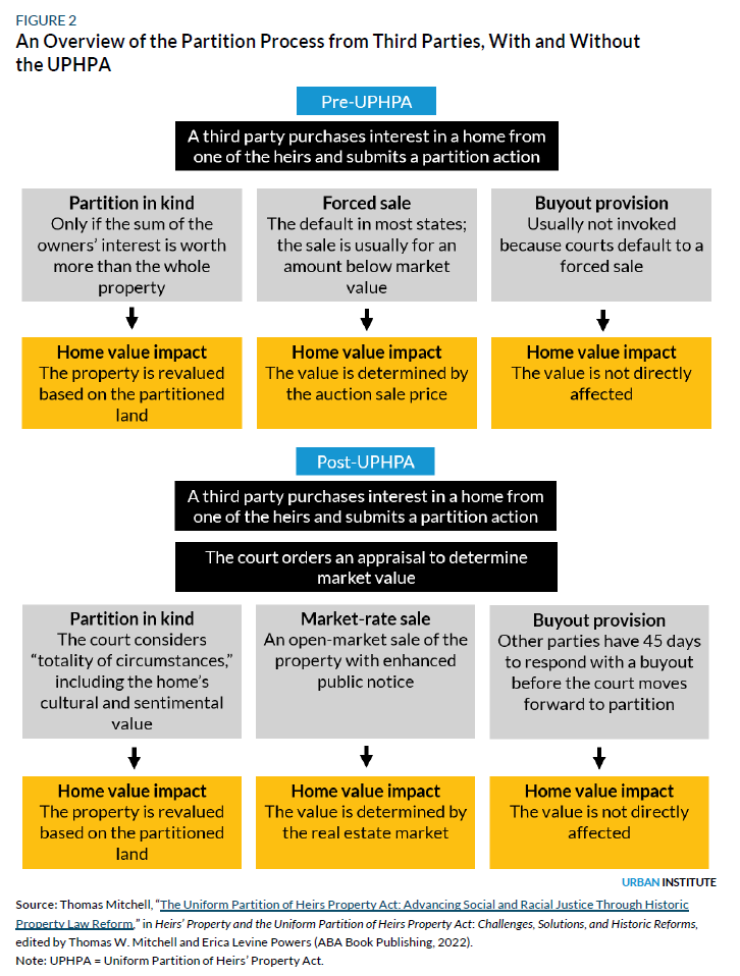
Only an estimated 3.8% of property owners have tangled titles or early indications of them, but that amounts to $243 billion in value across the U.S., the report showed. And property owners in low-income white areas like Appalachia, as well as Black and Hispanic Americans, display higher rates of heirs’ property or potential tangled titles. Without state regulations, investors may purchase a fraction of the assets from one of the owners, who are technically known as “tenants-in-common,” and file a motion in court called a “partition action” to force a sale of the rest to them at below-market rates.
That practice effectively turned on their head prior state laws calling for the simple physical division of the property where possible, according to a presentation by Thomas Mitchell, the director of the Initiative on Land, Housing & Property Rights at Boston College Law School and the architect of the UPHPA, at an event hosted by the Urban Institute earlier this year.
“In fact, state courts, judges throughout this country for decades had, de facto, reversed the presumption and made the forced sale the preferred remedy,” Mitchell said. “These forced sales are not under market-value conditions. They result in properties that are sold for 30, 40, 50, 60% less, sometimes 100% less than their market value. And this is the context of where the UPHPA comes in, because we were seeing that partition law was a significant driver of Black property loss.”
As part of that presentation, Mitchell displayed a photo of himself standing behind then South Carolina Gov. Nikki Haley when she signed the state’s version of the lawin 2016. More recently, legislators in a record five states have introduced similar bills this year, according to the nonpartisan Uniform Law Commission. And, since 2023, JPMorgan Chase has donated $16 million toward community-based organizations, legal services providers, researchers and other advocates raising awareness about the problem and the solutions, Olivia Barrow Strauss, the megabank’s vice president of neighborhood development, noted at the event. The bank has advocated for passage of the law in several states as well, since housing is so crucial to financial security and the building of wealth, Barrow Strauss said.
“It’s financial stability, it’s community health, it’s intergenerational opportunity and so much more,” she said. “But heirs’ property, which is an inherently unstable form of homeownership, can quietly undermine all of these aspirations. We know that, without clear ownership, multiple family owners may share ownership rights without an agreed-upon path for decisionmaking. And that type of uncertainty can limit a family’s ability to maintain the property, to invest in improvements, to access financing or even respond quickly when a crisis occurs.”
The state laws have “helped reduce forced sales among heirs’ property owners, but the legal and economic context in which the UPHPA operates can determine its effectiveness,” according to the institute’s report. Co-authors Michael Neal, Matthew Pruitt and John Walsh focused their study on Georgia, which was one of the first states to adopt the law in 2012, and specifically on Atlanta, where “heirs’ properties tend to concentrate in gentrifying areas” marked by the largest increases in average income, the study found.
Urban Institute
Even though the law has cut down on forced sales, other traditional barriers like the inability to secure financing because of the tangled titles and the cost of buying out other heirs or hiring a lawyer to draft documents and represent them in court continue to be a problem for many families. The general lack of awareness poses further difficulties, stakeholders such as Knox Lee told the researchers.
“Interviewees shared an emerging practice called probate fraud, which can target households with heirs’ property through the probate process,” the report said. “Multiple interviewees described how investors could interfere with homes in heirs’ property by offering to submit legal documents on one heir’s behalf and then fraudulently claiming that no other heirs exist. By preying on these information gaps and deception, investors can falsely obtain full ownership of the home through this tactic. Further research should explore how common probate fraud tactics have become in the Atlanta metropolitan area.”
READ MORE: Why the book-an-appointment tab is high-stakes for financial advisors
Problems that didn’t start overnight don’t get solved overnight
The researchers also called for more data to identify properties at risk of tangled titles. In addition, they recommended comparing outcomes across the various states that have adopted the law. More protections could guard against families’ losing their property through forced sales, property tax foreclosures or building code violations.
“Georgia’s UPHPA provisions provide important resources for heirs’ property owners, and interviewees believed the law has reduced the incentives for third-party investors to flip heirs’ properties through partition actions,” the report said. “But the law operates in a challenging legal and financial environment that reduces lawyers’ ability to understand and practice the law, as well as heirs’ property owners’ ability to afford some of its protections.”
Advisors guiding families through any number of estate planning issues that can be tricky for even the wealthiest households should be on the lookout for the warning signs of heirs’ property, according to Knox Lee. Those red flags could come in the form of offers to buy a property or discussions of land or homes owned by multiple family members. While advisors should avoid overstepping into areas of the law that are the specialty of certain estate and property the lawyers, their guidance on planning and business structures can enable families to hold onto assets that are rightfully a point of family pride. And they’ll be taking direct estate planning action against a contributing factor to the racial wealth gap.
“A good place to start is just being aware of the issue and aware of any flags when talking with clients that might indicate it’s heirs’ property,” Knox Lee said. “There are a lot of ways that families can set up the heirs’ property in a structure that will help protect it, but it comes down to knowing when you’re even in that situation.”