For financial advisors or clients trying to bring families together for tough estate planning discussions, Heather Hunt-Ruddy has some unfortunately personal advice.
Processing Content
After her stage 4 breast cancer diagnosis two years ago, she and her husband invited their three adult children to a brunch that they called “eggs and money,” the central division leader for Wells Fargo Advisors recalled. Despite more than three decades of industry experience, Hunt-Ruddy’s own family estate plan had gone 20 years without an update. So she “threatened to haunt” her kids if they continued refusing to discuss it, she said.
“They said, ‘We don’t want to talk about this, Mom.’ I said, ‘You are going to talk to me about this, whether you like it or not,'” Hunt-Ruddy said. “It was one of the most powerful conversations of our lives. I want them to have it when there’s really time to talk about what this money can mean for the next generation. … I want people to use my story as a reason to have these conversations with their families.”
Wells Fargo
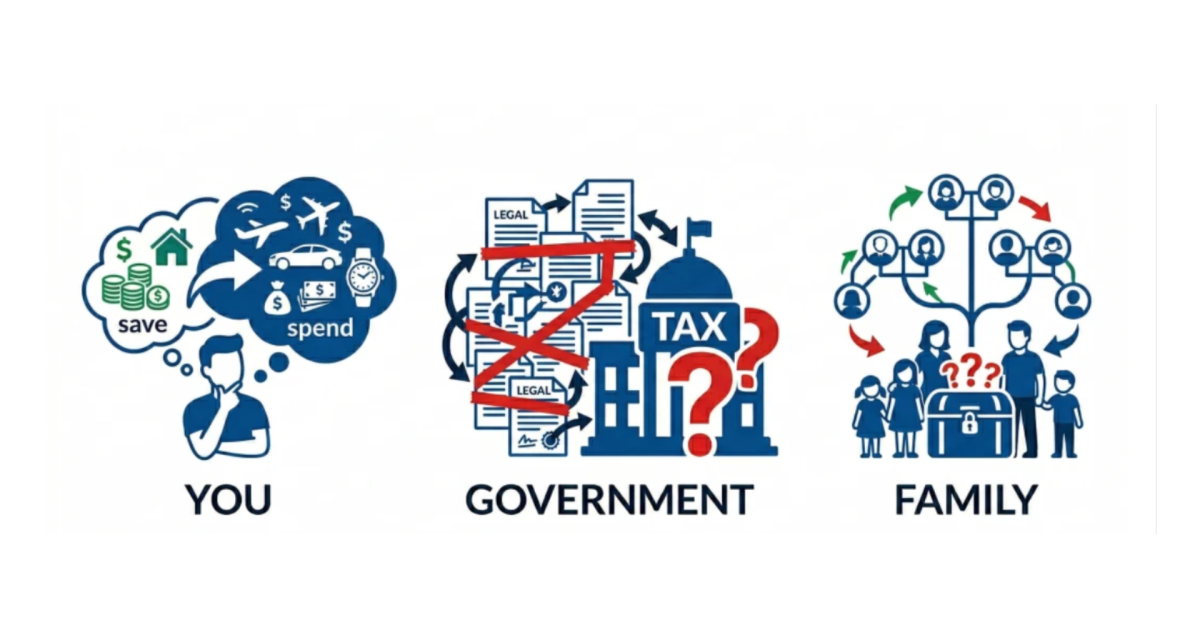
For financial advisors, nudging clients to have those talks may prove especially valuable. That’s because “you” and “family” represent two of the three primary categories of risk to the preservation of generational wealth, according to a recent Wells Fargo Wealth and Investment Management white paper by Hunt-Ruddy and Senior Wealth Strategist Harry Drozdowski. The third type of challenge — governments that collect estate, income and other taxes and enforce complex rules — often gets more attention. But Hunt-Reddy and other experts say that advisors’ clients must address the other two risks regularly to achieve the best outcome for their financial goals and their taxes.
READ MORE: 3 types of trusts that could help wealthy clients’ estate plans
Family first, then trusts
For instance, the white paper outlined how trust instruments like intentionally defective grantor trusts (IDGTs), spousal lifetime access trusts (SLATs), grantor retained annuity trusts and irrevocable life insurance trusts can aid families’ wealth transfers. First, however, it provided a three-part rubric underlying those strategies:
avoid higher taxes down the line by paying today’s lower rates; consider transferring part of certain assets to pay only a portion of the possible federal or state taxes; andmaximize annual gifts to friends and family in cash, tuition or health care.
To cite a concrete example, a family-owned business may strain relations among three children with varying degrees of involvement or interest, according to Michael Wargon, a trust and estates attorney who works with high net worth clients as a partner in the Boca Raton, Florida-based office of Day Pitney. At the same time, that business “is very often a major source of wealth for a family,” he pointed out. Transferring a minority interest or other partial stake to a trust can preserve more planning options than, say, dividing the business equally between the children.
Wargon frequently tells potential clients to “come to me with a problem,” rather than starting with a particular type of trust in mind.
“There are many different facets to the challenges of transferring wealth,” Wargon said. “The key to any one of these structures is maintaining as much flexibility as possible to prepare for any scenario that might come up down the road.”
Advisors seeking to retain those clients over generations should develop a multigenerational advisory practice and prepare clients before a tragedy forces less desirable actions, Hunt-Ruddy said. Advisors ought to “strongly encourage and have this discussion with both Mom and Dad about being ready for these unforeseen circumstances,” she said.
That became urgent in her case after the diagnosis, when she was “afraid I was going to be dead in a month,” Hunt-Ruddy noted. Her family has since met with advisors and an estate attorney to make collective decisions about assets and any complications such as divorces. She aims to “teach every advisor just to keep asking the questions of, ‘What do you want to accomplish?’ and, ‘What do you want to happen?’ in plain English,” she said. If advisors don’t have the technical requirements to execute on those answers, a collaboration with an estate attorney who’s good at explaining their options can help.
“What we have to do is talk about it,” Hunt-Ruddy said. “An advisor should be talking about that estate plan with their client annually and making sure that nothing has changed.”
READ MORE: 6 trust drafting pitfalls advisors need to know
The emotional side of estate planning
The many emotional issues involved with those discussions often get in the way.
“Facing our own mortality is never comforting,” she wrote in a personal note in the report. “Hearing words like ‘stage 4’ and ‘cancer,’ immediately and terrifyingly forces you to face your own mortality. Even though I’ve spent my career helping people manage generational wealth, I was simply not prepared. Overnight, I went from having all the time in the world to no time at all.”
Too often, families run out of time and wind up in lawsuits or probate. That’s where the government enters the equation — whether through the federal estate tax of 40% of the value of any assets above $15 million in 2026 or other levies.
“The government’s influence (through legislation and taxes) over your wealth can fluctuate with political tides,” the report said. “Above a certain threshold, the federal government is effectively a silent 40% partner in your estate, expecting its share upon your passing.”
To get ahead of that potential hit, marital trusts that direct assets to a surviving spouse while setting terms for transfers to younger generations can act as “a classic tool for balancing family needs and tax efficiency” and “a safety net and guardrails,” the report said. Planning for aging and diminished capacity must be part of that as well.
On the tax front, transferring assets at the current lower rates in the wake of the One Big Beautiful Bill Act will avoid further estate liability as they appreciate in value. If today’s rates pose too much of a burden, transferring a portion of the asset can still reduce the value of the estate and the taxes. Meanwhile, the annual gift exclusion of up to $19,000 and other types of payments to heirs “serve to reduce the value of your estate dollar for dollar,” even though “they do not reduce your lifetime gift tax exemption,” the report said.
READ MORE: Non-grantor trusts could ‘stack’ big tax breaks under OBBBA
The acronym soup — and the strategies behind irrevocable trusts
After exhausting those three strategies, trusts can become “the special box for your assets,” it continued.
“Many common trusts — revocable or living — are great for incapacity, privacy, and inheritance planning, but they don’t reduce estate taxes,” the report said. “The estate tax magic happens with irrevocable trusts. Often, these strategies require you to give up control and access, but in return, the assets are removed from your taxable estate. In other words, you can’t have your cake and eat it too, but your heirs might get a nice slice.”
An intentionally defective grantor trust may, in fact, increase the size of that “slice.” While the grantor uses their lifetime gift tax exemption to fund the entity, the assets move outside the estate and are valued at the date of the transaction. So their value can grow without any estate tax hit, and the grantor’s annual payment of income tax on the trust will push down possible bills further.
“Grantors often use discountable assets to ‘supercharge’ the gift,” the report said. “A straightforward $15 million gift to an IDGT uses $15 million of exemption, but a well-structured gift of discounted assets can move much more for the same coupon. A feature of the IDGT is that it remains part of the grantor’s income tax return even though the assets in the IDGT are outside of the grantor’s estate for estate tax purposes. Each year, the grantor’s estate is reduced by income tax payments on behalf of the IDGT, all while the IDGT’s assets grow income tax-free. Over time, this combination can yield tremendous estate tax savings.”
Families can tap into other advantageous structural characteristics of those trusts “by retaining the right to substitute assets of the trust with assets of equivalent value,” Wargon noted. Another option could enable the grantor to borrow from the trust as well.
“There are a million different reasons why you might want to substitute assets in a trust,” he said. “There’s a lot of flexibility, and I would say 90% of the time when we’re drafting an irrevocable trust we use the IDGT structure.”
While they’re not without their caveats, spousal lifetime access trusts can provide many of the same opportunities with the grantor’s spouse as the beneficiary. However, they don’t work for all assets, like a client’s primary personal residence. And, the report noted, there are other risks: In the event of an unexpected death, state laws adding more problems, and a divorce altering the equation significantly, since the grantor would lose access to the underlying assets.
“For married couples in the right circumstances, a SLAT can move wealth out of the taxable estate while still allowing indirect access to the assets,” it said. “You could create a SLAT for your spouse, making them a primary beneficiary, with your children as secondary beneficiaries. While your spouse is alive, they can receive distributions, benefit from trust assets, or even live in a house owned by the SLAT. The idea is to let every dollar grow outside of the estate, but knowing the assets are available if needed can be comforting. Later, in a totally unrelated transaction, your spouse also could create a SLAT for your benefit, though there are strict rules governing such a ‘dual SLAT’ arrangement. Done correctly, each of you could have a $15 million estate-tax-exempt trust for your respective benefit.”
Pairing life insurance with an irrevocable life insurance trust can also provide “a powerful, flexible tool for transferring wealth tax-efficiently” as collateral for borrowing and exclusions from the estate, it continued.
“By combining the concept of locking in today’s values with a special type of IDGT — the irrevocable life insurance trust (ILIT) — those proceeds can be excluded,” the report said. “The ILIT is funded with gifts today (using your gift tax exemption and/or annual exclusions), which are then used to purchase life insurance. Upon the insured’s death, the policy pays out to the ILIT, not the estate. For each beneficiary, the grantor can make annual gifts (currently $19,000 per person) to cover premiums. For a trust with four children and eight grandchildren, that’s nearly $230,000 per year to pay premiums on a substantial policy.”
Beyond those types of irrevocable trusts, a grantor retained annuity trust gives clients a “really unique structure” that allows clients to “shift appreciation to your heirs with minimal risk,” Wargon noted. But the grantors won’t be able to alter the beneficiaries or terms after establishing them, and the assets will be liable for estate taxes if the grantor dies before the end of the annuity term.
In other cases, qualified personal residence trusts or charitable structures could be beneficial, Wargon said. But everything starts with family discussions that engage all parties from the beginning.
“The way I like to describe it to clients is, every time you turn a piece or move a piece on the chessboard, there’s an implication,” Wargon said. “Aligning your assets with the plan is really key to an effective and constructive estate plan.”